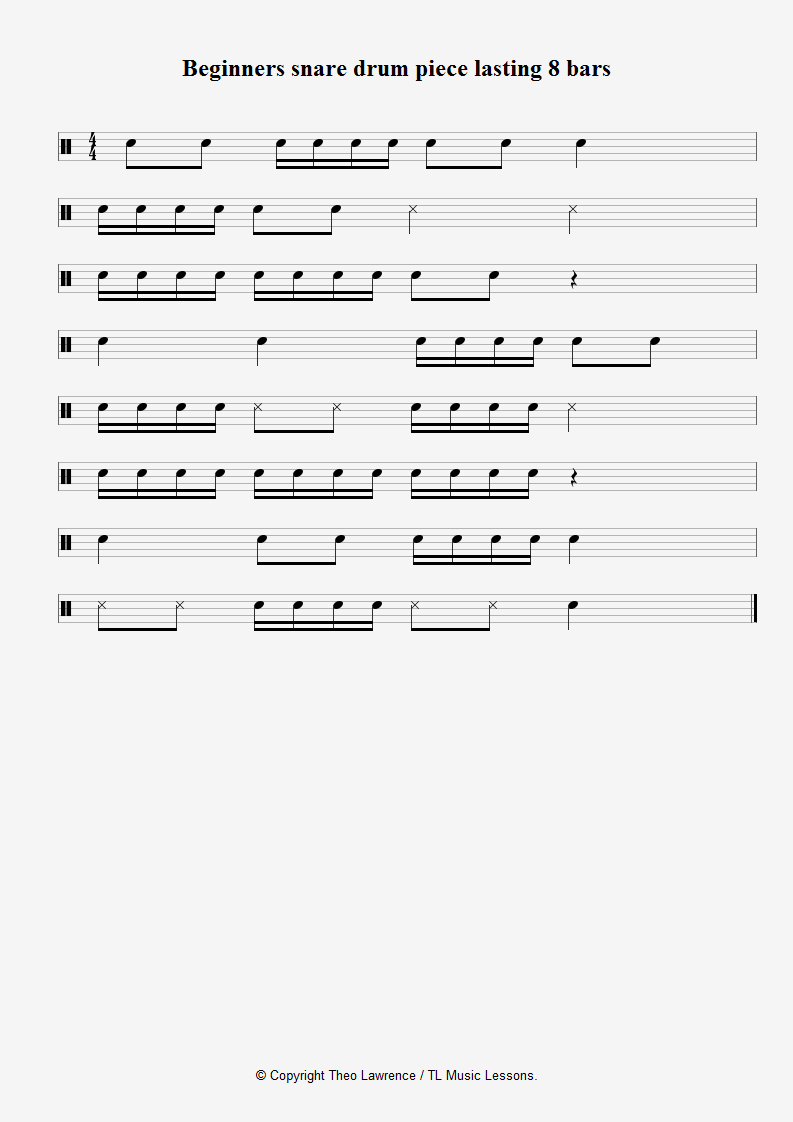
This short snare drum piece works on a few of the fundamental subdivisions and rhythms used at grade 1 level and leading up to it. The piece consists of quarter notes, 8th notes, 16th notes and quarter note rests. The performance technique of playing on the rim of the snare is also included, where the X note head is displayed instead of the usual snare.
(Premium) – 10 Snare Drum Pieces – Book 1 – Levels 1-3 (PDF ebooks)

Introduction
After a year of teaching a local youth group of drummers aged between 8 and 12, ranging from beginners to intermediate players, this collection of 10 snare drum pieces was created as an archive of this body of work.
The MYM Snare Drumline Group is an adaption of Snare Line / Drumline groups, tribal drumming, military drumming, Drum Corps, and film score music.
There are many areas left to explore for the drum group. This first book focusses on building a foundation of simple and short snare drum pieces to help give the group confidence and develop a strong sense of rhythm, timing and pulse. There is also a very small amount of dynamic use, repeats, and drum rudiments.
Demonstration of Pieces 6, 2 and 3 from the book
Here is a video of the girls in the group performing pieces (in order) 6, 2, and 3 from this snare drum book, which is an entry for the 2017 competition ‘Hit Like A Girl‘. The girl on your left is performing the level 2 pieces and the other 3 are playing from the level 3 book. At the time of video, 1 of the level 3 girls is studying grade 2 rockschool and the other two playing level 3 are studying grade 3 rockschool drums.
Level 1 Book
The Level 1 book is designed for complete beginners, or ‘basic beginners’ level. This level could also be played by players of other instruments that are new to drums.
Level 2 Book
Level 2 is designed for grade 1-2 level. The rhythms are more complex, but there are no buzz rolls or drags.
Level 3 Book
Created for grade 2-3 level drummers. It encorporates buzz rolls, drags, flams, and harder rhythms.
These books are primarily intended for groups of drummers or differing abilities. Teachers may print entire books for the students, or pick and choose pieces to suit them. Teachers or students may also use these sheets or books for single snare drum playing. Teachers may purchase this book online and print out unlimited copies for their students.
FREE PREVIEW OF THIS EBOOK: Group Snare Drum Piece with 3 difficulty levels (Piece 2, Book 1)
FREE PREVIEW OF THIS EBOOK: Group snare drum piece with 3 difficulty levels (Piece 5, Book 1)
Recommended reading for use with this ebook:
→ Accent Techniques – Down, Tap, Up, Full Strokes
→ Reading Buzz Rolls And Double Stroke Markings
7 Jazz Drum Patterns with 3 and 4 way co-ordination sheets
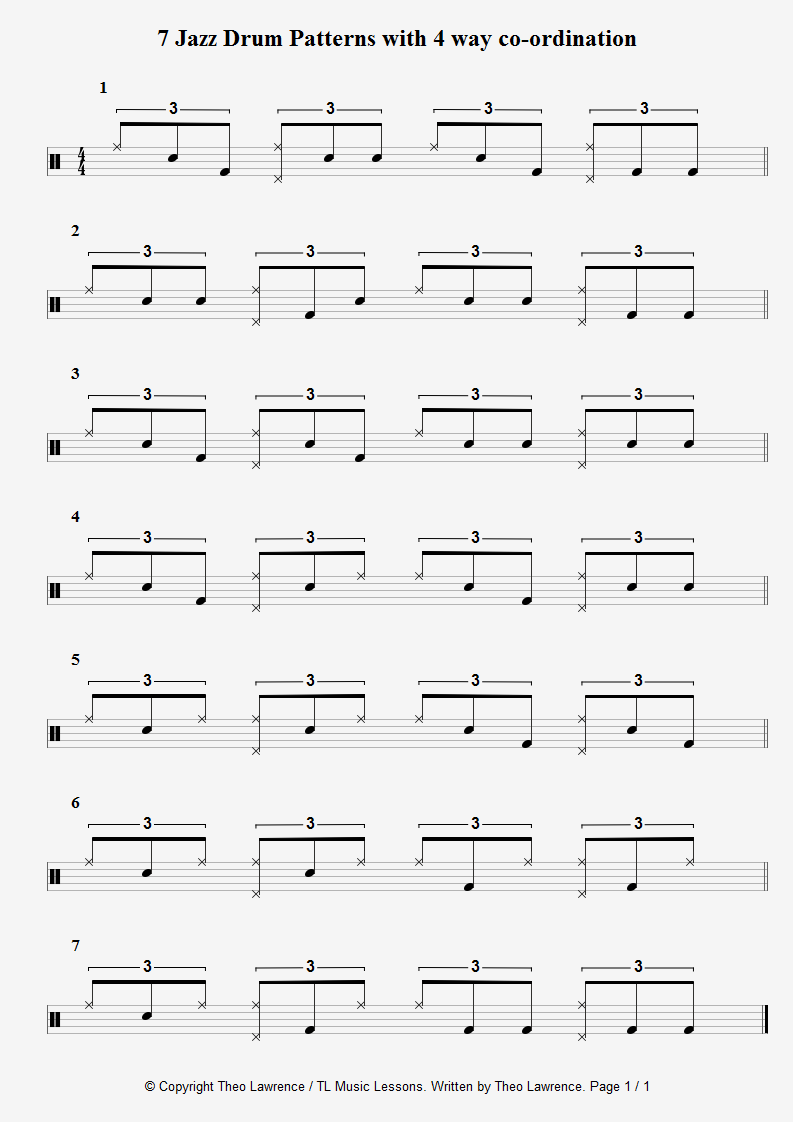
These jazz drum patterns are for at least grade 3 level. The 3 way co-ordination exercises could also be tried slowly by Grade 1-2.
Drummers that are new to jazz could start with these even if they are a pro in other genres. These patterns will be hard if you are new to less regimented styles like Jazz and Latin drumming (i.e. you are more used to pop/rock).
That is the background I come from with drums – pop, rock, funk, metal. Then I was introduced to Jazz. After my Rockschool Grades (we skipped Jazz in my lessons), after my early teenage years of practicing and learning and exploring new and old music. At drum college I was introduced to Jazz when I was 16 or 17. Since this I have always had a place in my heart for Jazz. It is probably where I really started to get an understanding for melody and how it related with my primary passion of drums. The drums in Jazz compliment the melody a lot! The thing I was always taught with Jazz was to either ‘learn the melody’, or to ‘play off the improvised melody’. Over 10 years later and my interests have been drawn even more to creating melodies on other instruments, and I learn more and more how the instruments compliment each other.
So, onto the drum patterns. The patterns are all triplet based and all have a ride cymbal on the 1 2 3 4 beats. The rest of the triplet beats are played by different bass drum and snare drum combinations. These type of movements are fundamental to Jazz drumming. The left foot hi hat is also fundamental. I have also included a 4 way co-ordination sheet for when the 3 way co-ordination patterns begin to get easy. The patterns are all linear apart from the left foot and and right hand on beats 2 and 4 on the 4 way co-ordination patterns, which means that there is only one drum voice playing at once. This helps to get used to playing in triplets, and for focusing on the snare and bass drum patterns. In more advanced Jazz, these types of snare and bass drum patterns will poly rhythm with different right hand ostinati, making things a lot harder.
Sheet 1: 3 way coordination

Sheet 2: 4 way coordination

7 Linear drum beats for beginners – and the Mieze·Katze drum beat

Linear drum beats, a term that I was introduced to at drum college, are made up of single drum hits only. No drums or cymbals are hit simultaneously. This leads to interesting sounding beats that can be quite hard to play after a little deviation from basic linear patterns.
Basic patterns like “Bass, Hi Hat, Snare, Hi Hat” are linear beats and this one in particular is very popular and easy. In germany, this linear rhythm is known as “Mieze Katze” or “Mie·ze·kat·ze”, which translates as “Kitty Kat”. This is something I saw on a show called ‘The moaning of life’ (see video below).
There are many many combinations you could try for linear beats, and they are a great way to use some of your rudiments, like paradiddle based rudiments. Introduce accents on certain notes to really spice things up. Have a go at these 7 linear drum beats, and then get experimenting with making up your own!
Sheet 3 – 10 EASY drum fills lasting 1 bar around the kit – 8ths and quarters
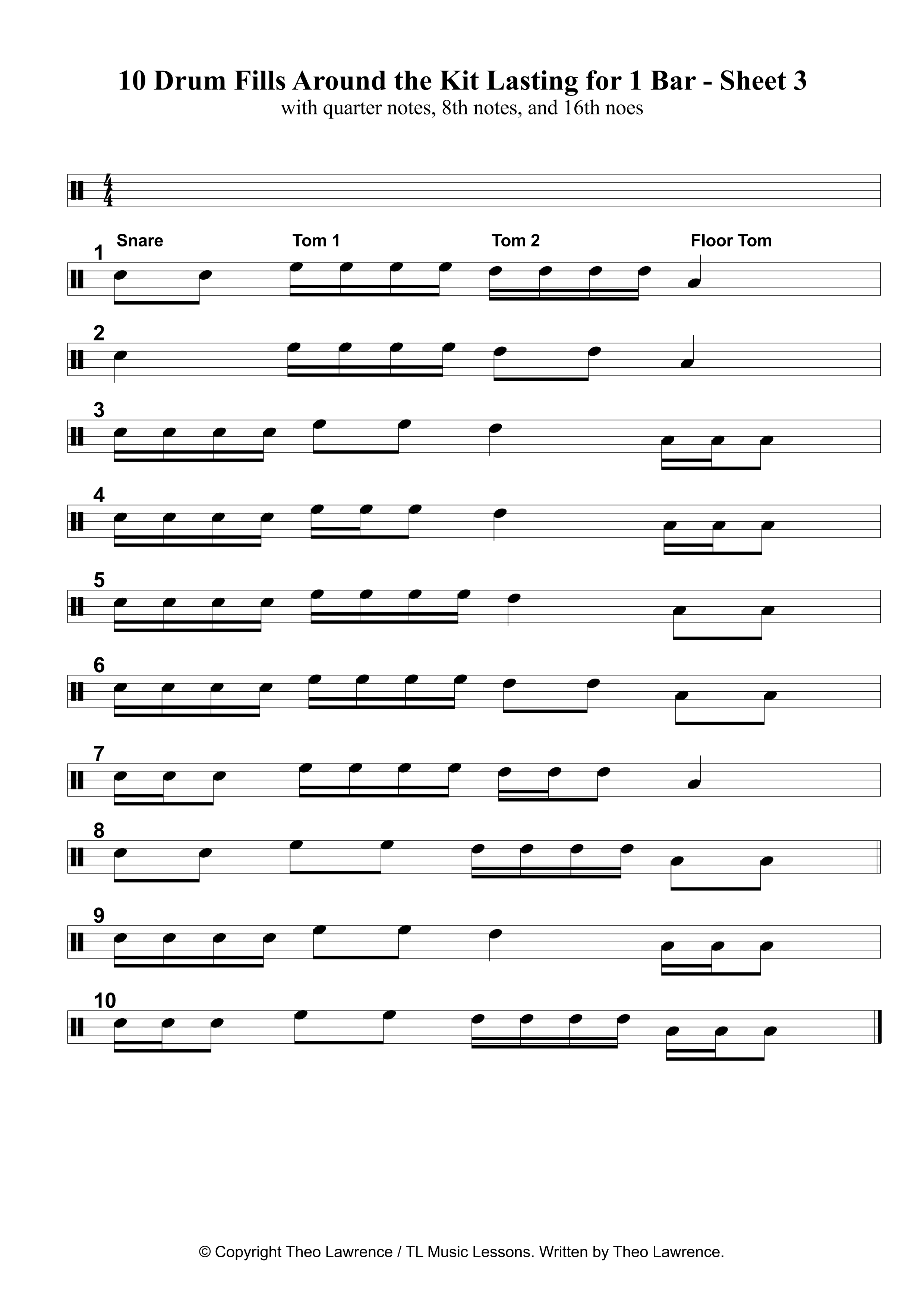
This free drum fills pdf sheet music is from page 11 of the premium ebook Beats and Fills Drum Book – Basic Beginners.
Each drum fill is an ‘around the kit’ fill, meaning that you play each note grouping on the drums as follows: snare drum, tom 1, tom 2, floor tom.
To help with reading the rhythms, you could try this sheet: 10 breakfast snare drum exercises – phonetic rhythms
(Premium) – Beats and Fills Drum Book – Basic Beginners – PDF Ebook
Number of Pages: 24
For a free preview, click the Buy Now button and then click the ‘Preview’ link at the top left of the product image.
This beats and fills drum book has been created for beginner drum students to follow from complete beginner up to grade 1 level. This book could either be used by self taught drummers, or it could be used during drum lessons, and practiced by the student in between lessons. Teachers may purchase this book online and print out unlimited copies for their students.
The book is aimed at students of any age, including adults. The minimum age is about 7 years old. This book is for complete beginners that have a little knowledge of reading drum music. The book can be worked on very soon after starting to learn drums. Younger players (age 5+) may struggle to read this book, and would need to be shown the beats and fills and/or start learning to read music in different ways, such as with hand sketched drum beats with clear visual icons for each drum voice (e.g. a pictures or sketches of bass drum, snare and hi hat).
There are 3 main sections: drum beats, drum fills, and various combination exercises of drum beats + drum fills. We focus on establishing a core and fundamental understanding and ability to play basic beginners drum beats and drum fills. Some prior knowledge of reading music will be required if you are working through this book on your own without a teacher.
Drum Beats
The drum beats in this book are all aimed at complete beginners with a little bit of knowledge of how to read drum music or they can be taught to read it while working through the book with a teacher.
Drum Fills
The drum fills in this book range from easy ‘around the kit’ fills with quarter notes and 8th notes, to more advanced movements, leading up to grade 1 level.
Drum Beats & Drum Fills
The drum beats and drum fills section brings together the things you have learned in the first two sections of the book. This section is designed to give a more realistic drumming experience, because most songs are not based on just beats or just fills. Master these and you will be well on your way to start playing along with songs.
I hope you find these useful.
Looking for something more challenging?
Try this similar book, next level up, which is for Grade 1-2:
Grades 1-2 Beats & Fills Drum Book – Unit 1 – Rock Pop Soul Funk – PDF ebook
10 tips and advice for running your own drum teaching business

Photo Credit: Image by rawpixel.com
Whether you are thinking of starting your own music leaching business, or looking for ways to improve the management of your self employed music lessons business, these 10 tips have been written with you in mind. All of these bits of advice are related to my own business and are things that I do or have learned throughout the 6 years of teaching music in schools and doing private lessons, while being self employed and organising everything else involved outside of the actual teaching.
1. Plan your week with a digital calendar
Easily manage your schedule online and sync it to your mobile devices. Reschedule lessons on the move and set reminders to pop up at certain times if needed. The main advantage of a digital calendar is that you can schedule recurring lessons to be the same every week, and then modify each one individually if you need reschedule for one week – saving you lots of time writing in the same things into your calendar each week. I use google calendar and sync it with my phone’s calendar.
2. Get a digital to do list
A todo list that syncs to your phone, like Remember The Milk, is very useful and can help build up your reputation of someone that is reliable, because you will actually follow through with the things you say you will do. There is always something that crops up in the day that needs to be addressed at a later time. A busy music teacher can have hundreds of little tasks in a week that crop up, and adding them to a todo list will make sure they get done.
3. Organise your lesson plans and content
Structure your teaching into ability levels and topics. Make sure you are covering everything that you should be teaching to the best of your knowledge. Create lesson plans or exercise sheets, or compile ones from books or online lessons. Keep digital files and print as needed. I keep my files in google drive or in dropbox so I can use them on the move. Don’t hand write everything in your own time unless you are only doing it once and photocopying it for future lessons. You should end up with more content than you can carry with you at once. Therefore you might want to structure lesson material into different topics throughout the year, or use or create a series of books that the students can progress through.
4. Use books and booklets rather than individual lesson handout sheets
If creating your own lesson plans, try to compile them into a book or booklet that can be printed out and stapled or binded together, or used as an ebook. This will mean you won’t need to worry about printing off new lesson handouts every week or so. Even better, the student will be able to visualise their progress as they make their way through the book. Furthermore, you could think about selling your books online. It can be a nice way of passively bringing in an extra income while you are doing other things. I use a company called Payhip to sell my ebooks and premium downloads.
5. Offer to teach grades
Working through a grade book is a good way of learning and teaching. Make sure you only teach grades that you could do yourself. You should always be at a higher grade than what you are teaching, and ideally be several higher.
Grade 6-8 award ucas points, which are a good incentive to start learning early and have dedication to progress up through the grades before university age, where extra ucas points might prove useful.
6. Dress smart and be professional
If you take your job seriously and want your students and parents of students to take you seriously then I believe you need to make the effort to look smart whilst working. You might also be a musician and have a strong image as well, but it is best to save certain things for the stage. Being your own boss is great so you don’t have to, but people feel more comfortable if you make the effort with your appearance, especially if you work in schools as a peripatetic music teacher.
7. Make sure you work enough hours per week
Music teachers can charge much more than minimum wage, which is great unless they don’t do enough billable hours. To make this job pay a decent wage you need to make sure you are putting full time hours during term time at least. It is easy to fall for the illusion of charging a high hourly rate, and working part time hours, only to end up with a low income at the end of the year.
8. Have music related goals and activities outside of your teaching
Keep your dreams, goals, ambitions and love of music alive. You might downsize them as the years pass by, but always remember why you play your instruments and do all you can to be a musician as well as a music teacher.
9. Practice and improve
There is always something new to learn in music. Never stop learning and improving! Make sure you practice – practice what you preach to your students. I also see recording music to a click as practice, and you are also getting a physical end result from it.
10. Keep a contact list of all pupils or parents of pupils
I use google contacts, and stay in regular contact about lesson times and news etc. I group them by instrument, and also by which school they have lessons in, or if they have non-school lessons. Emails are the best method of contact I think because you can send to many all at once easily, most people use email now, it is free, and you can attach things. Phone calls are inconvenient to many now, texts are not as easy to send to everyone quickly, and facebook and twitter messages/updates are easily missed.
/>I hope you have found some or all of these points useful and relevant to you. There are many other things I could write about in this list, and I hope to write another one in the future. Meanwhile, have a look around the internet for similar things as there are many helpful bits of advise. One website that I constantly find tips from for running a business, which I would recommend to you, is: www.entrepreneur.com
Related: (www.learnguitarforfree.com) 30 essential productivity apps, business management tools and other apps or websites that help to run an online business and a local music teaching business
Group snare drum piece with 3 difficulty levels (Piece 5, Book 1)
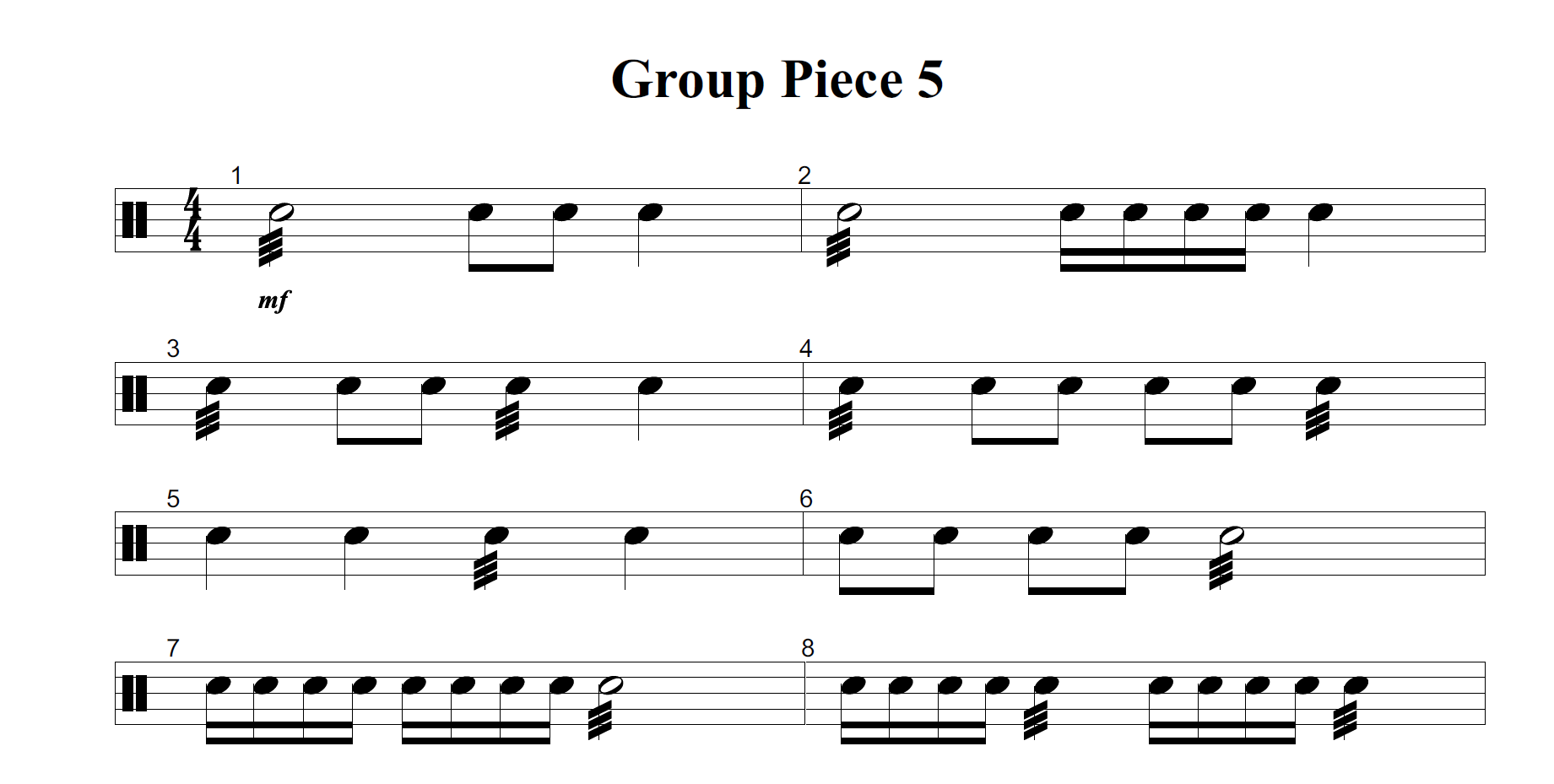
This snare drum piece could be played by a single drummer, or as part of a group of drummers. The snare drum piece is an example of a short piece with two snare drum parts of different ability levels. There are 2 difficulty levels; beginners up to grade 1, and grade 2 level.
I run a youth snare drumline group, and regularly produce snare music for various ability levels. The piece could also be adapted to a full drumline if extra parts are written – if you run a drumline please feel free to use this and to write extra parts for it.
Level 1

Level 2

Level 3

Related: Group Snare Drum Piece with 3 difficulty levels (Piece 2, Book 1)
Related: (Premium) 10 Snare Drum Pieces – Book 1 – Levels 1-3
8 Starter Jazz Drum Beats with 3 way co-ordination
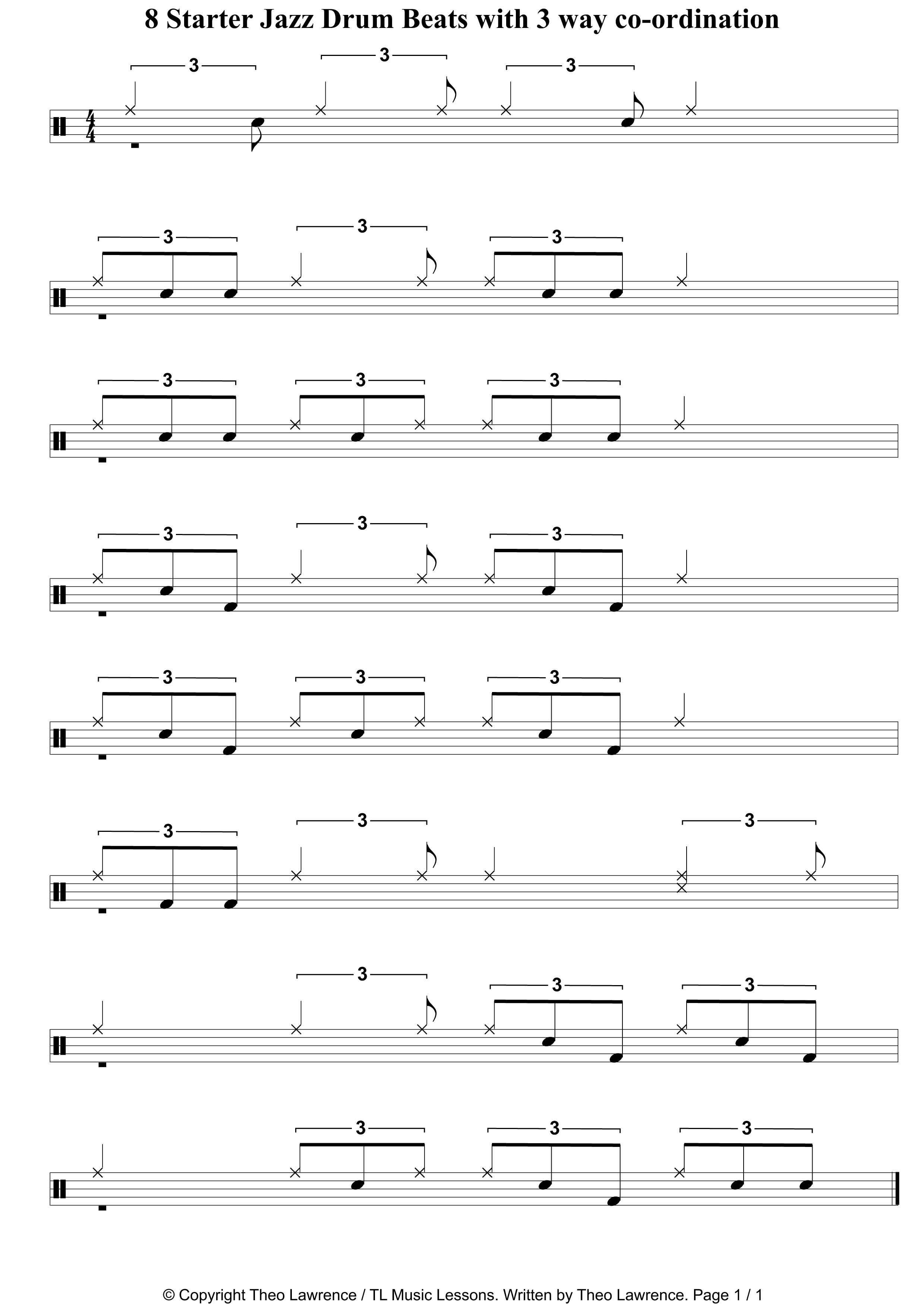
Jazz music can be very difficult. Even these starter beats for Jazz drumming are a challenge, and beginners will probably need a teacher’s help to play these.
The left foot is usually used in Jazz. To keep things simple we are just doing 3 way co-ordination in these 8 Jazz drum beats.
Related: 7 Jazz Drum Patterns with 3 and 4 way co-ordination sheets
Related: Learn to play the basic foundation Jazz drum groove
Related: 10 Jazz Ride Patterns
Cool music video with a large studio full of drummers playing the same beat on drum kits that light up – Sweet Nothing – Gabrielle Aplin

I saw Gabrielle Aplin live at The Ritz in Manchester on her debut album tour in 2013, so although I don’t watch many music videos, this was on my radar and the images of all the drummers lured me in. Gabrielle Aplin has released this music video ahead of her second album, which includes a room full of drummers playing light up drum along with the upbeat song. Drummers unite and watch this brilliant music video!
Also, here is the behind the scenes video: