8 beginners Jazz worksheets including bass drum and snare triplet patterns for comping ideas – FREE PDF

Get Free PDF Download →

There are 8 PDF files here with sheet music including Jazz drum beats. I thought rather than posting them seperately, I would rather group them all as one resource. They were created in 2010 near to when I started teaching and I used sibelius to make them.

Two of the sheets focus on the left foot hi hat and right hand cymbal ostinati.

Two of the sheets focus on only the left hand triplet based patterns used for comping.

Two of the sheets focus on the left hand snare drum and right foot bass drum, used for comping.

Two of the sheets (Full Jazz Grooves) bring it all together for 4 way coordination.

Get Free PDF Download →

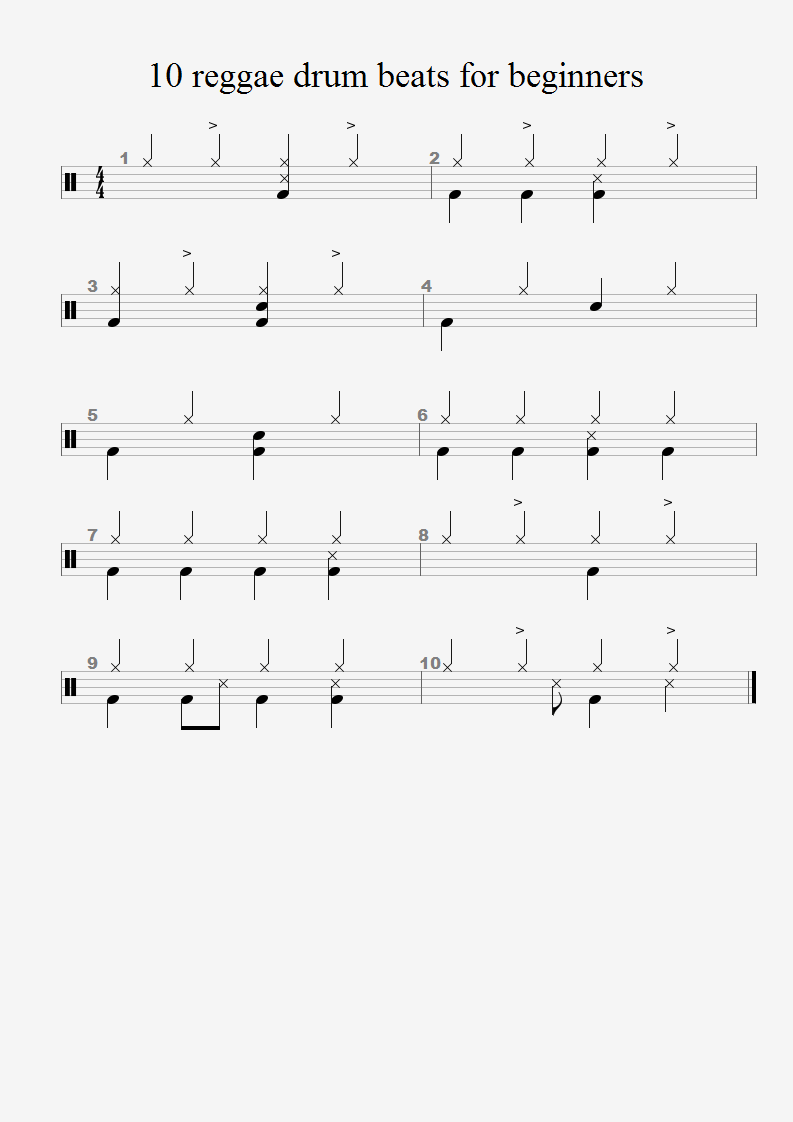
10 Reggae Drum Beats for Beginners

These drum beats are for any ability, even complete beginner. I would however recommend learning pop and rock first. For example: 10 Basic Rock Drum Beats.

Reggae beats often have an emphasis on beat 3 of the bar. Usually this is from the bass drum or bass drum and cross stick snare. Accents are often used on the hi hats to play louder on beat 2 and 4. In more advanced reggae hi hat work, they adopt a swing feel similar to blues, jazz or country. The cross stick snare is used instead of the full snare sometimes or much of the time if the song is fairly laid back and chilled, which it usually is with reggae! Normal snare hits, or hitting the snare head and rim simultaneously are used in reggae drum fills. You can see some reggae fills in the video below.

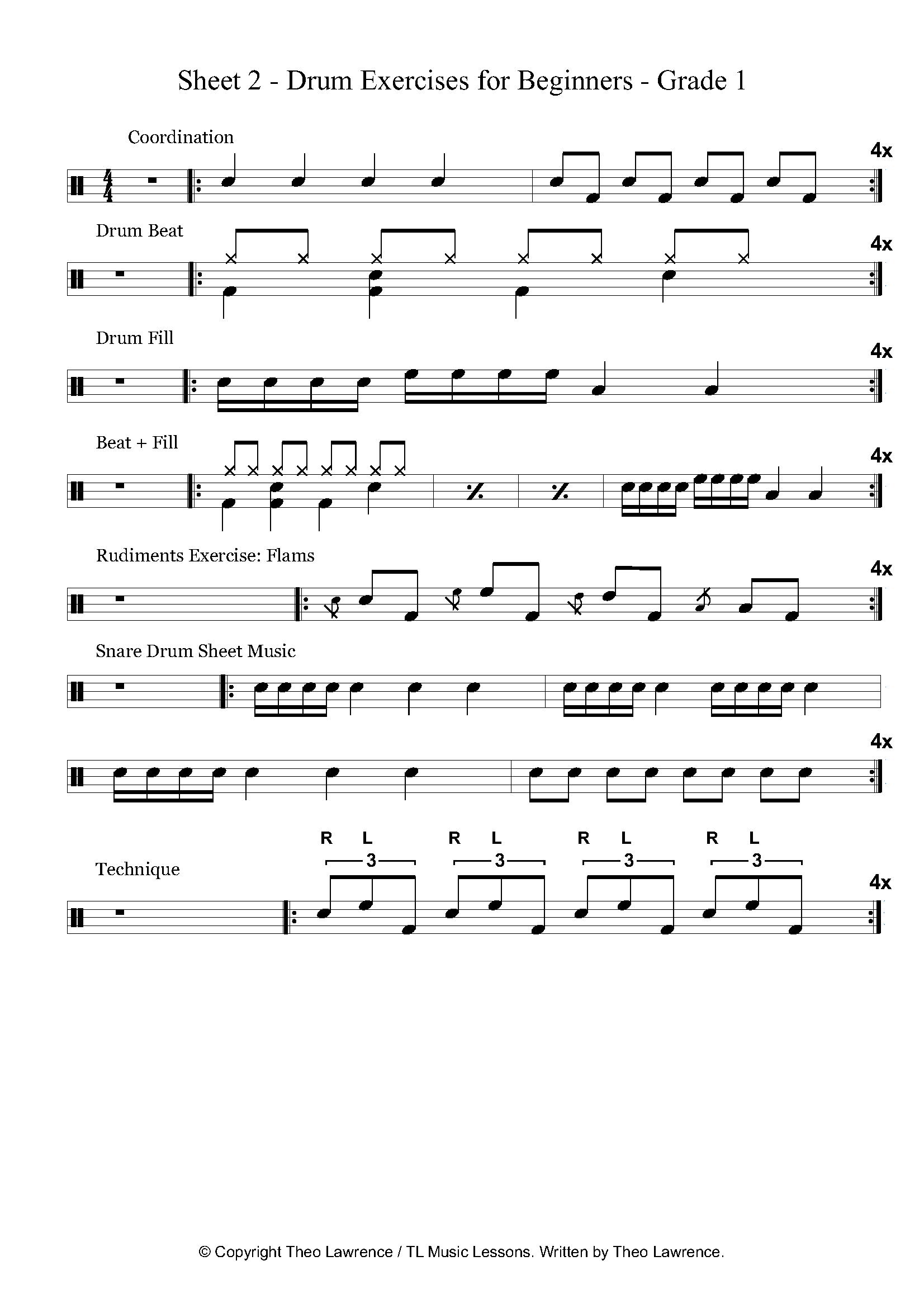
Sheet 2 – Drum Exercises for Beginners – Grade 1

Welcome to the second in the series of ‘Drum Exercises for Beginners – Grade 1’.

You may like to listen to the audio to help understand the sheet music.

There are short repeated exercises in the following categories, which are ideal for practicing on your own, or for using by drum teachers as part of a lesson plan.

  1. Coordination Exercise
  2. Drum Beat
  3. Drum Fill
  4. Drum Beat + Drum Fill (Combined Exercise)
  5. Rudiments Exercise (rudiments that have been developed)
  6. Snare Drum Sheet music
  7. Technique Exercise

← Exercise Sheet 1

Sheet 1 – Drum Exercises for Beginners – Grade 1

Welcome to the first in the series of ‘Drum Exercises for Beginners – Grade 1’.

There are short repeated exercises in the following categories, which are ideal for practicing on your own, or for using by drum teachers as part of a lesson plan.

You may like to listen to the audio to help understand the sheet music.

  1. Coordination Exercise
  2. Drum Beat
  3. Drum Fill
  4. Drum Beat + Drum Fill (Combined Exercise)
  5. Rudiments Exercise (rudiments that have been developed)
  6. Snare Drum Sheet music
  7. Technique Exercise

Exercise Sheet 2 →

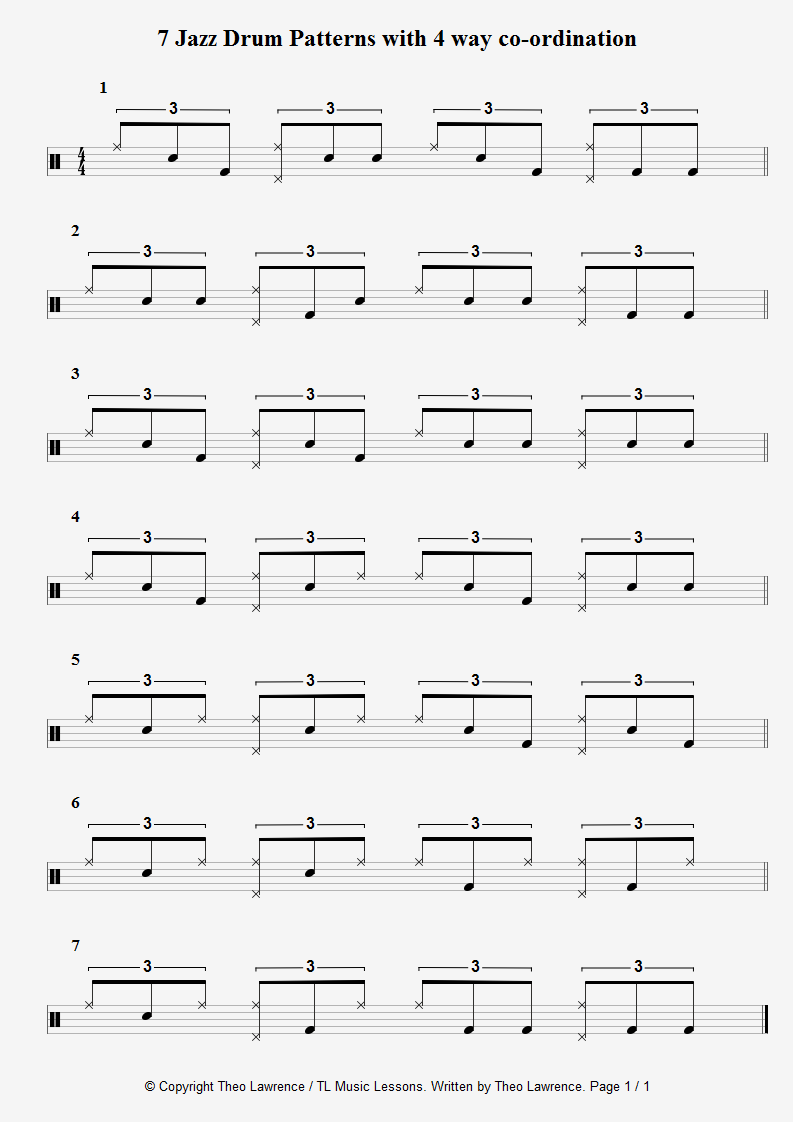
7 Jazz Drum Patterns with 3 and 4 way co-ordination sheets

These jazz drum patterns are for at least grade 3 level. The 3 way co-ordination exercises could also be tried slowly by Grade 1-2.

Drummers that are new to jazz could start with these even if they are a pro in other genres. These patterns will be hard if you are new to less regimented styles like Jazz and Latin drumming (i.e. you are more used to pop/rock).

That is the background I come from with drums – pop, rock, funk, metal. Then I was introduced to Jazz. After my Rockschool Grades (we skipped Jazz in my lessons), after my early teenage years of practicing and learning and exploring new and old music. At drum college I was introduced to Jazz when I was 16 or 17. Since this I have always had a place in my heart for Jazz. It is probably where I really started to get an understanding for melody and how it related with my primary passion of drums. The drums in Jazz compliment the melody a lot! The thing I was always taught with Jazz was to either ‘learn the melody’, or to ‘play off the improvised melody’. Over 10 years later and my interests have been drawn even more to creating melodies on other instruments, and I learn more and more how the instruments compliment each other.

So, onto the drum patterns. The patterns are all triplet based and all have a ride cymbal on the 1 2 3 4 beats. The rest of the triplet beats are played by different bass drum and snare drum combinations. These type of movements are fundamental to Jazz drumming. The left foot hi hat is also fundamental. I have also included a 4 way co-ordination sheet for when the 3 way co-ordination patterns begin to get easy. The patterns are all linear apart from the left foot and and right hand on beats 2 and 4 on the 4 way co-ordination patterns, which means that there is only one drum voice playing at once. This helps to get used to playing in triplets, and for focusing on the snare and bass drum patterns. In more advanced Jazz, these types of snare and bass drum patterns will poly rhythm with different right hand ostinati, making things a lot harder.


Sheet 1: 3 way coordination

Sheet 2: 4 way coordination


Related: 8 Starter Jazz Drum Beats with 3 way co-ordination

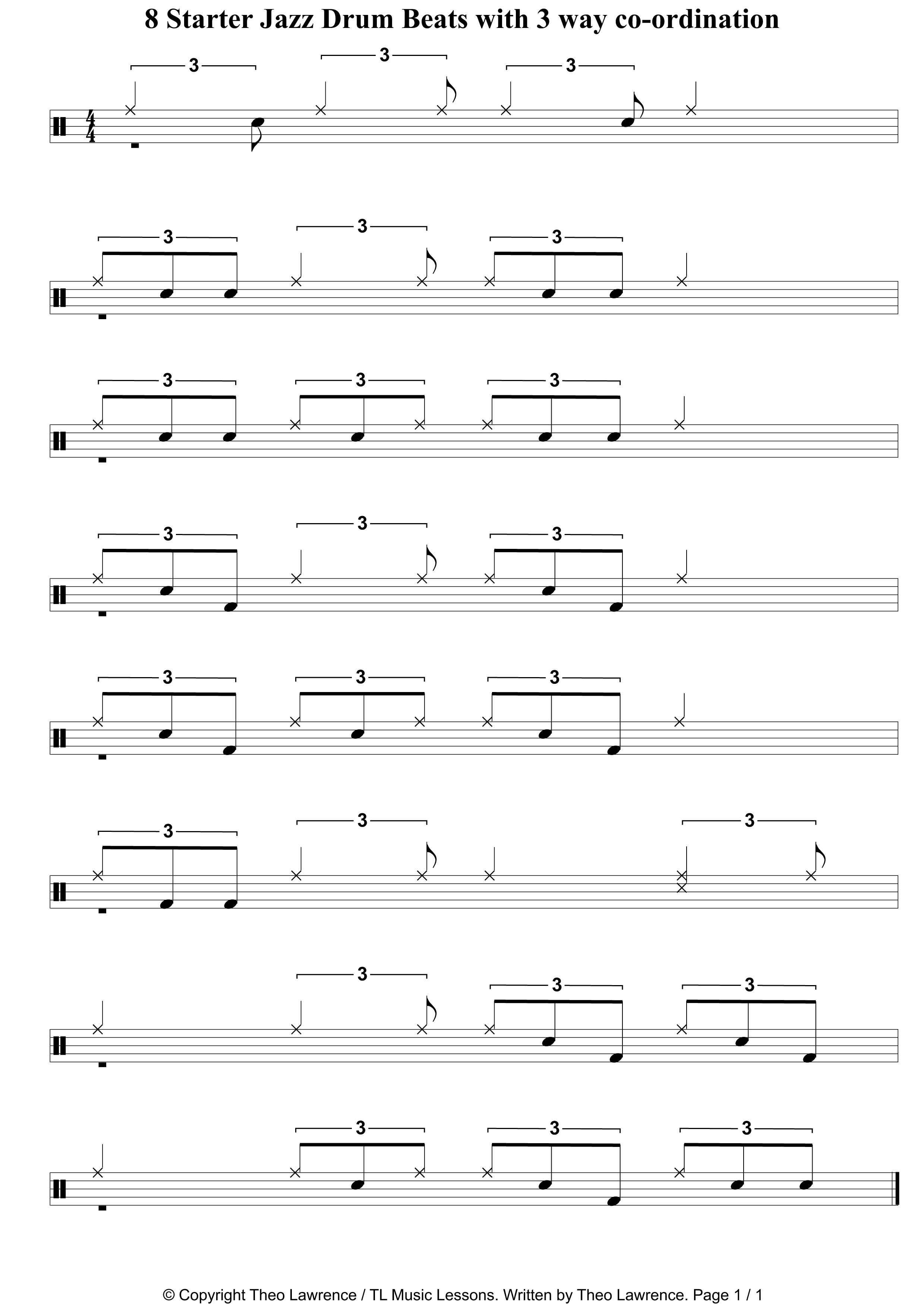
8 Starter Jazz Drum Beats with 3 way co-ordination

Jazz music can be very difficult. Even these starter beats for Jazz drumming are a challenge, and beginners will probably need a teacher’s help to play these.

The left foot is usually used in Jazz. To keep things simple we are just doing 3 way co-ordination in these 8 Jazz drum beats.


Related: 7 Jazz Drum Patterns with 3 and 4 way co-ordination sheets
Related: Learn to play the basic foundation Jazz drum groove
Related: 10 Jazz Ride Patterns

4 way co ordination pop drum beats with quarter note stepped hi hat – Step by step guide

Anyone who has some knowledge and experience playing essential beginners drum beats can give this a go. Moderate to fast speed and playing accuracy should be mastered first.

The left foot stepped hi hat

The left foot should quickly close the hi hat to make a sound similar to when you play a normal clised hi hat with the stick.

Beat 1

Step 1

Start by playing the ride, bass and the stepped hi hat all together.

Step 2

Then play the ride, snare and stepped hi hat all together.

Step 3

The next two beats are the same as the first two. Then the bar repeats (for as long as you like).

Beat 2

Step 1

Start by playing the ride, bass and the stepped hi hat all together.

Step 2

Next just a ride on it’s own.

Step 3

Then play the ride, snare and stepped hi hat all together.

Step 4

Next just a ride on it’s own.

Step 5

The next two beats worth are the same as the first two. Then the bar repeats (for as long as you like).

Beat 3

Step 1

Start by playing the ride, bass and the stepped hi hat all together.

Step 2

Then play the ride, snare, bass drum, and stepped hi hat all together.

Step 3

The next two beats are the same as the first two. Then the bar repeats (for as long as you like).

Beat 4

Step 1

Start by playing the ride, bass and the stepped hi hat all together.

Step 2

Next just a ride on it’s own.

Step 3

Then play the ride, snare, bass and stepped hi hat all together.

Step 4

Next just a ride on it’s own.

Step 5

The next two beats worth are the same as the first two. Then the bar repeats (for as long as you like).

Beat 5


Try not to get confused with the rests in this one, just ignore them.

Step 1

Start with a bass drum and closed hi hat together.

Step 2

Then play the ride on it’s own.

Step 3

Play the snare and closed hi hat together.

Step 4

Then play the ride on it’s own.

Step 5

The next two beats worth are the same as the first two. Then the bar repeats (for as long as you like).

Beat 6

Step 1

Start with a bass drum and closed hi hat together.

Step 2

Then play the ride on it’s own.

Step 3

Play the snare, bass and closed hi hat together.

Step 4

Then play the ride on it’s own.

Step 5

The next two beats worth are the same as the first two. Then the bar repeats (for as long as you like).


Related: 10 rock and pop drum beats with quarter note stepped hi hats – 4 way co ordination
Related: Drums Warm Up Exercise with 4 way co-ordination

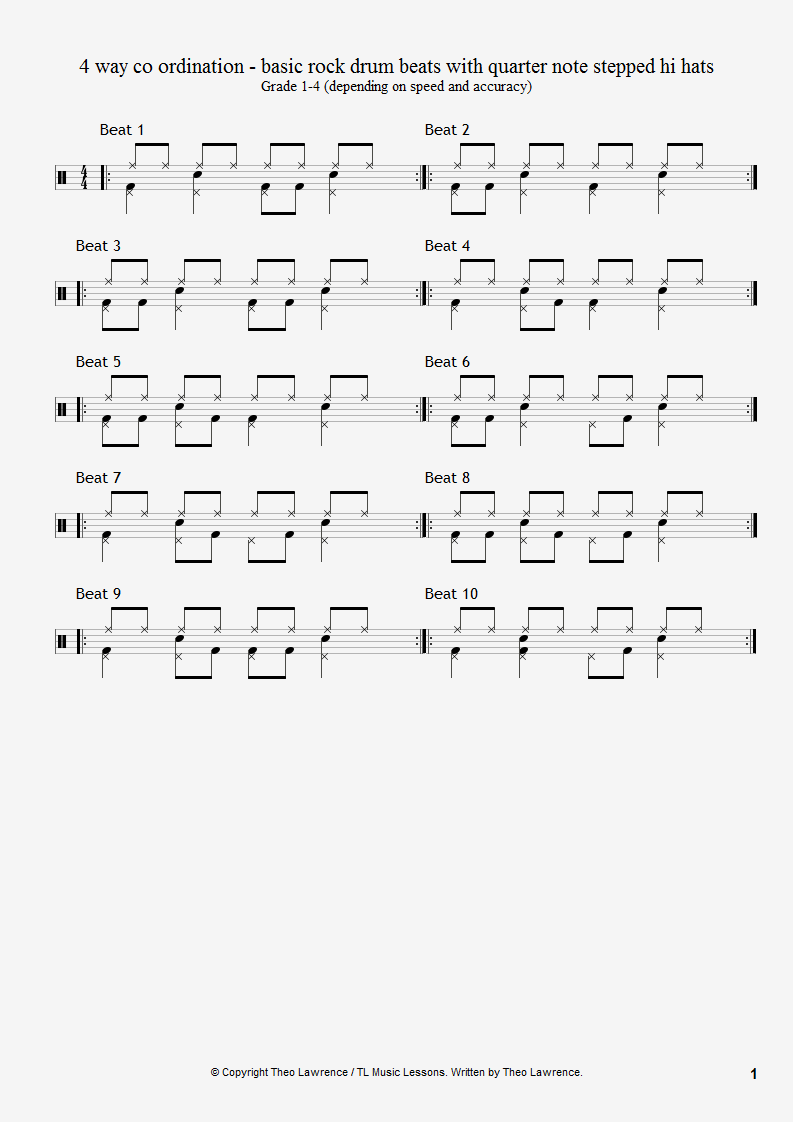
10 rock and pop drum beats with quarter note stepped hi hats – 4 way co ordination

This exercise sheet features most of the drum beats from page 3 of the Grade 1 Rock Beats ebook, by adding a quarter note stepped hi hat ostinato.

Anyone who has some knowledge and experience playing basic drum beats can give this a go. Moderate to fast speed and playing accuracy should be mastered before entering Grade 5 level.

Left foot hi hat ability is often overlooked or ignored by many pop and rock drummers. Don’t be one of them! I was and I spent ages as an adult going back and learning and practicing with the left foot. Even though I played double kick, my left foot hi hat technique was still weak in beats, in paticular for syncapated funk beats and latin styles.

Get stuck onto these exercises and give your left foot a much needed boost!


Related: Drums Warm Up Exercise with 4 way co-ordination
Drums Warm Up Exercise with 4 way co-ordination

The feet are walking, right, left, right, left, on the bass drum and stepped hi hat all the way though, until the last line, where it’s left foot hi hat on every beat.

Follow the sticking (R L R L) for the hands on the snare drum.

Either play as seperate exercises with a metronome, or as one continuous exercise through the whole sheet, with repeats.


Related: 10 rock and pop drum beats with quarter note stepped hi hats – 4 way co ordination

10 Jazz Ride Patterns

Before attempting these you will need to have a solid ability in the basic foundation Jazz drum groove, which involves the left foot hi hat on 2 and 4, and the right hand on 1 2 3 4.

This sheet explores variations in the right hand ride cymbal over a constant 2 and 4 left foot hi hat. Once you have learned these you can then move onto learning left hand rhythms on the snare drum.


Related: 8 Starter Jazz Drum Beats with 3 way co-ordination