Sheet 5 – Sheet 5 – Beginners Drum Warm Up Exercises

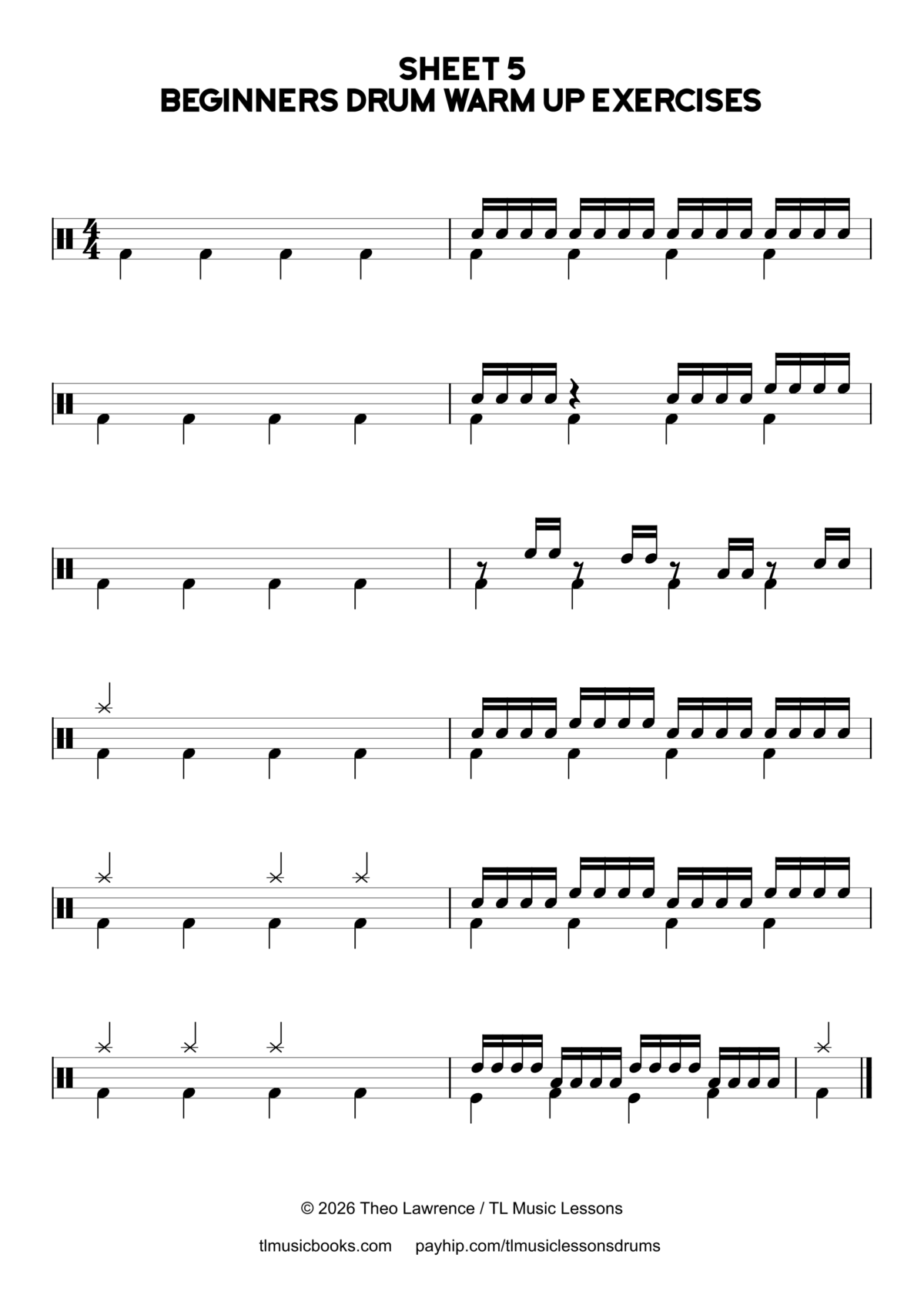
Lines 1-3

The first drum fill that most drummers learn is 4 groups of 16th notes around the kit, which is 4 hits on the snare drum with a RLRL sticking, then 4 on the high tom, 4 on the medium tom, and 4 on the floor tom. On this sheet we also have this pattern at the start but it’s all on the snare drum (16 snare hits in total) and there are bass drums on the 1st note of each group of 4 snares.

For the rest of the exercise sheet, this full bar of 16th notes is used again but on different drums, or to develop the patterns, some of the 16th notes have been taken away completly, such as on beat 2 of bar 4, or on bar 6 where there are 8th notes rests whilst the bass drum plays on its own.

The notation is kept fairly simple for it to be enjoyable to play as a warm up exercise, which should include elements of repetition. This is acheived by playing the bass drum on the 1 2 3 4 pulse throughout the exercise sheet.

Lines 4-6

There are crash cymbals introduced in the second half of the exercise sheets which ae added to give added challenges and also so that the 4 bass drum hits per bar don’t sound too repetative.

More Like This

Follow the links below to view more sheets in this ebook collection.

← Sheet 3

Free PDF Download

You can download the whole ebook as a pdf for free, or you can pay what you want, here: Drum Warm Up Exercises for Beginners.
Sheet 3 – Beginners Drum Warm Up Exercises

Free PDF Download

Beginners Drum Warm Up Exercises

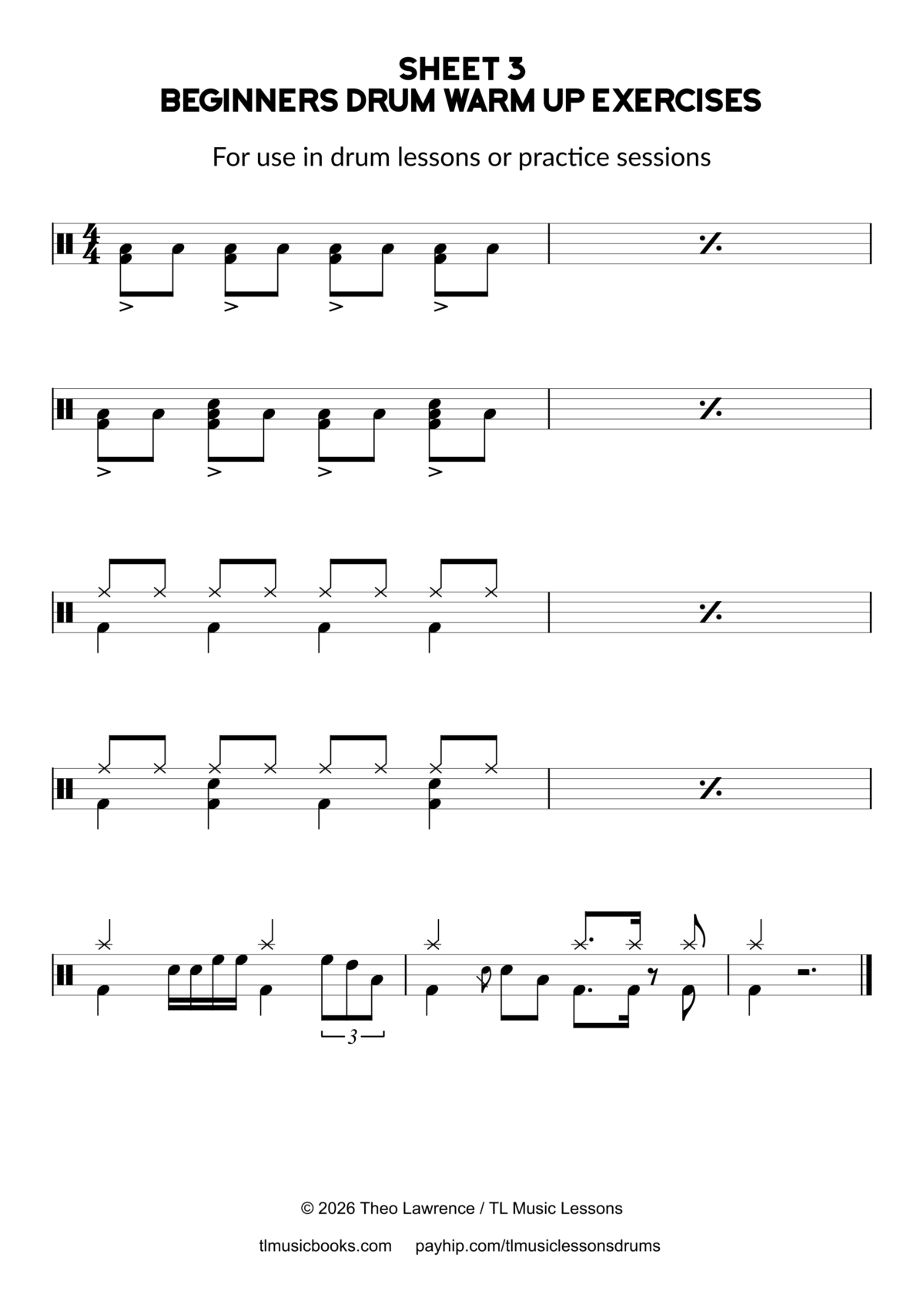
The difficulty on this sheet goes slightly higher with adding 8th notes to the drum beats and the drum fills are a little more advanced too, especially the rhythm of the crash and bass drum hits at the end. A drum teacher can help with this. Once you hear the rhythm it shouldn’t be too hard. You can hear the same rhythm of the ending crash cymbals (in the penultimate bar of this sheet) at the start of a famous song called We Found Love by Rhianna. Whenever I see this rhythm in any music, I always think of this song! I’m sure the rhythm has stronger roots elsewhere, perhaps in Latin American carnival type music, but that’s just what sticks in my mind.

To further disect the final line of fills, you also will need to play a triplet at the end of the first bar whilst counting ‘4 trip let’ and on the second bar there is a flam on beat 2 followed by a floor tom on beat 2 +.

Going back to the start, it’s also important to observe the driving accents on the beat, which should be played on the floor tom, and not really the bass drum. This also goes for the second line. Lines 3 and 4 could also be played with these driving accents on the ride cymbal if you would like to.

← Sheet 2

Sheet 1 – Drum Warm Up Exercises for Beginners

Free PDF Download

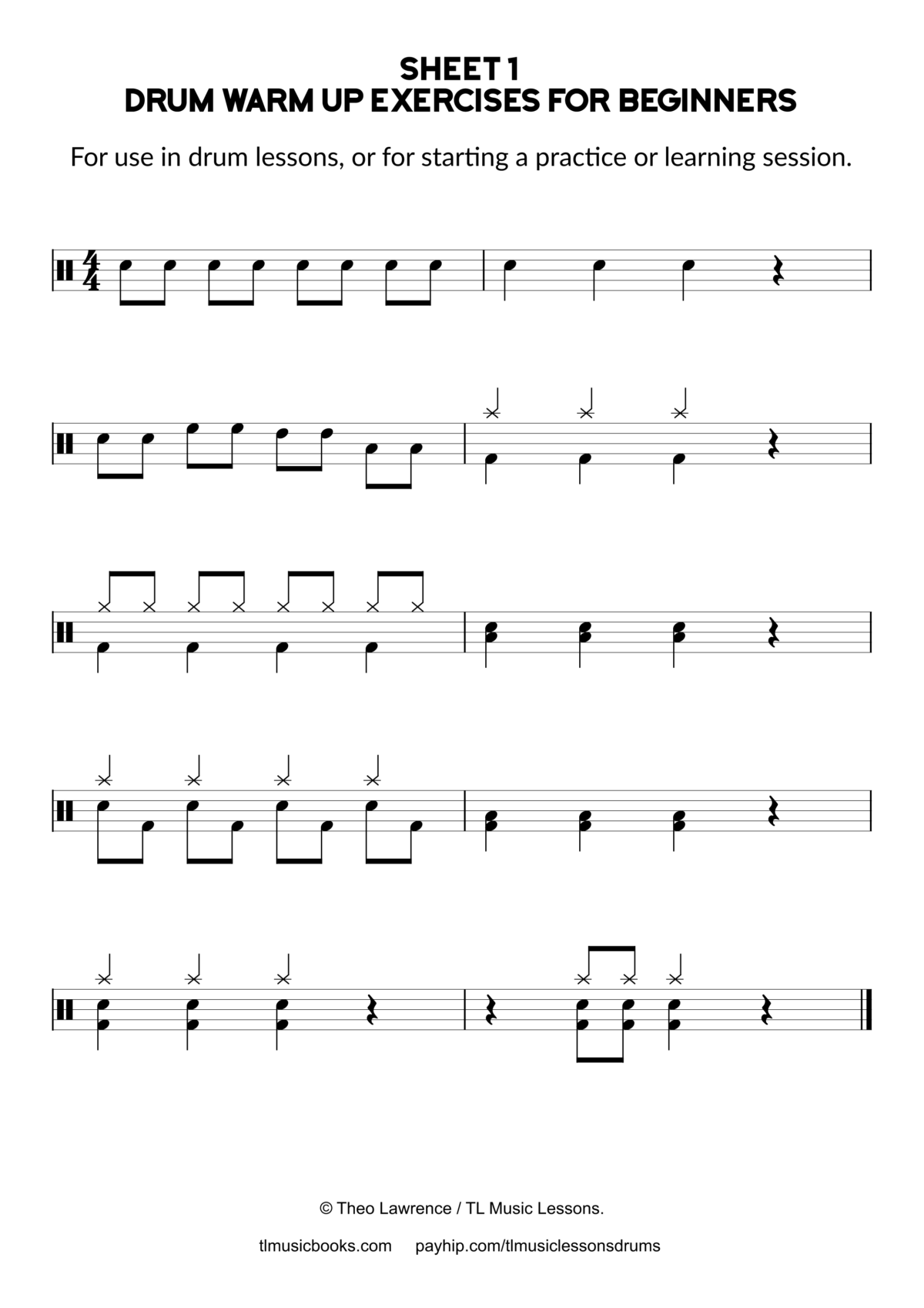
Download the PDF for ‘Sheet 1 – Drum Warm Up Exercises for Beginners’.

This 10 bar warm up sheet is for beginner drummers to learn and practice with at the start of a drum lesson or at the start of a practice routine. Once the sheet has been roughly learned, the drummer should try to play all of the way through the sheet in one go. No repeats are neccesary unless you want to.

Sheet 2 →

Drum Lesson Warm Up – 6th Jan 2026

Drum lesson warm up for advanced beginners and early intermediate levels.

Since posting this, I have focussed on creating an ebook with similar content, so the title has changed a little bit and it’s now the 2nd exercise sheet of the book. You can use the image on here and print it if needed, or you can also purchase PDF of Sheet 2 – Drum Warm Up Exercises for Advanced Beginners to Early Intermediate.

This Drum lesson warm up for advanced beginners and early intermediate levels is a summary of some of the exercises I worked on today with my students. This will probably be of use to any drummers wanting some original exercises to work on as part of a drum lesson or to self learn.

There are two exercises with sextuplets, accents and the use of a paradiddle-diddle (RLRRLL).

There are exercises based on one drum beat with examples of how you can develop it.

View Sheet 3 →

← Back to Sheet 1