How To Read The Notation – Inside the book: 40 Beats and Fills Exercises Book 2

PDF Ebook Buy Now →
Next Page: Warm Ups →

Here is part 1 of inside the book of “40 Beats and Fills Exercises Book 2“.

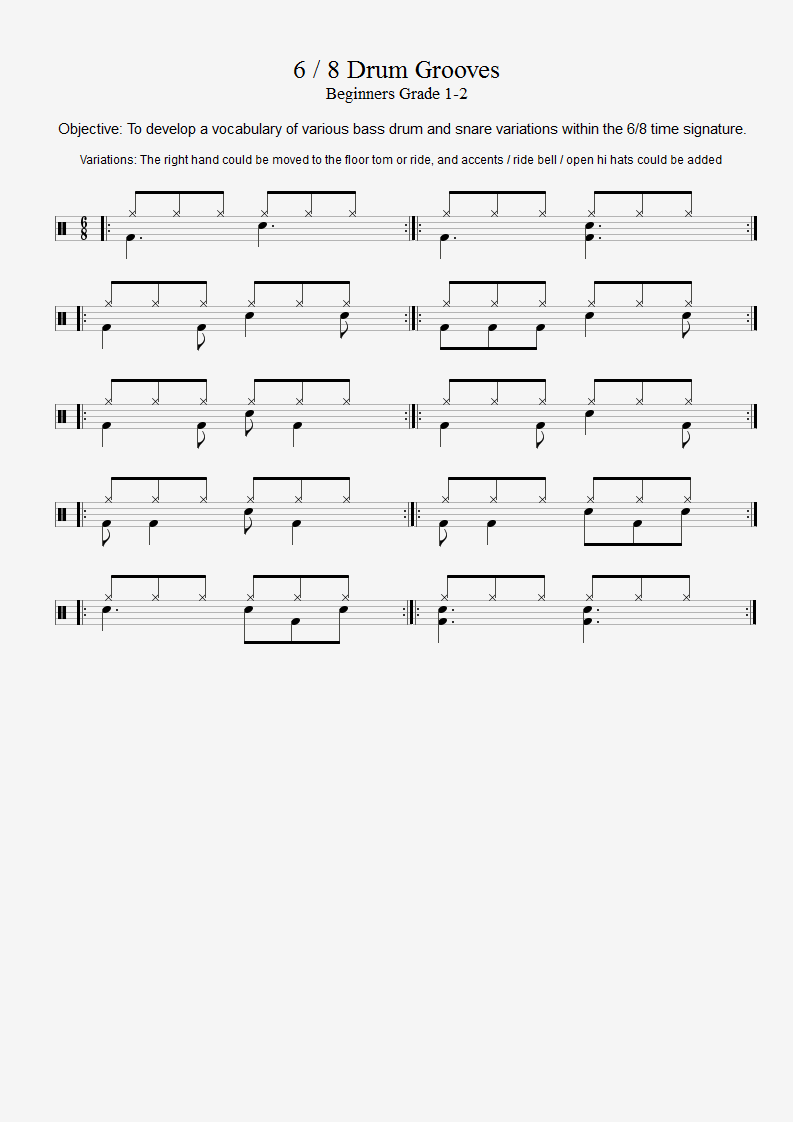
As you can see in the featured image, this post is showing you how to read the drum notation in the book. This is going to to be quite hard to understand without any prior knowledge or tuition, but I have made a video (see below) that shows you which drums are which and how to read and play the swing, rests, basic notes, and time signatures.

Here are all of the drum voices and notation markings on the sheet: crash cymbal, open hi hat, accent, ride cymbal, closed hi hat, tom 1 (small tom), tom 2 (medium tom), snare drum, floor tom, bass drum, stepped hi hat, cross stick snare drum, triplet swing, 3/4 bar, 5/4 bar, 6/8 bar, 4/4 bar, crotchet rest, quaver rest, quaver, crotchet.

There are more free pages like this one, use the the navigation below to view them.

Go forward to the Warm Up Sheet →
Buy the full PDF ebook →

40 Beats and Fills Exercises Book 2

PDF Ebook Buy Now →
Look Inside The Book →

This book contains drum beats and drum fills in the styles of pop, rock, blues, musical theatre, jazz, heavy metal, hard rock, punk rock, and indie, as well as covering fundamental techniques such as stepped hi hat, open hi hats, 16th note hi hats, 4 way coordination and  time signature changes. The book ranges from grade 1 to 3.

The last book focused on grades 1-2, so this book is focusing on the high end of grade 1 and up to grade 3 level. The book would be an ideal add on for anyone studying Grades 1-3, and in particular grads 2-3. To achieve grade 3 and possibly grade 4 level, the exercises would need to be played precisely, with correct dynamics, speed and fluidity.

Demonstration Video

There is a video accompaniment with timestamps for every exercise in this book here: https://youtu.be/jMT9UHOBHNM

About the book

This is the second book in the series, following directly on from “40 Beats and Fills Exercises (Grade 1-2)”. There are 40 exercises over 12 sheets, and a bonus sheet 13. There is also a warm up sheet, which can be played at the start of a lesson if you are studying some of the book.

Final Thoughts

I hope you enjoy working on this book or teaching with this book. Stick the metronome on and get into each exercise. Aim to repeat each exercise at least 2 times (ideally 4 or more). You could do 4, or keep repeating until you are happy with it. If you have done the sheet a few times before, perhaps 2 times each would be sufficient. Start without the metronome first if you are needing to slow down and learn each one. Slow it right down if it’s tricky and really make sure to play it properly. It’s better than trying to messily play it too fast.

Kind regards to you all,

Theo Lawrence / TL Music Lessons
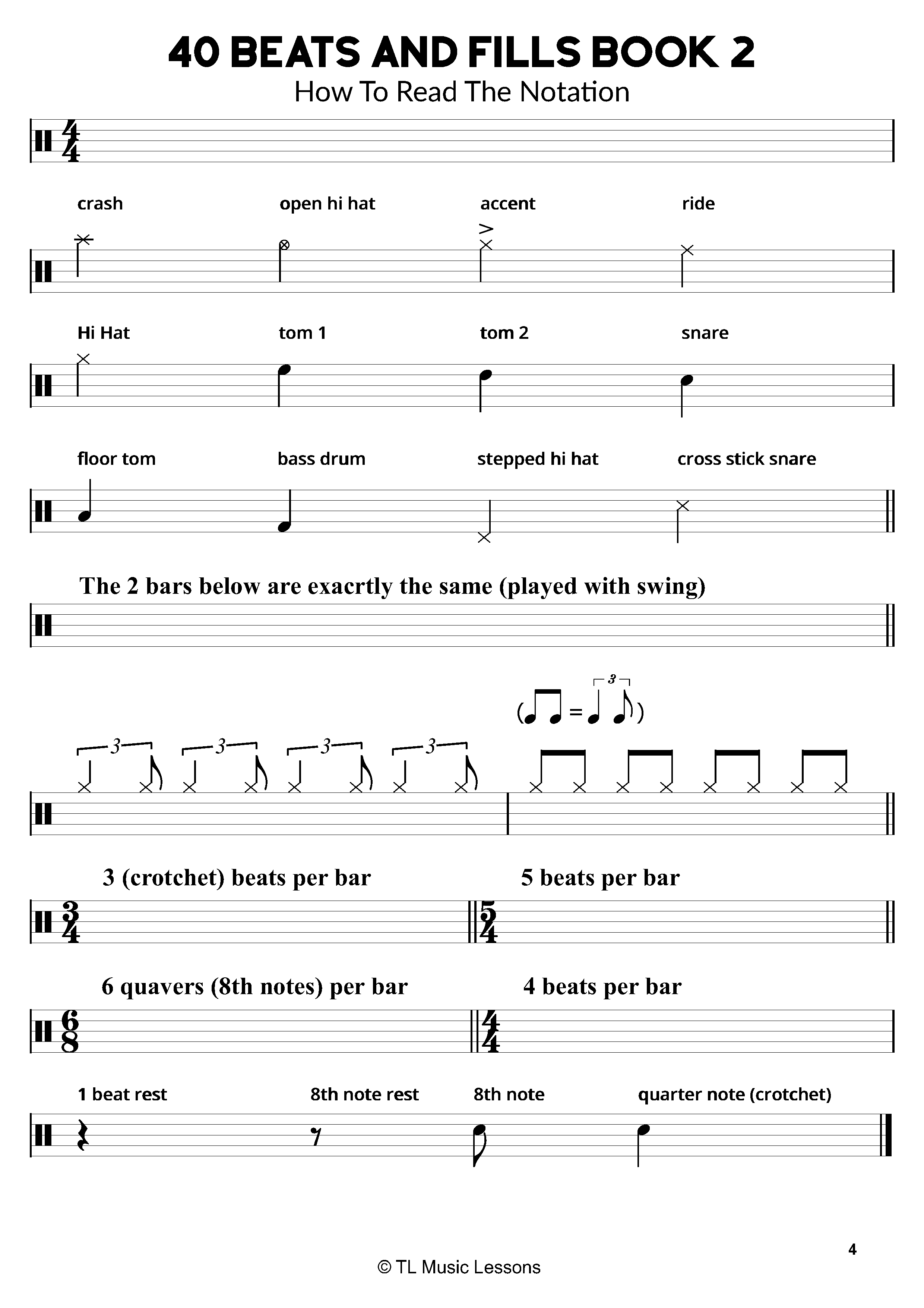
10 Drum Beats in a 6/8 Time Signature

Objective: To develop a vocabulary of various bass drum and snare variations that are usable when playing in the 6/8 time signature.

Variations: The right hand could be moved to the floor tom or ride, and accents / ride bell / open hi hats could be added

About the drum beats in 6/8

The first drum beat is the standard beat to play for many when playing in 6/8 and is a good place to start. The bass drum is on the first beat of the bar, and the snare drum is on the 4th quaver beat of the bar – these are the beats where the emphasis is in 6/8. You tend to count it with emphasis like 1 2 3 4 5 6.

The hi hats are playing on all 6 quaver beats of the bar, which is the same on all of these drum beats.

About the 6/8 time signature

Beat 3, 4, 5 and 6 all give a strong indication of a ‘swing’, or ‘shuffle’ feel to the beats. This is easy to do in 6/8 because it can easily feel like you are playing triplets, with a perceived time signature of 2/4 or 4/4. This is why the 6/8 time signature is sometimes used in blues and jazz music. It is also a popular time signature in musicals, especially in slower pieces where the crotchet beat would be too slow if notated with triplets. The same goes for blues, where instead of having a very slow “1 trip let 2 trip let” feel, the slow 1 2 3 4 5 6 is sometimes preferred, especially if staying in that feel for the whole song. Going back to musicals, and also for classical songs or any groups with a conductor, a 6/8 time signature is more efficient and clear for a conductor to beat, than a slow piece in 2/4 or 3/4.


Related (Premium): Grades 1-2 Beats & Fills Drum Book – Unit 1 – Rock Pop Soul Funk – PDF ebook
Related: Practice sheet for learning to play drum beats in 6/8 time