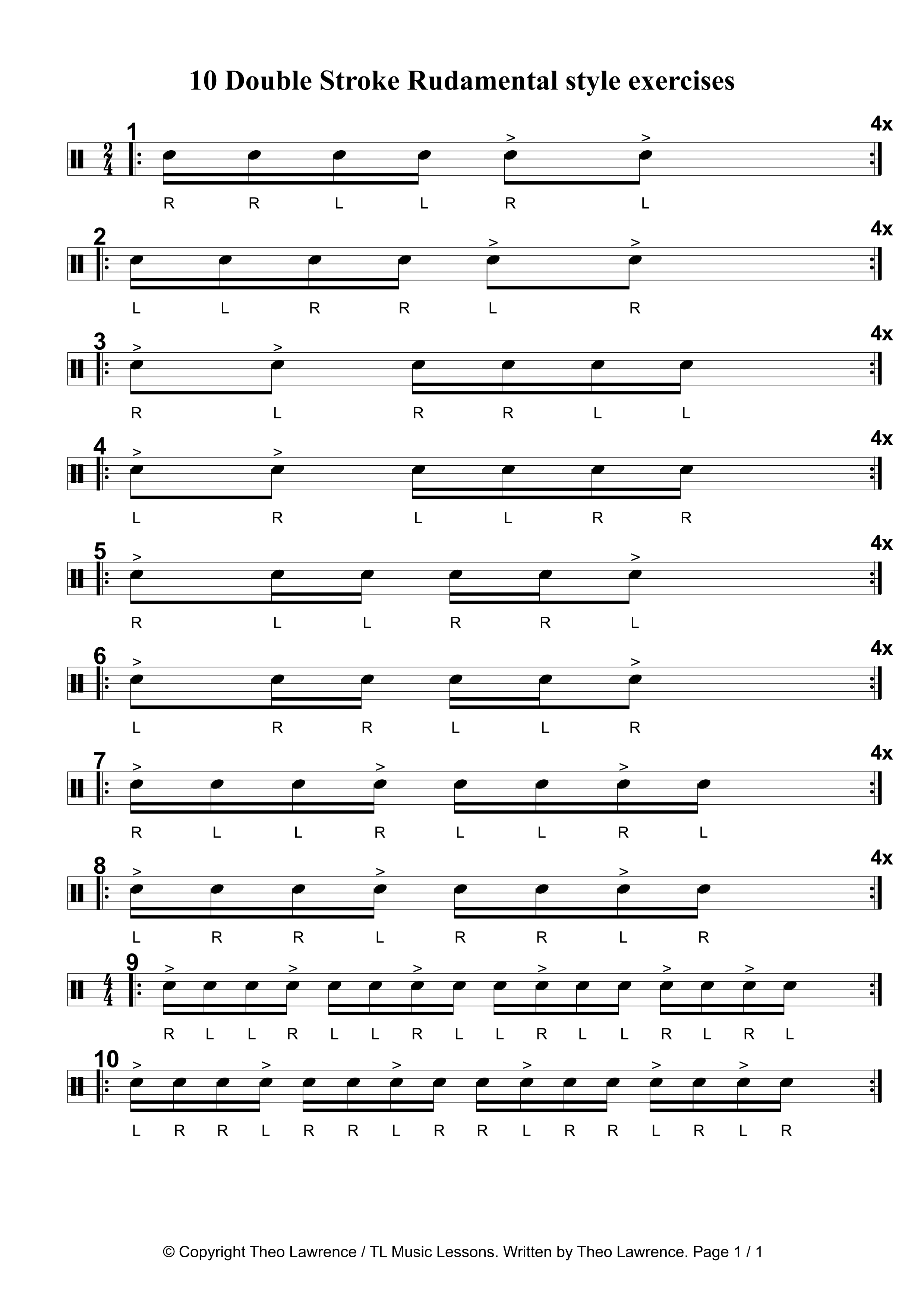
10 Double Stroke Rudamental style exercises

Video showing Exercise 1 & 2:

There are quite a few double stroke rudiment exercises in the 40 official drum rudiments, but none of these are in them. While the ’40 drum rudiments’ cover many of a drummers needs, in terms of practicing, there are many more double stroke exercises that are useful to learn.

The 10 rudiment – style snare drum exercises here are all involving double strokes. These snare drum exercises are all rhythms that I use quite often in my drumming, so to me they are quite essential I believe.

When learning rudiments, I was always taught that they are preparing you for possible eventualities in drumming – for example by learning and practicing the flam with different leading hands, you have prepared for using it in drum fills in songs, in a variety of situations. So to me, all of these 10 rudiment exercises are essential patterns that you will need at some point as a drummer, so to master these, will be beneficial to you for when you meet the patterns elsewhere.

Here is how all of the exercises sound:

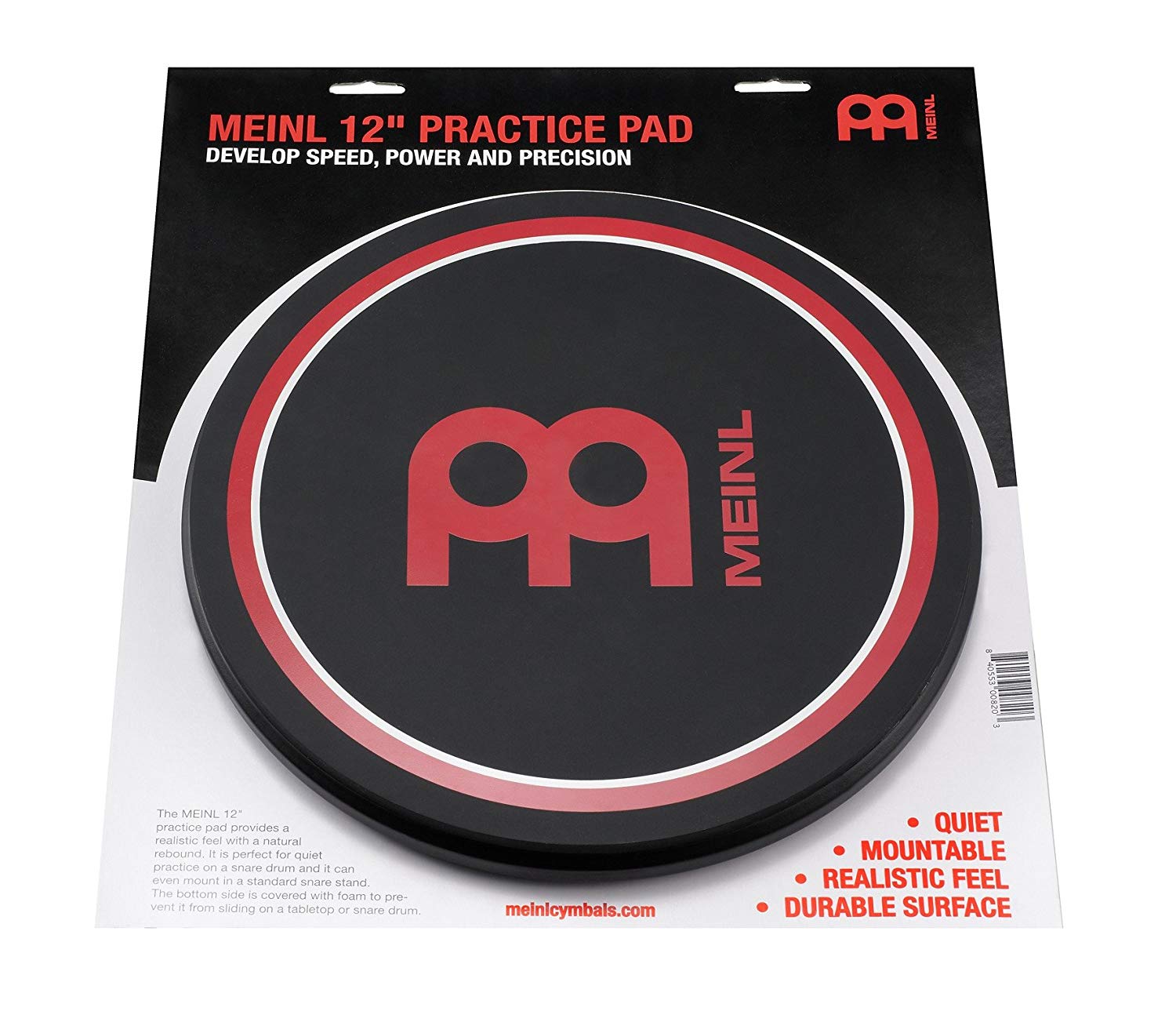
The best practice pad I have ever owned: Meinl MPP-12

The Meinl MPP-12 practice pad is quiet but loud enough that it’s satisfying to play. The rubber surface has some give to it so it’s not like hitting hard plastic. The bounce is realistic and similar to a tightly tuned snare.

I bought this pad to use with a youth snare drum group I tutor in the UK. It’s sort of a Snare Line, but I’m just a normal drummer adapting bits from what I’ve seen drumlines do for my group, and creating something different. We spend a large part of the weekly session on warm ups and exercises using the practice pads before then moving onto the snare drums to play pieces nearer the end of the session. I fell in love with this Meinl practice pad instantly when it came just by how nice it looks, and how it’s made. I was worried the playing surface might be too hard, but it’s not. When I started playing it, I knew this pad was a great choice.

The drum pad can sit on a table or on top of a snare drum just fine without moving around and with the volume staying about the same. It can also be attached to a snare drum stand. Meinl do sell a 6″ one that has a screw hole for attaching to a cymbal stand. I prefer the 12″ one because it can sit on a table or a snare drum and feels more sturdy than on a cymbal stand, which can wobble around. The 6″ pad is also less solid on a table or snare drum and is likely to move around a lot. I have attached a 6″ pad to a snare drum stand before an I can report it’s not good because the 3 parts where the stand grips the pad can get in the way of your sticks and you really have to crank up the screw thing underneath to get it to fit (annoying if you are switching between pad and snare often).

You can also get signature models such as the Thomas Lang practice pad seen in the video below. The video mentions it not being for practicing marching snares but I personally disagree because for the marching snare pads I’ve seen, such as the Ahead 14″ S-Hoop Marching Pad, I don’t think it’s good for people’s hands and arms to be hitting carbon fibre. My drum teachers in college always said it was dangerous to have practice pads that are hard because it can cause tendonitis. So I would say, these Meinl pads would be good for marching practice and general snare drum practice, but check with your drumline / drumming group before buying, because they might prefer something else. The sound of the 12″ pad has a nice crisp sound, not dissimilar to a marching snare.

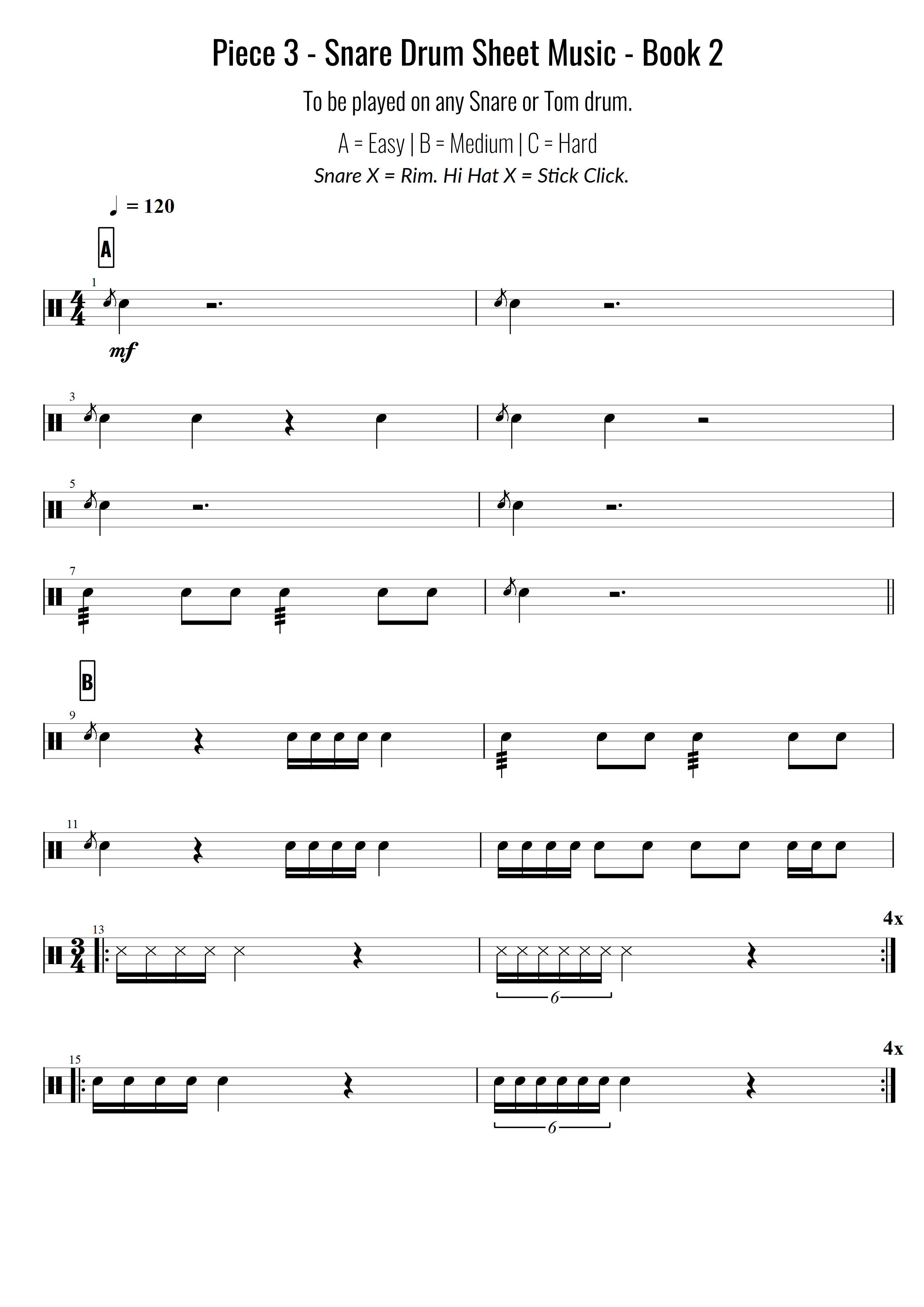
Piece 3 – Snare Drum Sheet Music – Book 2

For this 2 page snare drum piece there are 3 parts, A B and C. You can split up players into these groups of abilities (C is hardest). Some players could also play all three parts or just 2 parts.

Free PDF Download

PDF Download: Piece 3 – Snare Drum Sheet Music – Book 2

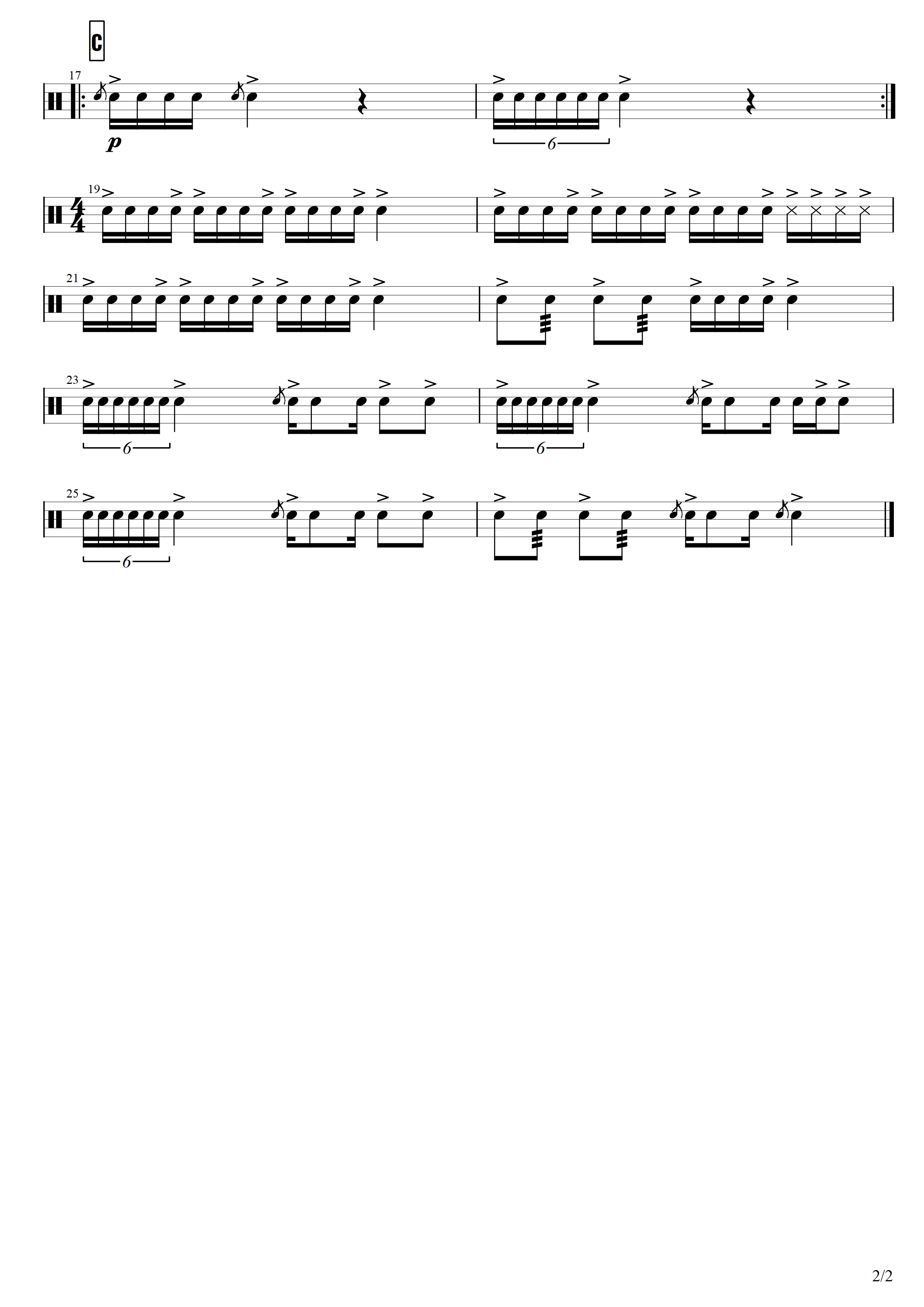
Here is what Page 2, part C looks like:

Paradiddle Exercises Moving Accents To Toms and Cymbals

The Paradiddle. The most popular drum rudiment.

So dramatic! Could be the flam actually.

I’ll never look at the paradiddle in the same way, after a student asked a sporadic question “who created the paradiddle?”. I replied quickly with “Jerry Paraddidle”. After some chuckles at the name and then the rest of the lesson passing, I had to admit at the end that it was a joke! I still don’t know who did, but I’m sure there is info out there.

But is the paradiddle boring?

Well yes and no. It’s how you look at it really. Practicing paradiddles can be boring if you focus on just repeating RLRRLRLL for 10 minutes with a metronome. However, when you look at it as a pattern to unlock a different path to the regular RLRLRLRL, then it’s more interesting because you can move the left and right hands onto different drum voices and make some interesting sounds.

The popularity of the paradiddle can also be limiting in the sense that it’s the go to rudiment. It’s important to keep an open mind with composing and to remember that you can make up your own patterns, in a similar way to the paradiddle, but different. Let’s take the idea of the paradiddle and make new rudiments, new patterns, new standards. Surely there’s other patterns we can be playing. OK let’s give it a go. RRLLLRLRRRL. Any good? Maybe it’s amazing played in an 11/8 time signature. I’ve not tried it, but do you get what I mean?

So anyway, let’s get onto the point of the post. This exercise sheet works with the popular paradiddle and shows how you can make practicing it interesting by moving the accents to toms and cymbals and making up different exercises with it.

The first 3 exercises are all seperate ideas, and then the 4th exercise combines all 3.

The paradiddle features in most of the Rockschool drum grades, so it’s not going away any time soon. You can work on these exercise at any level really, which is why I’ve specified a non specific ’60 to 120bpm’ as the speed. Basically, practice these with or without a metronome at what ever speed seems manageable and then try to increase it each time you go through it, or do it faster next time.

Free Downloads

PDF: Paradiddle Exercises Moving Accents To Toms and Cymbals
Accent Practice Exercise for Snare Drum

This exercise was created to support the learning of playing paradiddles with accents along with a metronome at 70bpm in the Grade 2 Rockschool technical exercises 2012-18 syllabus. I have also suggested to try practicing the sheet between 60 and 120bpm, with or without a metronome. 75-120bpm would be pushing the ability level up to at least Grade 3-4.

It can be hard to play paradiddles with a metronome at first, and if you haven’t worked with a click much before it’s also hard for 16th notes and 8th notes. This exercises works on playing 16th notes with a right, left, right, left sticking to get used to this. Then when you take away the left hand, you are left with right hand 8th notes, which is why they are the foundation of this exercise (first and 3rd line).

On the second line, the R L R L sticking on the 16ths prepares the drummer for the transition to 16ths from 8th notes before going from 8ths to paradiddle 16th notes in line 4. Then with the repeat the first 2 lines are there to settle in to the transitions again. By the end of the exercise the paradiddles exercise should become much easier. The actual grade 2 drums rockschool technical exercise is line 4 played twice.

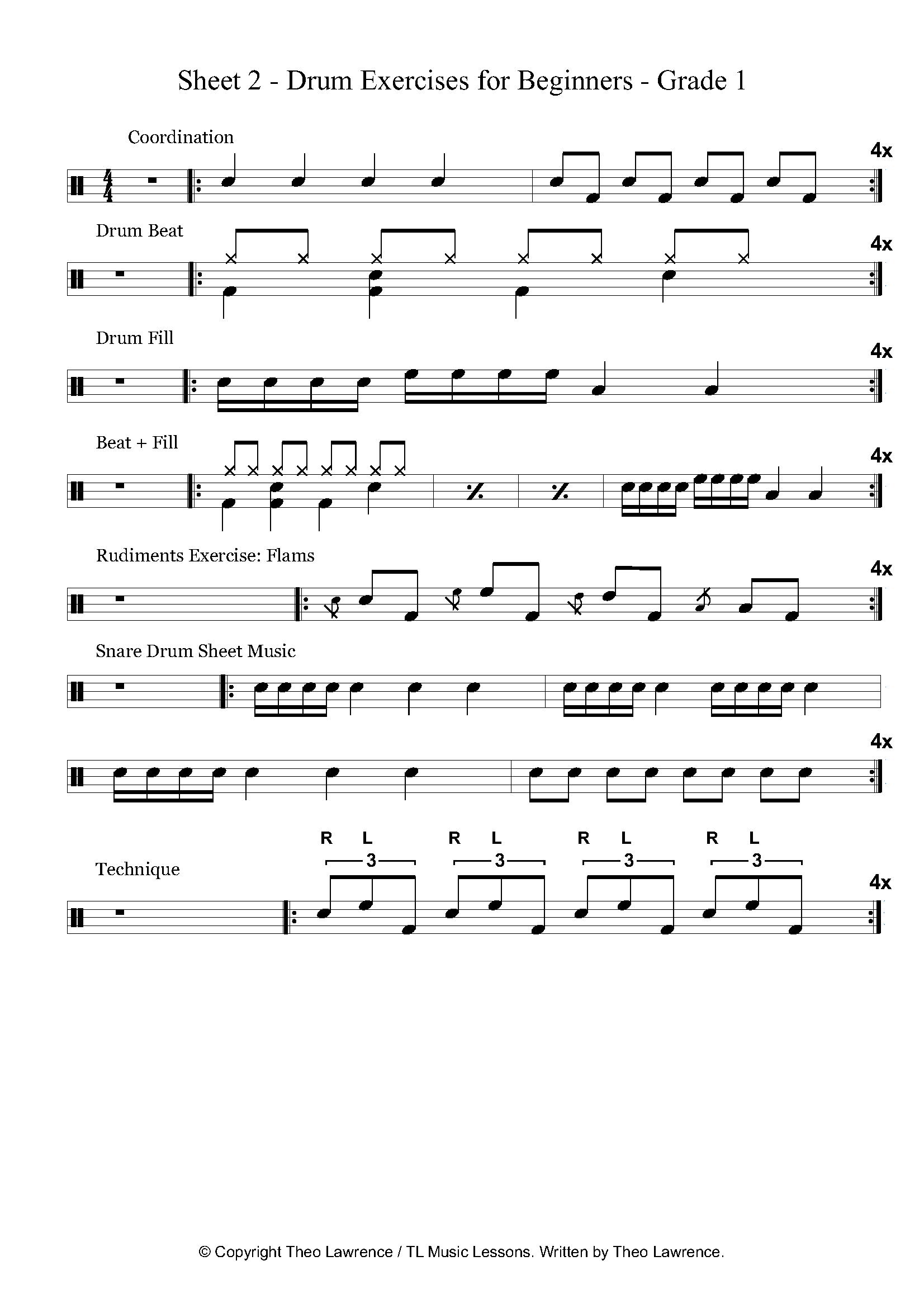
Sheet 2 – Drum Exercises for Beginners – Grade 1

Welcome to the second in the series of ‘Drum Exercises for Beginners – Grade 1’.

You may like to listen to the audio to help understand the sheet music.

There are short repeated exercises in the following categories, which are ideal for practicing on your own, or for using by drum teachers as part of a lesson plan.

  1. Coordination Exercise
  2. Drum Beat
  3. Drum Fill
  4. Drum Beat + Drum Fill (Combined Exercise)
  5. Rudiments Exercise (rudiments that have been developed)
  6. Snare Drum Sheet music
  7. Technique Exercise

← Exercise Sheet 1

Sheet 1 – Drum Exercises for Beginners – Grade 1

Welcome to the first in the series of ‘Drum Exercises for Beginners – Grade 1’.

There are short repeated exercises in the following categories, which are ideal for practicing on your own, or for using by drum teachers as part of a lesson plan.

You may like to listen to the audio to help understand the sheet music.

  1. Coordination Exercise
  2. Drum Beat
  3. Drum Fill
  4. Drum Beat + Drum Fill (Combined Exercise)
  5. Rudiments Exercise (rudiments that have been developed)
  6. Snare Drum Sheet music
  7. Technique Exercise

Exercise Sheet 2 →

8 Technique Exercises for Accents and Ghost Notes

These snare drum or practice pad exercises are similar to drum rudiments. The drum exercises work on possible sticking and dynamic eventualities that you may encounter in drum beats and grooves, drum fills, and snare drum sheet music. The exercises also could be used as a warm up, especially from playing snare drum sheet music.

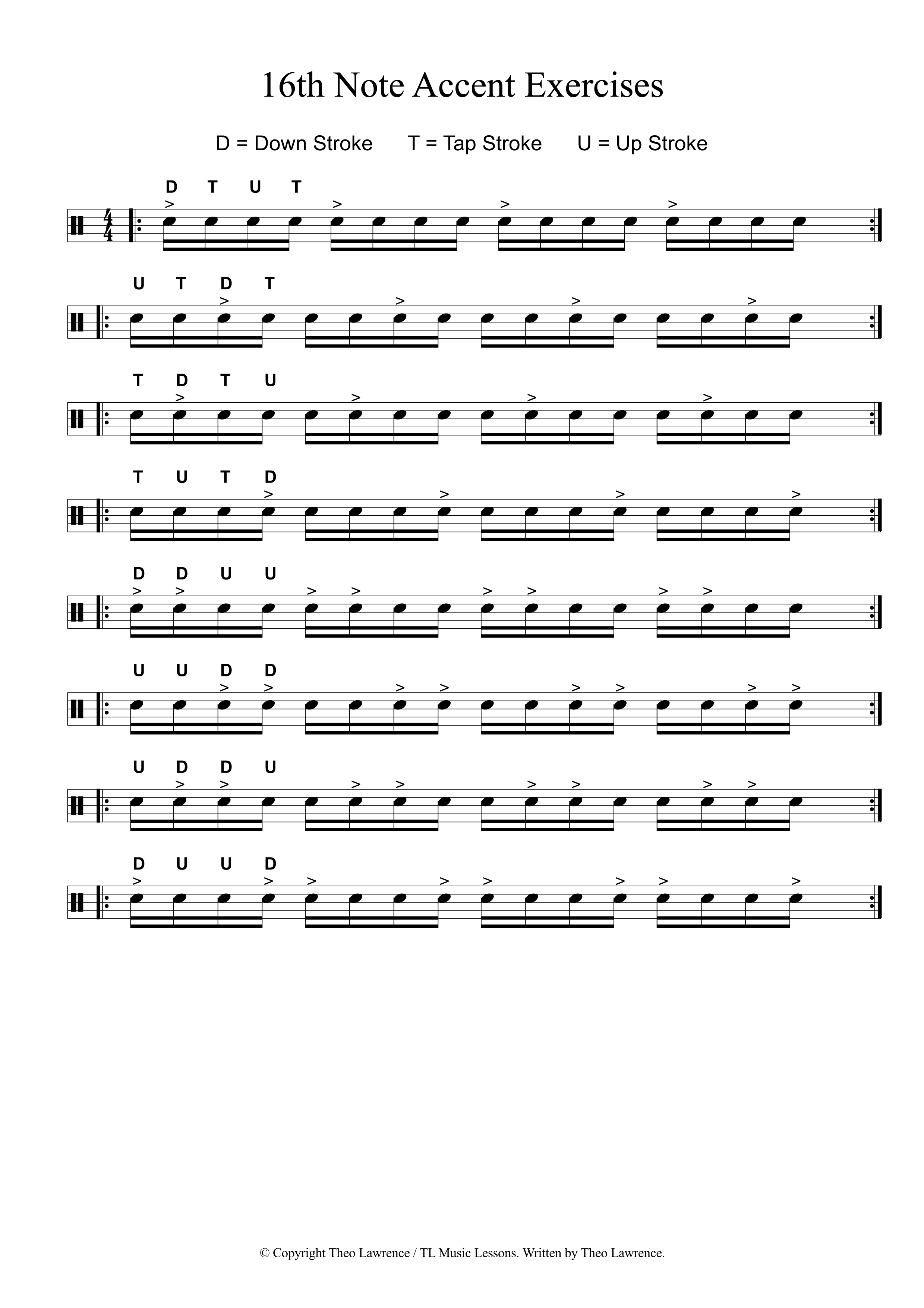
While beginners will be able to play these exercises at their level, advanced players should be aware of using Up Strokes, Tap Strokes, Down Strokes, and Full Strokes so that there is a greater continuity of volume and attack.

Accent Techniques – Down, Tap, Up, Full Strokes

When you play accents, you should ideally use 3 different stick strokes. These are tap stroke, up stroke, and down stroke.

Tap Stroke

You would play a tap stroke if you have just played a quiet note with that hand, and the next note with that hand is another unaccented note.

The tap stroke stick position should start about an inch or a few cms away from the snare drum. Move the stick straight down and hit the drum quietly, before coming straight back up and returning to the starting point.

Up Stroke

You would play a tap stroke if you have just played a quiet note with that hand, and the next note with that hand is an accent.

The up stroke should start in the tap position, and play a tap stroke, but instead of returning to the start position, the stick should end up much higher, somewhere between a 45 and 90 degree angle to the snare drum.

Down Stroke

You would play a Down stroke if you have just played an accent with that hand, and the next note with that hand is an unaccented note.

The stick position should start somewhere between a 45 and 90 degree angle to the snare drum. This stroke should be a loud stroke. Move the stick quickly to produce the loud stroke and finish in the starting position of the tap stroke.

The downstroke produces accents, which look like this: >

Full Stroke

You would play a Full stroke if you have just played an accent with that hand, and there is another accent to follow with that hand. The full stroke, which is played just like a down stroke, but instead of finishing in the tap position, the stick comes back to the starting position of the down stroke. So it plays a loud beat and comes straight back for another one.


Related:

→ The sheet in this post is Page 2 of this ebook: 10 Pages Of Accent Exercises With 16th Notes – PDF Ebook (includes double strokes exercises)
16th Note Hi Hat Grooves With Accents
Reading Buzz Rolls And Double Stroke Markings

(Premium) – 10 Pages of Accent Exercises with 16th notes – PDF ebook

Buy Now →

10 pages of 16th note accent exercises, which includes accents and doubles around the kit. This ebook is designed to help progress technique and explore creative concepts by moving sticking exercises around the kit in various different ways.

Most exercises in the ebook are suitable for all ability levels, played at varying speeds.

This ebook covers a lot of ability levels in just 10 pages. There is content from Grade 1 up to Grade 8 in there. You’ll be able to dip in and out of this ebook when you want to work on accents, fills and double strokes.


Recommended Reading for use with this ebook:
Accent Techniques – Down, Tap, Up, Full Strokes →
16th Note Hi Hat Grooves With Accents →
Reading Buzz Rolls And Double Stroke Markings →