16 bar snare drum piece – Grade 1-2 Snare Drum Exercise – Snare Drum Sheet Music

This free 16 bar snare drum piece is for grade 1-2 drums.

In the rhythm, there is a mixture of quarter notes, 8th notes, 16th notes, 8th note rests and quarter note rests.

For the dynamics, it could be played any volume, but i would recommend mp to mf, leaving plenty of room for the accents to stand out, which are featured in the last 8 bars.

When learning, take it a bar or a line at a time to get it right, but eventually play the whole piece in one go.

For the speed, aim to get up to about 95bpm or higher, but start off at about 60bpm.


Related (Premium): 10 Snare Drum Pieces – Book 1 – Levels 1-3
Related: Grade 1-2 Snare Drum Sheet Music – Practice Piece

How to stop drum mutes and drum silencer pads from falling off

I teach drums quite a lot in different schools, and one thing that has been neccesary is drum mutes to go on the drums to reduce the volume of the kit.

One problem that has occurred is sometimes the pads fall off the toms or snare when playing.

To solve this problem, buy some velcro circles or strips of velcro and place two on each drum skin, one at 12 oclock, and one at the 6 oclock position, near the edge of the skin. Place the opposite side of the velcro on top, and then press on the pad on top.

You will now have removeable pads, which don’t fall off when drumming.

Sometimes the adhesive on the velcro wears out, or the velcro pad doesnt stay stuck to the mute pads. You could use some heavy duty glue to stick the velcro to the drum mute pad to solve this issue.

8 rock or funk drum beats with 16th Note Accents for grade 5 and up

These 8 drum beats will test your ability to add accented notes to the two handed hi hat pattern, whilst also negotiating tricky bass drum rhythms and open hi hat combinations.

Start off slowly and build it up when you are comfortable with the grooves at low speed. Improve your timing and measure your progress with a metronome. You should start as low as 40 or 50 bpm, but probably easier without a click, or double it up to an 8th note click, because the slow click will be tricky to play to.

7 drum beats for keeping light time

Recently I played drums in a musical at my local Theatre. I hadn’t really done this kind of work before, apart from once a long time ago. I encountered quite a few sheet music directions that I was not used to – and a few that I had never heard of. One of the things I saw was ‘light time’, or ‘keep light time’. This was pretty straight forward and easy to know what it means (play a very soft drum beat to help the singer keep time), but this post is here to show you the types of beats I relied as a basis for these sections.  What I have for you here is 7 drum beats containing the drum sheet music of the kind of beats I played in these sections.

Construction of a basic drum beat in 7 steps

We are going to learn a basic drum beat. It’s one that you will have heard before.

I’m going to break it down into one thing at a time, or two things, and show you how it’s constructed. It’s a great way for beginners to learn how to play it, and how to count it properly.

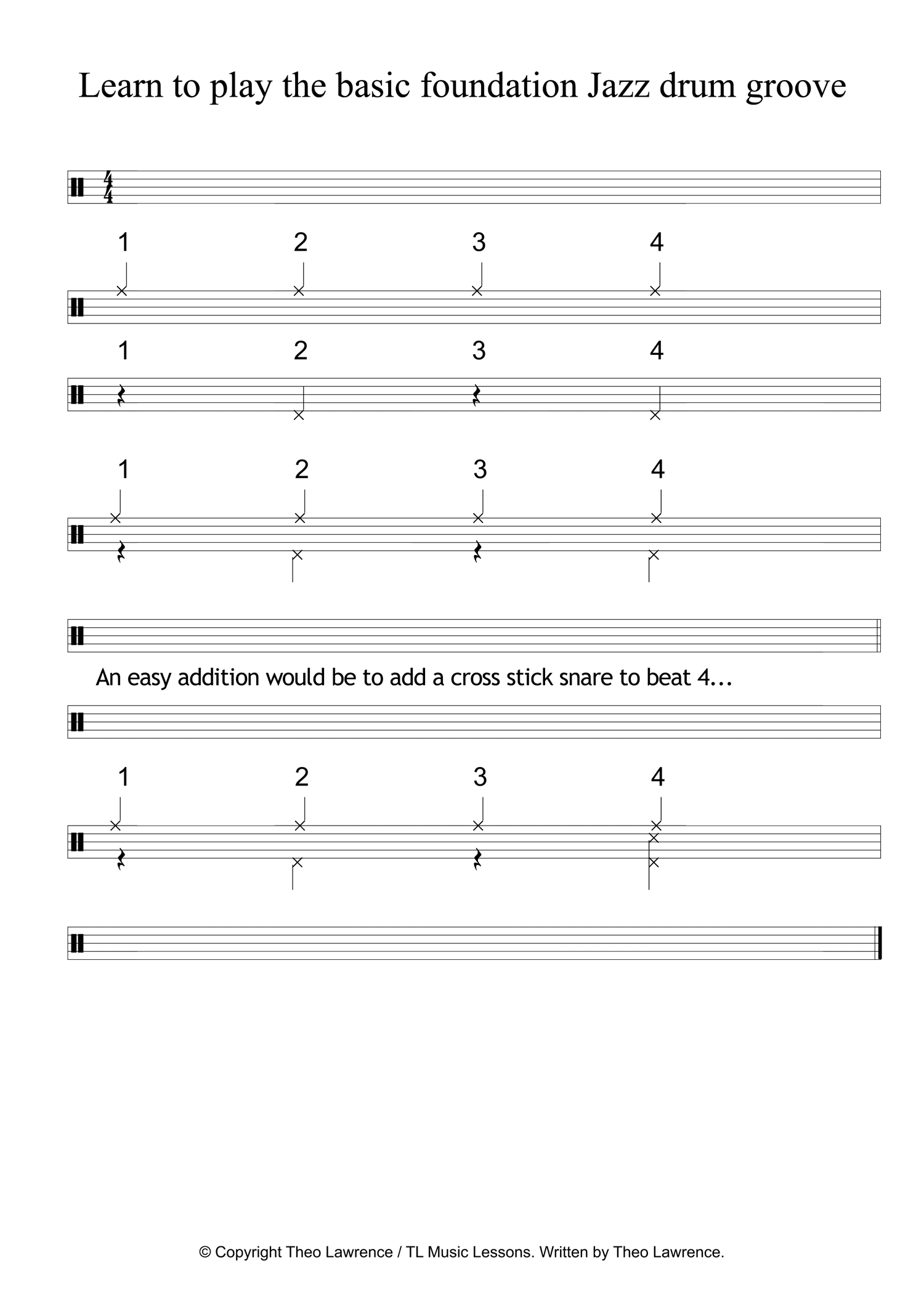
These are the instructions for each line of the sheet above:

  1. Let’s start by just playing the Hi Hat. Play it closed with your right hand, and count 1 + 2 + 3 + 4 +.
  2. Now just play the bass drum. Count 1 2 3 4, but only play the bass on beat 1 and 3. You can loop this round and around.
  3. Count 1 2 3 4 again, but this time play the snare drum on 2 and 4. Again, loop this until it’s easy.
  4. Now it’s going to start sounding like a beat. Count 1 2 3 4. Play the bass on 1 and 3, and the snare on 2 and 4. So it will go bass, snare, bass, snare. This is probably the most used sequence in drumming, so loop it and get really comfortable playing it.
  5. OK, let’s go back to the hi hat, and combine it with the bass drum. Hi hat on 1 + 2 + 3 + 4 +. Bass on 1 and 3.
  6. Just one more combo before the full drum beat. Hi hat on 1 + 2 + 3 + 4 +. Snare drum on 2 and 4.
  7. Finally, we will now combine everything we have learned, to make the most popular basic drum beat. Hi hat on 1 + 2 + 3 + 4 +. Snare drum on 2 and 4. Bass on 1 and 3.

Related: Construction Of A Basic 16th Note Hi Hat Drum Beat In 7 Steps

Related: 10 Basic Rock Drum Beats

Related (Premium): Grade 1 Rock Beats Ebook – The lesson you have just been through is featured in the ebook as an A4 printable handout for students.

Accent Techniques – Down, Tap, Up, Full Strokes

When you play accents, you should ideally use 3 different stick strokes. These are tap stroke, up stroke, and down stroke.

Tap Stroke

You would play a tap stroke if you have just played a quiet note with that hand, and the next note with that hand is another unaccented note.

The tap stroke stick position should start about an inch or a few cms away from the snare drum. Move the stick straight down and hit the drum quietly, before coming straight back up and returning to the starting point.

Up Stroke

You would play a tap stroke if you have just played a quiet note with that hand, and the next note with that hand is an accent.

The up stroke should start in the tap position, and play a tap stroke, but instead of returning to the start position, the stick should end up much higher, somewhere between a 45 and 90 degree angle to the snare drum.

Down Stroke

You would play a Down stroke if you have just played an accent with that hand, and the next note with that hand is an unaccented note.

The stick position should start somewhere between a 45 and 90 degree angle to the snare drum. This stroke should be a loud stroke. Move the stick quickly to produce the loud stroke and finish in the starting position of the tap stroke.

The downstroke produces accents, which look like this: >

Full Stroke

You would play a Full stroke if you have just played an accent with that hand, and there is another accent to follow with that hand. The full stroke, which is played just like a down stroke, but instead of finishing in the tap position, the stick comes back to the starting position of the down stroke. So it plays a loud beat and comes straight back for another one.


Related:

→ The sheet in this post is Page 2 of this ebook: 10 Pages Of Accent Exercises With 16th Notes – PDF Ebook (includes double strokes exercises)
16th Note Hi Hat Grooves With Accents
Reading Buzz Rolls And Double Stroke Markings