
10 tips and advice for running your own drum teaching business

Photo Credit: Image by rawpixel.com

Whether you are thinking of starting your own music leaching business, or looking for ways to improve the management of your self employed music lessons business, these 10 tips have been written with you in mind. All of these bits of advice are related to my own business and are things that I do or have learned throughout the 6 years of teaching music in schools and doing private lessons, while being self employed and organising everything else involved outside of the actual teaching.

1. Plan your week with a digital calendar

Easily manage your schedule online and sync it to your mobile devices. Reschedule lessons on the move and set reminders to pop up at certain times if needed. The main advantage of a digital calendar is that you can schedule recurring lessons to be the same every week, and then modify each one individually if you need reschedule for one week – saving you lots of time writing in the same things into your calendar each week. I use google calendar and sync it with my phone’s calendar.

2. Get a digital to do list

A todo list that syncs to your phone, like Remember The Milk, is very useful and can help build up your reputation of someone that is reliable, because you will actually follow through with the things you say you will do. There is always something that crops up in the day that needs to be addressed at a later time. A busy music teacher can have hundreds of little tasks in a week that crop up, and adding them to a todo list will make sure they get done.

3. Organise your lesson plans and content

Structure your teaching into ability levels and topics. Make sure you are covering everything that you should be teaching to the best of your knowledge. Create lesson plans or exercise sheets, or compile ones from books or online lessons. Keep digital files and print as needed. I keep my files in google drive or in dropbox so I can use them on the move. Don’t hand write everything in your own time unless you are only doing it once and photocopying it for future lessons. You should end up with more content than you can carry with you at once. Therefore you might want to structure lesson material into different topics throughout the year, or use or create a series of books that the students can progress through.

4. Use books and booklets rather than individual lesson handout sheets

If creating your own lesson plans, try to compile them into a book or booklet that can be printed out and stapled or binded together, or used as an ebook. This will mean you won’t need to worry about printing off new lesson handouts every week or so. Even better, the student will be able to visualise their progress as they make their way through the book. Furthermore, you could think about selling your books online. It can be a nice way of passively bringing in an extra income while you are doing other things. I use a company called Payhip to sell my ebooks and premium downloads.

5. Offer to teach grades

Working through a grade book is a good way of learning and teaching. Make sure you only teach grades that you could do yourself. You should always be at a higher grade than what you are teaching, and ideally be several higher.

Grade 6-8 award ucas points, which are a good incentive to start learning early and have dedication to progress up through the grades before university age, where extra ucas points might prove useful.

6. Dress smart and be professional

If you take your job seriously and want your students and parents of students to take you seriously then I believe you need to make the effort to look smart whilst working. You might also be a musician and have a strong image as well, but it is best to save certain things for the stage. Being your own boss is great so you don’t have to, but people feel more comfortable if you make the effort with your appearance, especially if you work in schools as a peripatetic music teacher.

7. Make sure you work enough hours per week

Music teachers can charge much more than minimum wage, which is great unless they don’t do enough billable hours. To make this job pay a decent wage you need to make sure you are putting full time hours during term time at least. It is easy to fall for the illusion of charging a high hourly rate, and working part time hours, only to end up with a low income at the end of the year.

8. Have music related goals and activities outside of your teaching

Keep your dreams, goals, ambitions and love of music alive. You might downsize them as the years pass by, but always remember why you play your instruments and do all you can to be a musician as well as a music teacher.

9. Practice and improve

There is always something new to learn in music. Never stop learning and improving! Make sure you practice – practice what you preach to your students. I also see recording music to a click as practice, and you are also getting a physical end result from it.

10. Keep a contact list of all pupils or parents of pupils

I use google contacts, and stay in regular contact about lesson times and news etc. I group them by instrument, and also by which school they have lessons in, or if they have non-school lessons. Emails are the best method of contact I think because you can send to many all at once easily, most people use email now, it is free, and you can attach things. Phone calls are inconvenient to many now, texts are not as easy to send to everyone quickly, and facebook and twitter messages/updates are easily missed.


/>I hope you have found some or all of these points useful and relevant to you. There are many other things I could write about in this list, and I hope to write another one in the future. Meanwhile, have a look around the internet for similar things as there are many helpful bits of advise. One website that I constantly find tips from for running a business, which I would recommend to you, is: www.entrepreneur.com


Related: (www.learnguitarforfree.com) 30 essential productivity apps, business management tools and other apps or websites that help to run an online business and a local music teaching business

How to get good sounds from your cymbals when playing the drums

Photo Credit: Owen Byrne

Hi Hats

Beginners often play the hi hat too loud, and sometimes this is down to where they are hitting on the hi hat cymbals rather than how hard they are hitting. As a result, their playing sounds messy, and their sticks wear more quickly. If this is happening to you, it may be time to address your technique for playing the hi hats.

Regular hi hat sounds should be played using the tip of the stick on the top of the hi hat, half way between the edge and the bell, and range of dynamics can be played here. The left foot should press down quite a bit so that the sound is clean and tight. However, too much pressing down with the foot will give the sound a weird ringing noise, which doesn’t sound good, as well as being tiring pressing down with the left foot for long periods of time.

The area closer to the bell has a higher frequency tone, which is good for a brighter sound. This area is good for styles like soul funk, particularly for adding in open hi hats.

The edge of the hi hat should be reserved for accents or for more frequent use in heavy genres like hard rock and metal. Even in those styles though, variation between the top and edge are effective.

The edge of the hi hat should be played with the thick part of the drum stick, which is called the shoulder. This is the best part of the hi hat to get an open slushy sound – this is used most of the time in metal music and fairly often in rock too.

For most other styles, single open hi hats that close after are best played with the tip of the stick on the top of the hi hat. This gives a crisp clean sound. You will find that these compliment a drum groove nicely, and that playing an open hi hat on the edge is good for times when you want it to stand out more – for example if a band is playing some stabbed rhythms.

To get a nice sizzley jazz open hi hat sound, try hooking on a light chain on the top of the cymbal.

Finally, you need a good set of cymbals! For a good studio recording or live playing, an expensive set of cymbals will always be better. You can still sound good though by following the advice above, as long as you have a set of fairly heavy weighted cymbals, unlike the water thin style cymbals that come with some cheap beginners kits.

I will leave you with this thought: a well played set of cheap hi hats will always sound better than badly played top of the range hi hats.

Ride Cymbal

The ride cymbal can be pretty loud, so always try to lower your stick so that your strokes are fairly close to the ride cymbal – this should help keep the volume from getting out of control and also give you dynamic room at add accents on the ride or the bell when needed. Make sure to hit the ride half way between the edge and the bell with the tip of the stick – NOT the shoulder (keep that arm up!). Play the bell with the shoulder of the stick, or if you want a light bell sound, with the tip of the stick. You can crash the ride too when required. To get a nice sizzley jazz sound, try hooking on a light chain on the top of the cymbal (as pictured in the featured image).

Crash Cymbal

Always “Crash” using the shoulder of the drum stick, on the edge of the cymbal at about a 45 degree angle. Hitting it to the left or right of the middle will help prevent cymbal cracking. Strike with a glancing blow whilst also following through with your stick. Continue the motion left or right depending on where you are going to next. For example, if the cymbal is on the left hand side of the drum kit and you want to get to the ride cymbal next, hit the cymbal at the right of the middle and glance off to the right – you’ll arrive at the ride cymbal much quicker.

You can also play a crash cymbal like a ride cymbal, with the tip of the stick. For example, in Jazz this can provide opportunity for variation when there are a lot of ride based drum beats.

China and Splash Cymbals

Play these like you would play a crash cymbal.

Bell Cymbals

Like a huge bell from a ride cymbal, these really cut through any mix and are usually played with the tip of the stick or sometimes with the shoulder of the stick. Some players have them positioned upside down. There is no right or wrong way.

How to stop drum mutes and drum silencer pads from falling off

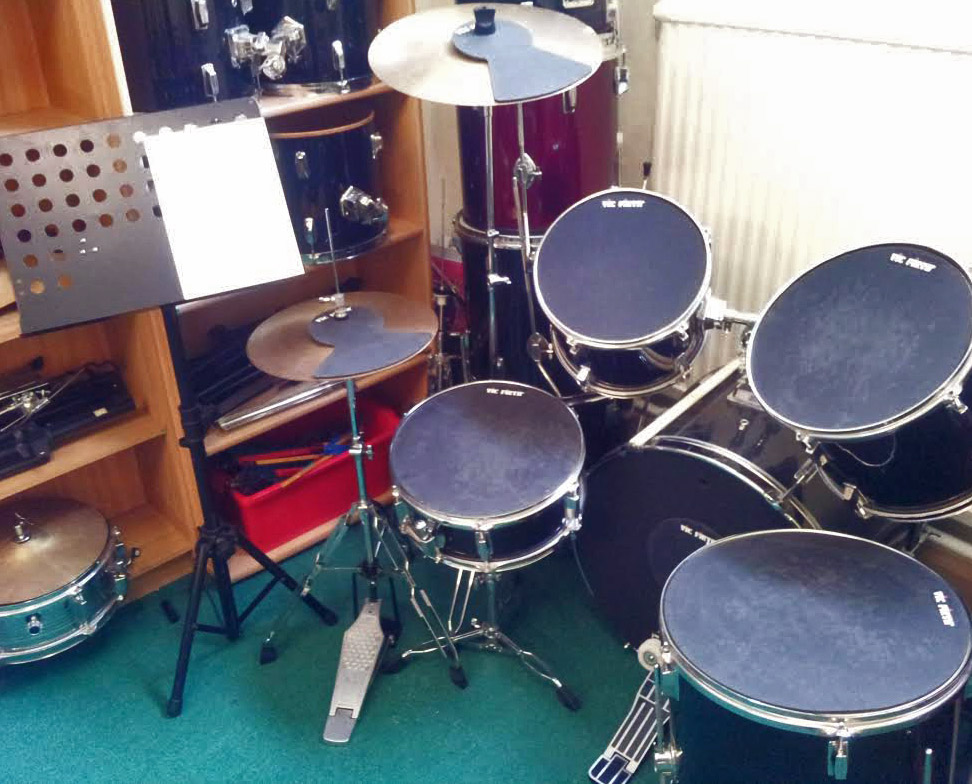
I teach drums quite a lot in different schools, and one thing that has been neccesary is drum mutes to go on the drums to reduce the volume of the kit.

One problem that has occurred is sometimes the pads fall off the toms or snare when playing.

To solve this problem, buy some velcro circles or strips of velcro and place two on each drum skin, one at 12 oclock, and one at the 6 oclock position, near the edge of the skin. Place the opposite side of the velcro on top, and then press on the pad on top.

You will now have removeable pads, which don’t fall off when drumming.

Sometimes the adhesive on the velcro wears out, or the velcro pad doesnt stay stuck to the mute pads. You could use some heavy duty glue to stick the velcro to the drum mute pad to solve this issue.

What happens when you opt for gaffa tape instead of bass drum impact pads

Having visited various rehearsal studios around the UK, I have seen this happen so many times.

I believe that it is a common thought to skimp on buying a bass drum impact pad, and choose gaffa tape instead. Please don’t do this!!

The idea of the pads is to prolong the life of a bass drum skin, by adding an extra layer of material where the bass drum beater hits. The problem with using gaffa tape (aka gaffer tape, duct tape), is that it wears away very quickly and becomes extremely sticky after a day or so of drumming. This then causes your bass drum pedal beaters to stick to the drum when playing and leaves a residue on the beater heads. After the stickiness has worn off, you can play the bass drum like normal again without it being an issue.

In conclusion, putting gaffa tape on a bass drum skin only serves the purpose of wrecking the aesthetics of the bass drum skin, and spoiling the surface of your bass drum pedal beaters, and perhaps prolongs the life of the bass drum head by approximately 1 day.

10 Drum Maintenance Tips

Photo Credit: Dejan Krsmanovic

A good drum kit can cost thousands so even if you have had one bought for you, look after it!

Make sure to tell your band mates not to do destructive “rock moves” on it like smashing their instrument on it, standing on the bass drum or jumping into it. They may have seen videos and got ideas, but when you’ve paid a lot of money for your kit, you need to lay out some ground rules with those ‘loose cannon’ band mates.

If you have to share your drums at a gig, you will find that other drummers tend to have respect for a drum kit that is kept in good condition. Either refuse to share your kit, or chat to the other drummers using it and let them know what they can / can’t do. I used to go to a blues jam night and the drummer of the band that played between the random jam sessions said to everyone you are welcome to use my kit, but just don’t move anything. This is completely fair in this instance because that would waste time and be an inconvienience for the drummer when the main band came back on to play. Other drummers will usually resepect any rules you give them.

How to Look After Your Drums Checklist

1. Keep Cymbals and Drum Shells Clean

2. Replace Broken or worn Drum Skins

3. Use protective patches (Evans, Remo and others make them) on your bass drum where the beater makes contact with drum. Never put duckt tape or gaffa tape or ANY other tape on there. It will get sticky when it wears through (only after a few songs) and your beater will start to stick to the drum after a while. This will wreck your drum and bass drum pedal. Replace broken patches immediately, for the same reason.

4. Make sure all cymbal stands have the correct plastic sleeves between cymbal and metal part of stand (may cause cymbal to crack otherwise) and that all wing nuts and protective felts are used. Never have metal contact with any cymbal. If you are sharing someone else’s kit, make sure you take spare plastic sleeves and felts.

5. The clutch for the high hats should have all the parts it came with. If not, replace it. You should also use it correctly – ask your drum teacher or someone in your local drum shop for more information. If you are a touring drummer that shares drums with other bands, you may come across a drummer that has a really bad clutch on their kit. Always bring your own clutch for this occurance. You will know what we mean when you come across one of those drummers. Don’t be one of them!!

6. If you share your drums with anyone at a show, make sure they bring and use their own cymbals, stands, snare and bass drum pedal. In return, you should bring these ‘breakables’ with you when sharing someone else’s drums.

7. Always set up your drums on carpet or a drum mat to prevent slippage of the drums. If they slip, your drums may scratch and be put in positions that damage them.

8. Transport your drums in soft or hard cases.

9. Transport your cymbals in soft or hard cases.

10. Consider having a practice kit (including a second set of cymbals) set up at home or in your rehearsal room, and having a gig kit in boxes ready to go. This is a lot easier, and also reduces wear and tear on the drum kit, and cymbals.