4 Blues Drum Beats and Fills Exercises – Sheet 6 – 40 Beats and Fills Book 2

PDF Ebook Buy Now →

Next Page: Sheet 7 →

Here is Exercise Sheet 6 from 40 Beats and Fills Exercises Book 2.

All of the 4 beats and fills exercises are in 6/8 time signature and the emphasis is naturally on beat 1 and 4. In the drum beats, the first beat of the bar usually has a bass drum and beat 4 of the bar usually has a strong snare drum. 6/8 means that there are 6 8th notes per bar.

This is how the emphasis on 1 and 4 looks like if you see them in bold:

1 2 3 4 5 6

On exercise 4, you can see dotted quarter notes (dotted crotchets) in the drum fill on bar 4. The dotted quarter notes each last for one and a half beats, which is the equivalent of half a bar each in this 6/8 time signature. If you think about trying to count these without prior knowledge of playing in 6/8 time, it can throw you off a bit, but if you think about the pulse of the bar (2 pulses per bar, on beats 1 and 4) then they really only feel like they are 1 beat each, along with the pulse.

Video Demonstration for Sheet 6


Watch on YouTube

← Go back to Sheet 5
Go forward to Sheet 7 →
Buy the full PDF ebook →
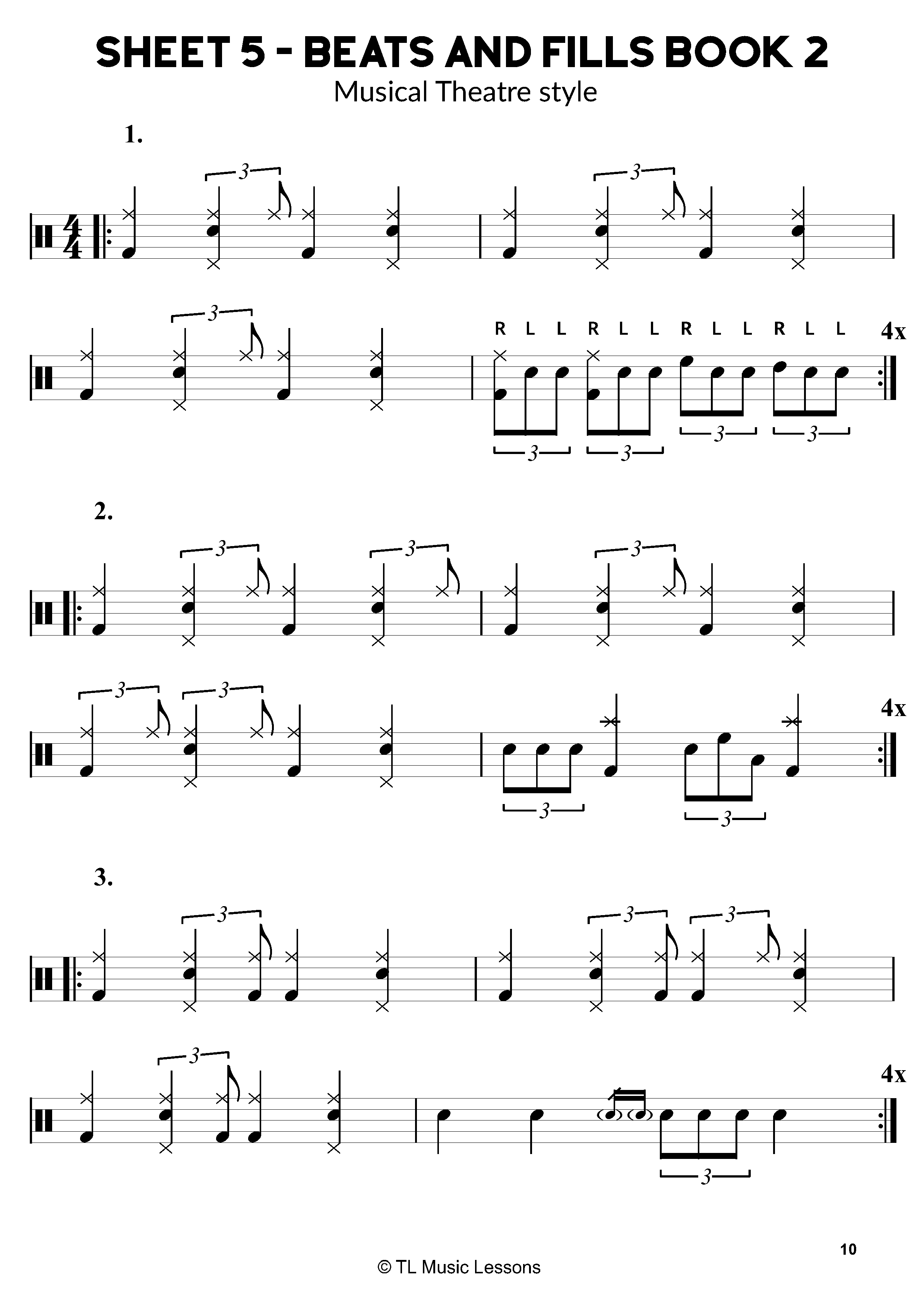
Musical Theatre Drum Beats and fills – Sheet 5 – 40 Beats and Fills Book 2

PDF Ebook Buy Now →

Next Page: Sheet 6 →

Here is Exercise Sheet 5 from 40 Beats and Fills Exercises Book 2.

Musical Theatre drumming generally has elements of swing, jazz, big band, blues, pop and rock. Unlike jazz music – which also has the swung hi hats – there is often a prominant snare on beats 2 and 4. Sometimes the time signature changes to 3/4, 2/4 and 6/8. Much of theatre style drumming is played with swing and therefore we use many fills with triplets, because they fit in with the swing rhythm easily.

The drum beats on Exercise 3 are similar to those grand finale type songs where they are a slow to medium speed. For this, perhaps you can imagine the cliché stage show of linked arms and kicking out of the legs together in time with the music (the snare on beats 2 and 4).

Video Demonstration for Sheet 5


Watch on YouTube

In Depth Drag Technique Video Demonstration

We also look in depth on the drag technique in the video during the Exercise 3 drum fill. The video shows the correct technique for performing the bounced drag, including how to hold the stick and how to control the bounces by using varying amounts of pressure to acheive the desired bounce frequency and length.

You can download the pdf for this page by buying the book or downloading the free preview on the product page.

There are more free pages like this one, use the the navigation below to view them.

← Go back to Sheet 4
Go forward to Sheet 6 →
Buy the full PDF ebook →

6 Skip Beat Drum Grooves With 8th Note Hi Hats

If you are new to these kind of drum beats, check out some of the easier looking sheets on the skip beats page.


This is a great drum sheet for drum students that enjoy playing basic bass drum and snare drum skip beats and want to progress with them further. These drum grooves explore some of the creative concepts that can be applied to these kind of drum beats.

There is plenty of syncopation and dynamic texture in the drum beats, so they are interesting to listen to and play. A good bass player would enjoy locking in with these types of funk drum grooves.

You could of course use these in different styles, such as fusion or rock. Drum & Bass would use these types of beats, played really fast.