6 Rock Exercises with Drum Beats and Fills

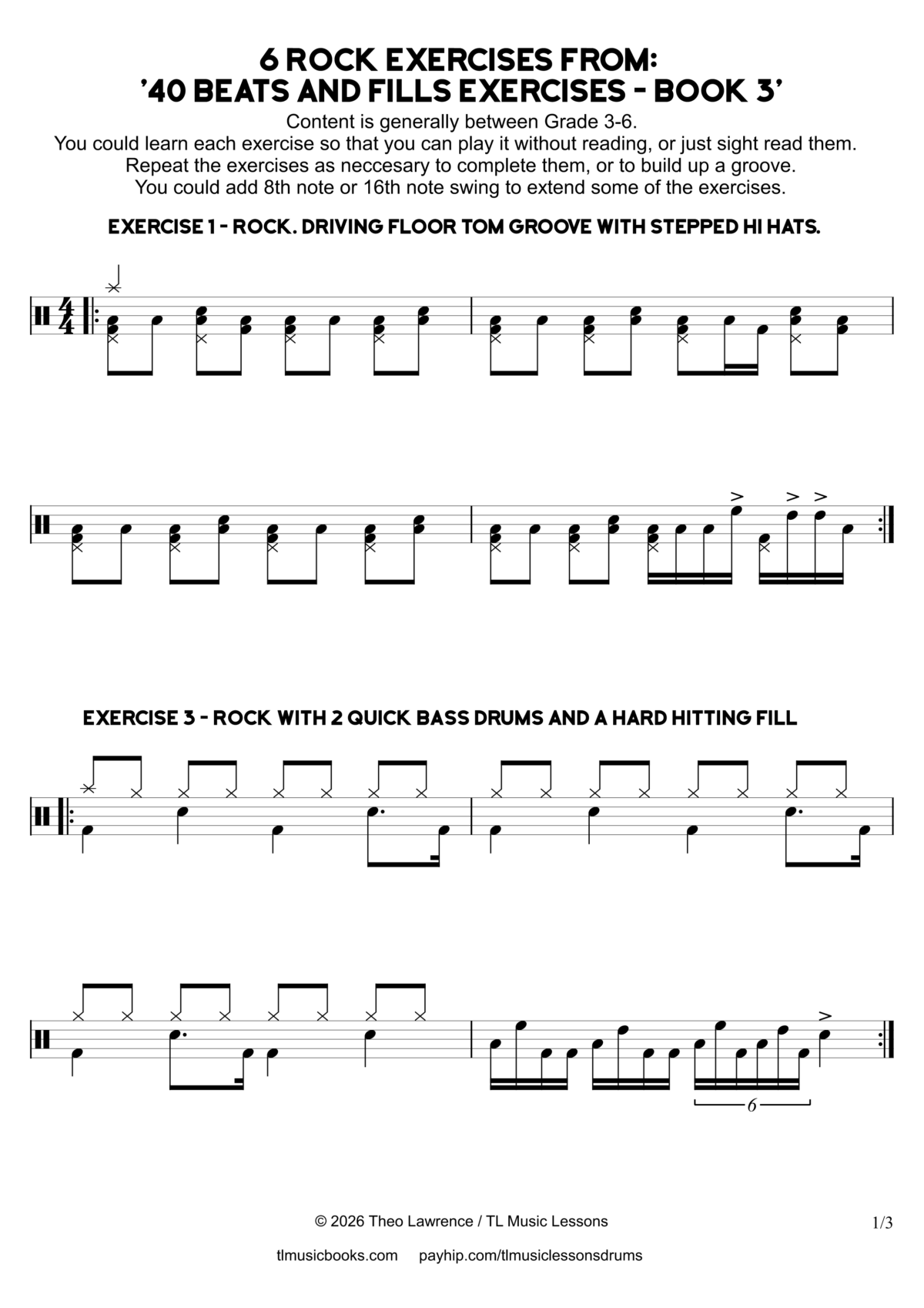
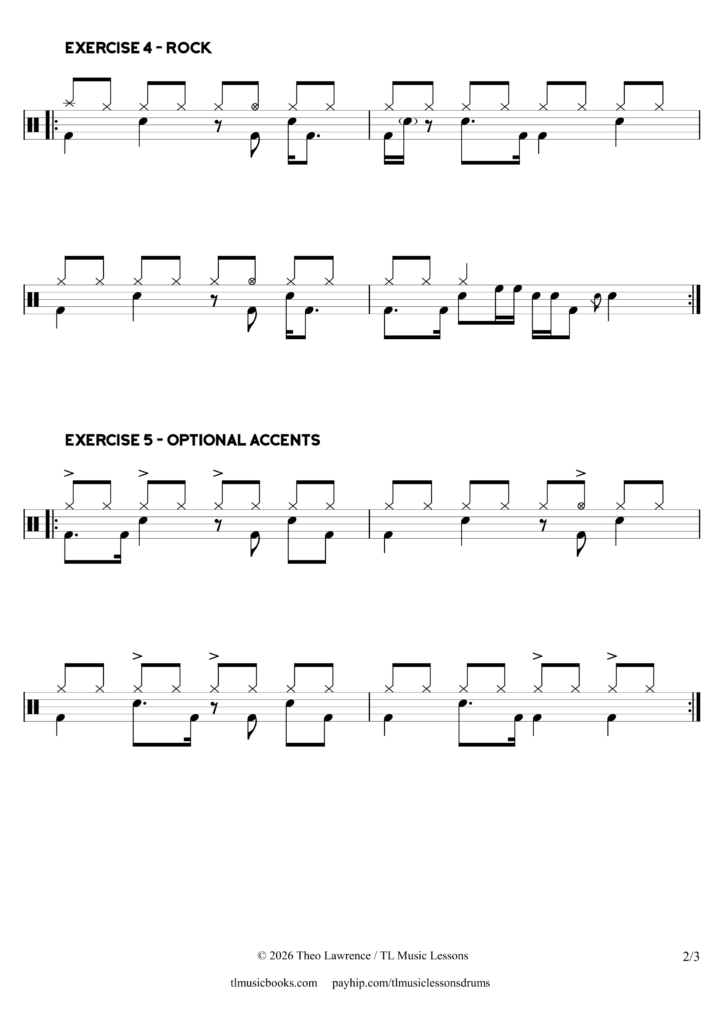
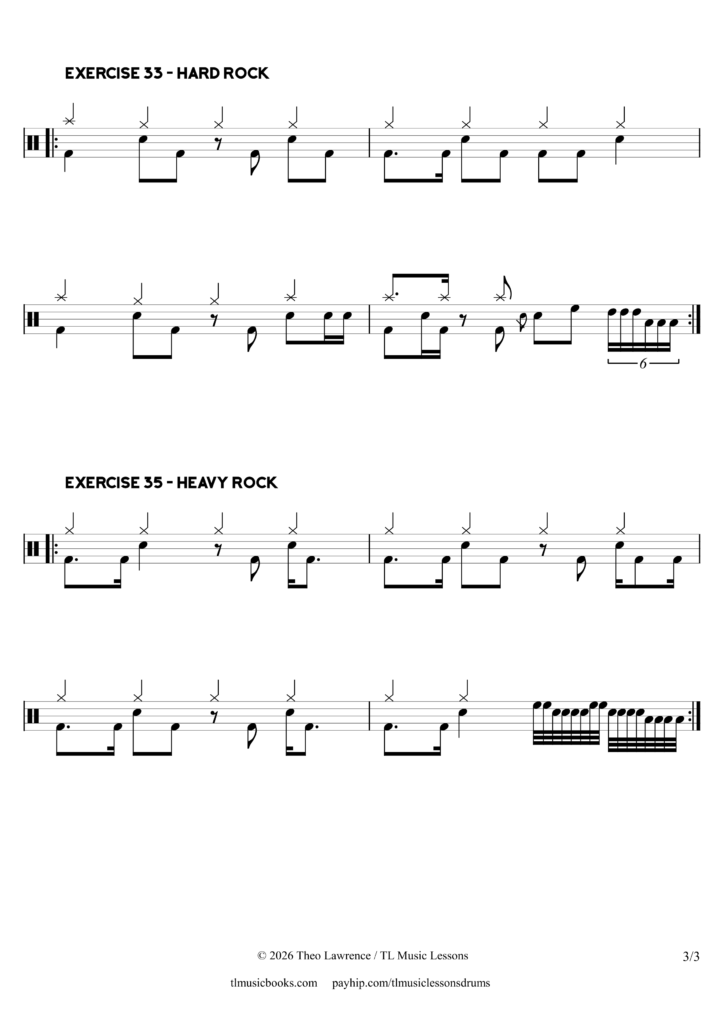
These 6 Rock Exercises are selected from the pdf ebook ‘40 Beats and fills Exercises – Book 3‘.

I have selected these 6 exercises because they give a good insight to the book as well as being a really useful resource on it’s own. Perhaps a drum teacher would print this off for their pupils to work on, or a drummer might want to focus on rock drumming and use this on it’s own for several sessions.

The difficulty levels range from about grade 3 to grade 6, which I would say is advanced beginner to intermediate.

Below is a copy of the other two pages. You can also get the PDF file from here: https://payhip.com/b/JESGw

Sheet 3 – Beginners Drum Warm Up Exercises

Free PDF Download

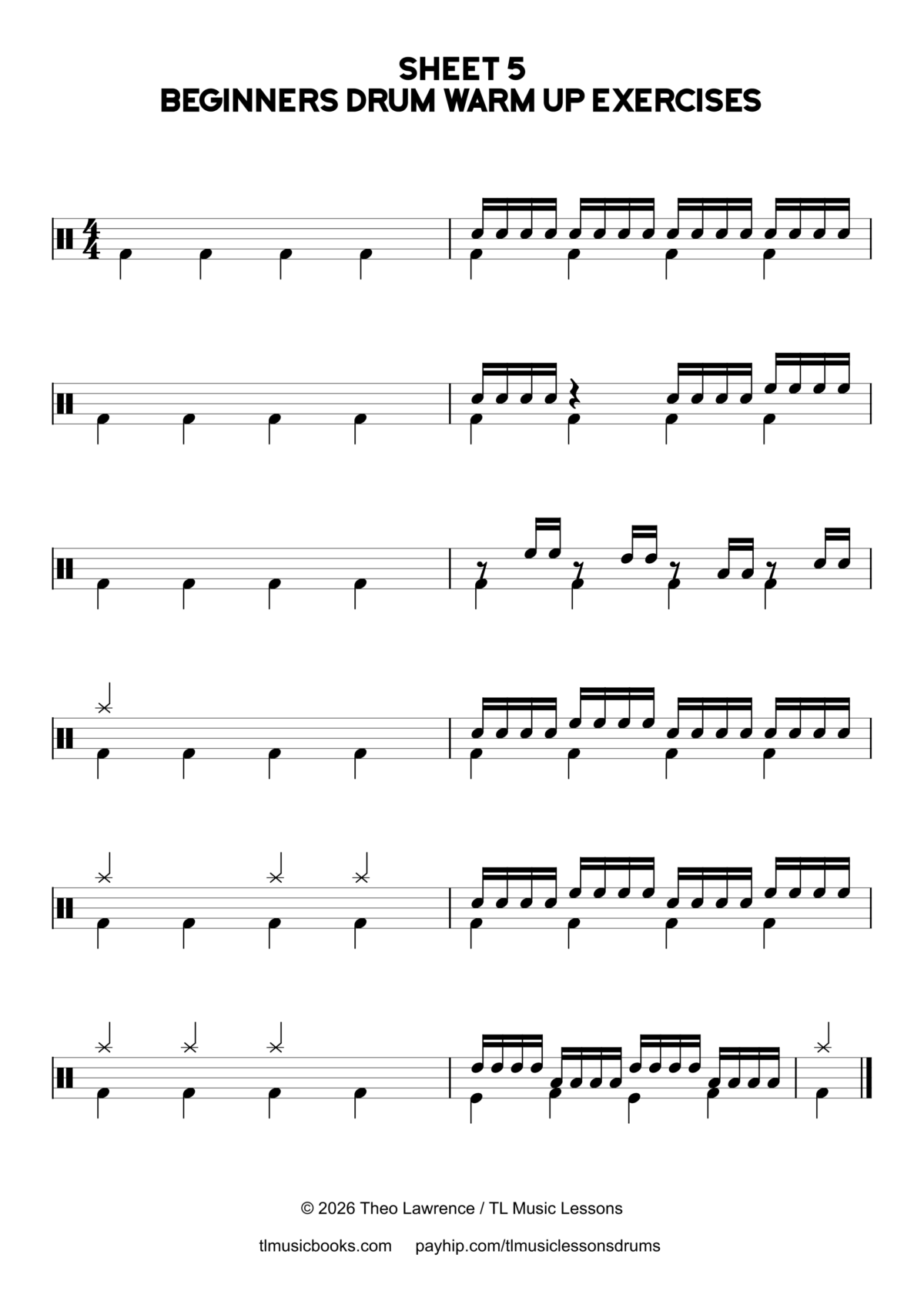
Beginners Drum Warm Up Exercises

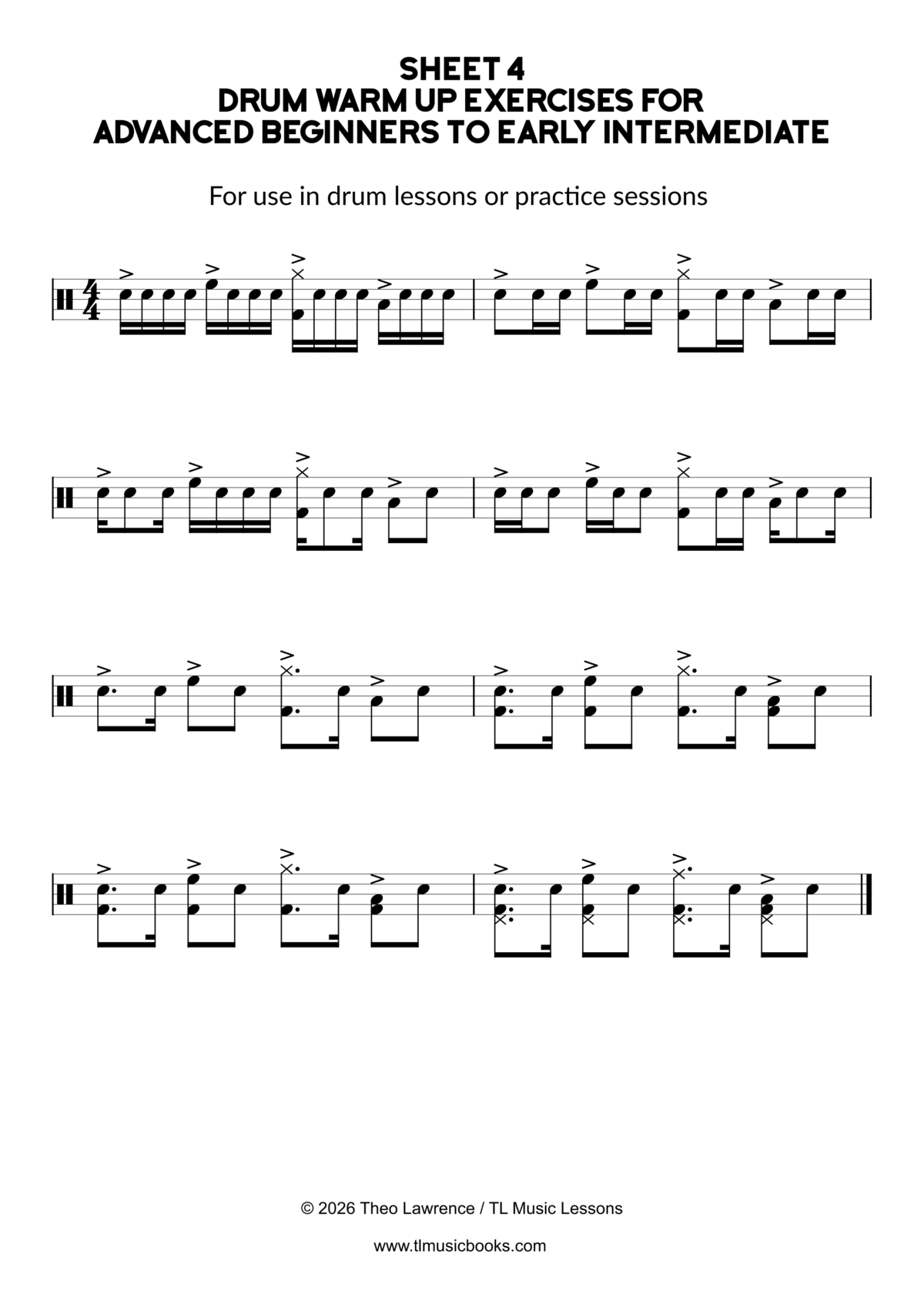
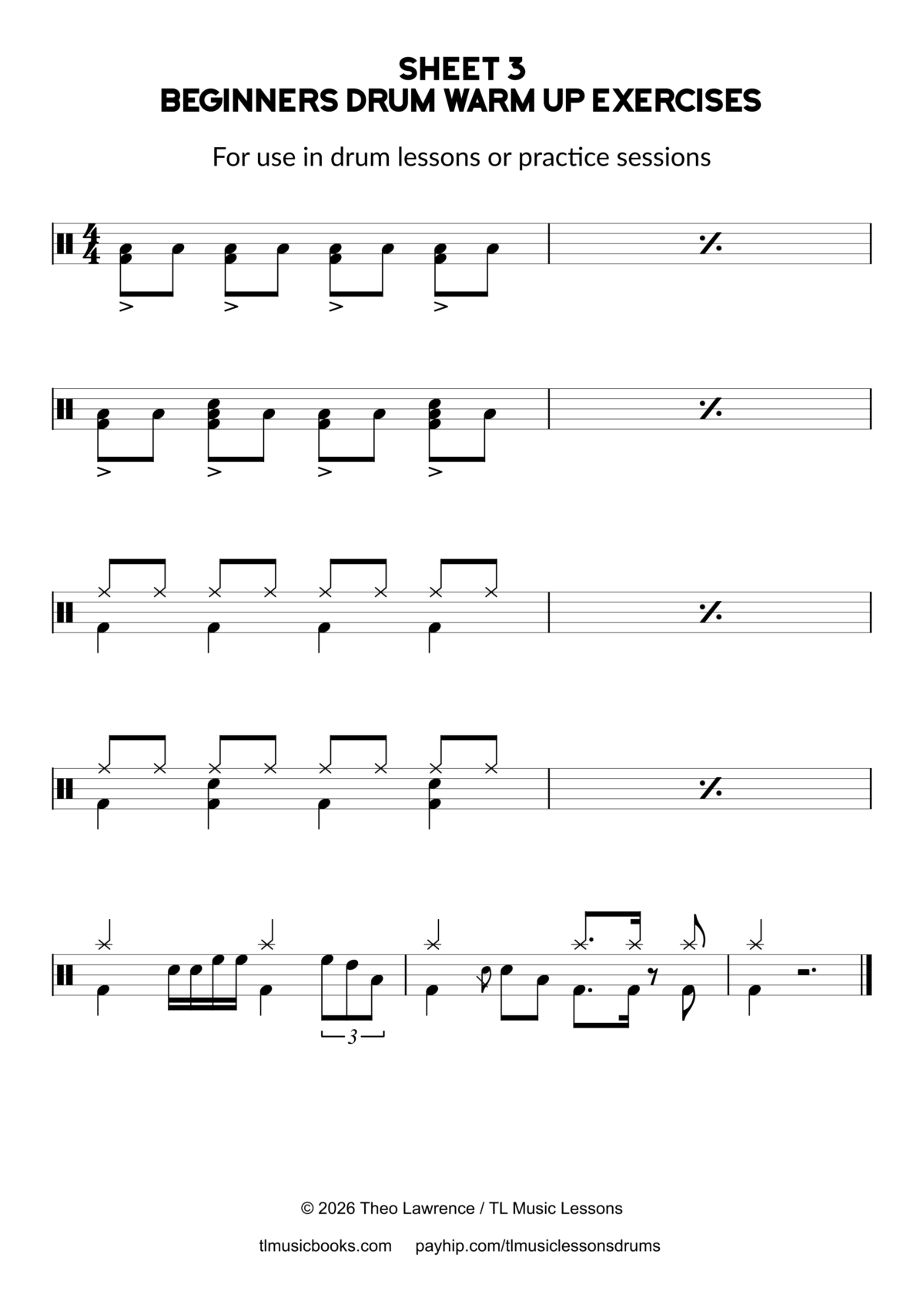
The difficulty on this sheet goes slightly higher with adding 8th notes to the drum beats and the drum fills are a little more advanced too, especially the rhythm of the crash and bass drum hits at the end. A drum teacher can help with this. Once you hear the rhythm it shouldn’t be too hard. You can hear the same rhythm of the ending crash cymbals (in the penultimate bar of this sheet) at the start of a famous song called We Found Love by Rhianna. Whenever I see this rhythm in any music, I always think of this song! I’m sure the rhythm has stronger roots elsewhere, perhaps in Latin American carnival type music, but that’s just what sticks in my mind.

To further disect the final line of fills, you also will need to play a triplet at the end of the first bar whilst counting ‘4 trip let’ and on the second bar there is a flam on beat 2 followed by a floor tom on beat 2 +.

Going back to the start, it’s also important to observe the driving accents on the beat, which should be played on the floor tom, and not really the bass drum. This also goes for the second line. Lines 3 and 4 could also be played with these driving accents on the ride cymbal if you would like to.

← Sheet 2

Sheet 2 – Drum Warm Up Exercises for Beginners

Free PDF Download

Download the PDF for ‘Sheet 2 – Drum Warm Up Exercises for Beginners’.

This beginners drum warm-up exercise includes easy drum beats with quarter note ride cymbals. The quarter note ride cymbal drum beats start off sparsely, like they are not complete drum beats, and then build into more of a basic beat with a kick-snare-kick-snare rhythm. The drum warm up then finishes with a fully formed drum fill, which tries to stay easy at the same time as being mildly challenging and musically interesting.

← Sheet 1

Sheet 3 →

Drum Warm Up Exercises for Advanced Beginners – Sheet 1

Advanced beginners drum warm up exercises for use in drum lessons, or for starting a practice or learning sessions.

Advanced beginners drum warm up exercises for use in drum lessons, or for starting a practice or learning sessions.

This is the first sheet in a collection of drum warm up exercises that will be made into a pdf ebook. You can use and print the main image on this website for educational use, or you also have the option of purchasing a PDF copy of Drum Warm Up Exercises for Advanced Beginners – Sheet 1.

In the sheet there is a snare drum rhythm exercise that has be made to sound good when repeated. Drummers should aim to increase the speed once comfortable with the rhythms. Likewise for the other exercises too. Start off slow and build up confidence and ability before going fast.

The flams exercise should be played by playing R L R L on all 8th notes, which is why one of the flams is played with the left hand playing the louder part of the flam, because it’s on one of the off-beat 8th notes. The second bar could be played R L R L or the 8th notes could be changed into paradiddles, meaning the second flam would be played with the left hand on the stronger note. Left handers will need to do the opposite to all of this.

The swing beat could easily be made harder but this could be the first time some drummers have been introduced to it so I’ve kept it fairly simple. The 8th notes are to be played with swing on the ride cymbals. If you don’ know what that means, have a listen to The Pink Panther theme tune and listen to the ride cymbals.

View Sheet 2 →

2 Longer Rock Exercises with Beats and Fills – Sheet 7 – Inside The Book: 40 Beats and Fills Book 2

PDF Ebook Buy Now →

Next Page: Sheet 8 →

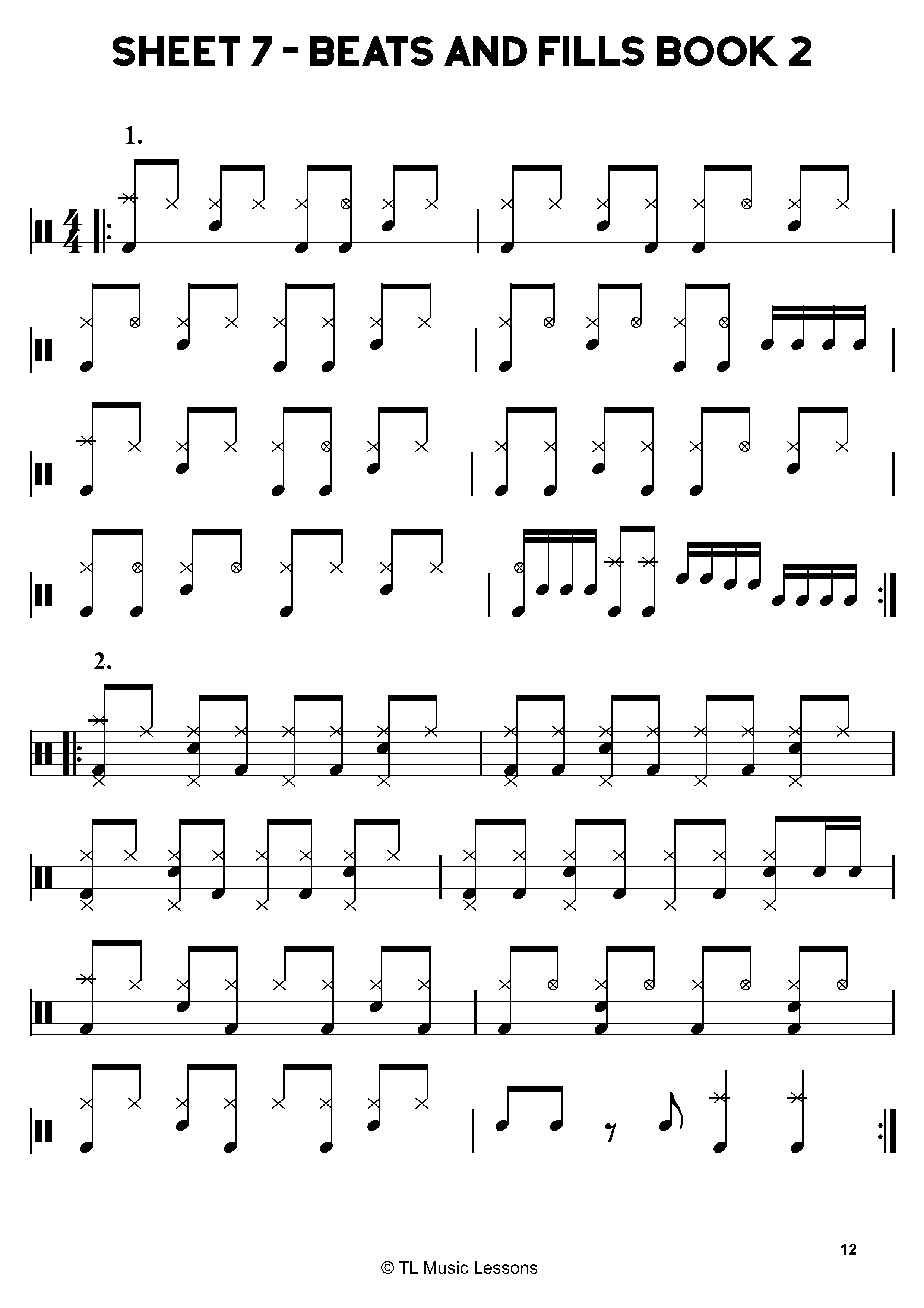
Here is Exercise Sheet 7 from 40 Beats and Fills Exercises Book 2.

This sheet only has 2 exercises because we have doubled the length to 8 bars. The structure is 7 bars of drum beats, with a 1 bar fill on bar 8, and then repeat. We are also adding in a short drum fill at the end of bar 4. Short drum fills in music help to break up repetative beats and sections and add a bit of interest to the music.

Exercise 1 is all on the hi hat and has plenty of open hi hats here and there to watch out for. Exercise 2 starts on the ride cymbal with stepped hi hats on all 4 beats of the bar, and then switches to the hi hats on bars 5-7 for some practice of switching your lead hand between the hi hat and ride.

Video Demonstration for Sheet 7

Watch on YouTube

← Go back to Sheet 6
Go forward to Sheet 8 →
Buy the full PDF ebook →

4 Blues Drum Beats and Fills Exercises – Sheet 6 – 40 Beats and Fills Book 2

PDF Ebook Buy Now →

Next Page: Sheet 7 →

Here is Exercise Sheet 6 from 40 Beats and Fills Exercises Book 2.

All of the 4 beats and fills exercises are in 6/8 time signature and the emphasis is naturally on beat 1 and 4. In the drum beats, the first beat of the bar usually has a bass drum and beat 4 of the bar usually has a strong snare drum. 6/8 means that there are 6 8th notes per bar.

This is how the emphasis on 1 and 4 looks like if you see them in bold:

1 2 3 4 5 6

On exercise 4, you can see dotted quarter notes (dotted crotchets) in the drum fill on bar 4. The dotted quarter notes each last for one and a half beats, which is the equivalent of half a bar each in this 6/8 time signature. If you think about trying to count these without prior knowledge of playing in 6/8 time, it can throw you off a bit, but if you think about the pulse of the bar (2 pulses per bar, on beats 1 and 4) then they really only feel like they are 1 beat each, along with the pulse.

Video Demonstration for Sheet 6


Watch on YouTube

← Go back to Sheet 5
Go forward to Sheet 7 →
Buy the full PDF ebook →

Musical Theatre Drum Beats and fills – Sheet 5 – 40 Beats and Fills Book 2

PDF Ebook Buy Now →

Next Page: Sheet 6 →

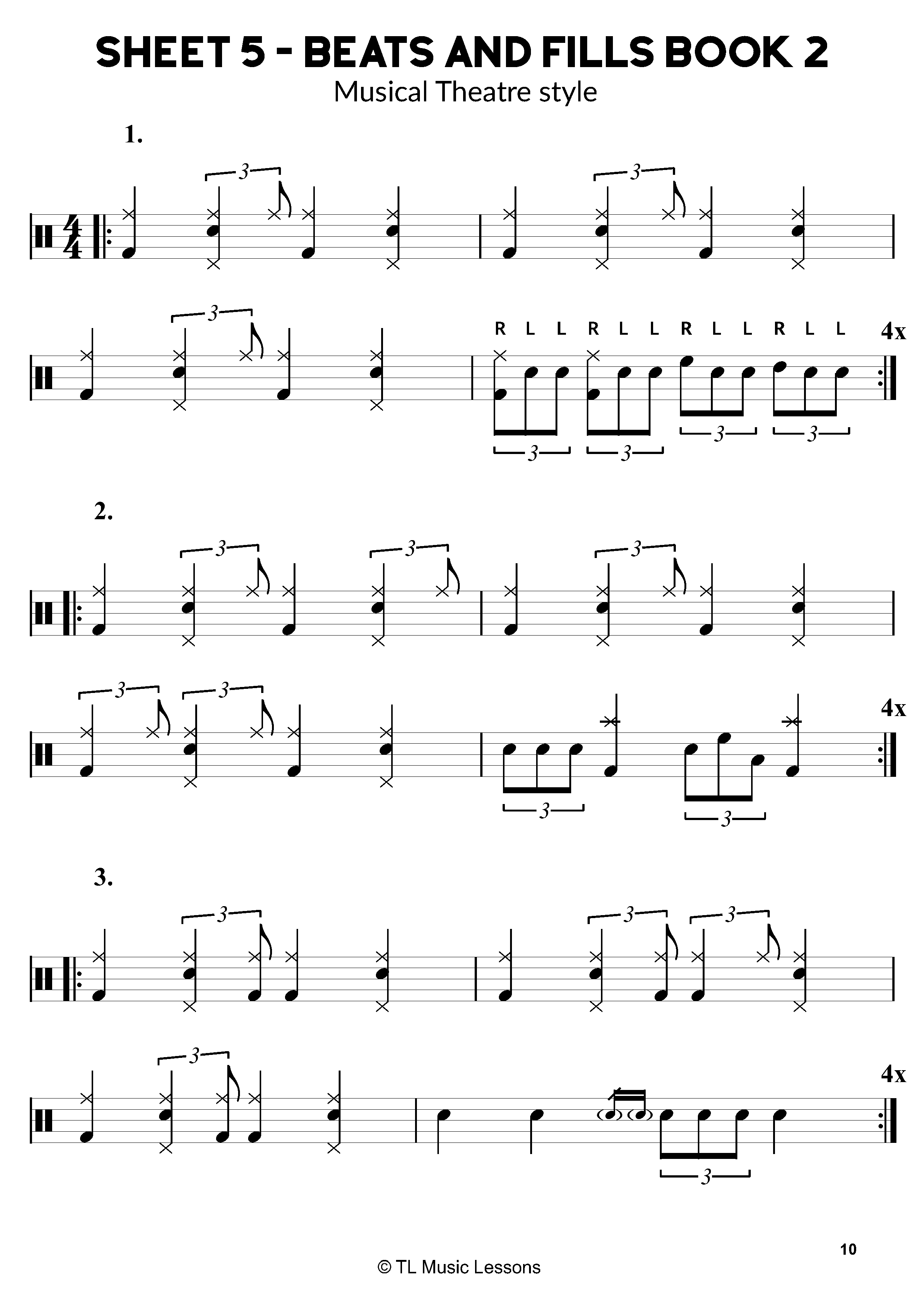
Here is Exercise Sheet 5 from 40 Beats and Fills Exercises Book 2.

Musical Theatre drumming generally has elements of swing, jazz, big band, blues, pop and rock. Unlike jazz music – which also has the swung hi hats – there is often a prominant snare on beats 2 and 4. Sometimes the time signature changes to 3/4, 2/4 and 6/8. Much of theatre style drumming is played with swing and therefore we use many fills with triplets, because they fit in with the swing rhythm easily.

The drum beats on Exercise 3 are similar to those grand finale type songs where they are a slow to medium speed. For this, perhaps you can imagine the cliché stage show of linked arms and kicking out of the legs together in time with the music (the snare on beats 2 and 4).

Video Demonstration for Sheet 5


Watch on YouTube

In Depth Drag Technique Video Demonstration

We also look in depth on the drag technique in the video during the Exercise 3 drum fill. The video shows the correct technique for performing the bounced drag, including how to hold the stick and how to control the bounces by using varying amounts of pressure to acheive the desired bounce frequency and length.

You can download the pdf for this page by buying the book or downloading the free preview on the product page.

There are more free pages like this one, use the the navigation below to view them.

← Go back to Sheet 4
Go forward to Sheet 6 →
Buy the full PDF ebook →

Drum beats and drum fills in different time signatures – Sheet 4 – 40 Beats and Fills Book 2

PDF Ebook Buy Now →

Next Page: Sheet 5 →

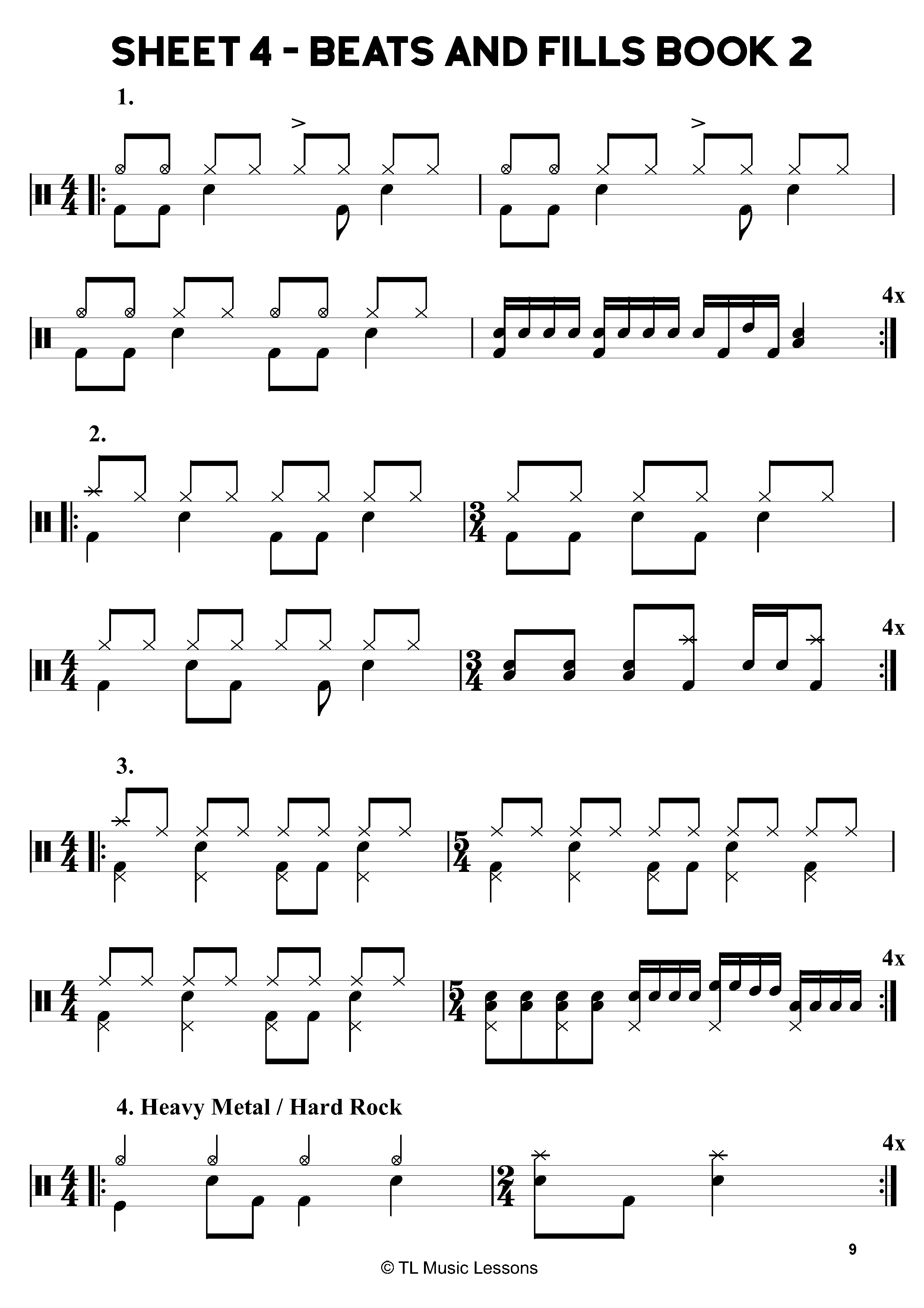
Here is Exercise Sheet 4 from 40 Beats and Fills Exercises Book 2.

The drum beats and drum fills are played in different time signatures (3/4, 5/4 and 2/4), as well as changing to and from the usual 4/4 bar length.

Time Signature Changes: “Do not panic – they’re quite easy”, as I say in the video!

The time signatures are not too hard And sometimes you don’t even need to worry about counting them. There are situations where you might need to count them and they might be harder depending on what is contained in the bars, but thes have been written for newcomers to time signatures in mind, so there are no real suprises – it’s meant to be a straightforward introduction.

On exercise 3, I have taken away the stepped hi hat so it’s 3 way coordination. The stepped hi hat is included on exercise 3 with the 5/4 bar, so there’s an added challenge there.

Video Demonstration

You can download the pdf for this page by buying the book or downloading the free preview on the product page.

There are more free pages like this one, use the the navigation below to view them.

← Go back to Sheet 3
Go forward to Sheet 5 →
Buy the full PDF ebook →

Drum Beats and Drum Fills in 6/8 time signature – Sheet 3 Inside the book

PDF Ebook Buy Now →

Next Page: Sheet 4 →

Here is Exercise Sheet 3 from 40 Beats and Fills Exercises Book 2.

The drum beats and drum fills are all in a 6/8 time signature. We will be putting emphasis on the beats 1 and 4 of the bar, which is standard for 6/8 drum beats. The counting should be 1 2 3 4 5 6 for 8th notes, and for 16th notes, you could count 1 + 2 + 3 + 4 + 5 + 6 +. This is unlike 4/4, where the 1 2 3 4 is counting the quarter notes, rather than the 8th notes.

We are playing in a blues style in this sheet, although you could also hear these beats in other styles such as Pop, Jazz and Musical Theatre.

Video Demonstration

As you can see in the video, some of the exercises are quite fun when played quickly. Do start slowly and correctly though, because those fills could sound messy if they are not played with accuracy.

You can download the pdf for this page by buying the book or downloading the free preview on the product page.

There are more free pages like this one, use the the navigation below to view them.

← Go back to Sheet 2
Go forward to Sheet 4 →
Buy the full PDF ebook →

Sheet 2 – Inside the book: 40 Beats and Fills Exercises Book 2

PDF Ebook Buy Now →

Next Page: Sheet 3 →

Here is page 7 inside the book (40 Beats and Fills Exercises Book 2). This sheet includes 4 drum beat and drum fill exercises with stepped hi hats on all 4 beats of the bar. The right hand is playing the ride cymbal and the left foot is playing the stepped hi hat (reverse if left handed).

Video Demonstration

As I say in the video, remember to always read a little bit ahead or glance to see what’s coming up when you are playing so you don’t get caught out by the drum fills. Reading and playing music is similar to driving a car. You need to drive the bit of the road that you are on (i.e. the current bar), but you also need to look ahead to see if there are any hazards (e.g. accents, drags, ghost notes, drum fills, complicated drum beats), drastic changes in the road such as a sharp corner (e.g. section changes), signs for a complicated junction (e.g. 1st and second time repeats), or for road diversions (e.g. D.S. al Coda).

You can download the pdf for this page by buying the book or downloading the free preview on the product page.

There are more free pages like this one, use the the navigation below to view them.

← Go back to Sheet 1
Go forward to Sheet 3 →
Buy the full PDF ebook →