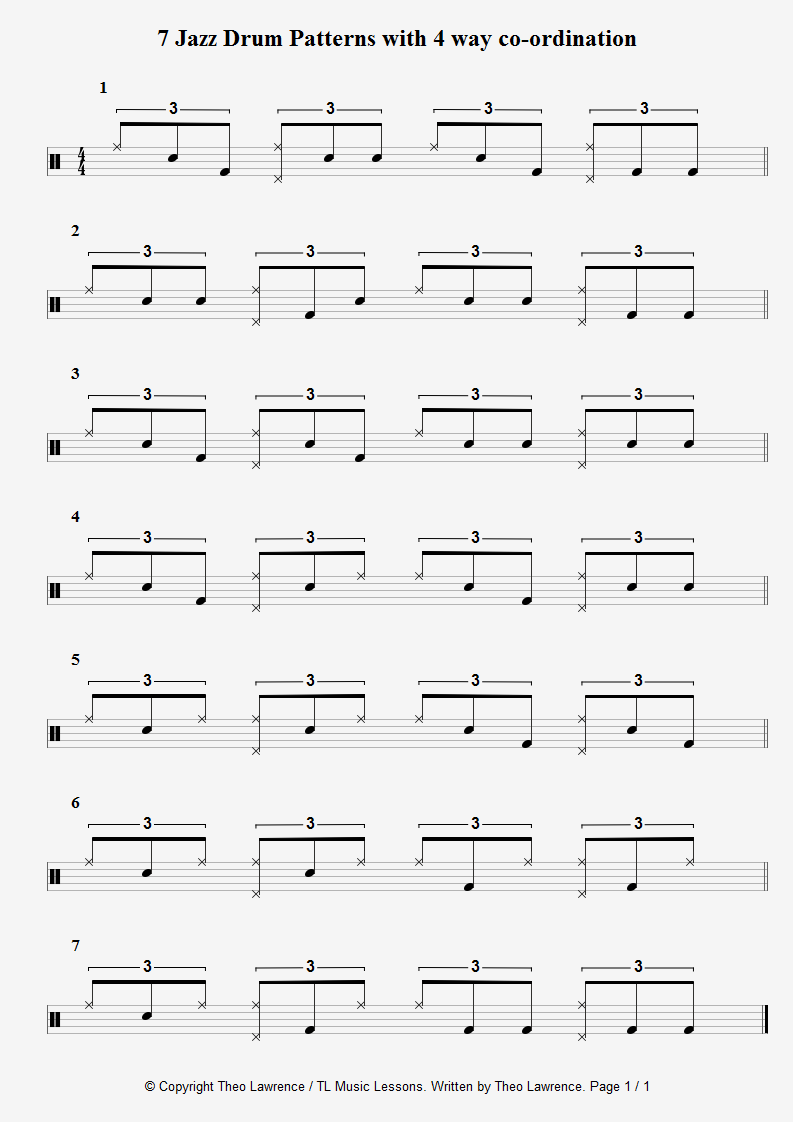
7 Jazz Drum Patterns with 3 and 4 way co-ordination sheets

These jazz drum patterns are for at least grade 3 level. The 3 way co-ordination exercises could also be tried slowly by Grade 1-2.

Drummers that are new to jazz could start with these even if they are a pro in other genres. These patterns will be hard if you are new to less regimented styles like Jazz and Latin drumming (i.e. you are more used to pop/rock).

That is the background I come from with drums – pop, rock, funk, metal. Then I was introduced to Jazz. After my Rockschool Grades (we skipped Jazz in my lessons), after my early teenage years of practicing and learning and exploring new and old music. At drum college I was introduced to Jazz when I was 16 or 17. Since this I have always had a place in my heart for Jazz. It is probably where I really started to get an understanding for melody and how it related with my primary passion of drums. The drums in Jazz compliment the melody a lot! The thing I was always taught with Jazz was to either ‘learn the melody’, or to ‘play off the improvised melody’. Over 10 years later and my interests have been drawn even more to creating melodies on other instruments, and I learn more and more how the instruments compliment each other.

So, onto the drum patterns. The patterns are all triplet based and all have a ride cymbal on the 1 2 3 4 beats. The rest of the triplet beats are played by different bass drum and snare drum combinations. These type of movements are fundamental to Jazz drumming. The left foot hi hat is also fundamental. I have also included a 4 way co-ordination sheet for when the 3 way co-ordination patterns begin to get easy. The patterns are all linear apart from the left foot and and right hand on beats 2 and 4 on the 4 way co-ordination patterns, which means that there is only one drum voice playing at once. This helps to get used to playing in triplets, and for focusing on the snare and bass drum patterns. In more advanced Jazz, these types of snare and bass drum patterns will poly rhythm with different right hand ostinati, making things a lot harder.


Sheet 1: 3 way coordination

Sheet 2: 4 way coordination


Related: 8 Starter Jazz Drum Beats with 3 way co-ordination

Cool music video with a large studio full of drummers playing the same beat on drum kits that light up – Sweet Nothing – Gabrielle Aplin

I saw Gabrielle Aplin live at The Ritz in Manchester on her debut album tour in 2013, so although I don’t watch many music videos, this was on my radar and the images of all the drummers lured me in. Gabrielle Aplin has released this music video ahead of her second album, which includes a room full of drummers playing light up drum along with the upbeat song. Drummers unite and watch this brilliant music video!

Also, here is the behind the scenes video:

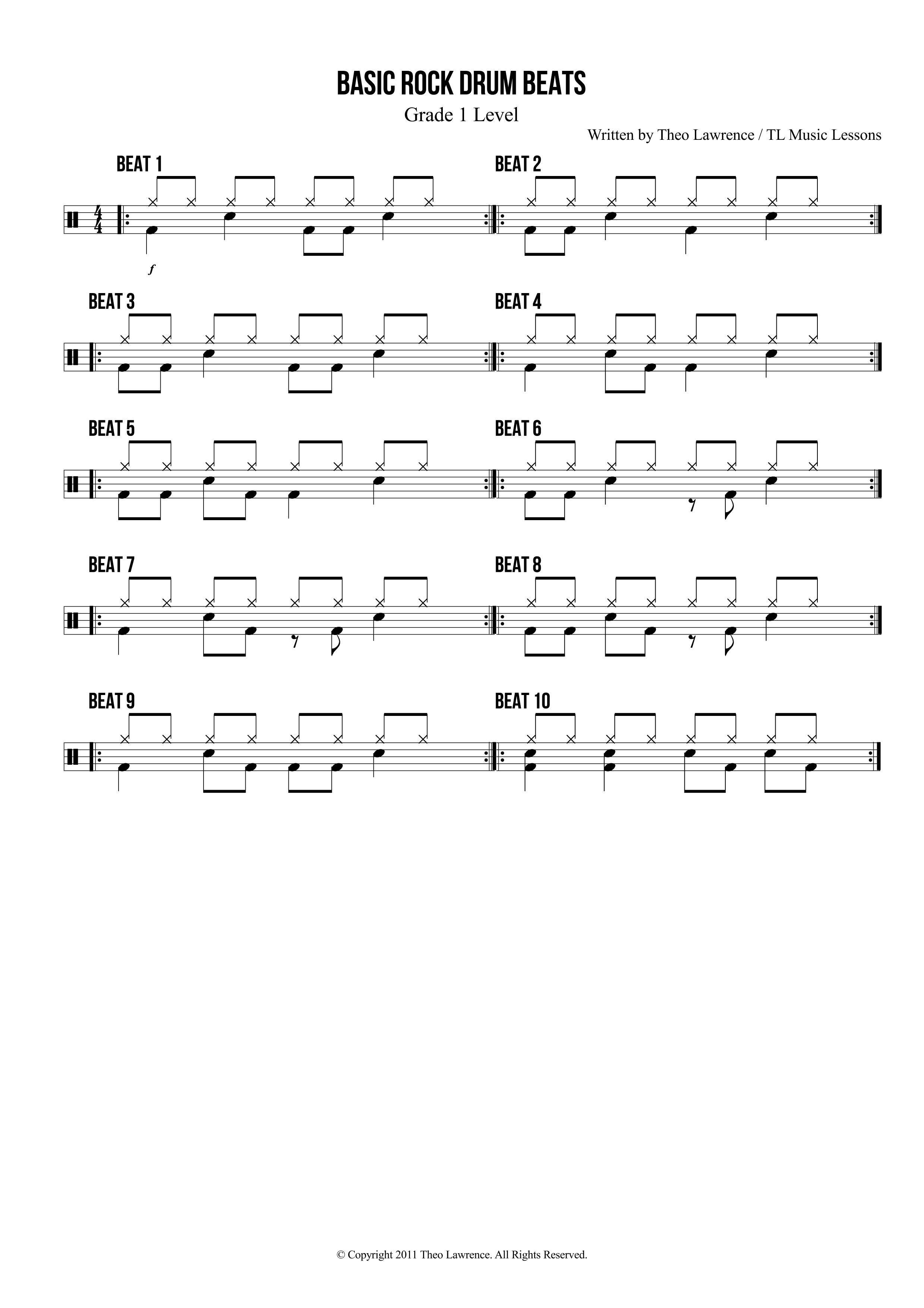
10 Basic Rock Drum Beats

Free PDF Download of Grade 1 Rock Beats (includes this sheet)

Video Lesson

In this lesson we will run through 10 popular rock drum beats. I will show you how to do variations on each beat, which will extend the contents of the sheet a lot, and give you ideas for practicing. I will also show you how they sound at slow, medium and fast speeds with a metronome. This is my first drum kit video and I am pleased to have included 2 camera angles, to show the feet. However, I was using my old phone to do this and it ran out of storage towards the end of the video, so it cuts off. Hopefully I can sort that out for future videos.

Beat 1 00:26 Beat 2 05:25 Beat 3 07:11 Quarter Note Hi Hats / Ride / Floor Tom Right Hand Pattern: 8:28 Beat 4 09:56 Beat 5 10:53 Beat 6 11:44 Metronome Tips 12:00 Beat 7 12:50 Beat 8 13:36 Hi Hat Stick Height Tips 15:01 Individual Drum Volumes / Self Mixing 15:44 Beat 9 18:30 Beat 10 20:23

About the lesson sheet

Here are 10 different rock drum beats, with notation and audio. These are for any beginners that have learned a basic drum beat, or maybe a few basic beats already and want to learn some more.

Basic rock drum beats learn drums for free

Basic drum beats should be repeated for ages to be most effective in truely learning the beats. It isn’t as useful to just read and play them. The most fun way to practice these is to jam them woth another instrument or a backing track. If you are a teacher that can play bass, guitar or piano, try this with your students if you haven’t already. Pupils can tire of repeating a drum beat on it’s own for several minutes (which is needed) but when playing along with another instrument it is fun and enjoyable to play for a while without stopping. Variation on the accompanying instrument can really add to the experience. Students can also do this on their own by putting on a song and just practicing one drum beat along with it, or finding another musician to jam grooves and drum beats with.

Drum Books with Basic Rock Beats

First Drum Book – Easy Reading Beats & Fills
Beats and Fills Drum Book – Basic Beginners
40 Beats and Fills Exercises – Ebook.

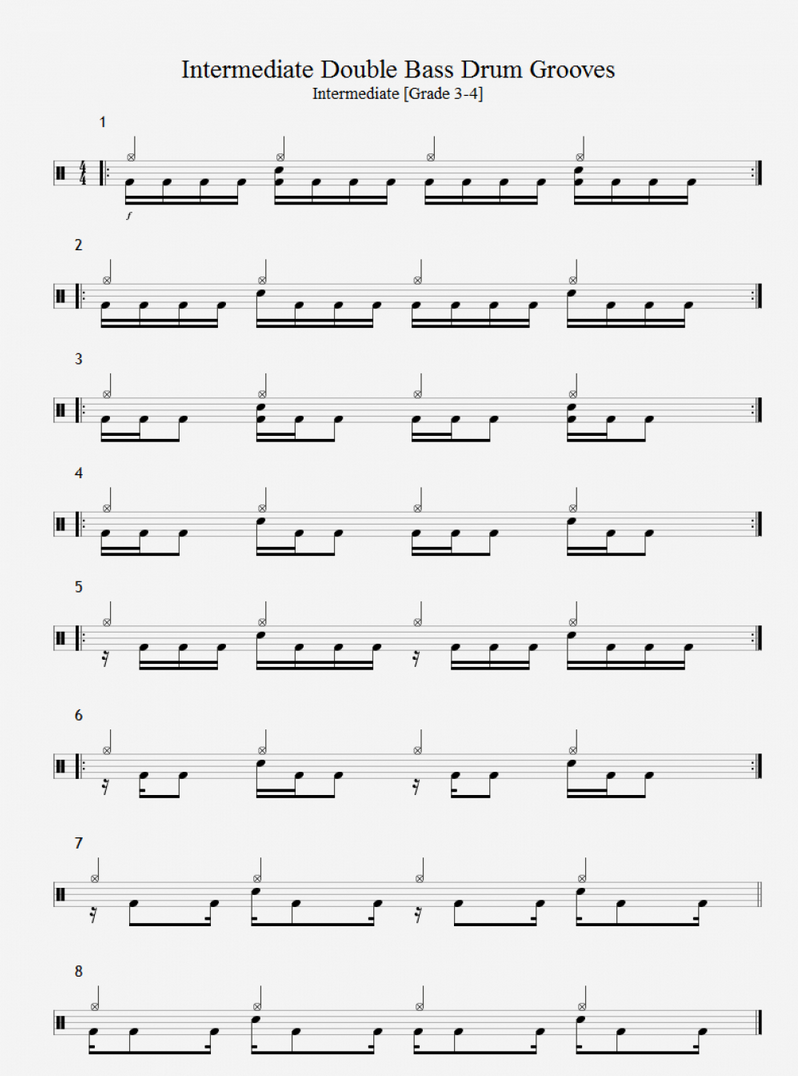
8 Intermediate Metal Double Bass Drum Beats

These double bass drum grooves can be played by advanced beginners, intermediate players, and above. Double kick beginners should try this very slowly to start with.

These grooves can be played in professional songs, they are mostly generic metal grooves and widely used by metal drummers.

These 8 metal drum grooves are all played with a quarter note hi hat ostinato, which is notated to be played with open hi hats. These should be played slightly open rather than fully open, to achieve that slushy hi hat sound heard in the majority of hard rock and metal songs. Many metal drummers keep the hi hats permanently in this position by setting up the height of the top hi hat cymbal to be only just a slither higher than the bottom one. This enables the drummer to have both feet free to bring the thunder on the bass drum pedals, whilst still being able to play a mixture of open and closed hi hats when needed.


  1. FOOT PATTERN: R L R L [x4


  2. FOOT PATTERN: R L R L – L R L [x2]


  3. FOOT PATTERN: R L R – [x4]


  4. FOOT PATTERN: R L R – – L R [x2]


  5. FOOT PATTERN: – L R L [x4]


  6. FOOT PATTERN: – L R – [x4]


  7. FOOT PATTERN: – L – L [x4]


  8. FOOT PATTERN: R L – L – L – L [x2]


The drum sheet music can be used as seperate exercises (1 per line), or as a complete exercise.

6 Beginners Drum Beats in Pop, Rock, Funk, Jazz, Reggae and Blues styles

A variety of 6 different musical styles in the form of drum beats.

Objective: To develop an awereness of different styles of music and to be able to play the basic drum beats.

With this sheet, although there are no repeats, you should repeat each line multiple times and get into the rhythm and groove. Aim for evenly spaced notes at a slow speed. Repeat slowly for a while and get into the beat. Then you can try speeding it up a little bit, and then a bit more and gradually more until it’s fast. Then onto the next beat.


Related: Reading Drum Notation

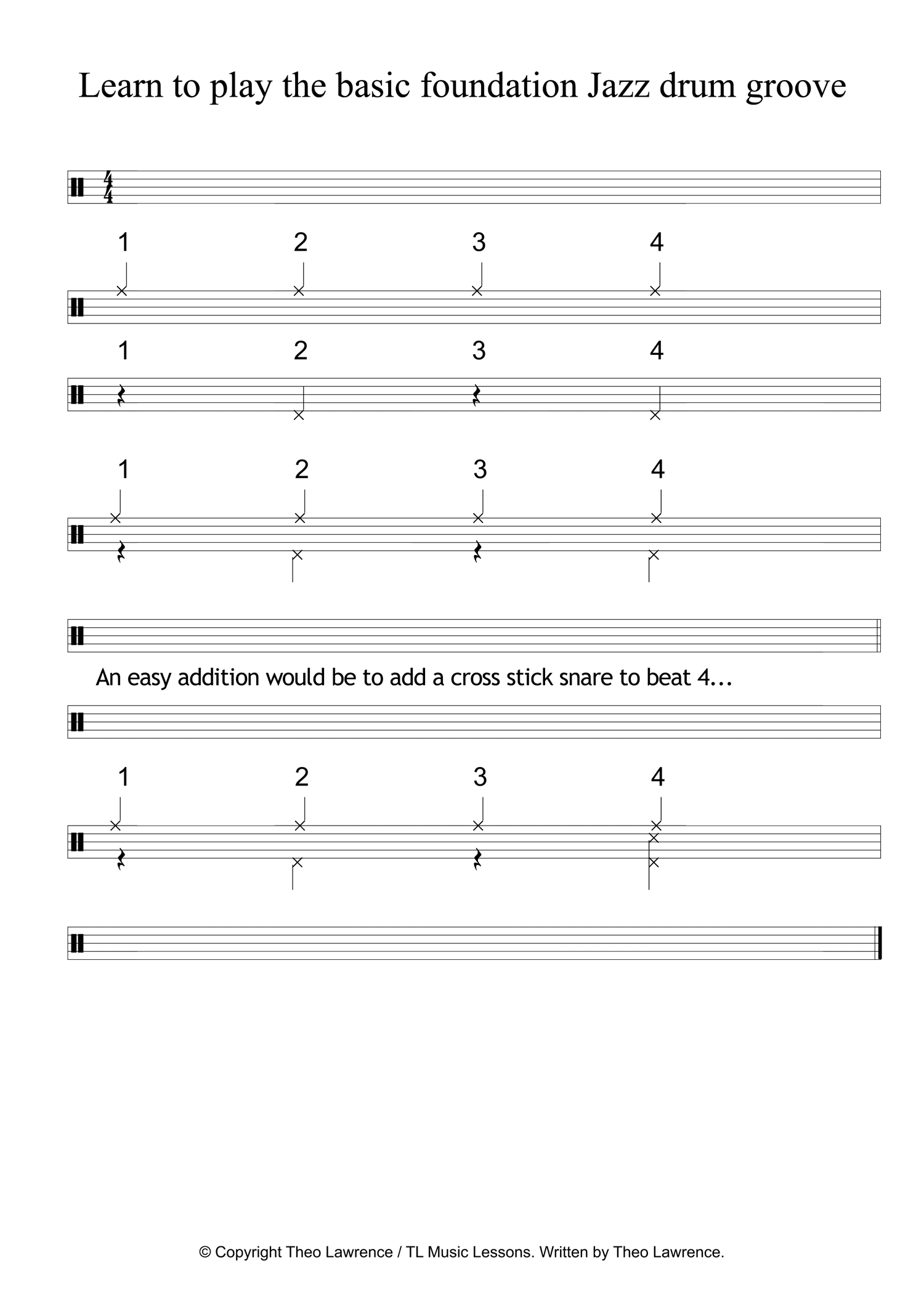
Learn to play the basic foundation Jazz drum groove

We are going to concentrate on the fundamental parts of playing Jazz drum beats.

We are only going to concentrate on the right hand, and the left foot.

Step 1 – Right hand

With your right hand, play the ride cymbal 4 times.

If this is too easy you can skip this and go to step 3. If not, repeat this for a while without stopping to get used to how long each bar lasts for, and used to counting too.

Step 2 – Use a metronome to improve timing

Now put on a metronome at a similar speed to what you have been playing, and play along for a while. Keep counting.

Step 3 – Left Foot

Now we will play the stepped Hi Hat by quickly pressing down on the hi hat pedal with the left foot, so that it sounds similar to when you play a closed hi hat with your sticks.

We need to only play on beat 2 and 4. So count 1 2 3 4, but don’t play anything on 1 or 3.

Repeat this for a while without stopping

Step 4 – Use a metronome to improve timing

Now put on a metronome at a similar speed to what you have been playing, and play along for a while. Keep counting.

The role of the Stepped Hi Hat in Jazz

In Jazz we will make use of all 4 limbs by using the left foot to play the hi hat.

The main function of the left foot will be to keep a steady regular beat on 2 and 4.

Even when things get crazy with 4 way co-ordination, comping and improvising with triplets and other syncopated rhythms, the left foot usually holds it all together with the 2 and 4 rhythm. This is both for the band to stay in time, and perhaps also for the listener to help make sense of whats going on by putting all the syncopation into context.

Step 5 – right hand and left foot – Bringing together the Ride and Stepped Hi Hat

So we are going to do Step 1 and Step 3 at the same time, to form the groove we are trying to acheive in this step by step lesson.

  • On beat 1, play the Ride.
  • On beat 2, play the Ride and Stepped Hi Hat with your left foot.
  • On beat 3, play the Ride.
  • On beat 4, play the Ride and Stepped Hi Hat with your left foot.
  • And then repeat this for a while without stopping…

Step 6 – Use a metronome to improve timing

Now put on a metronome at a similar speed to what you have been playing, and play along for a while. Keep counting.

Overview

When you feel confident in doing this at various speeds with and without a metronome, you are then ready to start building on this foundation Jazz groove by adding in snare and bass patterns.

Developing rock grooves with quarter note hi hats – Grade 2-3

I wrote this sheet initially to give students an idea of the type of things they could do to start off developing the drum beat for the guitar solo in a Grade 3 Rockschool song called Overrated (2012-18 syllabus). This sheet is also good for learning to develop the bass drum around a standard quarter note hi hat rock ostinato.

Start off by learning each bar separately before attempting a full run through. The hands will be playing the same beat in every bar apart from a crash half way through, and a drum fill in the last bar.

Every hi hat is to be played fairly open – enough to get that nice sizzley or slushy sound on the hi hats. You could play them more closed but with a slightly open feel, so they sound more crunchy – this would give a more hard rock sound.

These drum grooves would work well with classic rock and modern rock styles, and would fit with other styles in some situations, like for a slow metal groove or breakdown section, or played in a lively way in soul music, or in pop music (closed hi hats would also work well for pop).

8 rock or funk drum beats with 16th Note Accents for grade 5 and up

These 8 drum beats will test your ability to add accented notes to the two handed hi hat pattern, whilst also negotiating tricky bass drum rhythms and open hi hat combinations.

Start off slowly and build it up when you are comfortable with the grooves at low speed. Improve your timing and measure your progress with a metronome. You should start as low as 40 or 50 bpm, but probably easier without a click, or double it up to an 8th note click, because the slow click will be tricky to play to.

Samba Funk Drum Grooves – Grade 8

This drum grooves sheet is good for learning to improvise in a samba funk style. It was initially written for a drum lesson as a rough guide to the kind of things that could be improvised with during a Grade 8 Rockschool song from the 2006-2012 syllabus (Sampa Samba), but this sort of thing can also be played in other songs of a similar style, or it could just be used as a general practice exercise for a drummer who is at Grade 8 or above.

Playing Tip: The fast 32nd note hi hat notes are played using the double stroke technique.

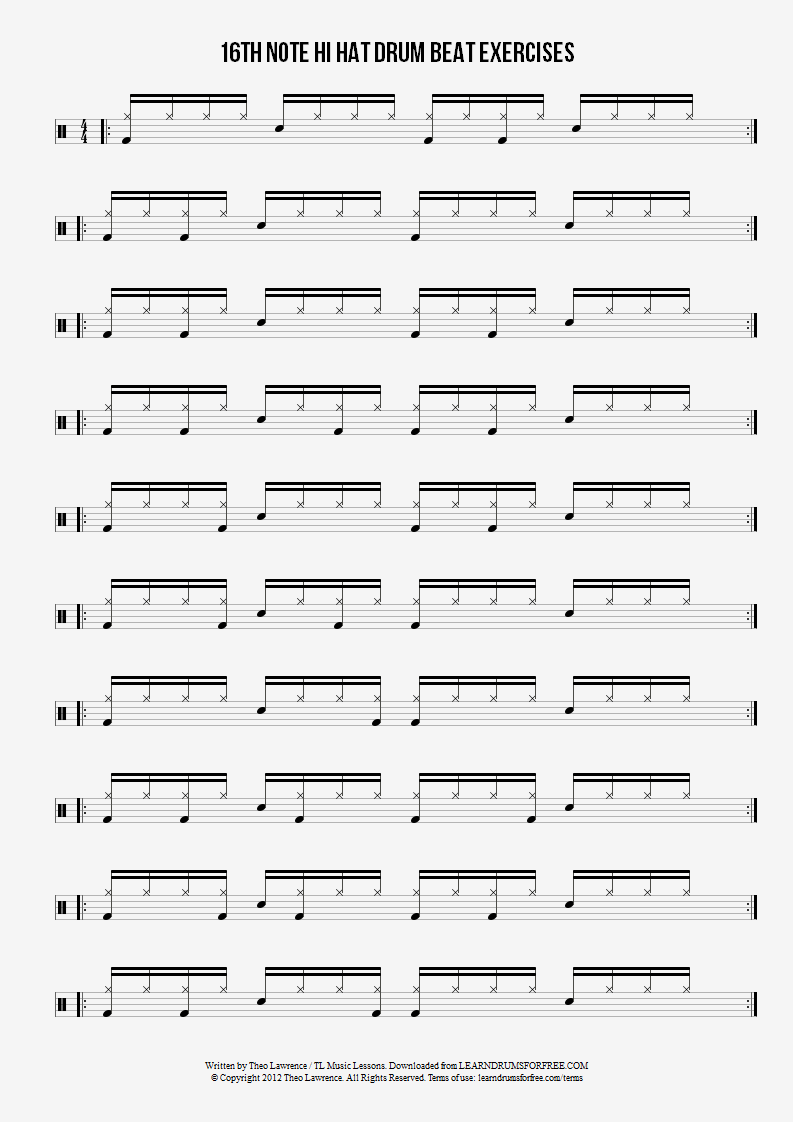
16th note hi hat drum beat exercises

Right handers should play ‘Right Left Right Left’ in a continuous pattern with the hands. Bring your left arm over to the left so both hands can play on the hi hat comfortably and without crossing the arms. The right hand would play the snare drum.

Left handers: lead with your left hand and the snare will be played with the left hand also.