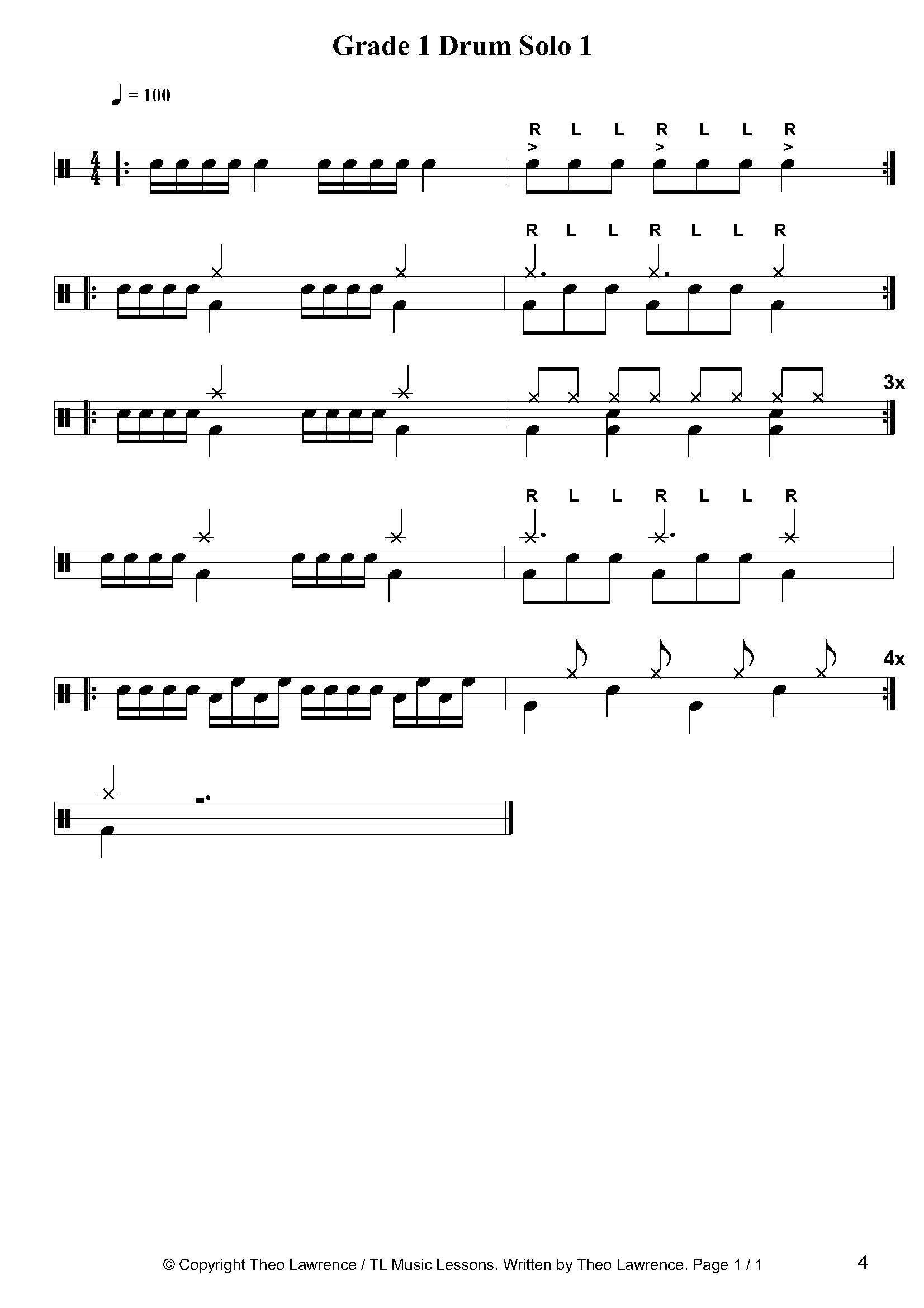
Drum Solo 1 – Performance Piece

This sheet is the first drum solo in my drum solos ebook 10 Drum Solo Performance Pieces Grade 1-3.

The sheet music is fairly easy to play for Grade 1-2 drummers. Make sure to follow the stickings (reverse if you are left handed), note the repeats and make sure to work out correctly which drums to hit on the last line.

Here is an audio example of the drum solo:

Snare drum sheet music based around single stroke fours and sextuplets

This snare drum sheet is ideal for practicing the single stroke four drum rudiment and also for playing sextuplet rhythms within a piece.

The piece could be played by a group of snare drums or other drums if the players are at an intermediate level of above (at least grade 3).

There are 5 sections labeled A-E, and A is recalled at the end for a repeat. Each section should be practiced seperately and mastered before playing through the whole snare drum piece in one go.

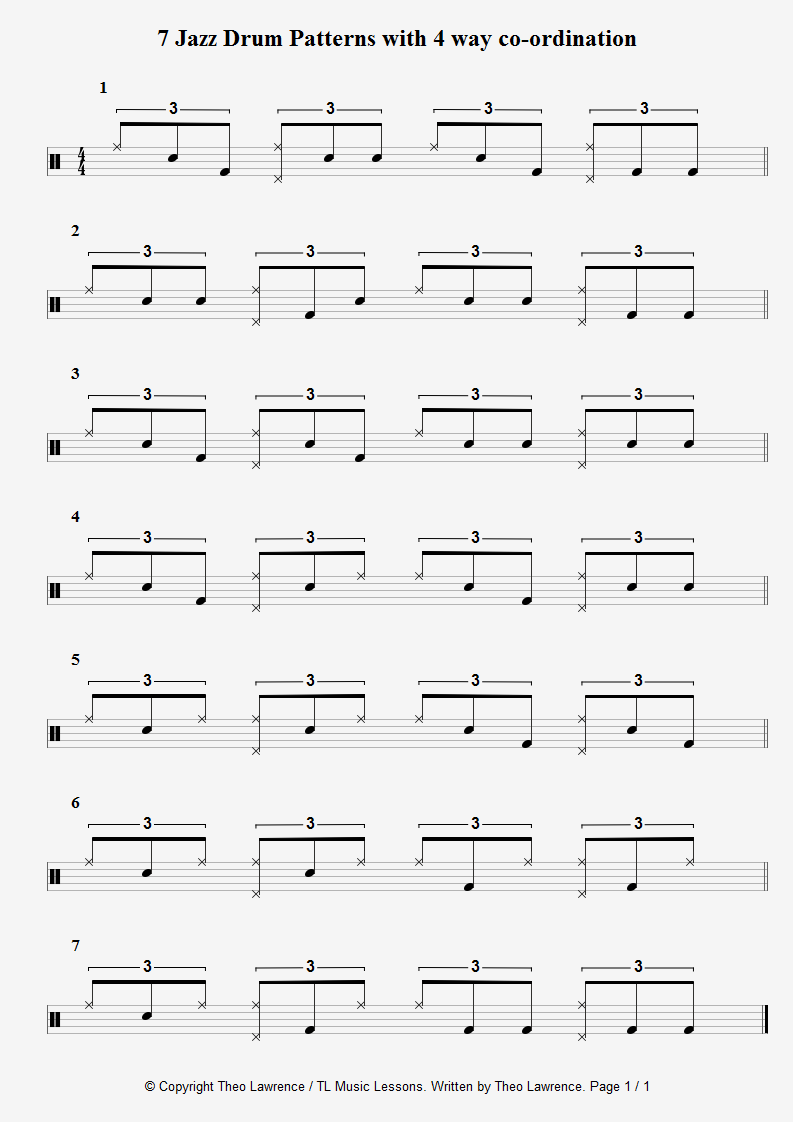
7 Jazz Drum Patterns with 3 and 4 way co-ordination sheets

These jazz drum patterns are for at least grade 3 level. The 3 way co-ordination exercises could also be tried slowly by Grade 1-2.

Drummers that are new to jazz could start with these even if they are a pro in other genres. These patterns will be hard if you are new to less regimented styles like Jazz and Latin drumming (i.e. you are more used to pop/rock).

That is the background I come from with drums – pop, rock, funk, metal. Then I was introduced to Jazz. After my Rockschool Grades (we skipped Jazz in my lessons), after my early teenage years of practicing and learning and exploring new and old music. At drum college I was introduced to Jazz when I was 16 or 17. Since this I have always had a place in my heart for Jazz. It is probably where I really started to get an understanding for melody and how it related with my primary passion of drums. The drums in Jazz compliment the melody a lot! The thing I was always taught with Jazz was to either ‘learn the melody’, or to ‘play off the improvised melody’. Over 10 years later and my interests have been drawn even more to creating melodies on other instruments, and I learn more and more how the instruments compliment each other.

So, onto the drum patterns. The patterns are all triplet based and all have a ride cymbal on the 1 2 3 4 beats. The rest of the triplet beats are played by different bass drum and snare drum combinations. These type of movements are fundamental to Jazz drumming. The left foot hi hat is also fundamental. I have also included a 4 way co-ordination sheet for when the 3 way co-ordination patterns begin to get easy. The patterns are all linear apart from the left foot and and right hand on beats 2 and 4 on the 4 way co-ordination patterns, which means that there is only one drum voice playing at once. This helps to get used to playing in triplets, and for focusing on the snare and bass drum patterns. In more advanced Jazz, these types of snare and bass drum patterns will poly rhythm with different right hand ostinati, making things a lot harder.


Sheet 1: 3 way coordination

Sheet 2: 4 way coordination


Related: 8 Starter Jazz Drum Beats with 3 way co-ordination
7 Linear drum beats for beginners – and the Mieze·Katze drum beat

Linear drum beats, a term that I was introduced to at drum college, are made up of single drum hits only. No drums or cymbals are hit simultaneously. This leads to interesting sounding beats that can be quite hard to play after a little deviation from basic linear patterns.

Basic patterns like “Bass, Hi Hat, Snare, Hi Hat” are linear beats and this one in particular is very popular and easy. In germany, this linear rhythm is known as “Mieze Katze” or “Mie·ze·kat·ze”, which translates as “Kitty Kat”. This is something I saw on a show called ‘The moaning of life’ (see video below).


There are many many combinations you could try for linear beats, and they are a great way to use some of your rudiments, like paradiddle based rudiments. Introduce accents on certain notes to really spice things up. Have a go at these 7 linear drum beats, and then get experimenting with making up your own!

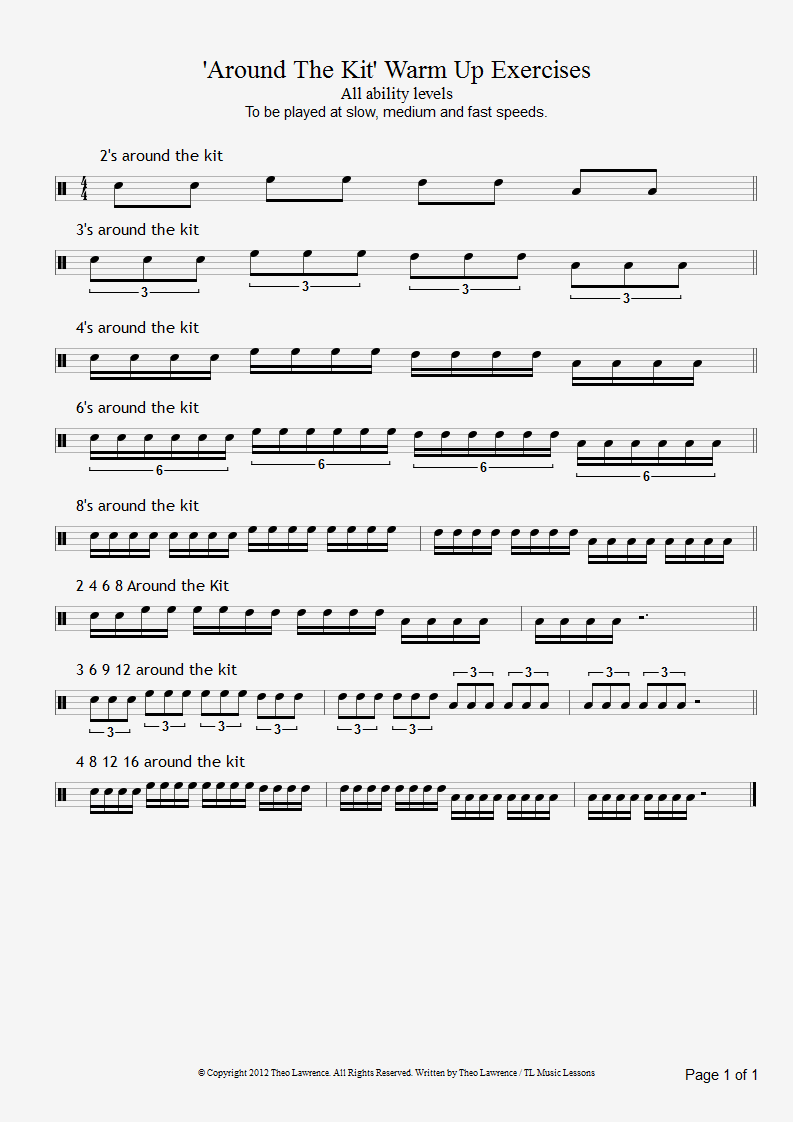
8 advanced warm up exercises for drums with patterns and subdivisions

The exercises on the drum notation are for grade 5-8 players. By reading the list of exercise below, you can begin to see clearly how easy they are. This exercise sheet can be used as a continuous warm up exercise.

The ability level would be measured on timing and speed. All drummers should begin slowly before building up the speed. A metronome is recommended.

The 8 Warm Up Exercises: Based on a drum setup with snare, tom 1, tom 2, and floor tom

Each exercise should be repeated as necessary, and could be started slowly and speeded up on repeat.

  1. Play 2 hits on each drum
  2. Play 3 hits on each drum
  3. Play 4 hits on each drum
  4. Play 6 hits on each drum
  5. Play 8 hits on each drum
  6. Play 2 hits on the snare, 4 hits on tom 1, 6 hits on tom 2, and 8 hits on the floor tom
  7. Play 3 hits on the snare, 6 hits on tom 1, 9 hits on tom 2, and 12 hits on the floor tom
  8. Play 4 hits on the snare, 8 hits on tom 1, 12 hits on tom 2, and 16 hits on the floor tom

10 Maths Drum Fills – Number Combinations adding up to 16

Each line is 1 drum fill, consisting of 16 x 16th notes. What we are doing with this sheet is diving that total number of 16 into various number combinations for different drums. Whilst all music could be related to maths, this exercise is a blatant use of numbers to make up the drum fills. You may hear of styles like ‘Math Rock’, where sometimes all the instruments explore this technique of coming up with and exploring rhythms, time signatures and phrases from a mathmatical stance, in a deliberate and focused way.

For example, an easy drum fill around the kit would be 4 + 4 + 4 + 4 = 16. That’s the drum fill that most drummers are taught first. 4 snares, 4 high toms, 4 medium toms and 4 floor toms.

Play every exercise with a continuous Right Left Right Left sticking (this is the opposite if you are left handed).