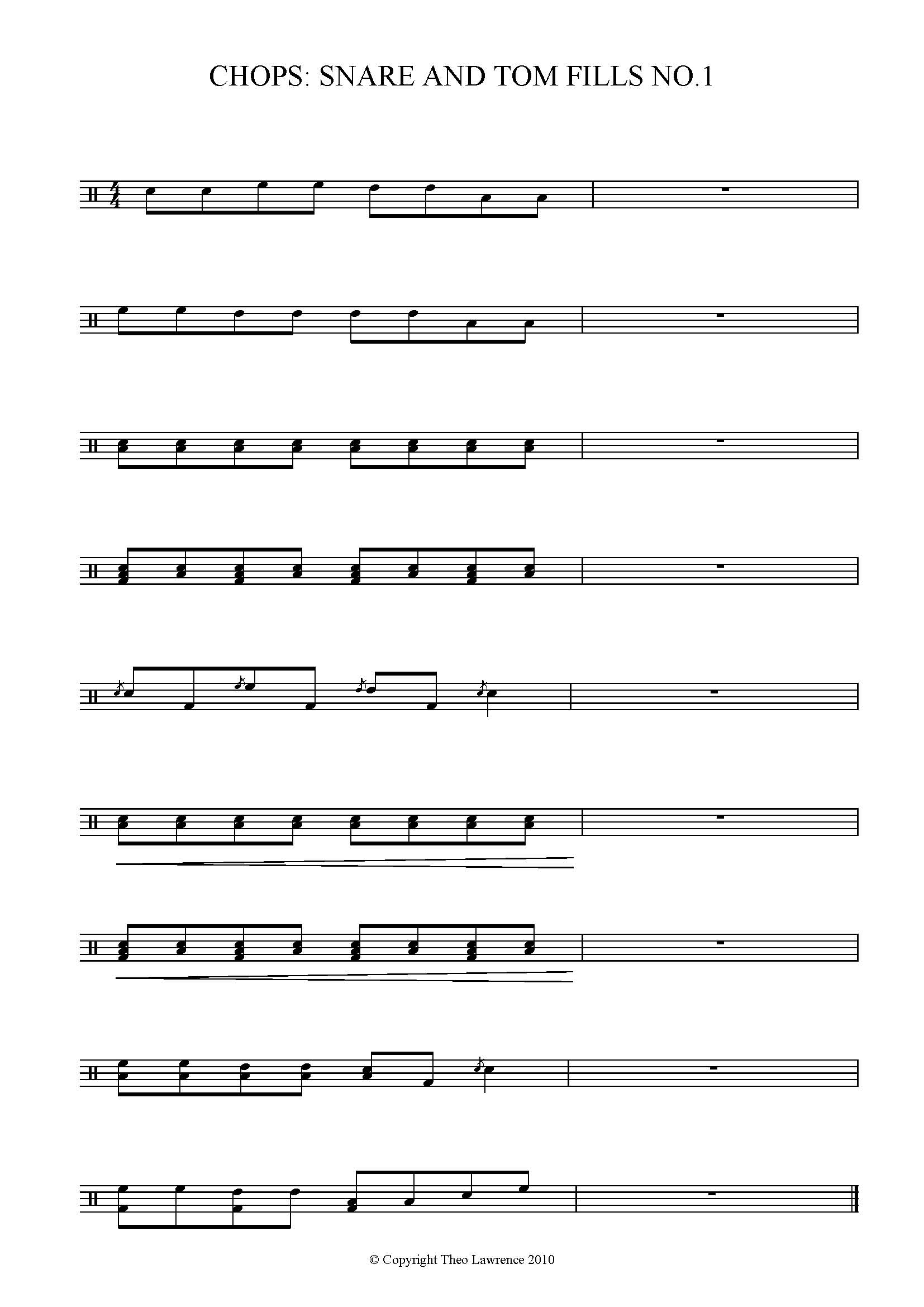
Here are some practice drum fills. Repeat each one until the drum fill flows nicely. You could also try playing 1, 3, 7 or 15 bars worth of drum beats leading up to playing each drum fill. This would replicate playing them in a song.
Tag: Drums
7 Drum & Bass Drum Beats
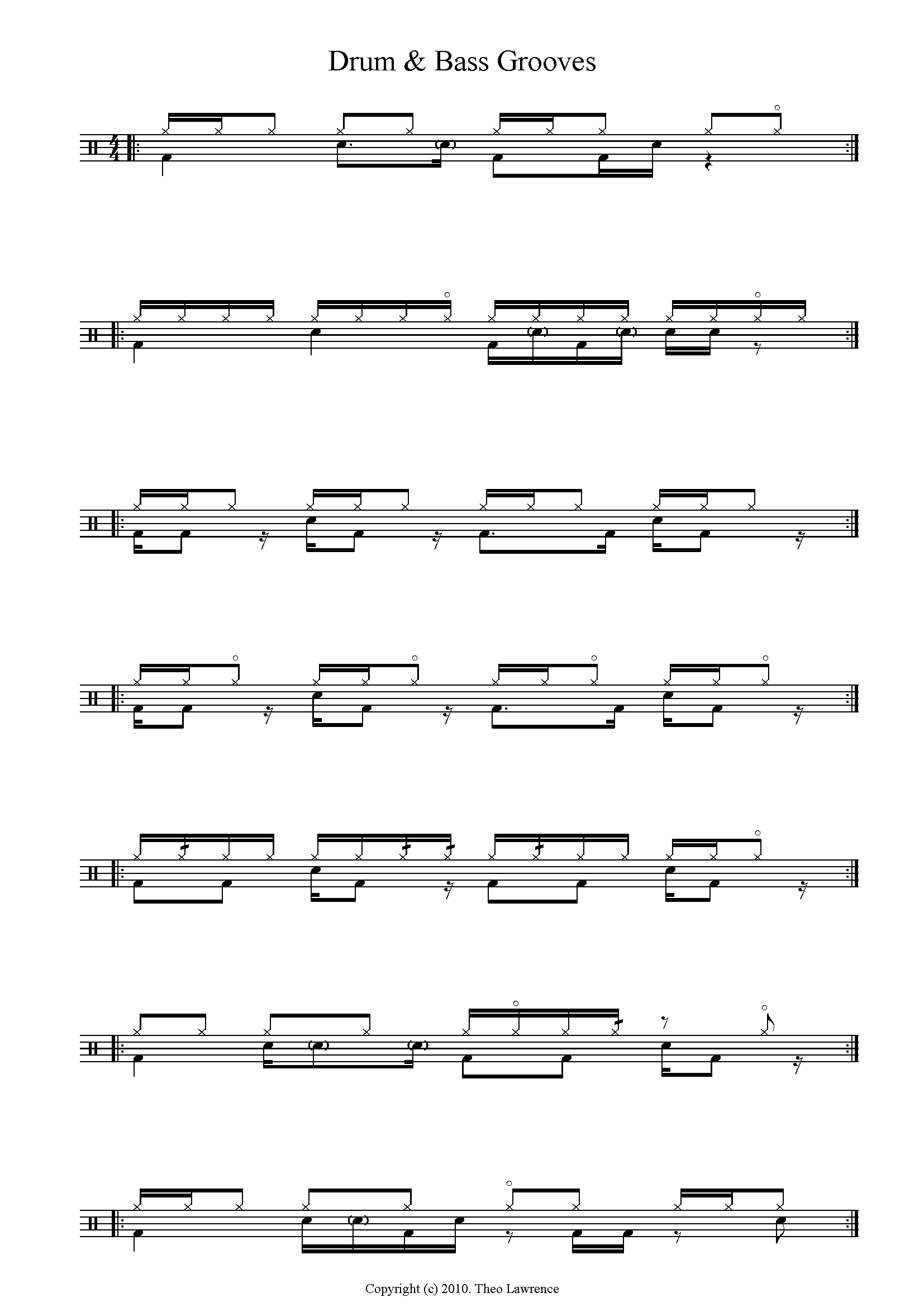
Repeat each line multiple times. You will need to be grade 5-6 level for this sheet. There is a lot of syncopation. Drum & Bass is generally fast paced, so start off slow and get the beats right first and then gradually up the speed until they are sounding fast.
The slashed Hi Hats on the 5th and 6th line mean to play double strokes on those Hi Hats. For example 1 slashed Hi Hat = 2 notes, played with a double stroke.
7 Short Drum Fills
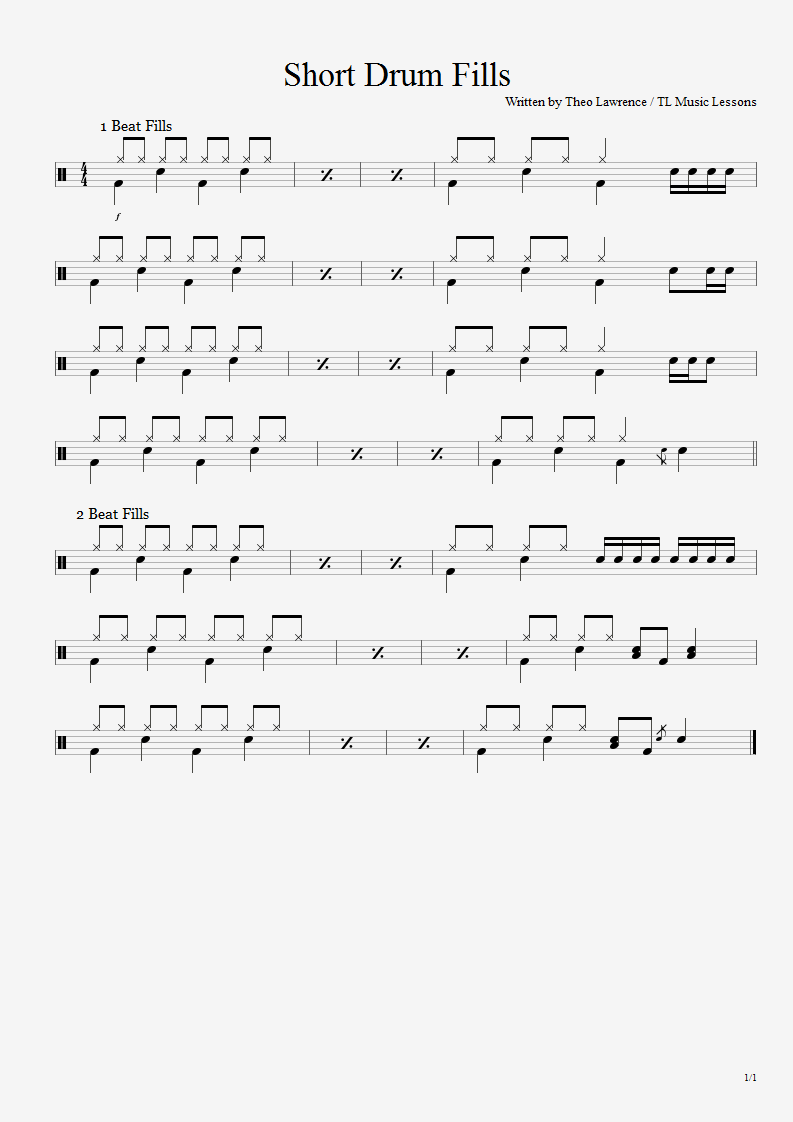
These drum beats and drum fills exercises are for drummers that have learned how to play basic beats and fills already. A strong foundation in Snare Drum Sheet Music would be extremely useful here due to the style of the drum fills being based on snare drum rhythms.
After the first bar of drum beat, there are two ‘repeat the previous bar’ markings. Here the drummer may either copy the first bar, or develop the beat slightly. Each exercise should be repeated at least once before stopping and trying the next one.
Drum Solo Exercises Using Six Stroke Roll With RLLRRL Sticking

This is an exercise that can be used in your practice schedule, and can be used as drum fills in your playing. This 6 Stroke Roll rudiment (played on the snare drum) is part of the technical exercises in Rockschool Grade 7 (Alternative paradiddle-diddle in sextuplet sixteenth notes), and is a good excercise for becoming more comfortable with playing it. This six stroke roll exercise can also be used / modified for drum soloing.
Related: Creative Exercises for Paradiddile-diddle in sextuplet sixteenth notes
6/8 time signature grooves and fills

A 6/8 time signature is the same as a fraction. In music it means that there are 6 eigth notes in each bar. Normally in a bar of 4/4, we have 8 eigth notes in the bar. Just like in fractions, 4/4 = 8/8).
In this 6/8 time signature, the emphasis is on beat 1 and 4.
Improvisation Test examples and ideas for Rockschool Grade 2 Drums exam
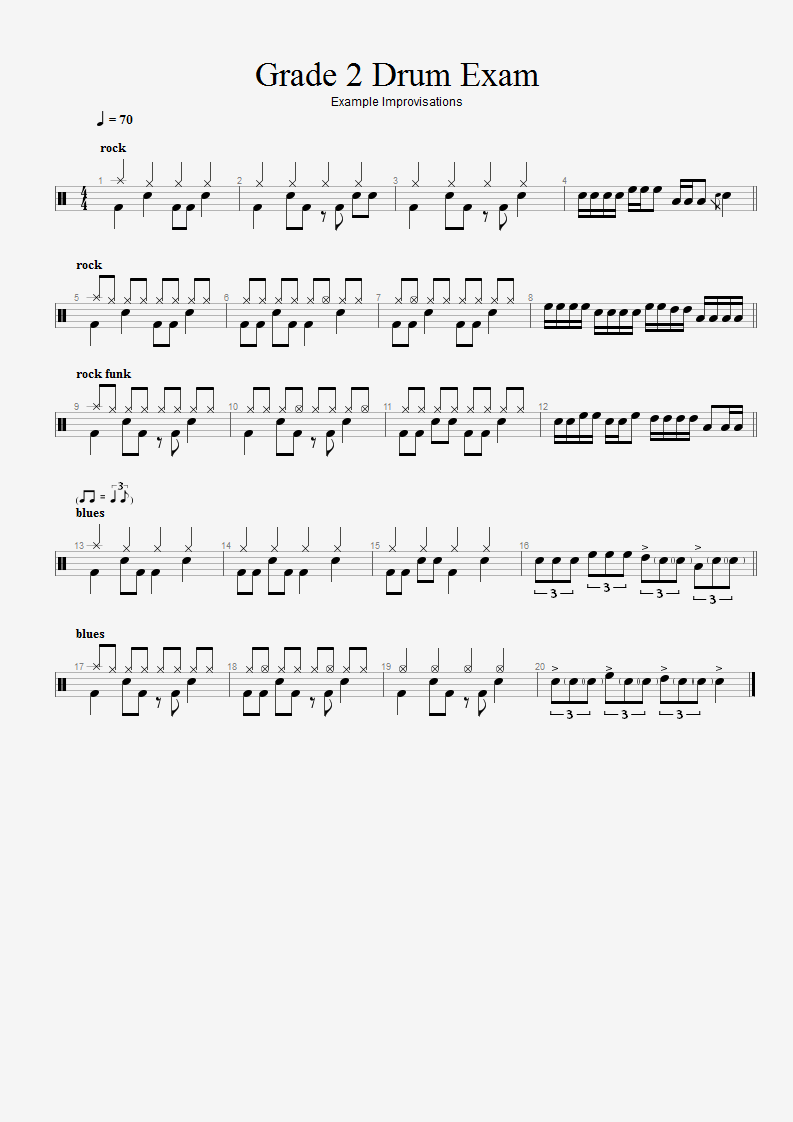
Unofficial rockschool preperation ideas for improvisation part of the Grade 2 drum exam.
Students should improvise (make up your own on the spot), but if you are stuck knowing what to do for bars 2-4 on the improvisation practice before the exam, then these should help you. Drum teachers are welcome to print these excercises out and teach them to your pupils in drum lessons.
You will get given 1 bar of a drum beat, then 2 blank bars to improvise drum beats in and then 1 blank bar for a drum fill to be played in.
The last drum fill should be played as R L L R L L R L L R, with accents on the Right hands and ghost notes (very quiet taps) on the left hands. Reverse sticking for left handed players.
5 Easy drum fills lasting 1 bar

Here is a grade 1 level drum beats and fills exercise sheet. All Fills use the Snare and Floor Tom together at the same time. There are crescendos on the last two fills (volume build up). You will need a basic level of reading knowledge to try this without a teacher.
Sixteenth Note Rhythms and Counting Exercise
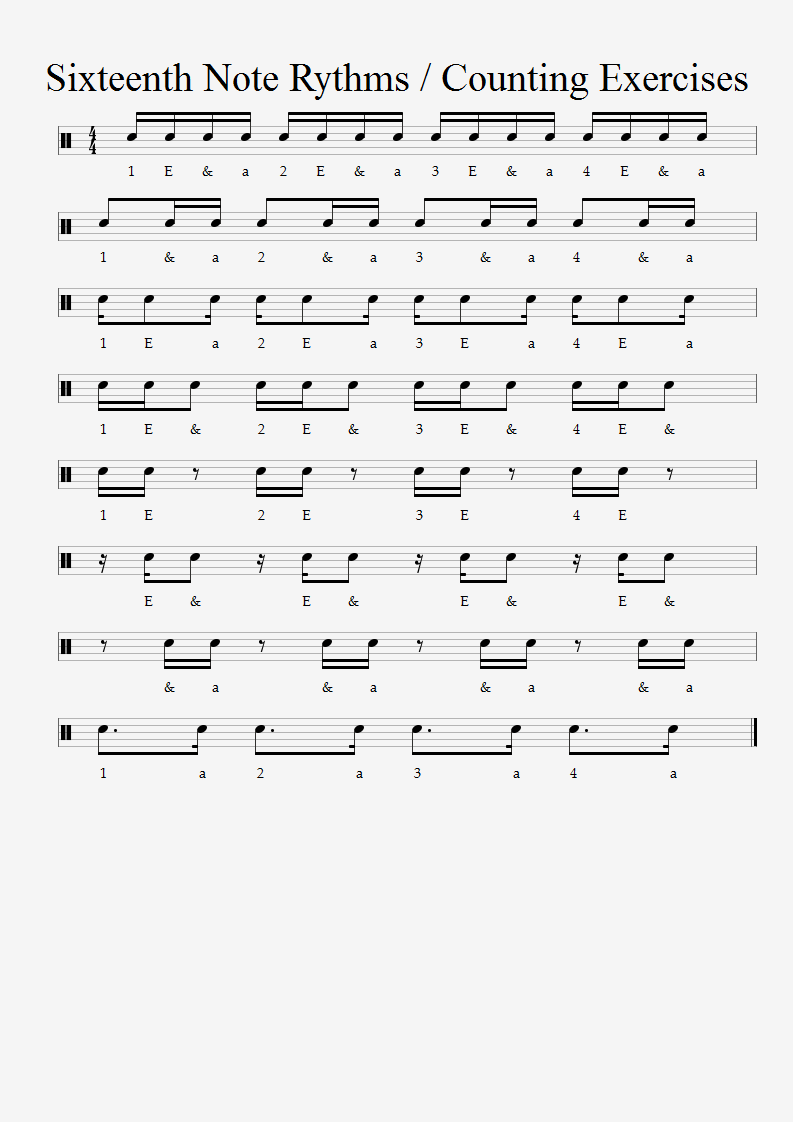
These exercises should be played on the snare drum or a practice pad. The counting is shown below the notes. Every exercise is based on the first one, with notes taken away.
For example, on the second line, you can still coun’t the full “1 E + a”, but don’t hit the drum when you count the “E”.
Simple 6 2 6 2 Drum Fill with 16th notes

You play 3 bars of groove then this drum fill using a 6 2 6 2 pattern that equals 16. By playing 16 x 16th notes, you get a fill that lasts one bar. More fills can be created by changing the numbers around. you could try 2 6 6 2 for example, or 4 4 6 2 – anything that adds up to 16.
10 Jazz Ride Patterns

Before attempting these you will need to have a solid ability in the basic foundation Jazz drum groove, which involves the left foot hi hat on 2 and 4, and the right hand on 1 2 3 4.
This sheet explores variations in the right hand ride cymbal over a constant 2 and 4 left foot hi hat. Once you have learned these you can then move onto learning left hand rhythms on the snare drum.