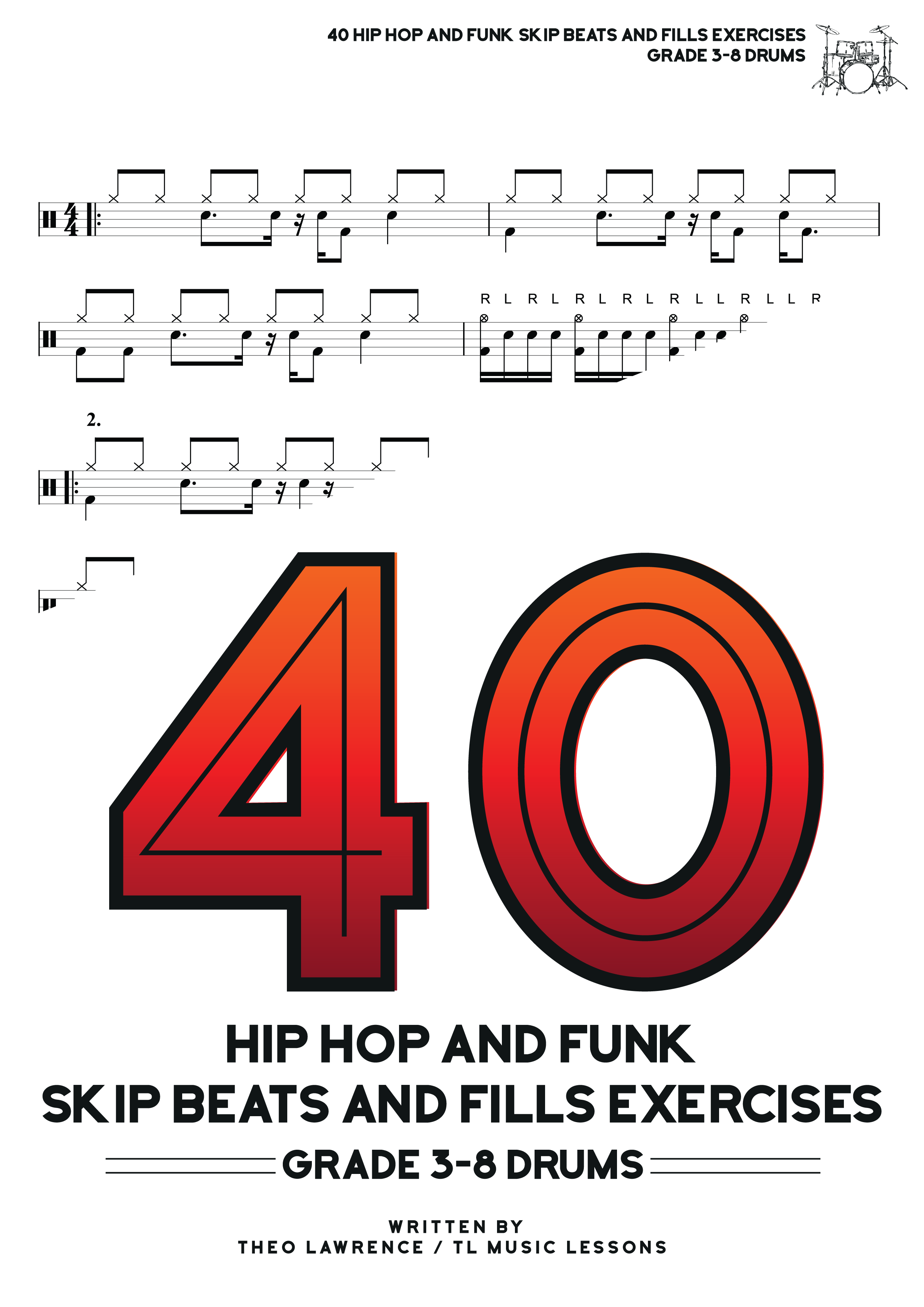
40 Hip Hop and Funk Skip Beats and Fills Exercises ebook – Grades 3-8

Buy The Book →

Introduction

This book contains drum beats and drum fills in the styles of Hip Hop, Rap, Grime and Funk, Soul and Rock/Pop. The book has some grade 3-4 level exercises and also some harder ones, ranging from Grade 5 to Grade 8. The book would be an ideal add on for anyone studying Grades 5-8, as many of the skills are needed at this level. To achieve grade 8, the exercises would need to be played precisely, with correct dynamics, speed and fluidity.

Video

You can use this video as a guide for when you are practicing the book but get stuck on a particular exercise – just look up the timestamp link below. Like I say later in the video, the book is not designed to be played in one go and you should focus on 1 or 2 sheets per session and really drill down those grooves and get the fills correct and precise. Precision is key with all of these exercises, no matter what speed you play them at.

Free PDF Sheets to browse or use before buying the book

People that might find this book useful

  • Drum teachers can print the book or single sheets for their students. They may like to select only some pages to teach if the students are not up to Grade 6 level. The flicks between ability levels and is not necessarily in order of ability. To achieve grade 8, the harder exercises would be played fluently and precisely at speed.
  • Drummers can teach themselves following on from a strong foundation in reading and playing at Grade 3 and above.
  • Drummers that want to learn funk and hip hop beats and fills in depth

About the book

The structure of the book is based on one of my favourite books “40 Beats and Fills Exercises (Grade 1-2)”. There are 40 exercises over 11 sheets, and I have also included 2 bonus sheets with basic skip beats with 8th note hi hats and 16th note hi hats, which adds an extra 20 exercises, but I’m not counting those in the title.

I created the book so that my students could study skip beats at grades 3-4 level and also for my students working on Grades 5, 6 and 8 (I usually skip grade 7) to work on alongside their grades.

Final Thoughts

I hope you enjoy working on this book or teaching with this book. Stick the metronome on and get into the groove. Repeat for less or more than 4 times for each exercise, it’s up to you. To extend the exercises, try playing the beats on the ride cymbal and adding in left foot hi hat ostinati.

Theo Lawrence / TL Music Lessons

Buy The Book →

3 Simple Drum and Bass Steps – How to Play, With Notation and Variations

This is a guest blog post from Ryan Alexander Bloom.

An interesting style of drumming that has become popular recently is live breakbeats or human drum ‘n’ bass music. Bands like Nerve and Shobaleader One have been on the cusp of the movement and players like Johnny Rabb and Jojo Mayer have been using their considerable chops and applying them to electronic sounding, yet still very acoustic, beats for decades. Playing in this style can be a lot of fun because it is improvisational like jazz, technical and chops heavy like metal or prog, and very flashy with a prominent and featured drum part.

To get into this style you can start in a couple of places. Drum and Bass beats are traditionally either created by sampling existing music off of a turntable, or by programming rhythms into a drum machine. In this selection of exercises we will focus on recreating the drum machine sound, rather than the sampled sound. Programmed beats are sometimes called steps because of the 16 steps (16th notes on which you can apply sounds) of an old loop sequencer drum machine. These exercises all feature essentially the same 3 core steps. These are classic rhythms that permeate much of electronic music and can be embellished in many ways to come up with more interesting grooves. These first 3 patterns are demonstrated here:


https://youtu.be/ob1O6vqSTmY

Variations

The hi-hat or ride cymbal can be used with any of these steps. We can also change the value of the cymbal pattern from 8ths to quarters to change the feel. Try to work these basic beats up to at least 160bpm if not higher for an authentic sound.

For slower tempos, more cymbals keep up the energy level. 16ths would be the next logical step.

For a layered texture, add in hi hat with your foot. Drum machines can play lots of notes simultaneously, so layering in another cymbal pattern helps keep up the illusion of a programmed beat.

Keep in mind that drum machines have no soul. Counterintuitively, the less human feeling or groove you can impart to these patterns the better they will sound in a drum and bass context. Try to play all the cymbal notes at the same dynamic level and keep everything steadily right down the center of the beat. Once you master these patterns, you can begin to add ghost notes, hi hat openings, fills, and other elements to make things more interesting. More advanced step patterns, classic breaks, break manipulation strategies, and extended techniques, can be found in Live Drum & Bass – Breakbeats and Electronic Music for Real Drummers available from Hudson Music and Amazon.com


Buy from Hudson Music – https://hudsonmusic.com/product/live-drum-bass/

Buy from Amazon.com – https://www.amazon.com/Live-Drum-Bass-Breakbeats-Electronic/dp/154285864X