Warm Up – Inside the book: 40 Beats and Fills Exercises Book 2

PDF Ebook Buy Now →

Next Page: Sheet 1 →
 

Here is part 2 of inside the book: 40 Beats and Fills Exercises Book 2.

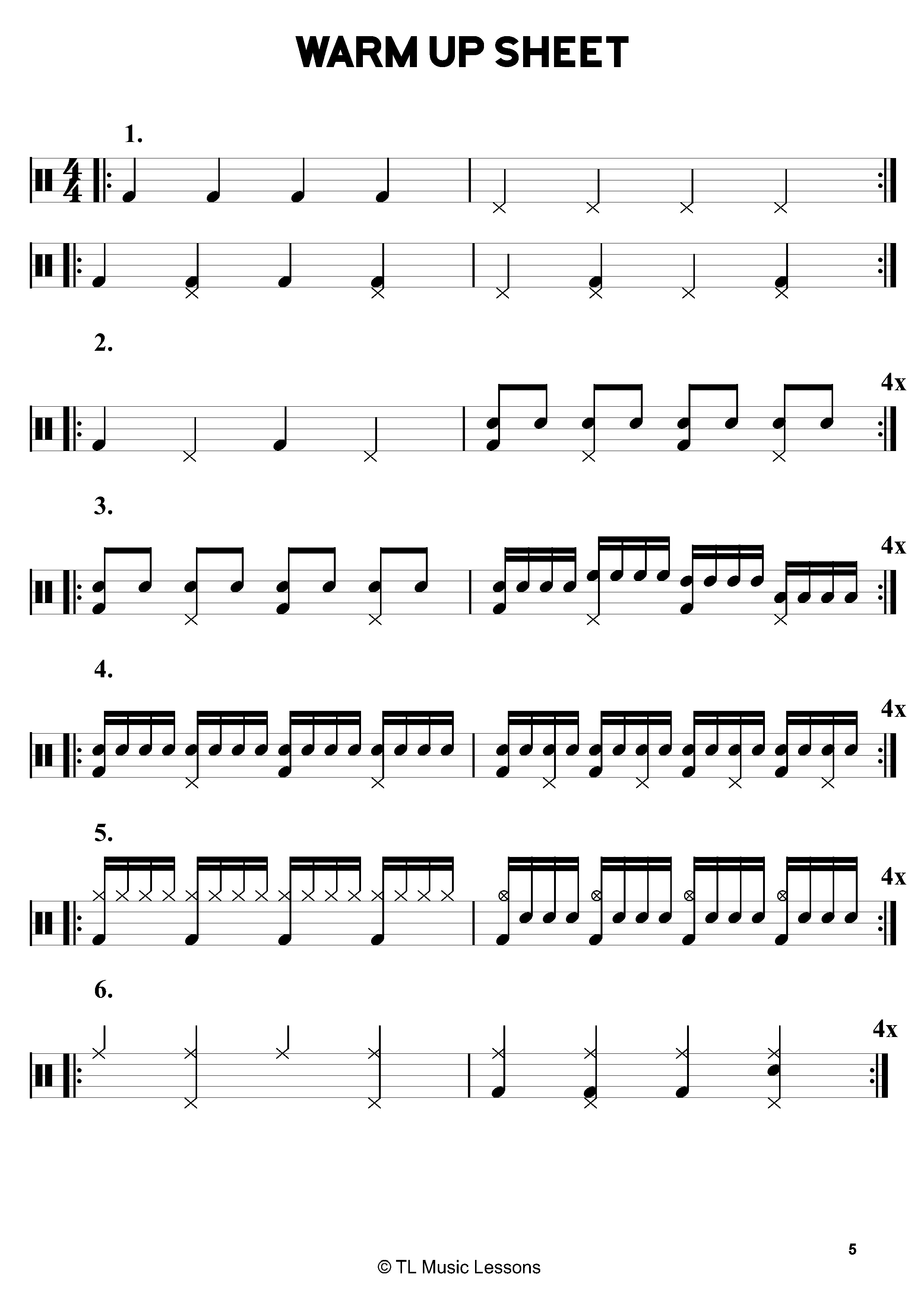
This sheet is a warm up sheet for the drum kit, which includes 4 way coordination. The stepped hi hat and bass drum provide the parts for the feet, to play along with the hand patterns consisting of quarter notes, eigth notes and sixteenth notes.

This warm up sheet could be used at the start of a practice session before going straight into the exercises in the book, as it prepares you for the kind of things to come in the 40 beats and fills exercises. It could also be used as a seperate warm up exercise for something else. By the end of the sheet, you should feel warmed up and ready to get stuck into whatever you would like to work on next. Follow the tuition video below for how to play this sheet.

Video Demonstration

There are more free pages like this one, use the the navigation below to view them.

← Go back to the How To Read The Notation page
Go forward to Sheet 1 →
Buy the full PDF ebook →

2 Minute Snare Drum Warm Up

It feels like we’ve all moved on with out lives after Nirvana, and then all of a sudden some kid reminds us what it used to be like listening to In Bloom, by slaying the drums along to the song and then we stick on the albums again! Let us not ever move on too far. Lest us forget.

Coincidentally (not!), I wrote this snare drum warm up this morning for my drum group. We went through it today without reading it but soon it will be a reading exercise. It has most of the basics needed for levels spanning grade 1-5. Lots of different subdivisions in here to practice. You could break up the warm up and just work on one line, or 4 bars, or 1 section at a time.

Free Downloads

PDF Download

Guitar Pro 7 Download

Here’s what page 2 looks like:

(Premium) – Grade 3-4 Drum Book with 17 Drum Lesson Sheets

Buy Now →

People that might find this book useful

– Drum teachers can print the book or single sheets for their students.
– Drummers can teach themselves following on from a strong basic foundation in reading and playing

Contents Highlights

Subdivisions, Counting Methods, Drum Fills, Skip Beats, 16th Note Hi Hat Accents, Double Kick Drum.

Full Contents

4 – Subdivision drum solo / warm up exercise
5 – 16th note counting exercises
6 – Snare drum piece with counting exercise
7 – Short fills to start a song or sections of music
8 – Bass drum skip beats
9 – Snare drum skip beats
10 – 10 rock drum beats with 16th note bass drum combinations
11 – Snare and bass drum skip beat practice beats – with open hi hats
12 – Snare and floor tom piece with sextuplets
13 – Grooves and fills piece in 6/8
14 – 10 drum fills with 6 stroke rolls
15 – 6 drum beats and drum fills exercises
16 – 10 snare drum accent exercises
17 – Part 1 – 9 drum grooves with 16th note hi hat accents
18 – Part 2 – 9 drum grooves with 16th note hi hat accents
19 – 8 beginners double kick drum beats
20 – Intermediate double kick drum beats

About the book

This ebook is a Grade 4 level compilation of 8 years of preparation work for teaching drums. It consists of drum lesson sheets that I have prepared and revised many times to be the best they can be for teaching with. To create the book I selected only the best sheets from my selection of drum sheet music lesson handouts. I printed them all out on my office floor and arranged them into a coherent order.

I have included only the sheets, rather than add lots of teaching text. This is partly to limit the amount of pages printing, and also to give teachers using the books freedom to put their own take on the lesson sheets. This will probably make it harder for self taught players, so to anyone getting stuck reading the book I would recommend building up their reading and counting knowledge online. The 16th note counting exercises on page 5 and 6 should help, and can be used when playing skip beats to help with reading and playing them.

Reading skills are really important if you are teaching yourself with this book. Further to counting 16ths like on page 5 and 6 to snare drum rhythms, you can also use them in drum beats. It’s really helpful when you learn how to do it. To give an example of counting 16ths in beats; on Page 8, Bass Drum Skip Beats, on the first bar you could count “1 & 2 & a 3 & 4 &” to help with the timing. The second bar would be counted “1 & 2 e & a 3 & 4 &”. The kick drum skips are therefore on the ‘a’ after beat 2 on the first bar, and on the second bar the skip beat kicks are on both the ‘e’ and ‘a’ after beat 2. This probably sounds complicated if you’ve never done this before. It’s how many teachers explain note placements, and it’s still how I count new beats that need working out or extra practice.

Final Thoughts

This ebook covers many of the Grade 4 elements, but it’s by no means all-encompassing. There are other ebooks that I have made for Grade 3-4 and I’m sure there will be more. This book is a leap on from “Grades 1-2 Beats & Fills Drum Book”, but there will be a Grade 3-4 beats and fills ebook soon. This book can also be used either side of these ebooks I have already created in the Grade 3-4 level: “10 Pages Of Accent Exercises With 16th Notes” and “90 Intermediate Drum Beats Focusing On The Bass Drum”.

Theo Lawrence / TL Music Lessons

Buy Now →

Snare Drum Subdivisions Exercise – 8ths, Triplets & 16th Notes

8th note Subdivisions

You need to play 2 snare drums per beat. Put a metronome on a slow tempo (60-80) and try to play the right hand on every click.

Then with your left hand, try to add a beat in between the right hands. When you do that you will be playing 2 snares for every 1 metronome click.

Count 1 + 2 + 3 + 4 + when you play this. The left hand falls on all the + counts, and the right hand will be with all the numbers.

Triplet Subdivisions

These are trickier. Think of them as groups of 3.

  • The 1st group is R L R (right left right).
  • The 2nd group is L R L (left right left).
  • The 3rd group is R L R (right left right).
  • The 4th group is L R L (left right left).

You should count “1 trip let 2 trip let 3 trip let 4 trip let”

If played with metronome, the click would land on all the numbers.

So it’s not just the right hand that lands on the click this time, it swaps onto the left hand for the 2nd and 4th group. That’s what makes it hard!

16th note Subdivisions

These are actually easier than triplets. You will need to play these twice as fast as 8th notes.

The counting for these is:

” 1 E + a 2 E + a 3 E + a 4 E + a “

I’ve written capital E and small a for a reason here. The E is pronounced as a capital E. and the ‘a’ is said like ‘a’ rather than ‘A’.

The sticking is R L R L all the way through.

With a metronome click, again the click lands on the numbers, and everything else should be played in between. So you get 4 notes (R L R L) per click.

Subdivision Exercise

You need to master the subdivisions seperately first before trying the exercise.

In a song you are likely to be changing between subdivisions frequently, as you move between fills and beats and sections in the music. This exercise prepares you for these changes.

In the exercise you will play 2 bars of a subdivision, before moving straight to the next without stopping. Take practice time to work on keeping the pulse the same when you change from one to the next. Make sure to practice with a metronome after you get comfortable with the changes.

The subdivision exercises are featured in Rockschool exams all the way up to grade 8, as part of the technical exercises. More subdivisions are added further on, but the core principles of changing from one to another remains. So spend time mastering this, it’s a valuable skill to have as a drummer.
Learning How To Read and Play Subdivisions

Put the metronome on at 60pm and try to play this sheet. Line 1 will be 1 note per click. Line 2 will be 2 hits per click (stricking R L R L). Line 3 will be 4 notes per click (again, R L R L sticking). Line 4 and 5 are duplicates of line 1 and 2, so follow the instructions for those.

Try the exercise at faster speeds when you have mastered 60bpm.

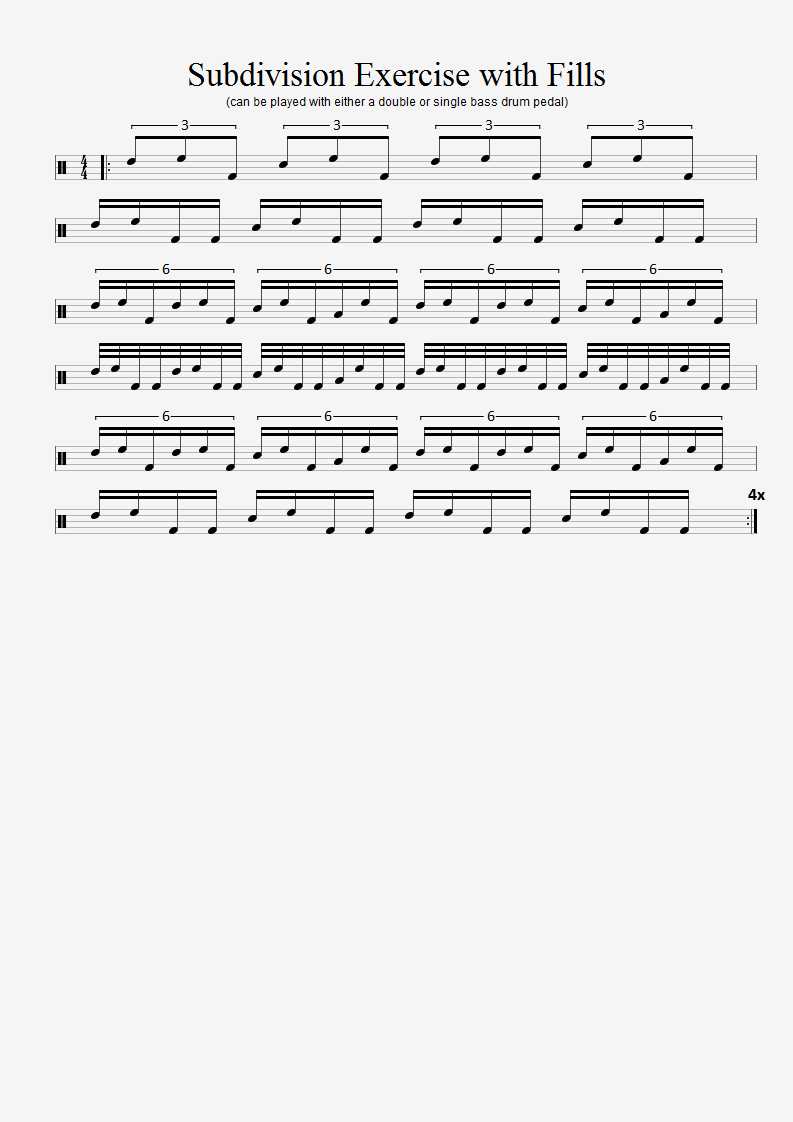
Subdivision exercise with linear drum fills

At grade 5-6 you should have good knowledge of triplets, 16th notes and sextuplets, and you will need to be able to switch seamlessly between them. This exercise works on changing between
triplets, 16th notes, and sextuplets like usual subdivision exercises, but with the twist of adding some interesting and challenging drum fills rather than just one one drum (usually just played as snare drum exercises).

Understanding Notes and Rests in Music Notation – Reference Sheet

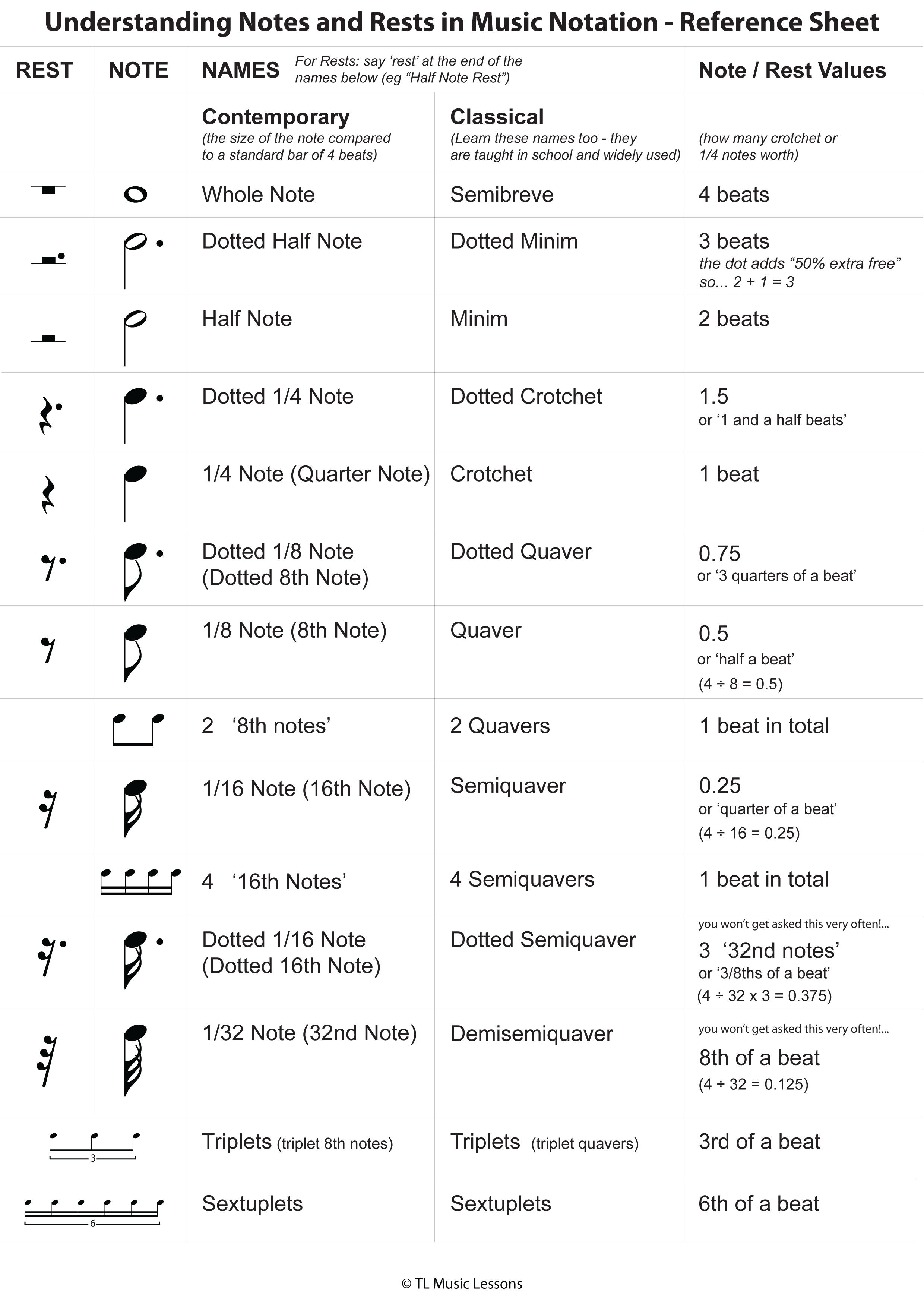
This is a reference sheet for students of all ages and abilities at whatever stage they are at with their instrument. It’s a handy printable sheet, which could be displayed on a wall at home or in a classroom.

Learn and revise the names of all of the note values and rests and what they look like.

Free PDF Download for this sheet →


This sheet is a very useful reference sheet for anyone that wants to read music. As you come across things in your own sheet music and exercises, you can turn to this sheet to check what things mean.

This sheet will help students of most intruments that read music because it is not specific to drums. The sheet includes images or rests and notes, and their modern or classic names, and also the value of the notes or rests.

This can be useful as a reference sheet for students to keep on your computer, phone or tablet, or you can also print it out and stick it on the wall or keep it somewhere handy.

Sixteenth Note Rhythms and Counting Exercise

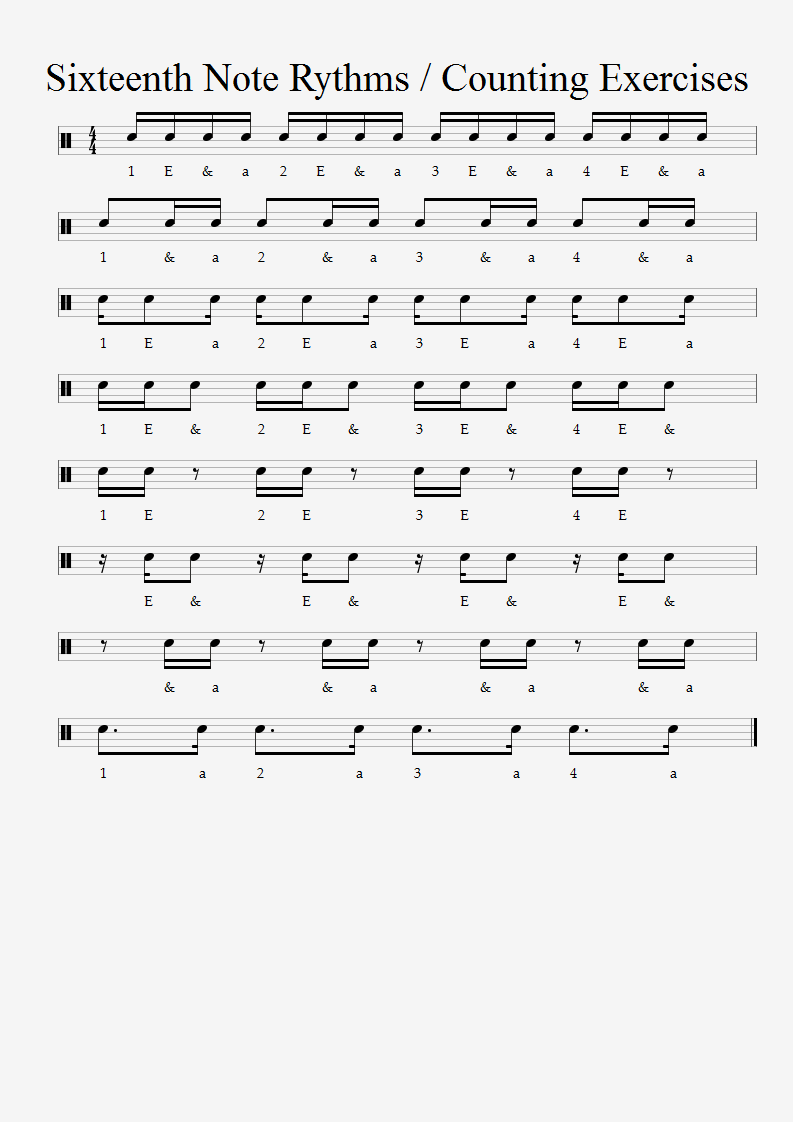
These exercises should be played on the snare drum or a practice pad. The counting is shown below the notes. Every exercise is based on the first one, with notes taken away.

For example, on the second line, you can still coun’t the full “1 E + a”, but don’t hit the drum when you count the “E”.