Breakfast Rhythms – Learning to read and play drum fills and snare rhythms

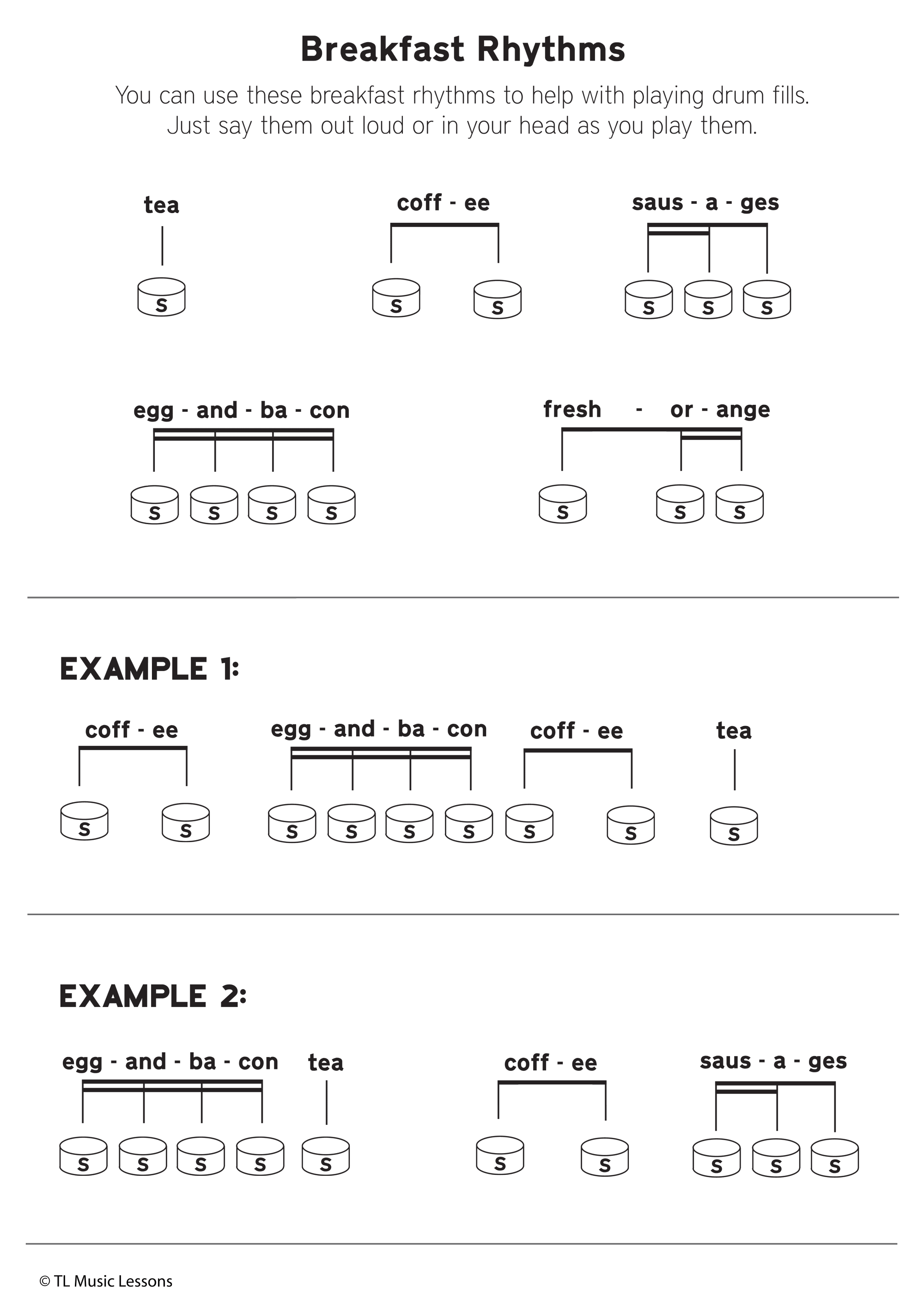
Breakfast rhythms are great for all primary school ages, and they can be fun for high school and adult ages too to help with the initial barrier of learning the rhythms. By saying the rhythm and seeing it at the same time, you will be associating the sound with how it looks on paper, so eventually you will know that two 16th notes and an 8th note sounds like the word “sausages”, so in the future you may not think of the word sausages but you will know how the rhythm goes instantly when you see them combined on the sheet music.

This sheet is an accompaniment for a book I have made called “First Drum Book – Easy Reading Beats & Fills” (it’s a premium download). This page is not in the book yet but I’m currently going through the book again to improve parts of it. If you download the book now, you’ll get a notification to download the latest version for free when it’s ready.

This sheet will also be very helpful for any of the free snare drum exercises or snare drum sheet music I have posted and also for any of the beats and fills exercises, for help with reading the drum fills.

Free Downloads

Breakfast Rhythms (PDF)

Paradiddle Exercises Moving Accents To Toms and Cymbals

The Paradiddle. The most popular drum rudiment.

So dramatic! Could be the flam actually.

I’ll never look at the paradiddle in the same way, after a student asked a sporadic question “who created the paradiddle?”. I replied quickly with “Jerry Paraddidle”. After some chuckles at the name and then the rest of the lesson passing, I had to admit at the end that it was a joke! I still don’t know who did, but I’m sure there is info out there.

But is the paradiddle boring?

Well yes and no. It’s how you look at it really. Practicing paradiddles can be boring if you focus on just repeating RLRRLRLL for 10 minutes with a metronome. However, when you look at it as a pattern to unlock a different path to the regular RLRLRLRL, then it’s more interesting because you can move the left and right hands onto different drum voices and make some interesting sounds.

The popularity of the paradiddle can also be limiting in the sense that it’s the go to rudiment. It’s important to keep an open mind with composing and to remember that you can make up your own patterns, in a similar way to the paradiddle, but different. Let’s take the idea of the paradiddle and make new rudiments, new patterns, new standards. Surely there’s other patterns we can be playing. OK let’s give it a go. RRLLLRLRRRL. Any good? Maybe it’s amazing played in an 11/8 time signature. I’ve not tried it, but do you get what I mean?

So anyway, let’s get onto the point of the post. This exercise sheet works with the popular paradiddle and shows how you can make practicing it interesting by moving the accents to toms and cymbals and making up different exercises with it.

The first 3 exercises are all seperate ideas, and then the 4th exercise combines all 3.

The paradiddle features in most of the Rockschool drum grades, so it’s not going away any time soon. You can work on these exercise at any level really, which is why I’ve specified a non specific ’60 to 120bpm’ as the speed. Basically, practice these with or without a metronome at what ever speed seems manageable and then try to increase it each time you go through it, or do it faster next time.

Free Downloads

PDF: Paradiddle Exercises Moving Accents To Toms and Cymbals

Sheet 1 – 40 Beats and Fills Exercises Grade 1-2

For this exercise sheet, you will need some basic beginners reading knowledge of drum beats and drum fills.

In the exercises, you will play 3 bars of drum beats, 1 bar of a drum fill and then repeat the exercise. There are 4 exercises on the sheet and each one can be played twice, or more times if you like and perhaps the sheet can be revisited on over several practice sessions if needed.

On the first 3 exercises, there are times when there are 2 hi hats on their own with no bass drum or snare drum, so it’s helpful to especially listen out for these two hits whilst playing to avoid missing one of them out, as some learners can do by accident.

All of the drum fills are played on the snare drum only. If there are 2 lines attaching the notes, they are played as 4 fast notes. If there is 1 beam attaching the notes, they are 2 medium speed notes, and if there is one single note on it’s own, it’s 1 single hit lasting for 1 beat. There is also a rests for 1 beat that look like a squiggle on the 3rd exercise’s drum fill, so for that you don’t play anything, and wait for 1 more beat before continuing.

More Sheets like this

If you found this exercise sheet useful, you can download all 10 sheets in this premium ebook: 40 Beats and Fills Exercises Ebook.

Drum Practice Routines – Sheet 2 – Grade 1-2

Free PDF Download:

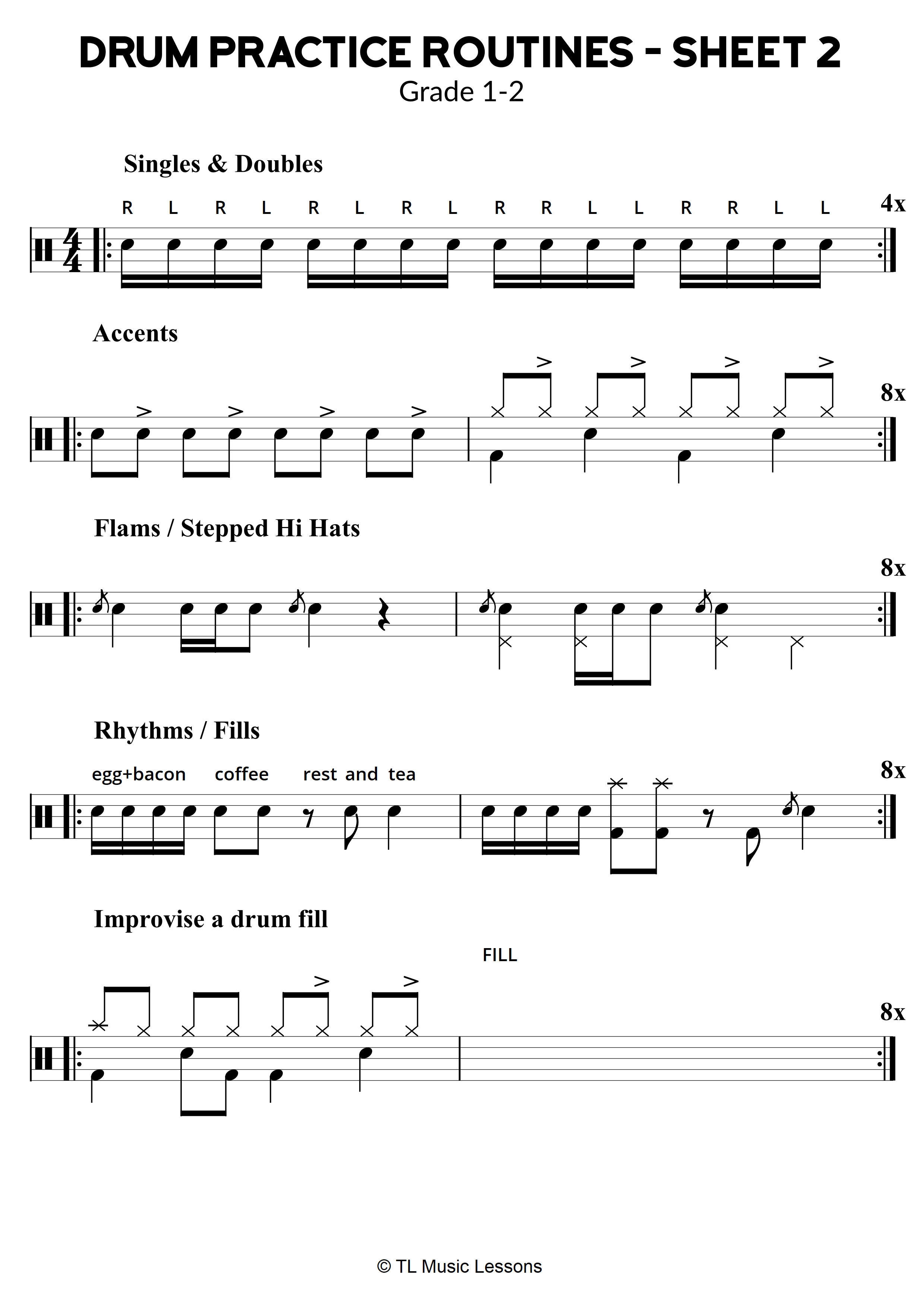
Drum Practice Routines – Sheet 2 – Grade 1-2


It’s still the summer holidays and most people are taking a well deserved break. I’ve been on holiday and I’m fully relaxed but I have a few lesson days coming up so I’m keeping on with lesson prep and making new material like this. I have made this sheet for some of my drum students to learn and practice over the holidays, which can be done in about 5 minutes and can be easily practiced several times per week.

In this practice routine, we are covering many of the fundamental parts of grade 1 and grade 2 material. First on the sheet we have singles and doubles (left handers need to play the opposite sticking to the ones shown). Whilst we don’t usually learn a proper double strokes technique until about grade 5 level, we still play doubles to get used to it, and you will just be hitting the drum with the same technique as you would for a single hit.

Secondly, we will be accenting (playing louder) the ‘off beat’, which means it’s not on the 1 2 3 4, it’s in between those. You could cound 1 + 2 + 3 + 4 +. The accents would then be on every +. Then, moving onto a basic drum beat in the second bar, the accents are played in the same place but this time you play them on the hi hats.

The flams and stepped hi hat section is for building up your stepped hi hat coorination aswell as for practicing the all important flam. Make sure the stick height for the quiet note in the flam is kept quite close to the drum (2 to 4 inches depending on the volume). The stick can start at a much higher position for the loud note in the flam.

For the rhythm/fills section, I have included ‘breakfast rhythm’ counting to help. If you say the words at the same time as playing the rhythm, it should help you. The rhythm on the drum fill is the same as the one in the first bar on the snare drum, so it’s a nice exercise that flows.

Lastly, many students complain about improvisation, so it’s important to practice this until confidence is higher. Start off with really easy drum fills lasting for 1 bar and build up your confidence with each practice.


Related: Drum Practice Routines – Sheet 1 – Grade 1-2

Drum Practice Routines – Sheet 1 – Grade 1-2

In this practice routine, we are covering many of the fundamental parts of grade 1 and grade 2 material. On the sheet we have a paradiddle 8 times (left handers need to play the opposite sticking).

There are accents on 8th note snare drums and then moving onto a basic drum beat, the accents are played in the same place but this time on the hi hat part of the drum beat.

The flams and stepped hi hat section has a classic rock feel to it and it is an easy way of introducing 4 way coordination into your playing.

For the rhythm/fills section, it’s the same rhythm on the drum fill as it is in the first bar on the snare drum, so it’s a nice exercise that flows, so we do that 8 times.


Related: Drum Practice Routines – Sheet 2 – Grade 1-2

Drum Practice Routines – Sheet 1

Here is a sheet that is ideal for drum teachers to give their grade 3-4 students to practice as ongoing homework for perhaps a half term, or 4-6 weeks. Rather than giving them something new each lesson to practice, this substantial sheet can be given to practice alongside a song or their homework for a grade they might be working towards.

There are several sections, covering many of the techniques and requirements of the Grade 3 level, and a lot of it crosses over to Grade 4 too, so I’d say Grade 3-4. The following techniques and exercises are included on the sheet: Paradiddles, Accents, Skip Beats, Flams, Stepped Hi Hats, 4 way coordination, Syncopated Rhythms, Drum Fills, Improvisation.

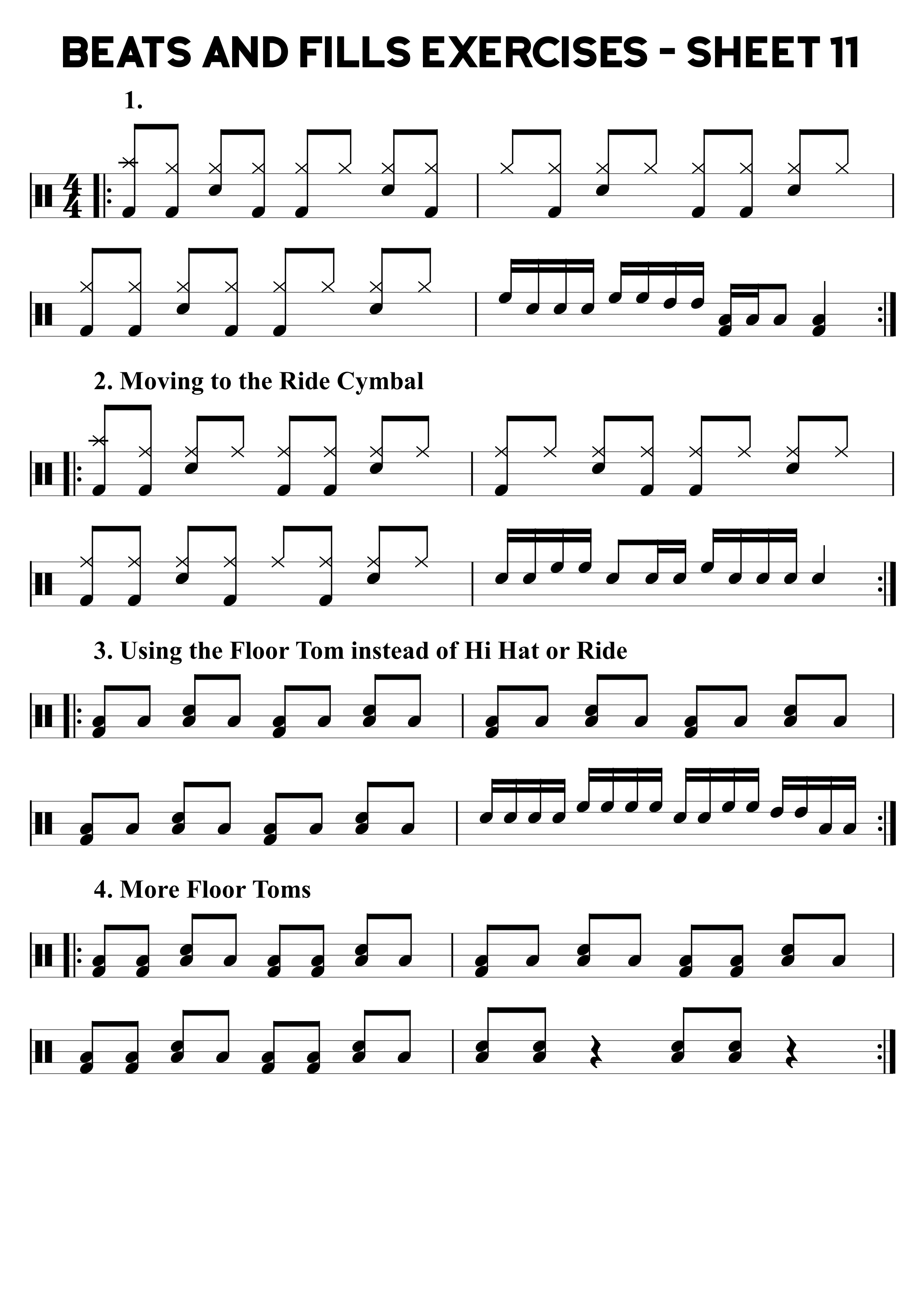
Beats and Fills Exercises – Sheet 11

Sheets 1 to 10 are available as an ebook called 40 Beats and Fills Exercises Ebook, which consists of 10 drum exercise sheets with 4 exercises on each page.

In that book, the exercises are all based on beats using the Hi Hat and playing a drum fill on bar 4, and then repeating. The next step you could take is continuing those beats but moving the right hand (if you are right handed) onto the Ride cymbal or the Floor Tom, instead of playing the Hi Hats throughout the drum beats.

This, ‘Sheet 11’, is a continuation of this book, available for free, There are various directions you could go after the first book. I am also writing another book focusing on playing on the ride cymbal and using the stepped hi hat, which may become or feature as ‘Book 2’ of this series, or perhaps I will do a mixture and include sheets like this one too.

The drum music is written in an easy to read sort of way, where all of the drum voices (bass, snare, hi hat etc) are linked in one stem, rather than separating the cymbals from the rest of the drums. This way of writing and reading has proved very popular with my students and I think it’s a good way of reading drums to start with, before moving on to the regular way of writing and reading the music.

Drumming Session for Keeping Fit

Guest Blog Post: Mia Johnson


People don’t normally think of instruments when they consider ways to get fit. They’re usually left to the realm of artistic expression. You create music with them and that’s basically it. However, one instrument has proven itself worthy of also being called a tool for fitness: drums. If you’ve ever looked at some of the best drummers in the world, you might have noticed that they are extremely lean. This is because drumming is a surprisingly good way to get in shape. It can be a very dynamic exercising tool with a bunch of fitness benefits. Here are some reasons why you might want to incorporate drumming into your fitness regime.

1. It’s a fast-paced instrument

If you had to pick one instrument to help you stay fit, drums would stand out as the obvious choice. They’re arguably the most fast-paced instruments that you can get your hands on. Drumming sessions involve constant hand movements that push players arm muscles to their limits.

Songs that are focused on drums usually sound extremely dynamic, which means that playing them will further motivate you to commit to the workout. When playing the drums, you can consider yourself an endless source of workout pump songs.

If you prefer slow songs that sound smooth, you won’t lose out on the exercise potential of drumming. You’d be surprised at how many movements are required to keep up even a slow hat pattern while other parts of the drum kit are working. Drums are very consistently dynamic when they’re used in songs.

Even if you’re not following the tempo of a specific song, but rather creating rhythm from scratch, you will still naturally aim for a higher tempo to test your skill and push your body to its limits.

2. Easy to get into

Many instruments have a very steep learning curve. For example, new musicians playing the violin will sound horrible until they get to a certain point where they might sound bearable. Even the simplest of instruments require quite a bit of practice before they can be used to create something that is appealing to listen to.

Drums are a bit easier to play in this regard. You get a lot of payoffs relatively quickly into the learning process. The learning curve isn’t as steep as some more melodic instruments. You can start with some very simple rhythms made up of two sounds and it will already be easy to listen to, although it might be horribly boring at first.

You don’t need to hire tutors to give you lessons in playing the drums. Using it as a way to exercise will help motivate you to learn more. After all, practice and repetition are what makes someone a good instrumentalist. You will unwittingly use your drum workout sessions as a way to get a lot better at playing them.

3. An endless source of fun

If you’re a fan of rock music, drums can give you the opportunity to bring some of that hardcore energy directly to your own room. Popular rock songs often have drum patterns that are just as recognizable as their guitar melodies. This means you can get the emotional rush of playing the song rather easily.

Drums are pretty unique instruments because their focus isn’t on creating a melody or chord progression, but rather keeping up a rhythm. It requires just as much skill as other instruments, but you might find that it gives you a lot more leeway and satisfaction than most other instruments. Drumming is all about improvising and going wild when you figure out a rhythm that suits your current state of mind. Once you get going, it can be hard to stop because it’s so ridiculously fun to play them.

4. It’s a cardio exercise

The constant and rhythmic movements of drumming help make it an ideal cardio exercise. You’re using a lot of your muscles for stability, which means much of your upper body is getting a hefty workout. The consistency at which drumming movements have to be done also affects your heart. It’s almost like having a run but using your upper body for the movements. In fact, there are various studies that compare the effects of drumming for cardio exercise versus running for long periods of time. It has been shown to be as effective as playing soccer for ninety straight minutes.

Drumming is a lot more adaptable than running or walking. People of all ages and skill levels can enjoy the perks of using it as a way to exercise. It doesn’t depend on the weight and it doesn’t give you any joint pain. Best of all, it’s going to help you keep your heart rate up no matter how good you are at playing them. Even if you make mistakes and have to have a do-over, it’s still going to be a very effective workout.

5. It’s an art

There are very few exercises that also qualify as an art form. Drumming allows you to create new music while also getting a wonderful workout. You don’t expect to get sweaty while playing the guitar or bass.

When you get better at playing the drums, you will find that your movements are much smoother and more precise. This is complemented by the same kind of improvement in terms of drumming as a workout. Your muscles get stronger and they allow you to make more precise movements with less energy being wasted. Your improvement as a musician will be followed by your fitness level and vice versa.

There’s a degree of emotional payoff when you play the music that you enjoy. At the same time, your body will get a rush of endorphins from the workout that drumming provides. Together, these two effects make playing the drums a very enjoyable physical and artistic experience

6. Drumming builds muscles

Most exercises fit into two different categories. You have aerobic exercises which consistently increase your heart rate and get blood pumping throughout your entire body. These include running, sprinting, and riding a bicycle. Basically, things that require constant movement. On the other hand, anaerobic exercises are sudden and powerful movements which tear a few muscle fibers and make way for muscle growth. Just about any weight-lifting exercise fits this criterion very well. Exercises like squats are considered anaerobic.

Surprisingly, drumming can fit both of these criteria rather well. Not only does it take your breath away, but it also paves the way for an increase in muscle mass for most of your upper body. You can expect to get chiseled hands the longer you play the drums. The harder you move the drum stick, the more stability your back needs to make that movement, which means that even your back muscles get bigger and stronger over time.

The muscle-building aspect of drumming shouldn’t be understated. It causes a lot of fibers to break and it leaves your body craving for protein and rest. After a long drumming session, you should always eat well and take a break. If you want to keep drumming for longer periods of time, you might want to keep your True Protein shakes near your drum kit. Without a constant intake of protein, you’ll very quickly get fatigued and you won’t be able to continue playing at the same level.

7. You can do it with friends

Working out with your friends is a great way to get your mind off of being tired. When you go out for a run, it’s a lot more fun to bring someone along with you. You can have a chat and make the workout session much more than just a bit of running. Hitting the gym with your buddy lets both of you enjoy the rest period after a tough workout.

Drumming is no different, you can easily work out while you’re spending time with your friends. It’s even encouraged that you get some like-minded individuals to play some instruments alongside you. You don’t even have to join a band to get the whole musical experience. People enjoy getting together to create spontaneous jamming sessions. There’s something about creating freestyle music that appeals to most musicians.

If you want to create something bigger than the sum of its parts, you could become part of a band. Rock music is traditionally made in a band environment, but it isn’t an absolute must. Some famous acts such as the White Stripes, have only two members that are multi-instrumentalists. Still, a band environment can help you meet new people and improve your talents as a musician and song creator.

Conclusion

Drumming has proven itself to be a ridiculously effective way to keep your body fit. It combines some of the best elements of various workout regimes while also being a really fun activity overall. You hardly even notice that it’s a workout. You can consider it an artistic expression that just happens to keep you fit the better you get. There’s no better way to combine art and fitness in one powerful and effective package.

5 Ways to Improve your Drumming Speed

Photo Credit: Mark Latham

Guest Blog Post by: NetSoundsMusic.com


Playing drums requires a little bit more physical effort than many other instruments. While many instruments require correct breathing and fingering techniques, and some utilize pedals as well, drummers are constantly using their whole body, including not just fingers or hands, but the whole arms and both legs. This is why drumming for prolonged times is very draining, especially at higher speeds.

Certain genres of music have high tempos as a defining trait. Speed metal, techno, trap and some types of folk music require you to consistently play 16th notes (or even 32nd notes!) at very high BPMs. But even classic rock or chillstep songs can have faster passages, sometimes known as speed-bursts, or a very intricate drum solo that is hard to execute because of the combination of speed and unpredictable, almost pattern-less lines.

Getting up to speed is not exactly easy. It is required that you physically practice playing at higher speeds, that you understand how muscles work, and to mentally recognize, feel and hear the 16th notes even at very high speeds. It is definitely a steep learning curve.

So, where to start? How about relaxing a little bit first.

1) Learn to play slow and precise:

This is a tip that has been repeated so often that it has completed its route from being the most popular advice to being the most hated one. Yes, learning to play slow will not increase your speed directly, but that is not the point. The point is to hear the beat and to get accustomed.

By playing slow, we mostly mean playing at slower tempos. Keep in mind that while playing at slower tempos, you can still add in speed bursts in form of 16th or even 32nd notes. That means that at a lower BPM, you can still play faster than when you play a high BPM. 16th notes of a lower BPM are still faster than many 8th notes of a high BPM. The low BPM simply makes it easier to get into the whole speed-game and it enables you to actually feel what you’re playing.

2) Relax your muscles as much as possible:

The second reason why you are supposed to slow down at first is to learn to relax. At higher speeds, we tend to tense up, and tension slows us down. So, to be able to play fast, you need to learn to control your movement, breathing, and tension. This requires a lot of mental effort and will take some time to get accustomed to.

Playing relaxed doesn’t mean playing quietly or slowly, though. It means that you are simply not straining a much as you probably do right now.

3) Start off slow and increase the BPM:

This is another widely repeated advice that is not wrong and that it is helpful, but please keep in mind that this is only part of the whole learning process. Learning a song part at a lower BPM, then increasing it is going to help you track your movement and get the precision down before getting the speed under control.

You can even take songs that you know and “over practice” them to get them down properly. Many rock acts play their songs at higher tempos live, which is both a way to reduce the duration of the venue and fit in more songs, but also gives a certain kick to the songs that are increasing the unique feeling of a live concert. Practicing along recordings of live performances might be a good idea for you.

4) Practice smaller parts at high tempos:

While learning how to play a hard drum solo slowly and then working your way up the metronome, another way is to learn the solo part by part with very small segments played at the correct tempo.

This will help you get down the movements at the correct time and then all you have to do is put them together. This is very effective and becomes even more useful once you get better and playing fast because you will be able to learn and master solos this way much faster.

5) Practice speed bursts and double the amount of notes:

Another way to use lower BPMs is to practice speed bursts. Add to your patterns a small and short solo line or bridge that lasts only for one bar or even less. Or double the number of notes.

This can be done by simply doubling what you are playing. For example, instead of a single kick, you can either play with a double bass drum set very fast or use a double bass drum pedal to add a second kick to the first one.

You can also create more solo-like lines from time to time. Lastly, you could try to consistently add a cymbal throughout the whole song, essentially changing the 8th note feel to a 16th note feel, though doing this consistently might not be very musical and also very difficult to pull off.

6) Be comfortable with your gear (Bonus)

As mentioned in the beginning, being relaxed is very important. This includes being used to your gear. Make sure you find the correct type of sticks and the best throne that fits your needs.

Experiment with different drum setups and don’t be afraid to change up your layout. Getting two bass drums or a double kick pedal might seem like a big change, but everything can be learned and mastered. Some setups work better for faster styles than others, so make sure to check out and draw inspiration from jazz, prog, and metal drummers to see how they are dealing with faster parts.

Summary:

Learning to play fast cannot be done in a day, and mastering high BPMs can take a very long time. One thing that is sure is that it can be done with enough practice and patience. Try out different methods and don’t be afraid to search for inspiration out of your comfort zone. There are many different genres that utilize fast drum lines, so try expanding your musical repertoire. And should you get stuck, don’t panic.

Stagnation is a normal phase that we all go through from time to time and sometimes it can feel that you haven’t progressed in weeks or even months. But this will go away. Play fun songs that you are comfortable with and with each song, your brain and muscle memory will passively pick up certain details that will help you increase your speed later on.

Peter has a passion for music since he was 12 years old. Enjoying jamming and teaching, he runs Net Sounds Music, a space to learn and get involved with music.

[Premium] – 40 Beats and Fills Exercises Ebook

I’ll start by saying I’m really pleased with this ebook! It’s a compilation of half a year’s work, which started out as making some fun and useful exercise sheets for my drum students. I would make one sheet every every couple of weeks or so and it eventually finished at sheet 10, not just because it’s a round number, but because I was ready to start introducing other things that wouldn’t neccesarily fit in neatly with this ebook. I’m very pleased with the book because it’s very focussed on the fundamentals of drumming that every drummer should be learning to start with at least.

Buy Now →

Introduction

This drum ebook is a good set of exercises for the beginner drummer that has learned how to read and play very basic beats and fills already. All 40 exercises are laid out in the same way so it’s a focussed effort on building up your core drum beat beat and drum fill skills.

  • For beginners Grade 1-2 level drummers.
  • 10 Exercise sheets with 4 exercises per sheet.
  • Improve your drum beats and drum fills and practice changing from one to the other.
  • Exercises consist of 3 bars of a drum beat and 1 bar of a fill, repeated.
  • It’s a fun ebook to work through quickly or slowly. 1 sheet per week would work well for some.

The layout is slightly different to my other books so far. Usually the cymbals are notated separately (stems pointing up) to the rest of the drums (pointing down), but in this book everything is pointing in the same direction (usually up, although it doesn’t matter which way they go). I find that at this beginners / grade 1 stage, it all makes more sense this way to learners because otherwise you get rests appearing sometimes in the bottom part of the stave when there are still hi hats playing, and this almost always causes confusion with beginners young and old. It’s important to learn the other way too and move onto that, and it’s like that in most of my other books.

For beginners, but not straight away

A complete beginner could start this book early on, but not straight away. They can follow the book either with a teacher or on their own if they are a quick learner. Self taught learners may need to look some things up because not everything is explained for the complete beginner. A good book to start with for complete beginners is First Drum Book – Easy Reading Beats & Fills, which is especially good for younger learners. Another ebook that has content for complete beginners in is Beats and Fills Drum Book – Basic Beginners – PDF Ebook. That book goes beyond complete beginner too and has similar ability level content to this book, so it can be used in addition.

The usual info

  • When you purchase, you get a pdf file to keep. Please do not redistribute the file, unless you are a teacher sending it to students to practice with.
  • Drum teachers can print the book or single sheets as required for their students.
  • Drummers can teach themselves following on from a strong basic foundation in reading and playing

I hope you enjoy the ebook!

Free Preview

Buy Now →