Drum beats and drum fills in different time signatures – Sheet 4 – 40 Beats and Fills Book 2

PDF Ebook Buy Now →

Next Page: Sheet 5 →

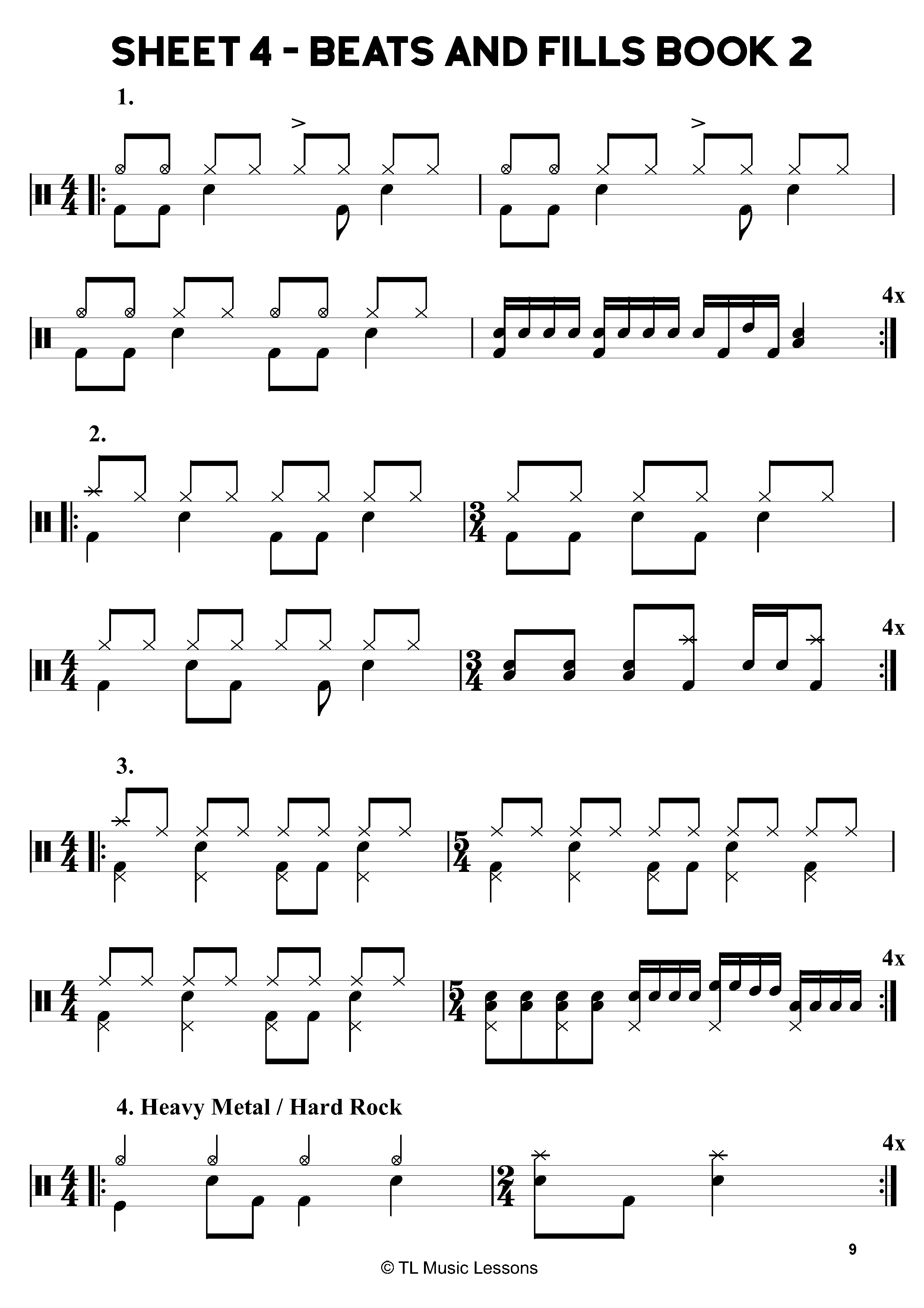
Here is Exercise Sheet 4 from 40 Beats and Fills Exercises Book 2.

The drum beats and drum fills are played in different time signatures (3/4, 5/4 and 2/4), as well as changing to and from the usual 4/4 bar length.

Time Signature Changes: “Do not panic – they’re quite easy”, as I say in the video!

The time signatures are not too hard And sometimes you don’t even need to worry about counting them. There are situations where you might need to count them and they might be harder depending on what is contained in the bars, but thes have been written for newcomers to time signatures in mind, so there are no real suprises – it’s meant to be a straightforward introduction.

On exercise 3, I have taken away the stepped hi hat so it’s 3 way coordination. The stepped hi hat is included on exercise 3 with the 5/4 bar, so there’s an added challenge there.

Video Demonstration

You can download the pdf for this page by buying the book or downloading the free preview on the product page.

There are more free pages like this one, use the the navigation below to view them.

← Go back to Sheet 3
Go forward to Sheet 5 →
Buy the full PDF ebook →

How To Read The Notation – Inside the book: 40 Beats and Fills Exercises Book 2

PDF Ebook Buy Now →
Next Page: Warm Ups →

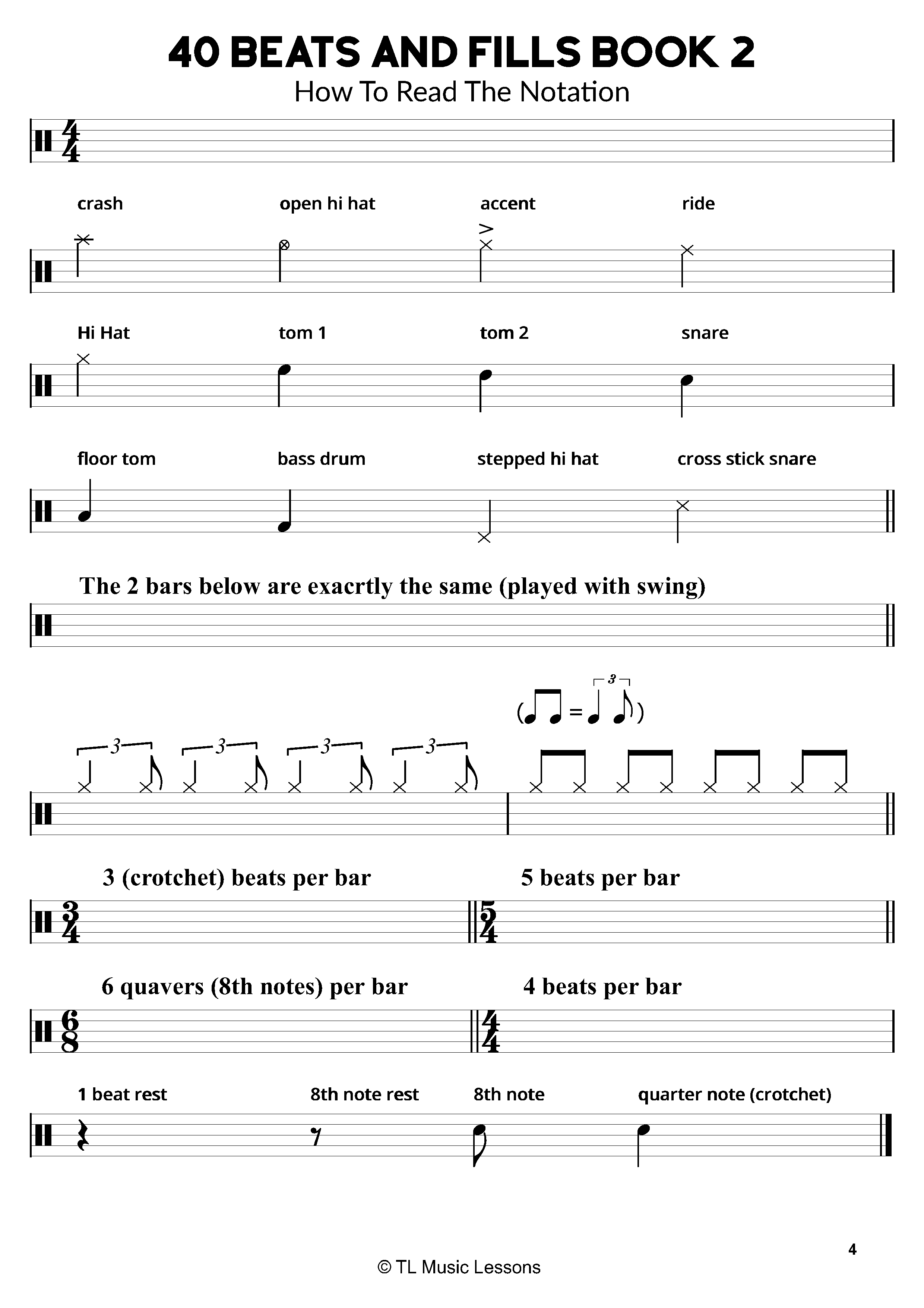
Here is part 1 of inside the book of “40 Beats and Fills Exercises Book 2“.

As you can see in the featured image, this post is showing you how to read the drum notation in the book. This is going to to be quite hard to understand without any prior knowledge or tuition, but I have made a video (see below) that shows you which drums are which and how to read and play the swing, rests, basic notes, and time signatures.

Here are all of the drum voices and notation markings on the sheet: crash cymbal, open hi hat, accent, ride cymbal, closed hi hat, tom 1 (small tom), tom 2 (medium tom), snare drum, floor tom, bass drum, stepped hi hat, cross stick snare drum, triplet swing, 3/4 bar, 5/4 bar, 6/8 bar, 4/4 bar, crotchet rest, quaver rest, quaver, crotchet.

There are more free pages like this one, use the the navigation below to view them.

Go forward to the Warm Up Sheet →
Buy the full PDF ebook →

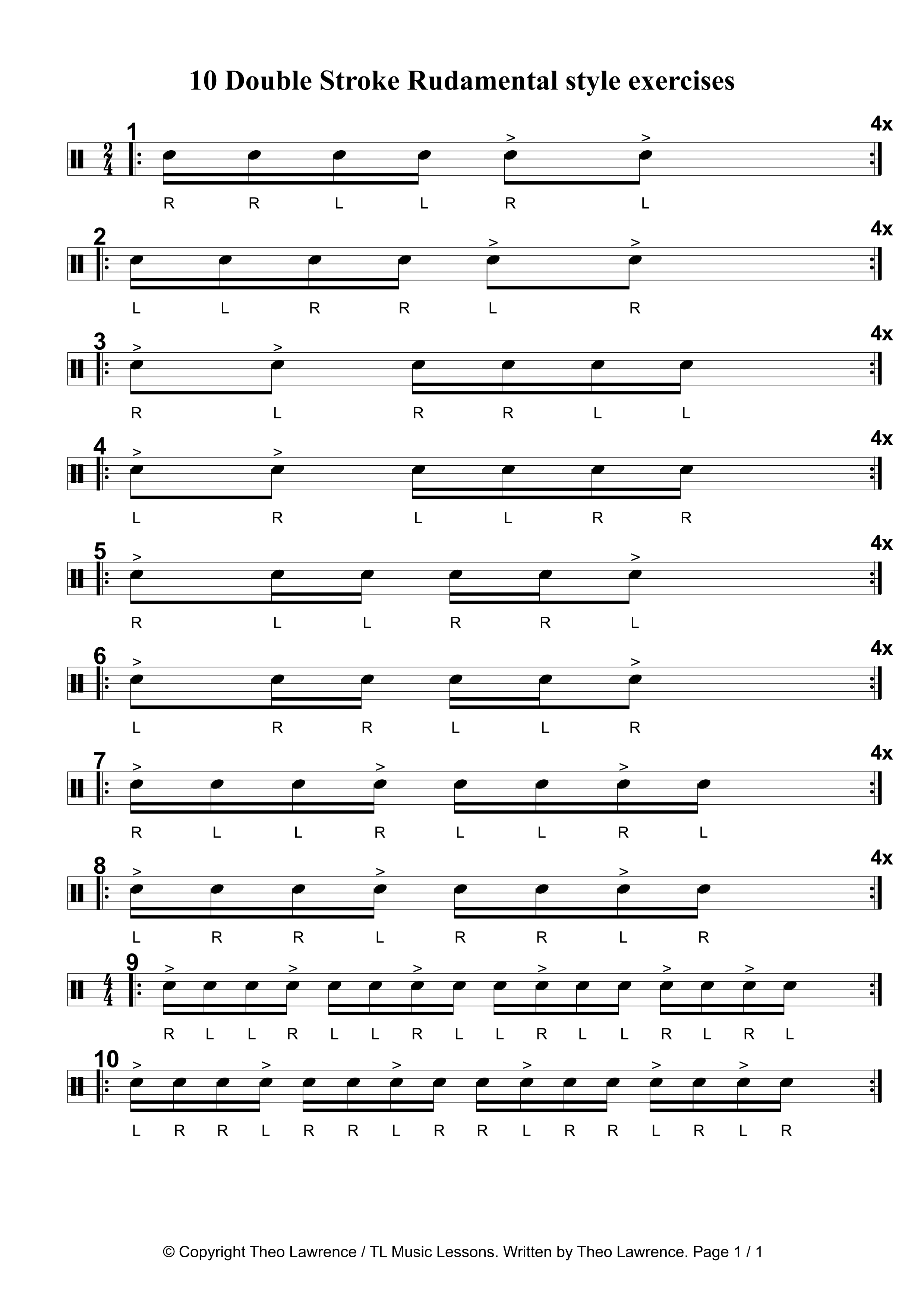
10 Double Stroke Rudamental style exercises

Video showing Exercise 1 & 2:

There are quite a few double stroke rudiment exercises in the 40 official drum rudiments, but none of these are in them. While the ’40 drum rudiments’ cover many of a drummers needs, in terms of practicing, there are many more double stroke exercises that are useful to learn.

The 10 rudiment – style snare drum exercises here are all involving double strokes. These snare drum exercises are all rhythms that I use quite often in my drumming, so to me they are quite essential I believe.

When learning rudiments, I was always taught that they are preparing you for possible eventualities in drumming – for example by learning and practicing the flam with different leading hands, you have prepared for using it in drum fills in songs, in a variety of situations. So to me, all of these 10 rudiment exercises are essential patterns that you will need at some point as a drummer, so to master these, will be beneficial to you for when you meet the patterns elsewhere.

Here is how all of the exercises sound:

Intermediate Drum Warm-Up – Part 2

Following on from the Grade 1-3 Drum Lesson Warm Up posted recently, and the intermediate drum warm-up Part 1 for drummers that have reached a higher level of ability (about Grade 4-6 +), here is the second part of the Intermediate drum warm up.

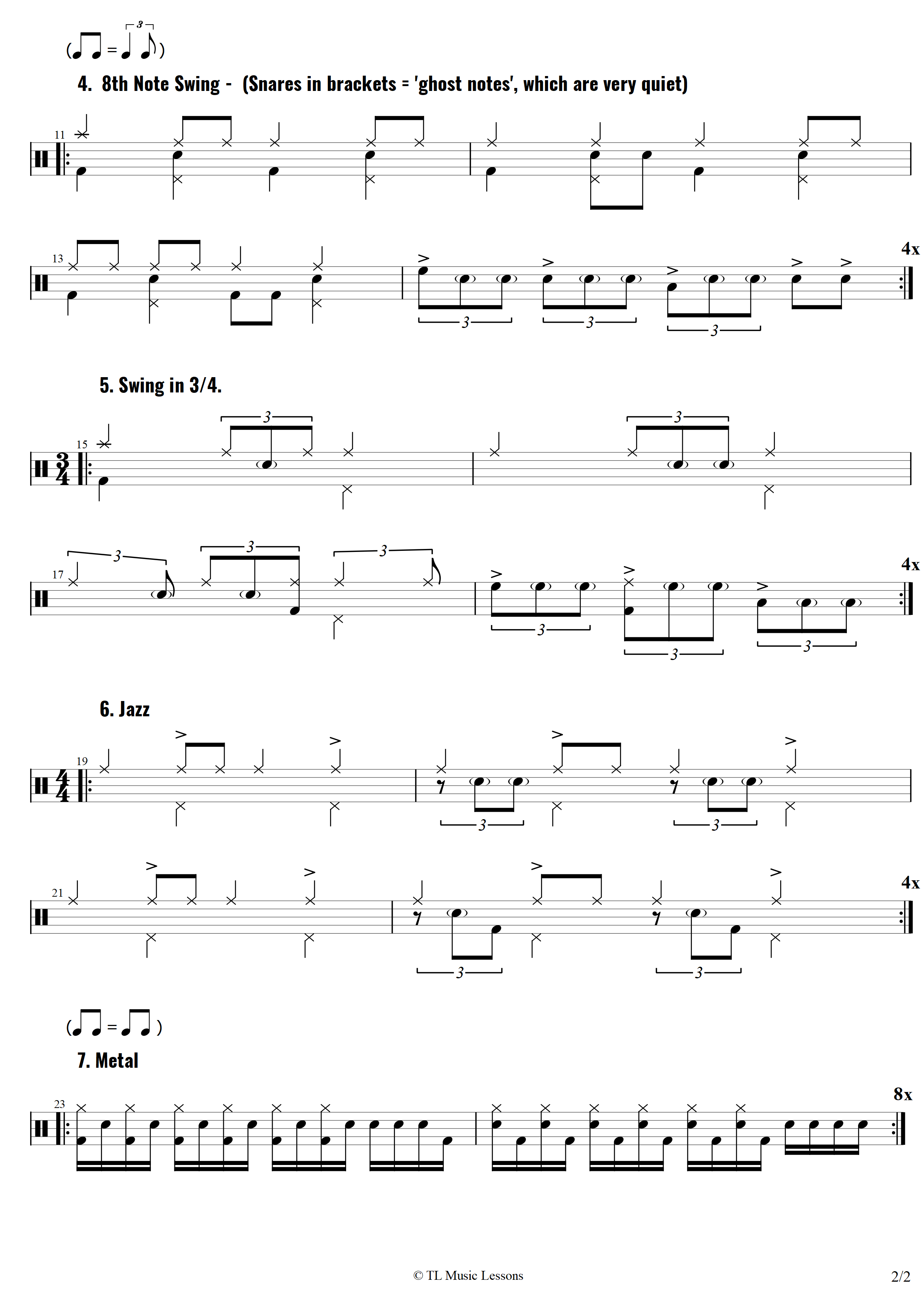
This second part of the warm up consists of stylistic exercise, including Swing in 4/4, Swing in 3/4, Jazz and metal. This is a continuation from part 1 where on exercise 3 there was a funk rock exercise.


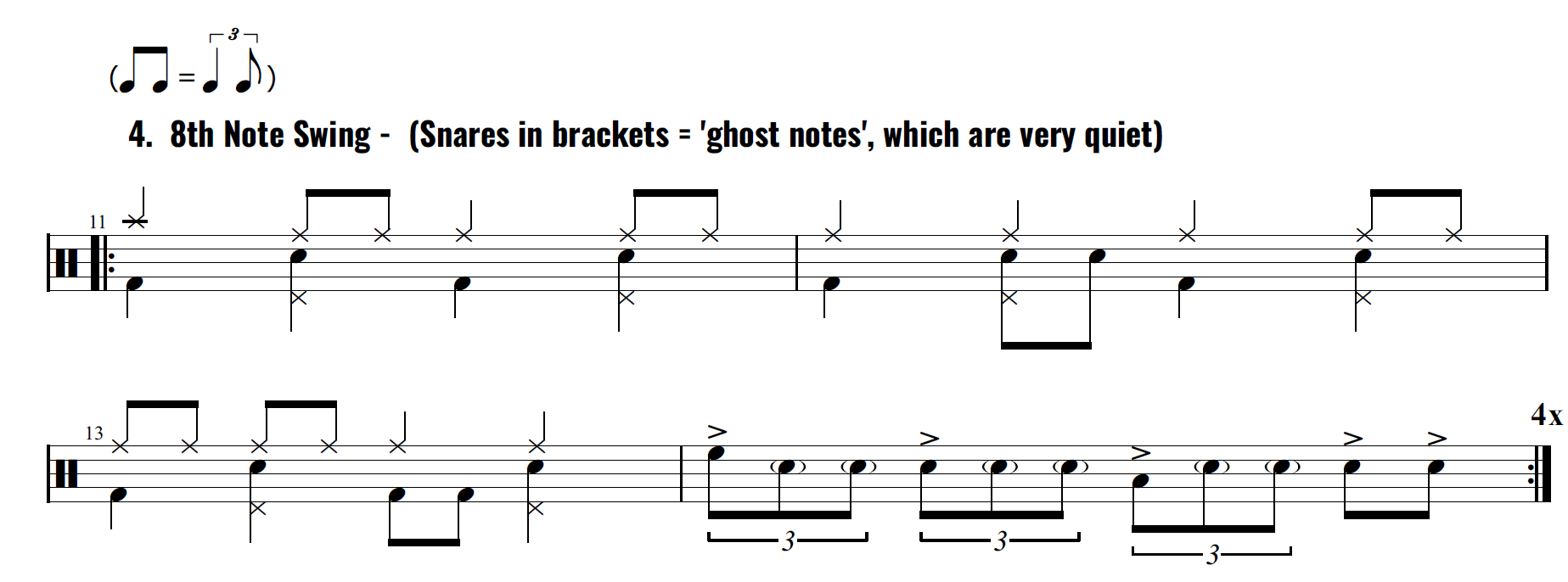
Exercise 4 – 8th Note Swing in 4/4.

The snare drums with brackets around are ghost notes, which means small quiet taps on the snare drum about 1-2 inches from the snare head. These beats and fills could be heard in musicals or swing bands for example.


Exercise 5 – 8th Note Swing in 3/4

These beats and fill again could be heard in musicals, swing bands, and also in Jazz.

Exercise 6 – Jazz

The ghost note snares and bass drums on the 4th bar are what you might play if you were comping. Here is a video that goes into great detail about comping:

Exercise 6 Jazz Warm up

Exercise 7 – Metal

This exercise is a good warm up for anyone and only needs a single bass drum pedal (kick pedal). It’s sort of an introduction to blast beats. You can learn more here in this video:


2 Minute Snare Drum Warm Up

It feels like we’ve all moved on with out lives after Nirvana, and then all of a sudden some kid reminds us what it used to be like listening to In Bloom, by slaying the drums along to the song and then we stick on the albums again! Let us not ever move on too far. Lest us forget.

Coincidentally (not!), I wrote this snare drum warm up this morning for my drum group. We went through it today without reading it but soon it will be a reading exercise. It has most of the basics needed for levels spanning grade 1-5. Lots of different subdivisions in here to practice. You could break up the warm up and just work on one line, or 4 bars, or 1 section at a time.

Free Downloads

PDF Download

Guitar Pro 7 Download

Here’s what page 2 looks like:

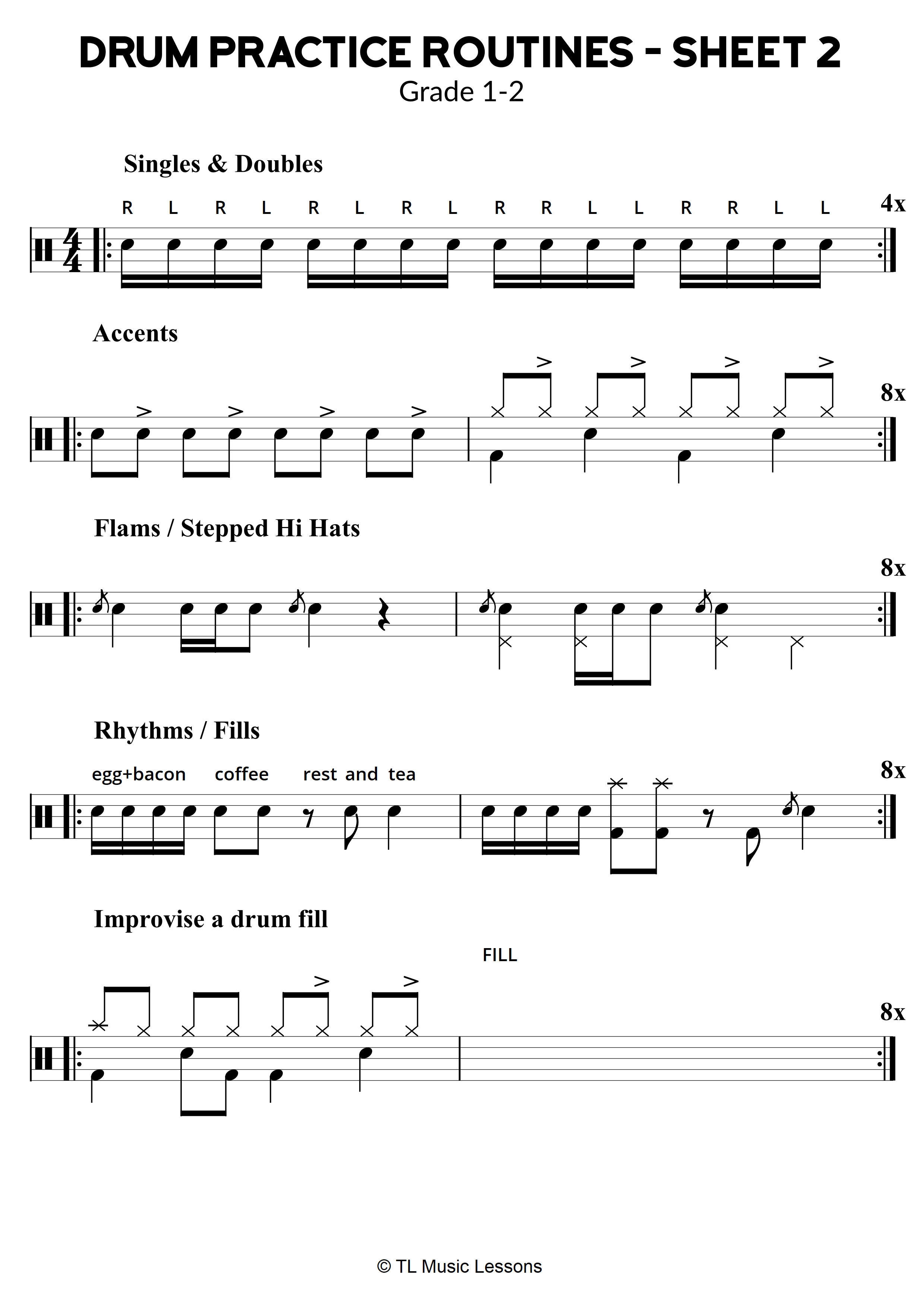
Drum Practice Routines – Sheet 2 – Grade 1-2

Free PDF Download:

Drum Practice Routines – Sheet 2 – Grade 1-2


It’s still the summer holidays and most people are taking a well deserved break. I’ve been on holiday and I’m fully relaxed but I have a few lesson days coming up so I’m keeping on with lesson prep and making new material like this. I have made this sheet for some of my drum students to learn and practice over the holidays, which can be done in about 5 minutes and can be easily practiced several times per week.

In this practice routine, we are covering many of the fundamental parts of grade 1 and grade 2 material. First on the sheet we have singles and doubles (left handers need to play the opposite sticking to the ones shown). Whilst we don’t usually learn a proper double strokes technique until about grade 5 level, we still play doubles to get used to it, and you will just be hitting the drum with the same technique as you would for a single hit.

Secondly, we will be accenting (playing louder) the ‘off beat’, which means it’s not on the 1 2 3 4, it’s in between those. You could cound 1 + 2 + 3 + 4 +. The accents would then be on every +. Then, moving onto a basic drum beat in the second bar, the accents are played in the same place but this time you play them on the hi hats.

The flams and stepped hi hat section is for building up your stepped hi hat coorination aswell as for practicing the all important flam. Make sure the stick height for the quiet note in the flam is kept quite close to the drum (2 to 4 inches depending on the volume). The stick can start at a much higher position for the loud note in the flam.

For the rhythm/fills section, I have included ‘breakfast rhythm’ counting to help. If you say the words at the same time as playing the rhythm, it should help you. The rhythm on the drum fill is the same as the one in the first bar on the snare drum, so it’s a nice exercise that flows.

Lastly, many students complain about improvisation, so it’s important to practice this until confidence is higher. Start off with really easy drum fills lasting for 1 bar and build up your confidence with each practice.


Related: Drum Practice Routines – Sheet 1 – Grade 1-2
Drum Practice Routines – Sheet 1 – Grade 1-2
In this practice routine, we are covering many of the fundamental parts of grade 1 and grade 2 material. On the sheet we have a paradiddle 8 times (left handers need to play the opposite sticking).

There are accents on 8th note snare drums and then moving onto a basic drum beat, the accents are played in the same place but this time on the hi hat part of the drum beat.

The flams and stepped hi hat section has a classic rock feel to it and it is an easy way of introducing 4 way coordination into your playing.

For the rhythm/fills section, it’s the same rhythm on the drum fill as it is in the first bar on the snare drum, so it’s a nice exercise that flows, so we do that 8 times.


Related: Drum Practice Routines – Sheet 2 – Grade 1-2

Drum Practice Routines – Sheet 1

Here is a sheet that is ideal for drum teachers to give their grade 3-4 students to practice as ongoing homework for perhaps a half term, or 4-6 weeks. Rather than giving them something new each lesson to practice, this substantial sheet can be given to practice alongside a song or their homework for a grade they might be working towards.

There are several sections, covering many of the techniques and requirements of the Grade 3 level, and a lot of it crosses over to Grade 4 too, so I’d say Grade 3-4. The following techniques and exercises are included on the sheet: Paradiddles, Accents, Skip Beats, Flams, Stepped Hi Hats, 4 way coordination, Syncopated Rhythms, Drum Fills, Improvisation.

Snare Drum Piece – Jan 2018

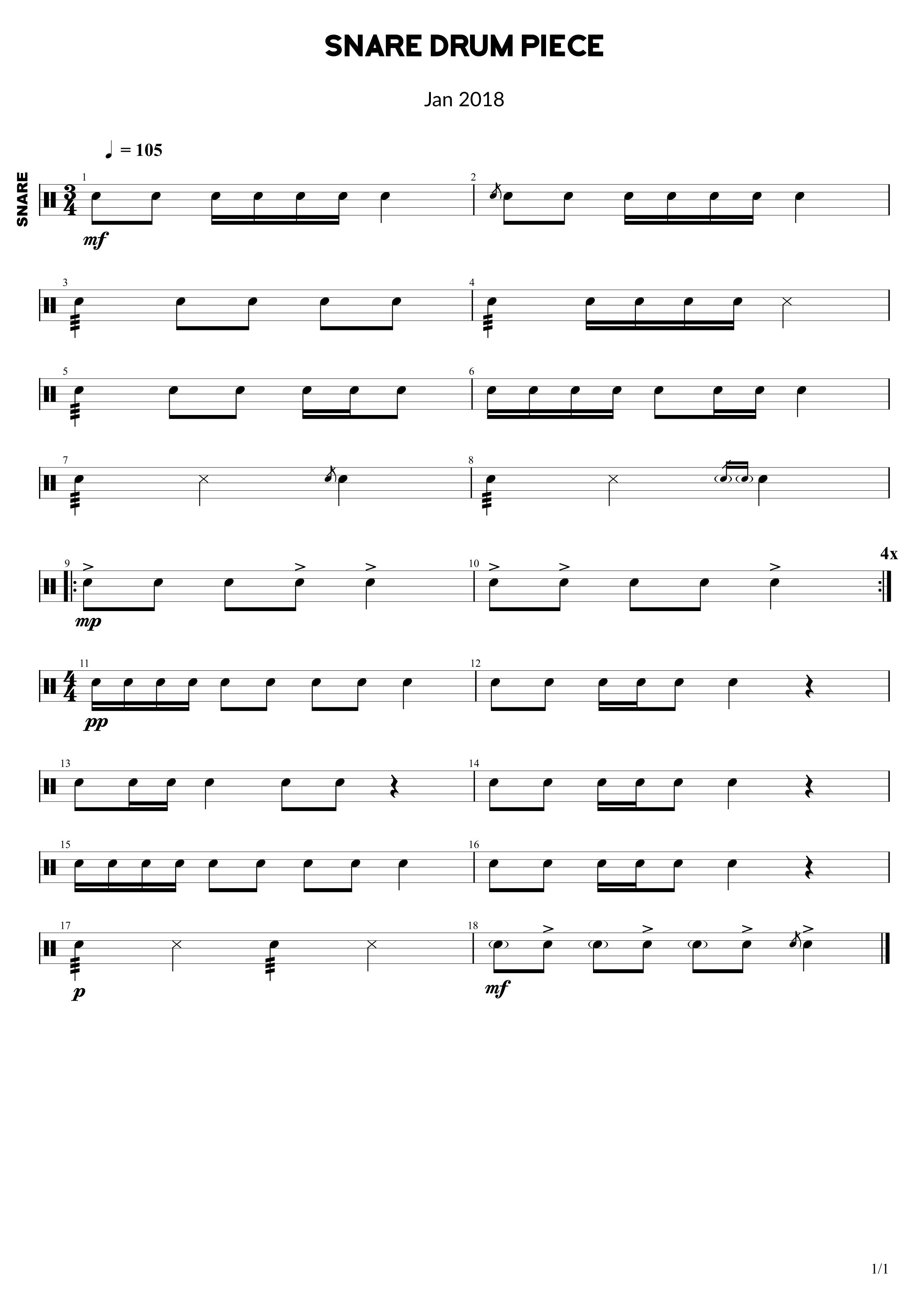
Here is some drum sheet music of a snare drum piece, which can be played by a solo snare or a snare line group.

The snare piece starts off in 3/4 timing and then moves into 4/4. There are various dynamic changes. There are also plenty of techniques involved. In bar 2 there is a flam. Bar 3 sees the first buzz roll. Bar 4 has a rim hit on the last note. Bar 8 has a drag at the end. Bar 9 and 10 are repeated 4 times and feature accents. Bar 11 starts the quietest section in pp, which means very quiet (pianissimo). Bar 12 sees the first rest, and the final techniques are found in the final bar, which are ghost notes.


Related: Group Snare Drum Piece with 3 difficulty levels (Piece 2, Book 1)

(Premium) – 10 Snare Drum and Floor Tom Pieces – Book 1

Buy Now →

Summary

This book was written over the course of 1 year for a group of youth drummers (Montgomeryshire Youth Music Drumline) in Powys, Wales. I have compiled the year’s pieces into an ebook that can be used by other drum teacher, or by self taught drummers. The pieces are similar to Snare Drum Sheet Music style pieces, but with the added timbre of a floor tom. You can achieve quite an epic cinematic sound by combining the two drum voices in unison. Difficulty levels from Grade 1 to Grade 3-4.

People that might find this book useful

  • Drum groups, drum workshops and drum ensembles – Youth groups or adults
  • Drum teachers are completely free to print the book or single sheets for their students.
  • Drummers can teach themselves following on from a strong basic foundation in reading and playing
  • Drummers that need to perform for school or competition etc.
  • Drummers looking to improve their rhythms for drum fills and snare drum sheet music
  • Groups of drummers can perform together using a snare and floor tom each, or by using any other two drums

Rules for sharing this content

When you purchase the book, you will receive a .pdf file that you can keep and use forever.
You can email the .pdf file privately to your students
You can print out unlimited copies for your students or for yourself
You cannot resell the .pdf or distribute the .pdf file online in any way (not even for free). This also applies to exported images, photos or scanned copies of the book

About the book

The 10 pieces are performance pieces for drums, with no backing. Drum groups, or individual drummers can perform these pieces. They have been written to sound good as standalone pieces – they are not just practice exercises. The pieces do not focus on many dynamics, but they do cover many techniques, rhythms and some rudiments, from quarter notes to sextuplets and triplets, and from flams to drags and buzz rolls.

Some of the pieces have multiple parts, which may be played together. So, if your group has varying ability levels, some can play part 1, some part 2, and some part 3. Not all the pieces have 2 or 3 parts. Please check the contents page to match up the pieces. I have compiled the book in order of difficulty. The levels go from about grade 1 up to grade 3-4 level.

Reading Tip: I developed the writing over the year. For pieces with two stave lines – the top line is the snare and the bottom line is the floor tom.

Final Thoughts

This book is a follow on from “10 Snare Drum Pieces – Book 1”, written in 2015. That book was for snare drum only, and in the last 2 years has been purchased by 60 people from all around the world, many of which are teachers themselves who are using the book to teach their students or drum groups with.

I hope this new ebook will inspire more groups of this type. I’m sure it’s not the first time it’s been done with groups of drummers, each playing a snare and floor tom, but I do think it is very rare to see it. I hope to inspire other groups to adopt this idea. I’m sure this won’t be the first and last book of it’s kind, because I intend to continue teaching the MYM Drumline for many years to come, and I will be writing new pieces for the group regularly.

Recommended reading for use with this ebook:
Accent Techniques – Down, Tap, Up, Full Strokes
Reading Buzz Rolls And Double Stroke Markings

Buy Now →