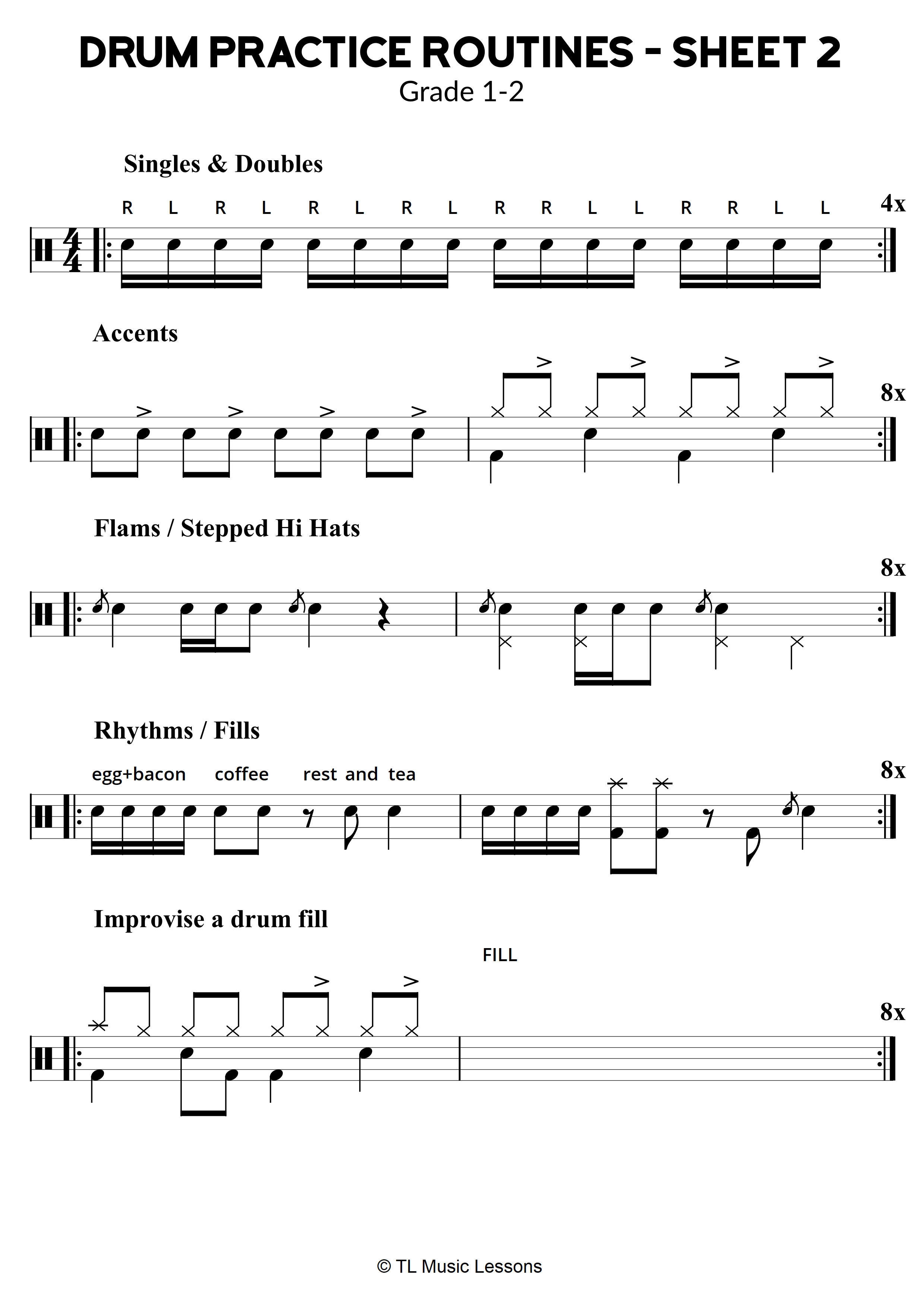
For this exercise sheet, you will need some basic beginners reading knowledge of drum beats and drum fills.
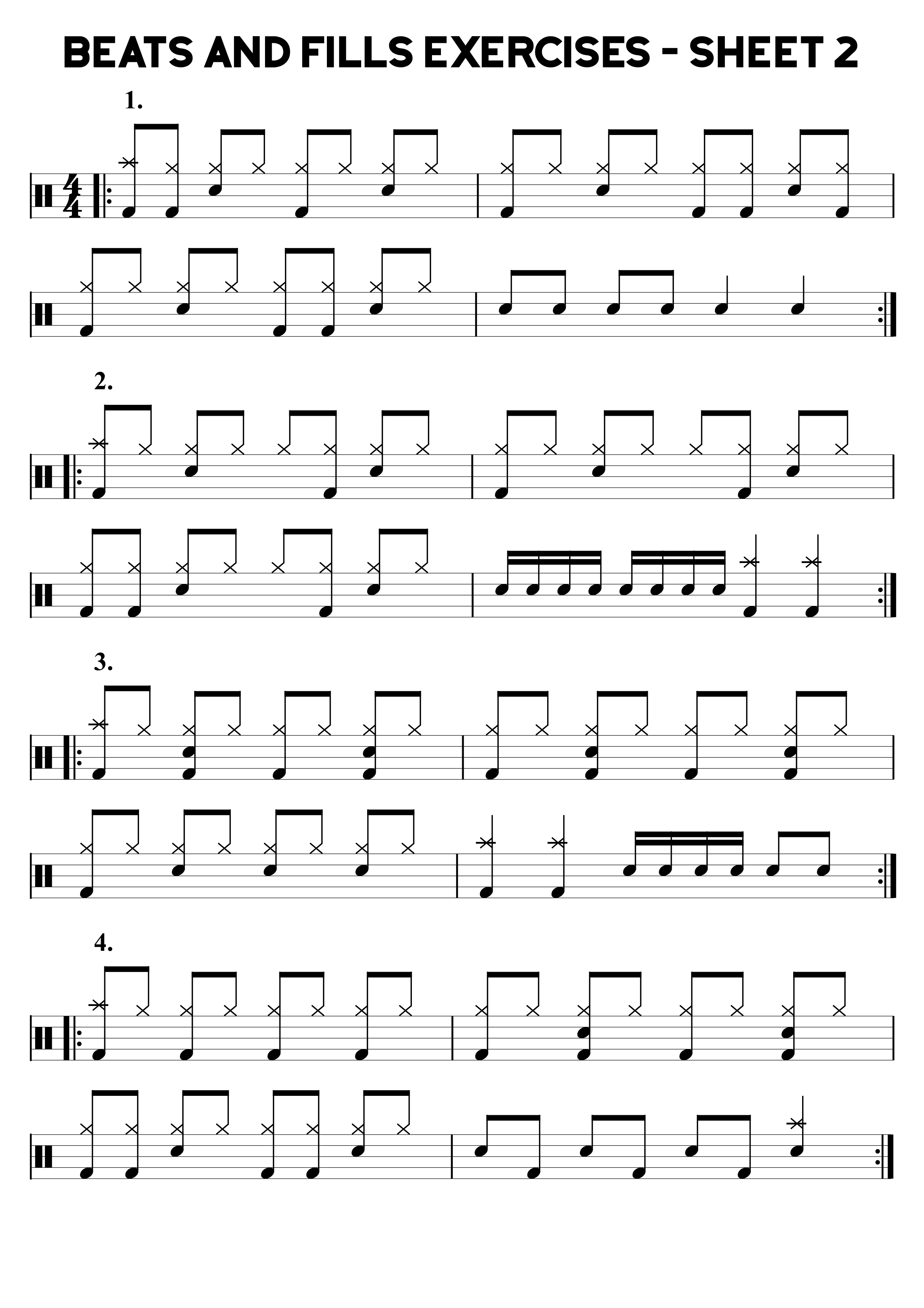
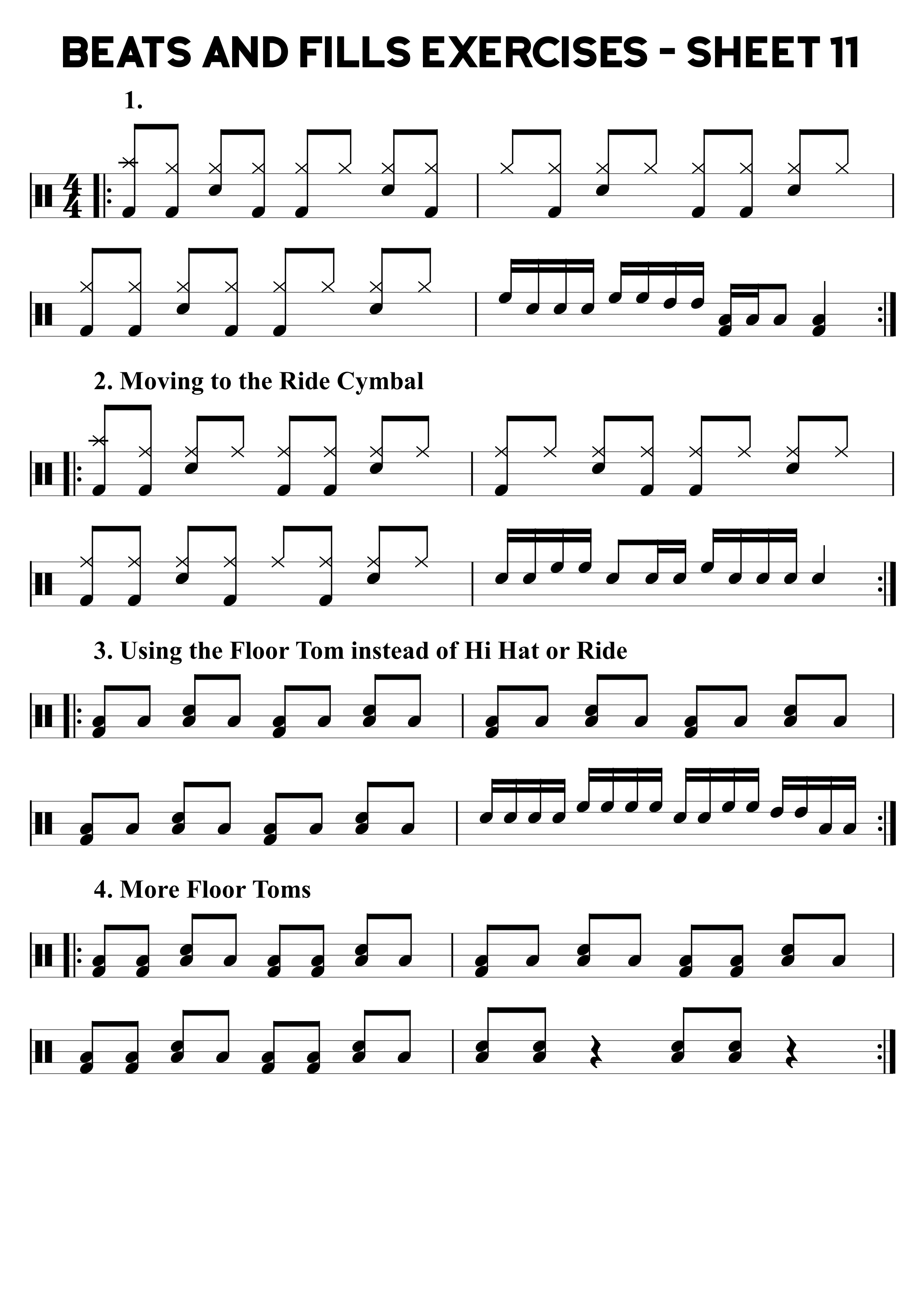
In the exercises, you will play 3 bars of drum beats, 1 bar of a drum fill and then repeat the exercise. There are 4 exercises on the sheet and each one can be played twice, or more times if you like and perhaps the sheet can be revisited on over several practice sessions if needed.
On the first 3 exercises, there are times when there are 2 hi hats on their own with no bass drum or snare drum, so it’s helpful to especially listen out for these two hits whilst playing to avoid missing one of them out, as some learners can do by accident.
All of the drum fills are played on the snare drum only. If there are 2 lines attaching the notes, they are played as 4 fast notes. If there is 1 beam attaching the notes, they are 2 medium speed notes, and if there is one single note on it’s own, it’s 1 single hit lasting for 1 beat. There is also a rests for 1 beat that look like a squiggle on the 3rd exercise’s drum fill, so for that you don’t play anything, and wait for 1 more beat before continuing.
It’s still the summer holidays and most people are taking a well deserved break. I’ve been on holiday and I’m fully relaxed but I have a few lesson days coming up so I’m keeping on with lesson prep and making new material like this. I have made this sheet for some of my drum students to learn and practice over the holidays, which can be done in about 5 minutes and can be easily practiced several times per week.
In this practice routine, we are covering many of the fundamental parts of grade 1 and grade 2 material. First on the sheet we have singles and doubles (left handers need to play the opposite sticking to the ones shown). Whilst we don’t usually learn a proper double strokes technique until about grade 5 level, we still play doubles to get used to it, and you will just be hitting the drum with the same technique as you would for a single hit.
Secondly, we will be accenting (playing louder) the ‘off beat’, which means it’s not on the 1 2 3 4, it’s in between those. You could cound 1 + 2 + 3 + 4 +. The accents would then be on every +. Then, moving onto a basic drum beat in the second bar, the accents are played in the same place but this time you play them on the hi hats.
The flams and stepped hi hat section is for building up your stepped hi hat coorination aswell as for practicing the all important flam. Make sure the stick height for the quiet note in the flam is kept quite close to the drum (2 to 4 inches depending on the volume). The stick can start at a much higher position for the loud note in the flam.
For the rhythm/fills section, I have included ‘breakfast rhythm’ counting to help. If you say the words at the same time as playing the rhythm, it should help you. The rhythm on the drum fill is the same as the one in the first bar on the snare drum, so it’s a nice exercise that flows.
Lastly, many students complain about improvisation, so it’s important to practice this until confidence is higher. Start off with really easy drum fills lasting for 1 bar and build up your confidence with each practice.
In this practice routine, we are covering many of the fundamental parts of grade 1 and grade 2 material. On the sheet we have a paradiddle 8 times (left handers need to play the opposite sticking).
There are accents on 8th note snare drums and then moving onto a basic drum beat, the accents are played in the same place but this time on the hi hat part of the drum beat.
The flams and stepped hi hat section has a classic rock feel to it and it is an easy way of introducing 4 way coordination into your playing.
For the rhythm/fills section, it’s the same rhythm on the drum fill as it is in the first bar on the snare drum, so it’s a nice exercise that flows, so we do that 8 times.
Here is a sheet that is ideal for drum teachers to give their grade 3-4 students to practice as ongoing homework for perhaps a half term, or 4-6 weeks. Rather than giving them something new each lesson to practice, this substantial sheet can be given to practice alongside a song or their homework for a grade they might be working towards.
There are several sections, covering many of the techniques and requirements of the Grade 3 level, and a lot of it crosses over to Grade 4 too, so I’d say Grade 3-4. The following techniques and exercises are included on the sheet: Paradiddles, Accents, Skip Beats, Flams, Stepped Hi Hats, 4 way coordination, Syncopated Rhythms, Drum Fills, Improvisation.
Sheets 1 to 10 are available as an ebook called 40 Beats and Fills Exercises Ebook, which consists of 10 drum exercise sheets with 4 exercises on each page.
In that book, the exercises are all based on beats using the Hi Hat and playing a drum fill on bar 4, and then repeating. The next step you could take is continuing those beats but moving the right hand (if you are right handed) onto the Ride cymbal or the Floor Tom, instead of playing the Hi Hats throughout the drum beats.
This, ‘Sheet 11’, is a continuation of this book, available for free, There are various directions you could go after the first book. I am also writing another book focusing on playing on the ride cymbal and using the stepped hi hat, which may become or feature as ‘Book 2’ of this series, or perhaps I will do a mixture and include sheets like this one too.
The drum music is written in an easy to read sort of way, where all of the drum voices (bass, snare, hi hat etc) are linked in one stem, rather than separating the cymbals from the rest of the drums. This way of writing and reading has proved very popular with my students and I think it’s a good way of reading drums to start with, before moving on to the regular way of writing and reading the music.
I’ll start by saying I’m really pleased with this ebook! It’s a compilation of half a year’s work, which started out as making some fun and useful exercise sheets for my drum students. I would make one sheet every every couple of weeks or so and it eventually finished at sheet 10, not just because it’s a round number, but because I was ready to start introducing other things that wouldn’t neccesarily fit in neatly with this ebook. I’m very pleased with the book because it’s very focussed on the fundamentals of drumming that every drummer should be learning to start with at least.
This drum ebook is a good set of exercises for the beginner drummer that has learned how to read and play very basic beats and fills already. All 40 exercises are laid out in the same way so it’s a focussed effort on building up your core drum beat beat and drum fill skills.
For beginners Grade 1-2 level drummers.
10 Exercise sheets with 4 exercises per sheet.
Improve your drum beats and drum fills and practice changing from one to the other.
Exercises consist of 3 bars of a drum beat and 1 bar of a fill, repeated.
It’s a fun ebook to work through quickly or slowly. 1 sheet per week would work well for some.
The layout is slightly different to my other books so far. Usually the cymbals are notated separately (stems pointing up) to the rest of the drums (pointing down), but in this book everything is pointing in the same direction (usually up, although it doesn’t matter which way they go). I find that at this beginners / grade 1 stage, it all makes more sense this way to learners because otherwise you get rests appearing sometimes in the bottom part of the stave when there are still hi hats playing, and this almost always causes confusion with beginners young and old. It’s important to learn the other way too and move onto that, and it’s like that in most of my other books.
For beginners, but not straight away
A complete beginner could start this book early on, but not straight away. They can follow the book either with a teacher or on their own if they are a quick learner. Self taught learners may need to look some things up because not everything is explained for the complete beginner. A good book to start with for complete beginners is First Drum Book – Easy Reading Beats & Fills, which is especially good for younger learners. Another ebook that has content for complete beginners in is Beats and Fills Drum Book – Basic Beginners – PDF Ebook. That book goes beyond complete beginner too and has similar ability level content to this book, so it can be used in addition.
The usual info
When you purchase, you get a pdf file to keep. Please do not redistribute the file, unless you are a teacher sending it to students to practice with.
Drum teachers can print the book or single sheets as required for their students.
Drummers can teach themselves following on from a strong basic foundation in reading and playing
This short ebook gives you 1 page of the break down of how a basic drum beat is contructed and then 3 pages with 10 rock drum beats on each page.
The first of the 3 core pages of beats is with 8th note closed hi hats. The second page is the same beats again but with open hi hats (the note heads with cirles around them). The 3rd page has different beats with quarter note hi hats (really has that rock sound), which can also be played as half open hi hats or closed hi hats.
I hope this free ebook is helpful for students and teachers looking for a few quick sheets to get them started with. I also hope that you will enjoy the quality of the free ebook enough to try some of the premium drum ebooks.
An interesting style of drumming that has become popular recently is live breakbeats or human drum ‘n’ bass music. Bands like Nerve and Shobaleader One have been on the cusp of the movement and players like Johnny Rabb and Jojo Mayer have been using their considerable chops and applying them to electronic sounding, yet still very acoustic, beats for decades. Playing in this style can be a lot of fun because it is improvisational like jazz, technical and chops heavy like metal or prog, and very flashy with a prominent and featured drum part.
To get into this style you can start in a couple of places. Drum and Bass beats are traditionally either created by sampling existing music off of a turntable, or by programming rhythms into a drum machine. In this selection of exercises we will focus on recreating the drum machine sound, rather than the sampled sound. Programmed beats are sometimes called steps because of the 16 steps (16th notes on which you can apply sounds) of an old loop sequencer drum machine. These exercises all feature essentially the same 3 core steps. These are classic rhythms that permeate much of electronic music and can be embellished in many ways to come up with more interesting grooves. These first 3 patterns are demonstrated here:
The hi-hat or ride cymbal can be used with any of these steps. We can also change the value of the cymbal pattern from 8ths to quarters to change the feel. Try to work these basic beats up to at least 160bpm if not higher for an authentic sound.
For slower tempos, more cymbals keep up the energy level. 16ths would be the next logical step.
For a layered texture, add in hi hat with your foot. Drum machines can play lots of notes simultaneously, so layering in another cymbal pattern helps keep up the illusion of a programmed beat.
Keep in mind that drum machines have no soul. Counterintuitively, the less human feeling or groove you can impart to these patterns the better they will sound in a drum and bass context. Try to play all the cymbal notes at the same dynamic level and keep everything steadily right down the center of the beat. Once you master these patterns, you can begin to add ghost notes, hi hat openings, fills, and other elements to make things more interesting. More advanced step patterns, classic breaks, break manipulation strategies, and extended techniques, can be found in Live Drum & Bass – Breakbeats and Electronic Music for Real Drummers available from Hudson Music and Amazon.com
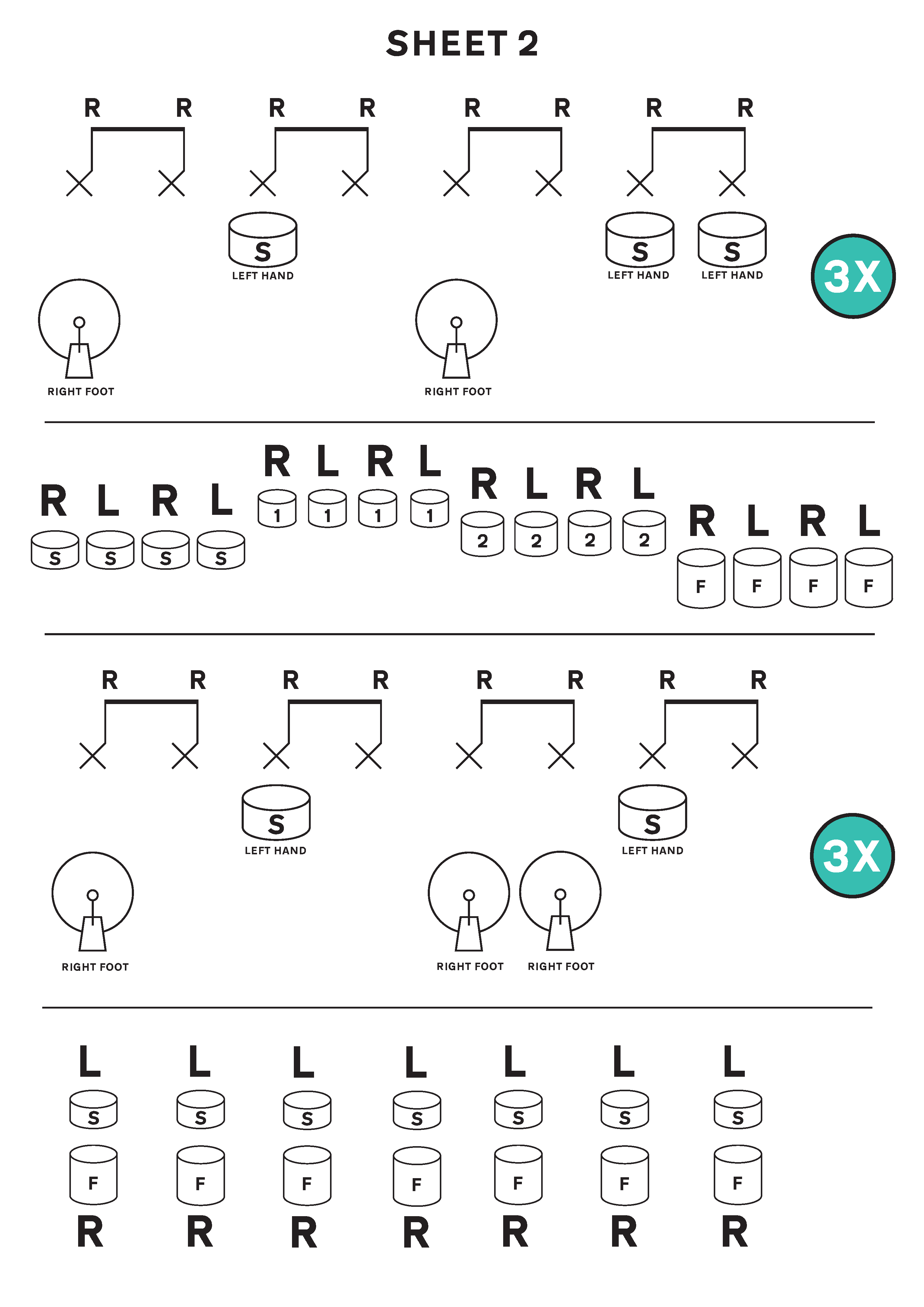
Here we have a drum beat repeated 3 times, then a fill, then another drum beat 3 times followed by another drum fill. The sheet can be then repeated around multiple times, or you could just repeat the first half around for a while and then focus on repeating the second half.
These are great for beginners and especially for those that haven’t moved on to reading drum sheet music properly yet. It will help those that struggle to read the drum music, for example young drum students.
Right handed drummers should play all of the hi hats with their right hand, and all of the snare drums with their left hand. Left handed drummers should do the opposite.
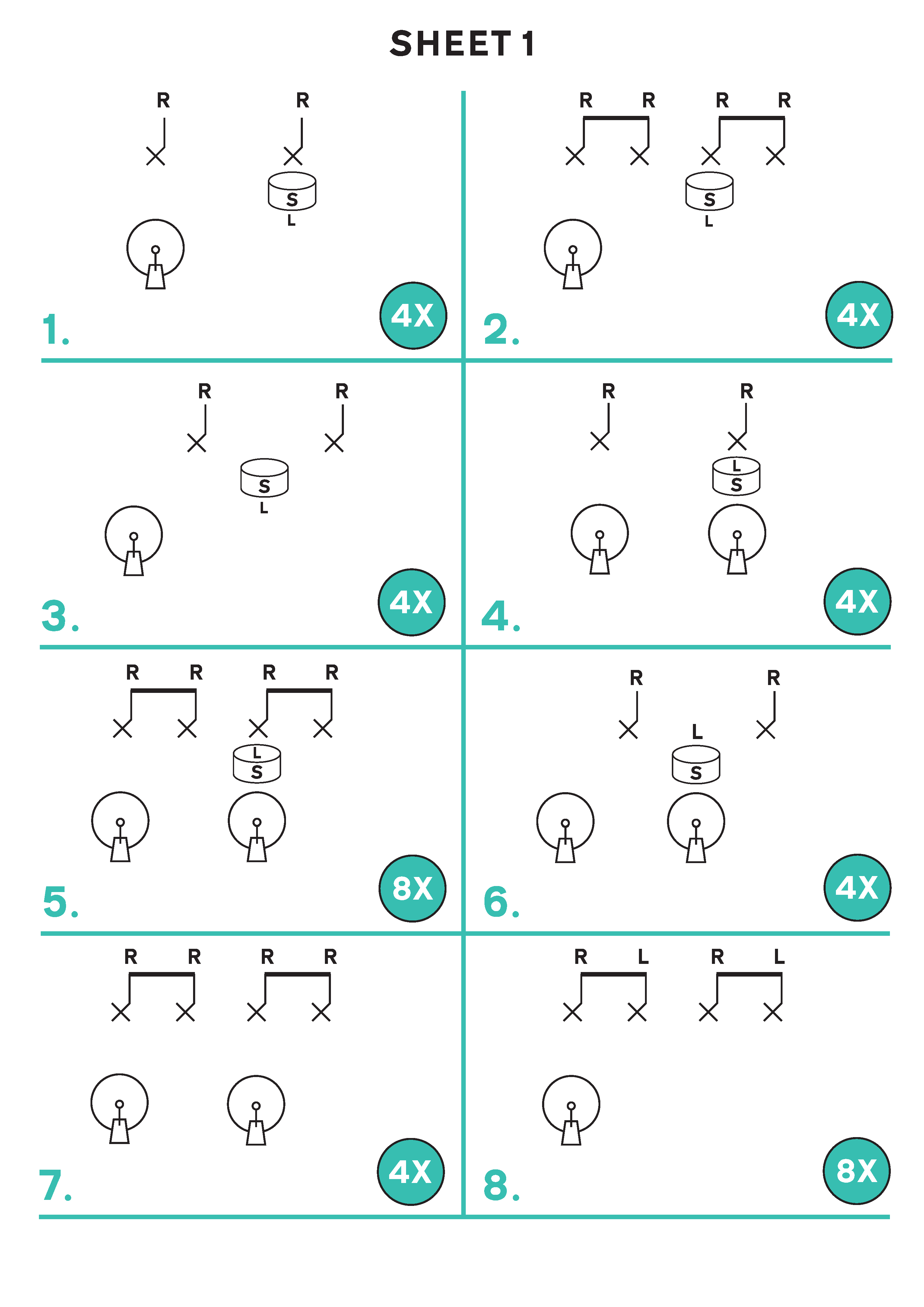
Here we have 8 drum beats, each lasting half a bar each. We’ll play them each 8 times, which will total 4 bars worth for each beat.
There are 3 drum voices; Hi Hat (the X‘s), Snare Drum (the drum with an S in it), and the Bass Drum / Kick Drum (the one that has a pedal attached to a circle).
These are great for beginners and especially for those that haven’t moved on to reading drum sheet music properly yet. It will help those that struggle to read the drum music, for example young drum students.
Right handed drummers should play all of the hi hats with their right hand, and all of the snare drums with their left hand. Left handed drummers should do the opposite.
Contains information related to marketing campaigns of the user. These are shared with Google AdWords / Google Ads when the Google Ads and Google Analytics accounts are linked together.
90 days
__utma
ID used to identify users and sessions
2 years after last activity
__utmt
Used to monitor number of Google Analytics server requests
10 minutes
__utmb
Used to distinguish new sessions and visits. This cookie is set when the GA.js javascript library is loaded and there is no existing __utmb cookie. The cookie is updated every time data is sent to the Google Analytics server.
30 minutes after last activity
__utmc
Used only with old Urchin versions of Google Analytics and not with GA.js. Was used to distinguish between new sessions and visits at the end of a session.
End of session (browser)
__utmz
Contains information about the traffic source or campaign that directed user to the website. The cookie is set when the GA.js javascript is loaded and updated when data is sent to the Google Anaytics server
6 months after last activity
__utmv
Contains custom information set by the web developer via the _setCustomVar method in Google Analytics. This cookie is updated every time new data is sent to the Google Analytics server.
2 years after last activity
__utmx
Used to determine whether a user is included in an A / B or Multivariate test.
18 months
_ga
ID used to identify users
2 years
_gali
Used by Google Analytics to determine which links on a page are being clicked
30 seconds
_ga_
ID used to identify users
2 years
_gid
ID used to identify users for 24 hours after last activity
24 hours
_gat
Used to monitor number of Google Analytics server requests when using Google Tag Manager



![[Premium] – 40 Beats and Fills Exercises Ebook](https://learndrumsforfree.com/2019/wp-content/uploads/2019/04/40-Beats-and-Fills-Exercises-Cover.png)