Drum Lesson Warm Up

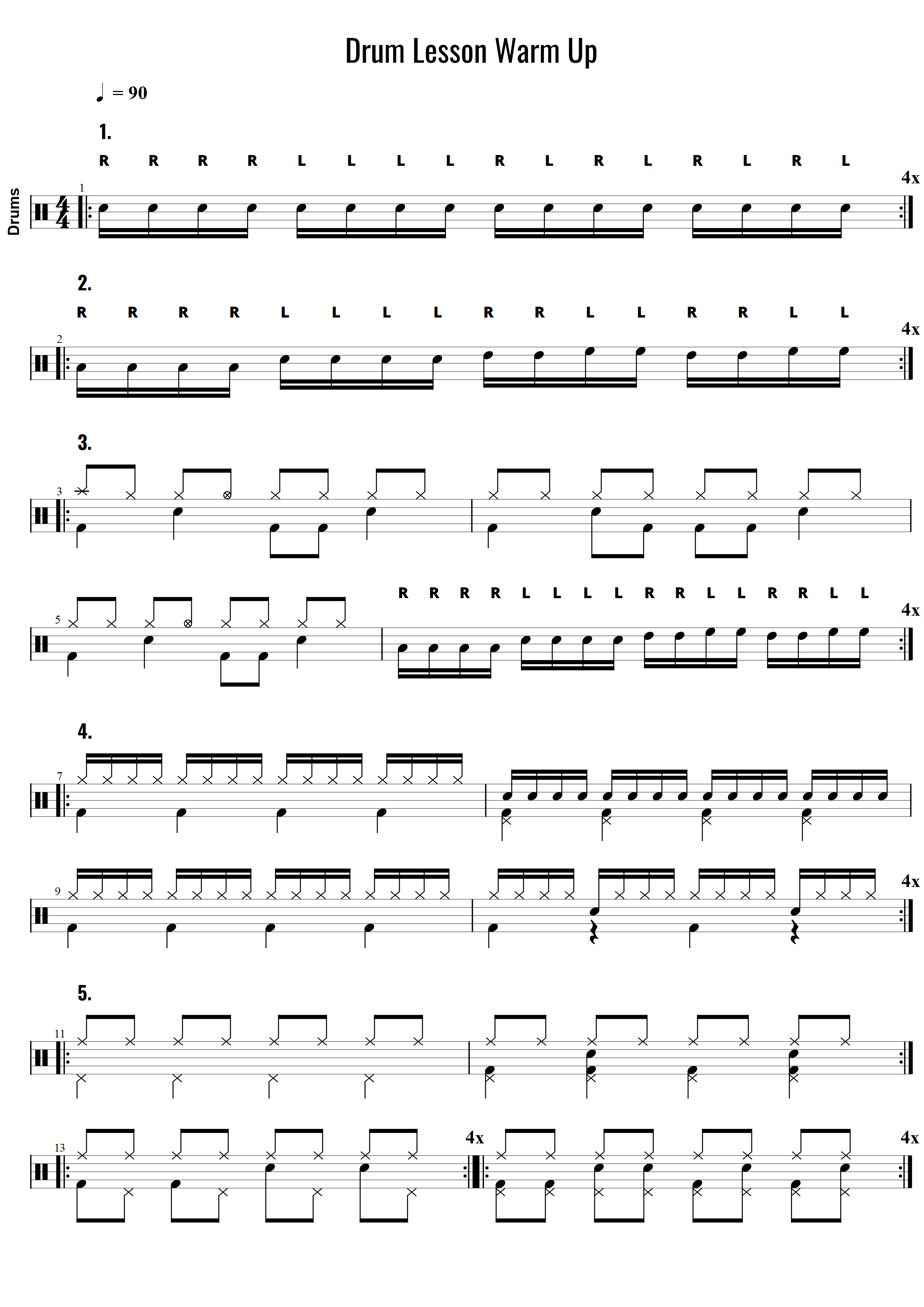
5 warm up exercises for the start of a drum lesson. Sticking patterns, drum beats, drum fills and beats with 4 way co-ordination.


These exercises that would be a good warm up at the start of a drum lesson or at the start of a drum practice session. Anyone from Grade 1 up to Grade 6 could use this as a warm up. It would be quite a challenge for grade 1. For a grade 6 player, they should be able to play through this quite quickly.

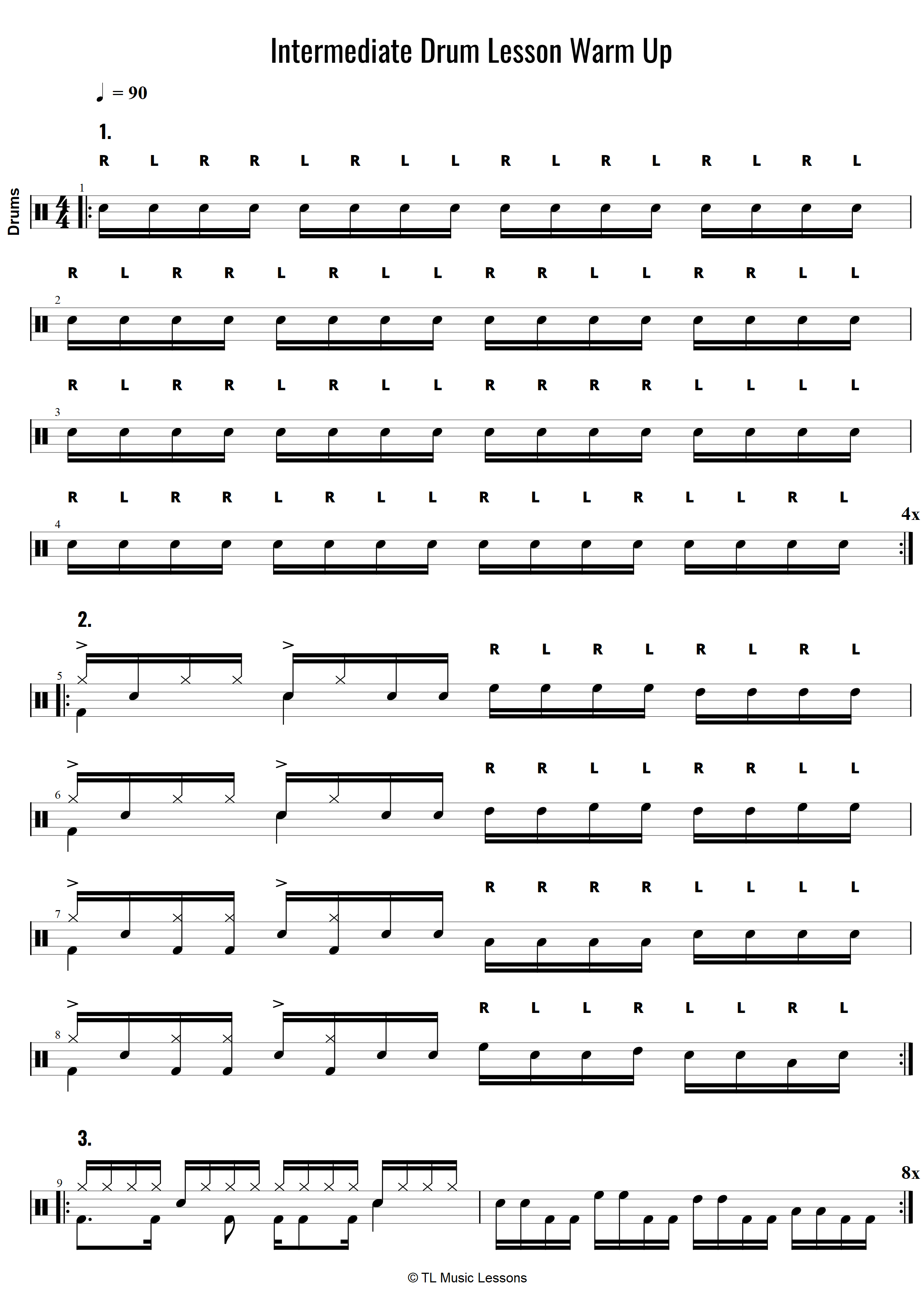
Exercise 1:

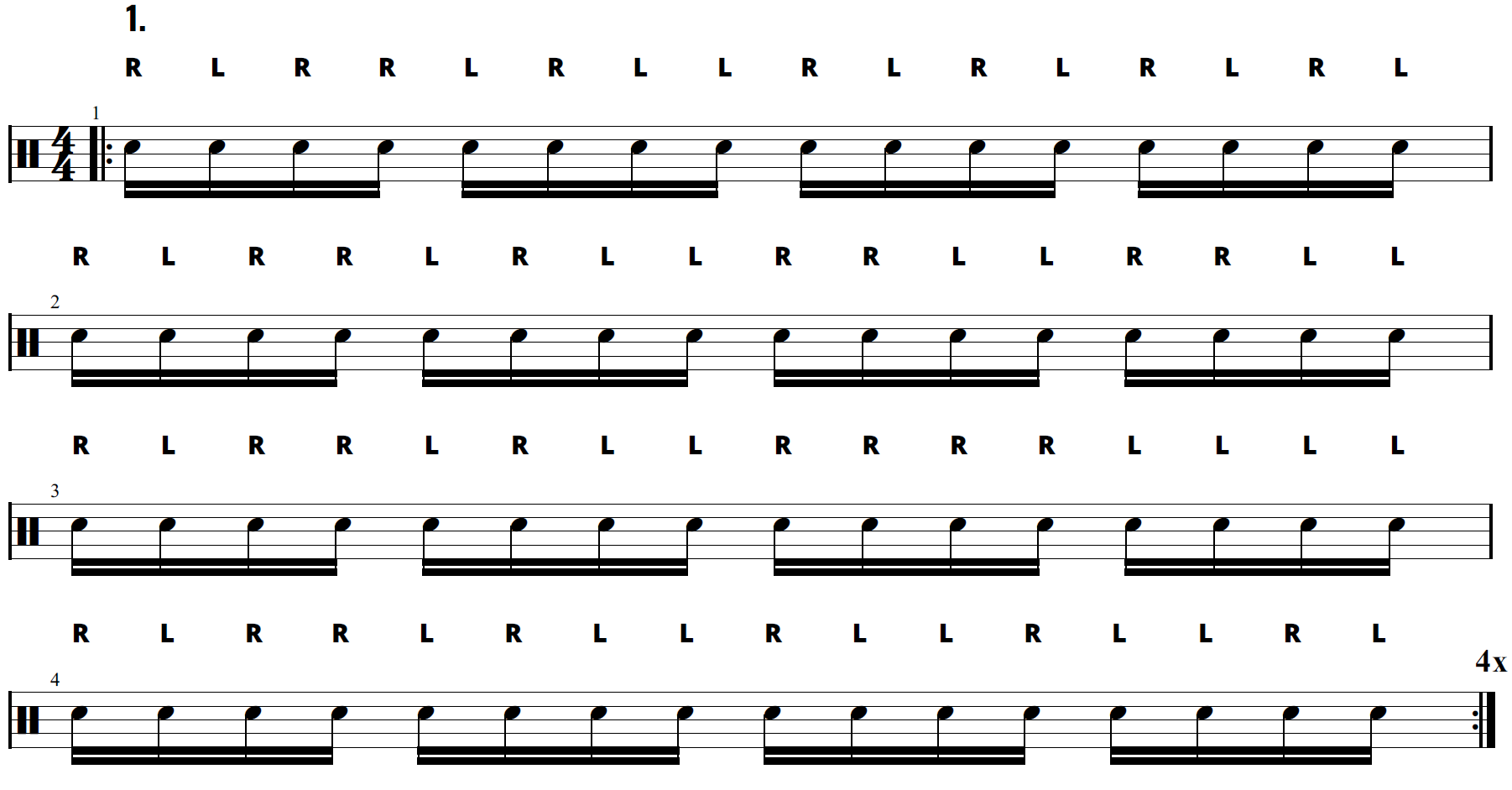
Snare drum exercise with a RRRR LLLL RLRLRLRL sticking pattern.

Snare drum exercise with a RRRR LLLL RLRLRLRL sticking pattern.

Exercise 2:

A drum fill exercise using a RRRR LLLL RRLLRRLL sticking pattern.

A drum fill exercise using a RRRR LLLL RRLLRRLL sticking pattern.

Exercise 3:

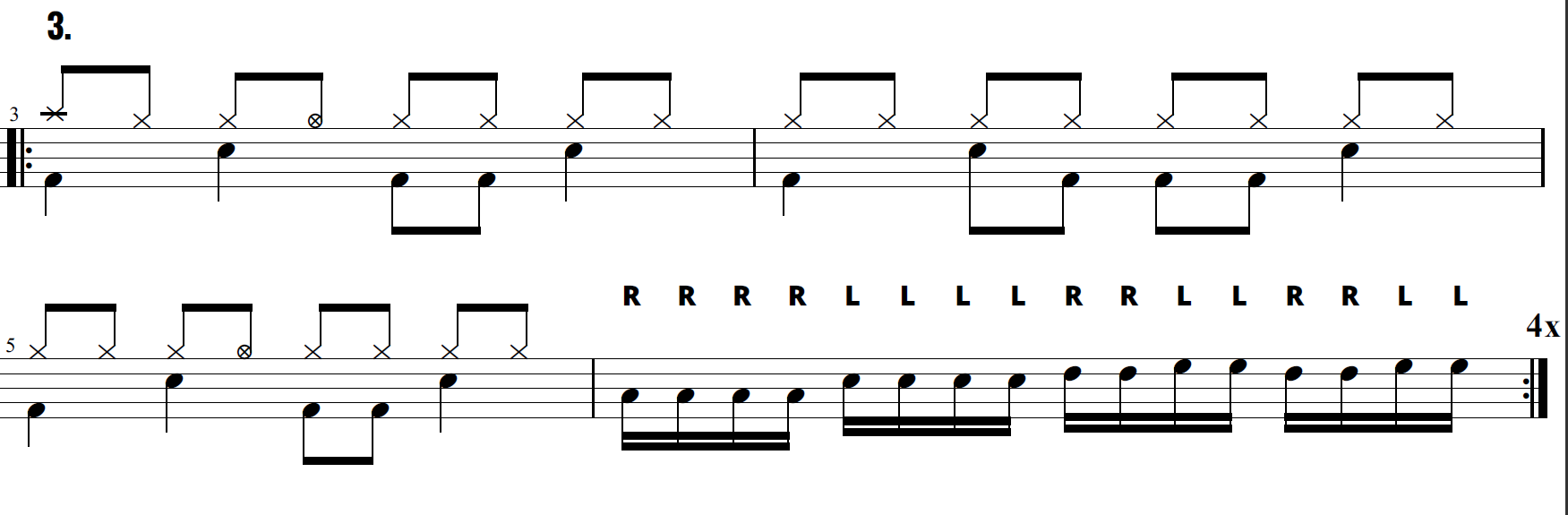
A 3 bar drum beat with open hi hats and drum fill exercise using Exercise 2 as the drum fill

A 3 bar drum beat with open hi hats and drum fill exercise using Exercise 2 as the drum fill

Exercise 4:

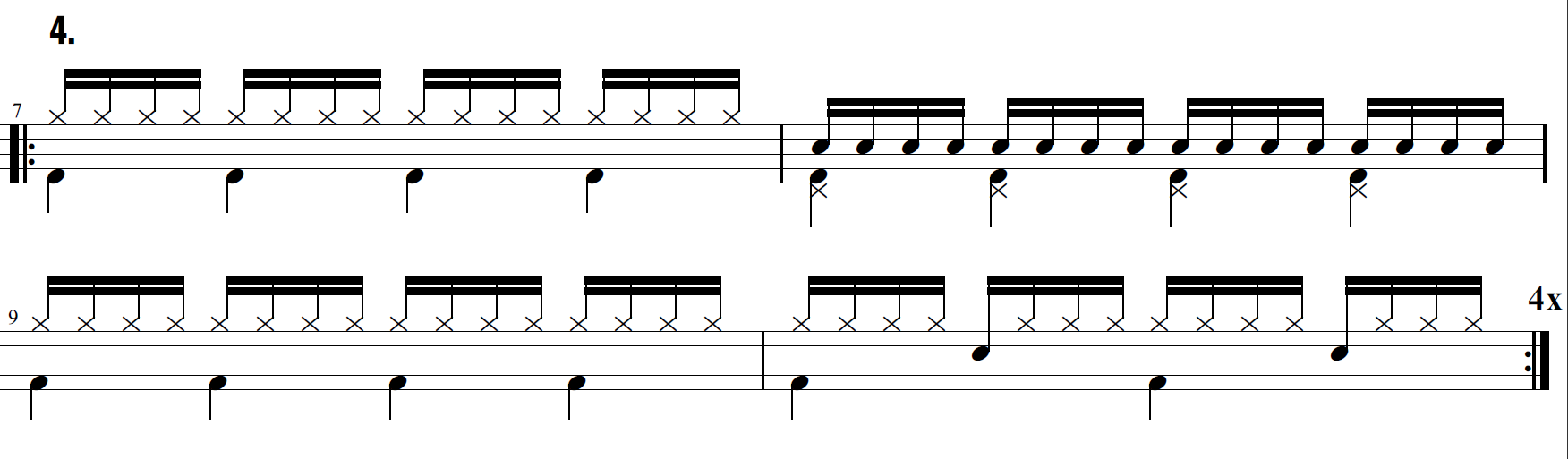
Working on a 16th note hi hat pattern and moving that to a snare drum whilst adding a stepped hi hat to work on 3 way co-ordination.

Working on a 16th note hi hat pattern and moving that to a snare drum whilst adding a stepped hi hat to work on 3 way co-ordination.

Exercise 5:

Drum grooves focusing on 3 way co ordination and 4 way co ordination between both hands and both feet.

5 warm up exercises to do at the start of a drum lesson

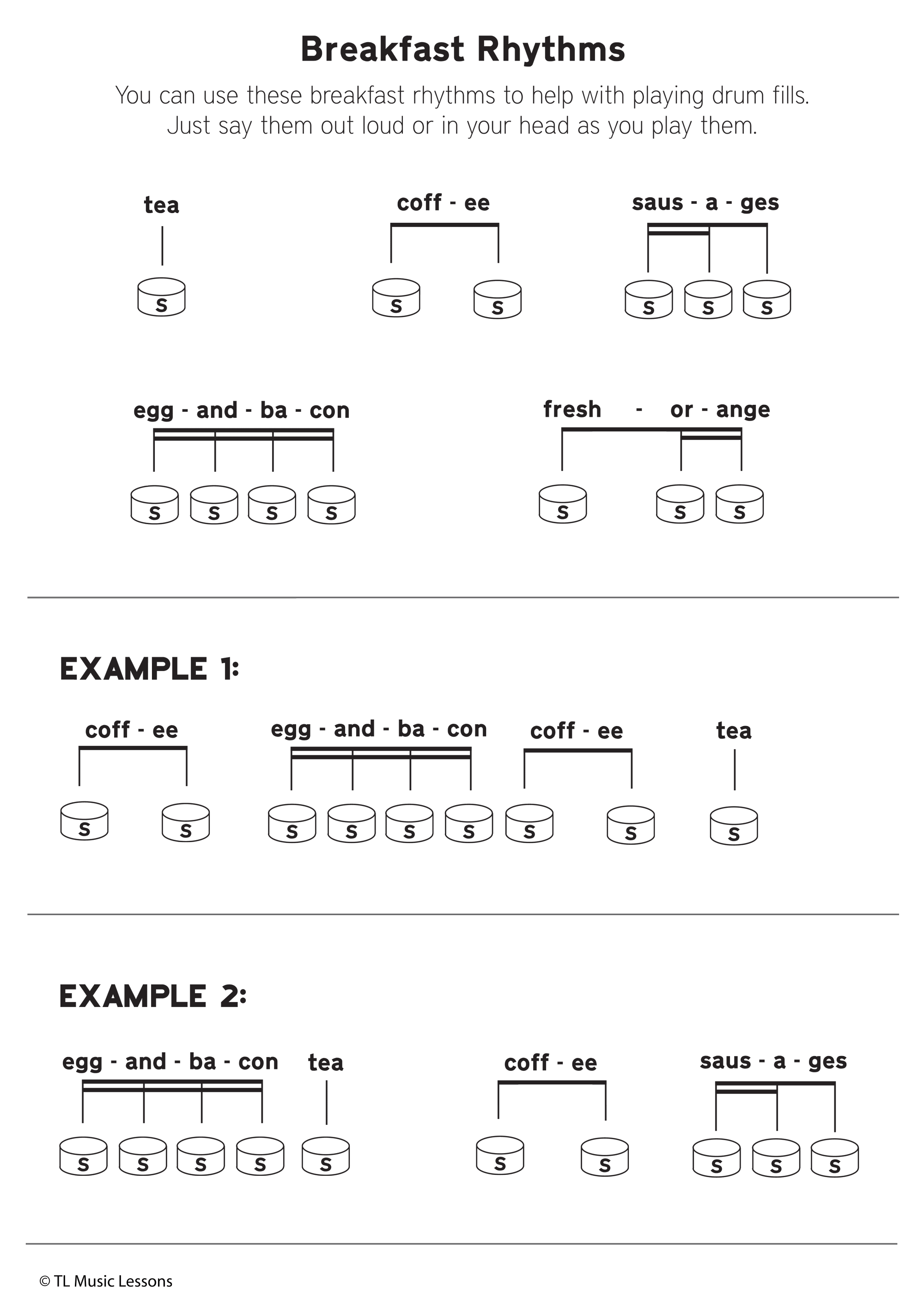
Breakfast Rhythms – Learning to read and play drum fills and snare rhythms

Breakfast rhythms are great for all primary school ages, and they can be fun for high school and adult ages too to help with the initial barrier of learning the rhythms. By saying the rhythm and seeing it at the same time, you will be associating the sound with how it looks on paper, so eventually you will know that two 16th notes and an 8th note sounds like the word “sausages”, so in the future you may not think of the word sausages but you will know how the rhythm goes instantly when you see them combined on the sheet music.

This sheet is an accompaniment for a book I have made called “First Drum Book – Easy Reading Beats & Fills” (it’s a premium download). This page is not in the book yet but I’m currently going through the book again to improve parts of it. If you download the book now, you’ll get a notification to download the latest version for free when it’s ready.

This sheet will also be very helpful for any of the free snare drum exercises or snare drum sheet music I have posted and also for any of the beats and fills exercises, for help with reading the drum fills.

Free Downloads

Breakfast Rhythms (PDF)

Sheet 1 – 40 Beats and Fills Exercises Grade 1-2

For this exercise sheet, you will need some basic beginners reading knowledge of drum beats and drum fills.

In the exercises, you will play 3 bars of drum beats, 1 bar of a drum fill and then repeat the exercise. There are 4 exercises on the sheet and each one can be played twice, or more times if you like and perhaps the sheet can be revisited on over several practice sessions if needed.

On the first 3 exercises, there are times when there are 2 hi hats on their own with no bass drum or snare drum, so it’s helpful to especially listen out for these two hits whilst playing to avoid missing one of them out, as some learners can do by accident.

All of the drum fills are played on the snare drum only. If there are 2 lines attaching the notes, they are played as 4 fast notes. If there is 1 beam attaching the notes, they are 2 medium speed notes, and if there is one single note on it’s own, it’s 1 single hit lasting for 1 beat. There is also a rests for 1 beat that look like a squiggle on the 3rd exercise’s drum fill, so for that you don’t play anything, and wait for 1 more beat before continuing.

More Sheets like this

If you found this exercise sheet useful, you can download all 10 sheets in this premium ebook: 40 Beats and Fills Exercises Ebook.

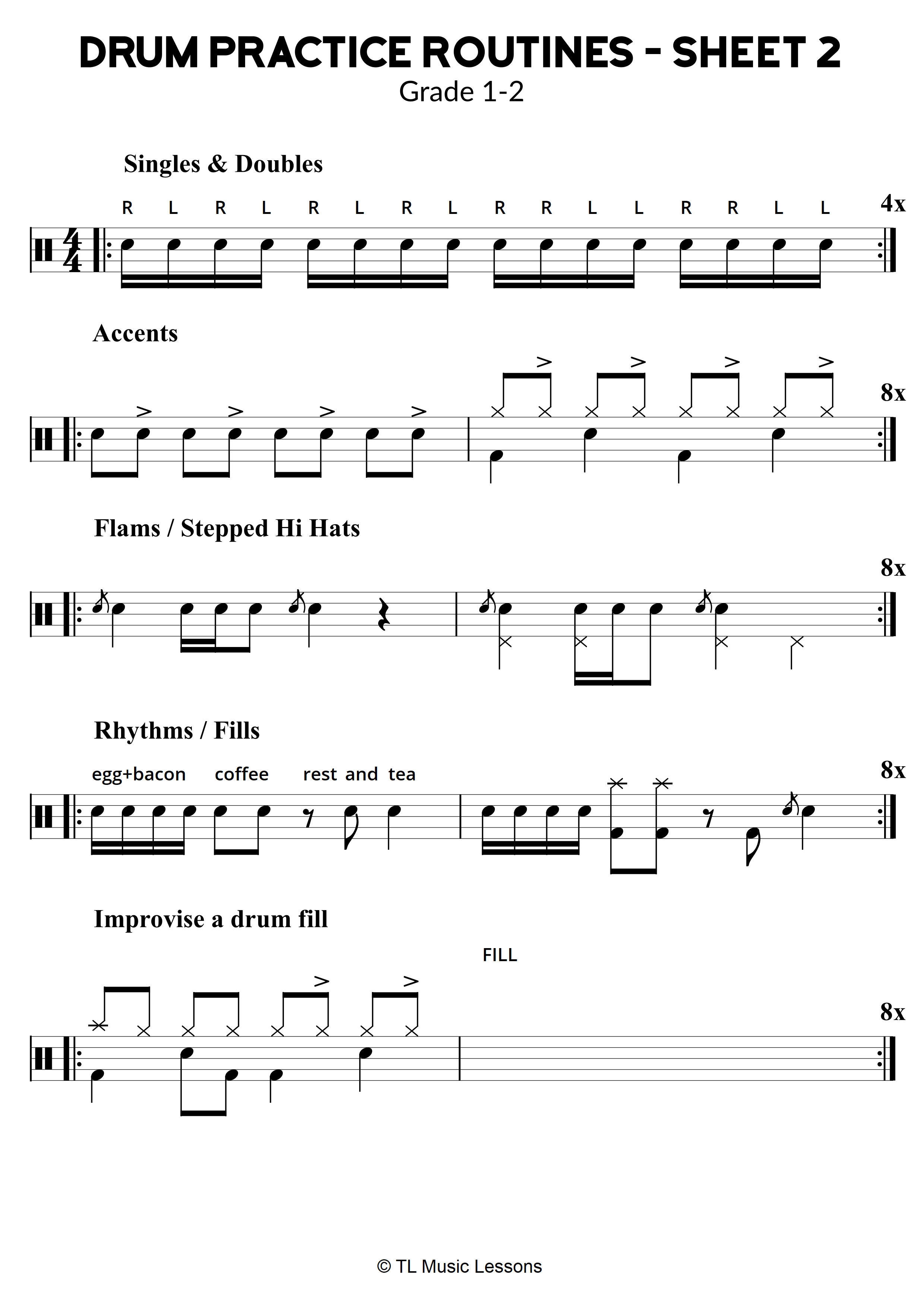
Drum Practice Routines – Sheet 2 – Grade 1-2

Free PDF Download:

Drum Practice Routines – Sheet 2 – Grade 1-2


It’s still the summer holidays and most people are taking a well deserved break. I’ve been on holiday and I’m fully relaxed but I have a few lesson days coming up so I’m keeping on with lesson prep and making new material like this. I have made this sheet for some of my drum students to learn and practice over the holidays, which can be done in about 5 minutes and can be easily practiced several times per week.

In this practice routine, we are covering many of the fundamental parts of grade 1 and grade 2 material. First on the sheet we have singles and doubles (left handers need to play the opposite sticking to the ones shown). Whilst we don’t usually learn a proper double strokes technique until about grade 5 level, we still play doubles to get used to it, and you will just be hitting the drum with the same technique as you would for a single hit.

Secondly, we will be accenting (playing louder) the ‘off beat’, which means it’s not on the 1 2 3 4, it’s in between those. You could cound 1 + 2 + 3 + 4 +. The accents would then be on every +. Then, moving onto a basic drum beat in the second bar, the accents are played in the same place but this time you play them on the hi hats.

The flams and stepped hi hat section is for building up your stepped hi hat coorination aswell as for practicing the all important flam. Make sure the stick height for the quiet note in the flam is kept quite close to the drum (2 to 4 inches depending on the volume). The stick can start at a much higher position for the loud note in the flam.

For the rhythm/fills section, I have included ‘breakfast rhythm’ counting to help. If you say the words at the same time as playing the rhythm, it should help you. The rhythm on the drum fill is the same as the one in the first bar on the snare drum, so it’s a nice exercise that flows.

Lastly, many students complain about improvisation, so it’s important to practice this until confidence is higher. Start off with really easy drum fills lasting for 1 bar and build up your confidence with each practice.


Related: Drum Practice Routines – Sheet 1 – Grade 1-2

Drum Practice Routines – Sheet 1 – Grade 1-2

In this practice routine, we are covering many of the fundamental parts of grade 1 and grade 2 material. On the sheet we have a paradiddle 8 times (left handers need to play the opposite sticking).

There are accents on 8th note snare drums and then moving onto a basic drum beat, the accents are played in the same place but this time on the hi hat part of the drum beat.

The flams and stepped hi hat section has a classic rock feel to it and it is an easy way of introducing 4 way coordination into your playing.

For the rhythm/fills section, it’s the same rhythm on the drum fill as it is in the first bar on the snare drum, so it’s a nice exercise that flows, so we do that 8 times.


Related: Drum Practice Routines – Sheet 2 – Grade 1-2

Drum Practice Routines – Sheet 1

Here is a sheet that is ideal for drum teachers to give their grade 3-4 students to practice as ongoing homework for perhaps a half term, or 4-6 weeks. Rather than giving them something new each lesson to practice, this substantial sheet can be given to practice alongside a song or their homework for a grade they might be working towards.

There are several sections, covering many of the techniques and requirements of the Grade 3 level, and a lot of it crosses over to Grade 4 too, so I’d say Grade 3-4. The following techniques and exercises are included on the sheet: Paradiddles, Accents, Skip Beats, Flams, Stepped Hi Hats, 4 way coordination, Syncopated Rhythms, Drum Fills, Improvisation.

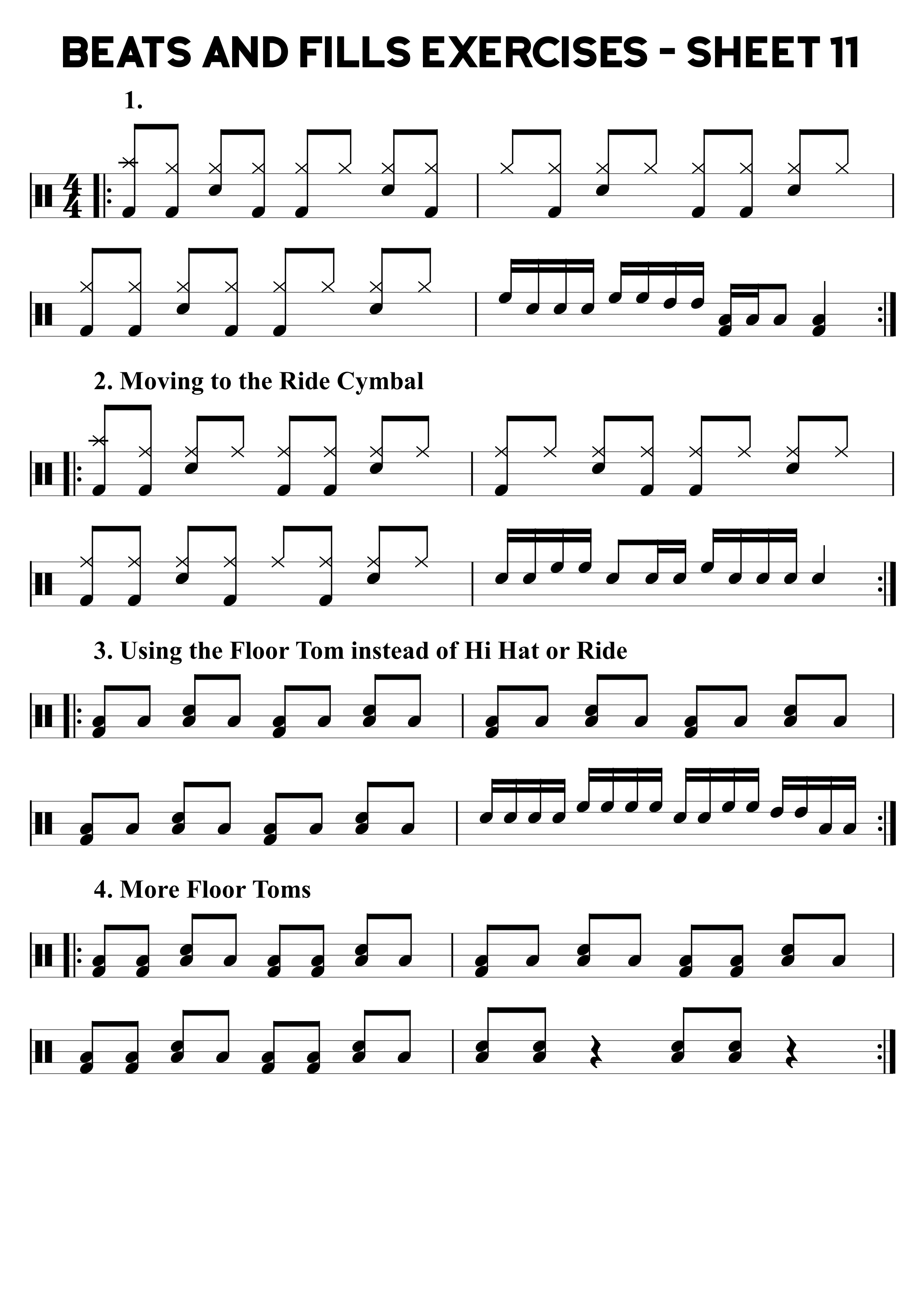
Beats and Fills Exercises – Sheet 11

Sheets 1 to 10 are available as an ebook called 40 Beats and Fills Exercises Ebook, which consists of 10 drum exercise sheets with 4 exercises on each page.

In that book, the exercises are all based on beats using the Hi Hat and playing a drum fill on bar 4, and then repeating. The next step you could take is continuing those beats but moving the right hand (if you are right handed) onto the Ride cymbal or the Floor Tom, instead of playing the Hi Hats throughout the drum beats.

This, ‘Sheet 11’, is a continuation of this book, available for free, There are various directions you could go after the first book. I am also writing another book focusing on playing on the ride cymbal and using the stepped hi hat, which may become or feature as ‘Book 2’ of this series, or perhaps I will do a mixture and include sheets like this one too.

The drum music is written in an easy to read sort of way, where all of the drum voices (bass, snare, hi hat etc) are linked in one stem, rather than separating the cymbals from the rest of the drums. This way of writing and reading has proved very popular with my students and I think it’s a good way of reading drums to start with, before moving on to the regular way of writing and reading the music.

[Premium] – 40 Beats and Fills Exercises Ebook

I’ll start by saying I’m really pleased with this ebook! It’s a compilation of half a year’s work, which started out as making some fun and useful exercise sheets for my drum students. I would make one sheet every every couple of weeks or so and it eventually finished at sheet 10, not just because it’s a round number, but because I was ready to start introducing other things that wouldn’t neccesarily fit in neatly with this ebook. I’m very pleased with the book because it’s very focussed on the fundamentals of drumming that every drummer should be learning to start with at least.

Buy Now →

Introduction

This drum ebook is a good set of exercises for the beginner drummer that has learned how to read and play very basic beats and fills already. All 40 exercises are laid out in the same way so it’s a focussed effort on building up your core drum beat beat and drum fill skills.

  • For beginners Grade 1-2 level drummers.
  • 10 Exercise sheets with 4 exercises per sheet.
  • Improve your drum beats and drum fills and practice changing from one to the other.
  • Exercises consist of 3 bars of a drum beat and 1 bar of a fill, repeated.
  • It’s a fun ebook to work through quickly or slowly. 1 sheet per week would work well for some.

The layout is slightly different to my other books so far. Usually the cymbals are notated separately (stems pointing up) to the rest of the drums (pointing down), but in this book everything is pointing in the same direction (usually up, although it doesn’t matter which way they go). I find that at this beginners / grade 1 stage, it all makes more sense this way to learners because otherwise you get rests appearing sometimes in the bottom part of the stave when there are still hi hats playing, and this almost always causes confusion with beginners young and old. It’s important to learn the other way too and move onto that, and it’s like that in most of my other books.

For beginners, but not straight away

A complete beginner could start this book early on, but not straight away. They can follow the book either with a teacher or on their own if they are a quick learner. Self taught learners may need to look some things up because not everything is explained for the complete beginner. A good book to start with for complete beginners is First Drum Book – Easy Reading Beats & Fills, which is especially good for younger learners. Another ebook that has content for complete beginners in is Beats and Fills Drum Book – Basic Beginners – PDF Ebook. That book goes beyond complete beginner too and has similar ability level content to this book, so it can be used in addition.

The usual info

  • When you purchase, you get a pdf file to keep. Please do not redistribute the file, unless you are a teacher sending it to students to practice with.
  • Drum teachers can print the book or single sheets as required for their students.
  • Drummers can teach themselves following on from a strong basic foundation in reading and playing

I hope you enjoy the ebook!

Free Preview

Buy Now →

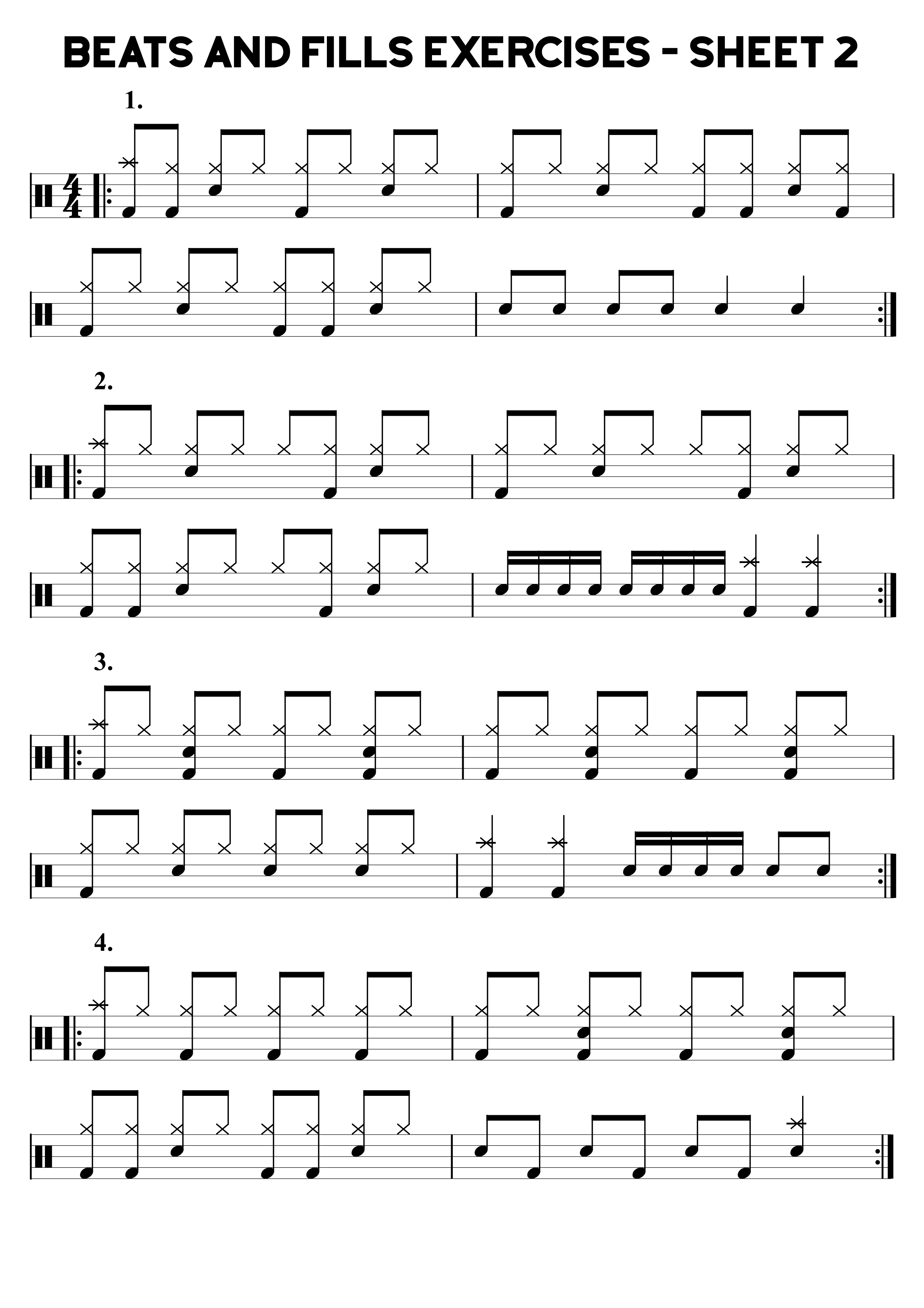
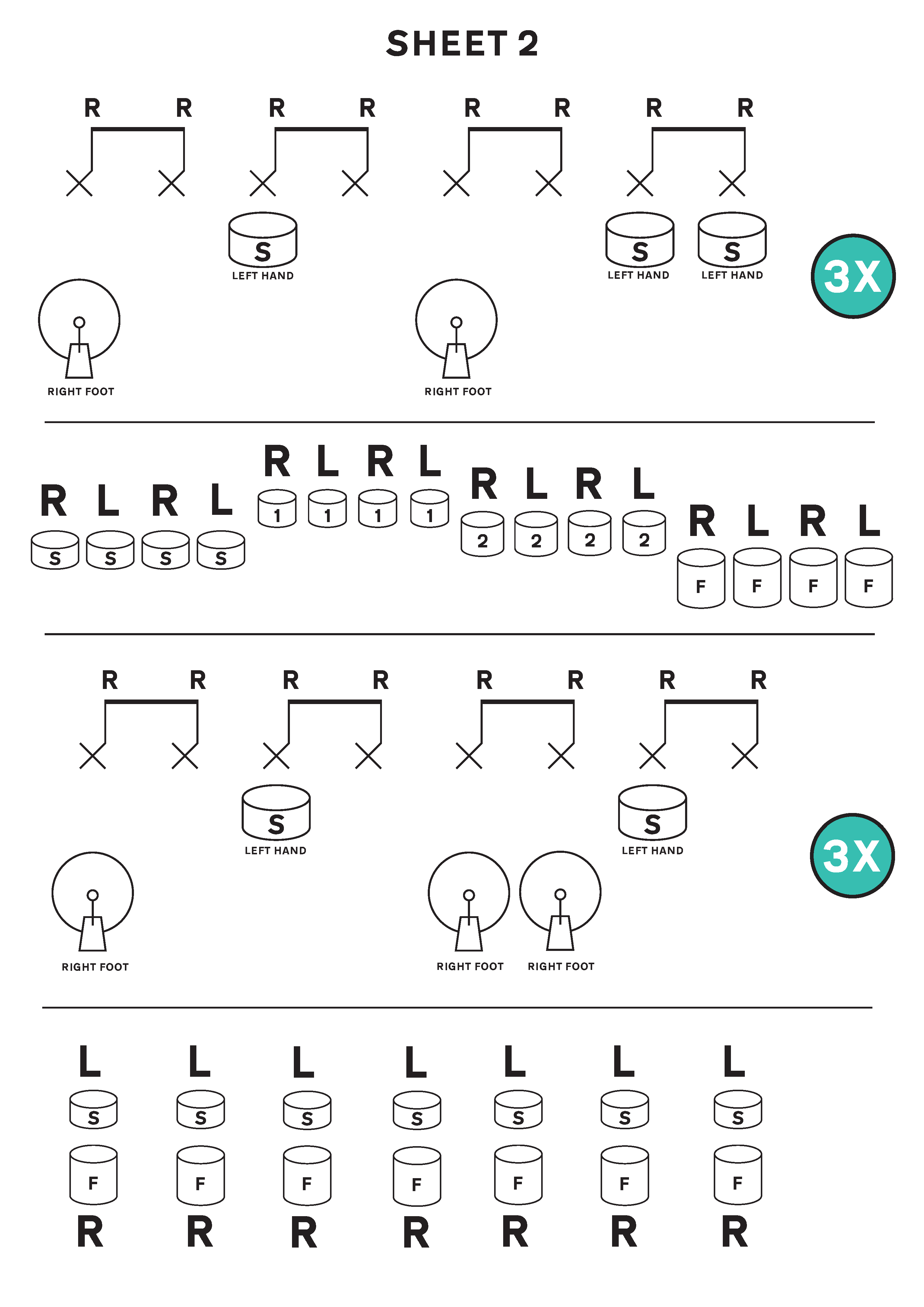
Sheet 2 – Easy Reading Beats & Fills

Here we have a drum beat repeated 3 times, then a fill, then another drum beat 3 times followed by another drum fill. The sheet can be then repeated around multiple times, or you could just repeat the first half around for a while and then focus on repeating the second half.

These are great for beginners and especially for those that haven’t moved on to reading drum sheet music properly yet. It will help those that struggle to read the drum music, for example young drum students.

Right handed drummers should play all of the hi hats with their right hand, and all of the snare drums with their left hand. Left handed drummers should do the opposite.


Related: Sheet 1 – Easy Reading Beats & Fills
Related (Premium): This free drum sheet is part of a premium ebook, which you can purchase here: First Drum Book – Easy Reading Beats & Fills

(Premium) – First Drum Book – Easy Reading Beats & Fills

Buy Now →

For a free preview of the ebook, click Buy Now and then click ‘Preview’ at the top left of the cover image.

  • 28 Pages
  • 20 Drum Lesson Exercise Sheets

Introduction

People that might find this book useful

  • All ages will be able to enjoy this book as the drumming content will be a challenge for any beginner.
  • Beginners at ages 5-11 should benefit the most from these sheets when starting out, as they take away a lot of the initial reading difficulties.
  • Drum teachers can print the book or single sheets for their students. They can be taught to beginners of any age and also to very young beginners that wouldn’t otherwise understand some of the standard drum notation – especially the drum fills.
  • Drummers can teach themselves to play the drums using the easy to read music

About the book

This ebook has been created after nearly 9 years of teaching the drums and after many of these years developing my own way of writing drum music for beginners so that they could focus on the drumming rather than getting stuck working out which drum to hit. I noticed this problem with almost all of my drum students of school ages from ages 5 to 11 especially (these are the ‘Primary School’ ages in the UK).

After planning to write this book over a year ago, I have been handwriting similar types of sheets and photocopying them for my students to test the water and see which exercises work best. It’s really quick to write out your own sheets and I do encourage writing out your own by hand if there is something that you want to either teach or remember for yourself to play, that doesn’t appear in this book. All you need to do is draw out the symbols as they appear in this book, just on a blank sheet of A4 with any type of pen (I like using a think pen like a permanent marker so it stands out).

Following on from honing the hand drawn drum exercises, they have been recreated using Adobe Illustrator to give them a clean look and so that they are easy to read and well presented as an ebook.

This ebook should get students familiar with how real drum music is laid out, because I have kept everything the same really. So, when moving on to trying to read real drum sheet music, it should start to make sense a lot quicker than usual. My next ebook to try after this might be Beats And Fills Drum Book – Basic Beginners because it covers most of the content again in a different way but this time with real drum sheet music notation.

You are freely welcome to print this ebook for personal use or for giving a copy to your students if you are a teacher, but please do not redistribute the .pdf file online.

Buy Now →