Sheet 3 – Beginners Drum Warm Up Exercises

Free PDF Download

Beginners Drum Warm Up Exercises

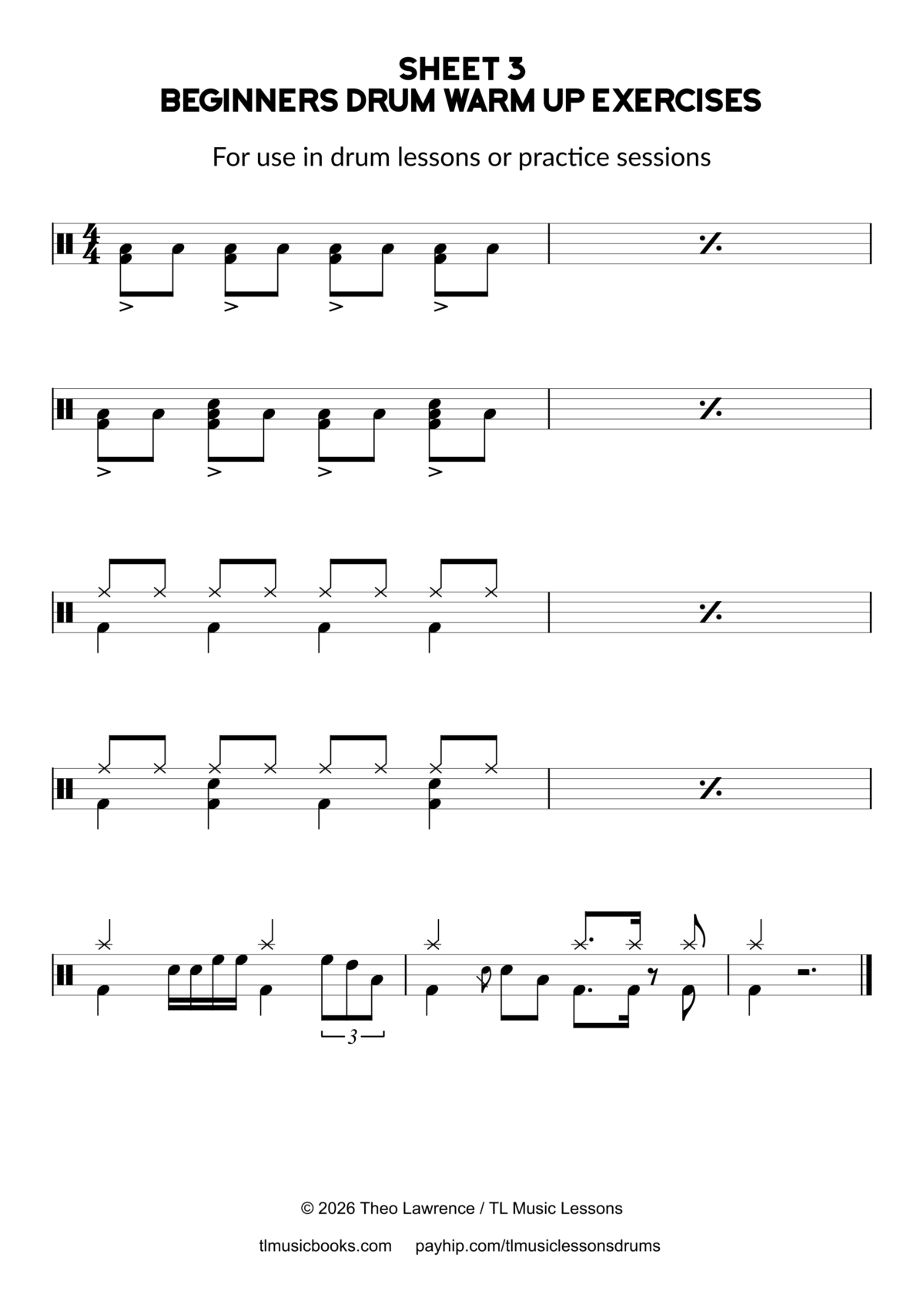
The difficulty on this sheet goes slightly higher with adding 8th notes to the drum beats and the drum fills are a little more advanced too, especially the rhythm of the crash and bass drum hits at the end. A drum teacher can help with this. Once you hear the rhythm it shouldn’t be too hard. You can hear the same rhythm of the ending crash cymbals (in the penultimate bar of this sheet) at the start of a famous song called We Found Love by Rhianna. Whenever I see this rhythm in any music, I always think of this song! I’m sure the rhythm has stronger roots elsewhere, perhaps in Latin American carnival type music, but that’s just what sticks in my mind.

To further disect the final line of fills, you also will need to play a triplet at the end of the first bar whilst counting ‘4 trip let’ and on the second bar there is a flam on beat 2 followed by a floor tom on beat 2 +.

Going back to the start, it’s also important to observe the driving accents on the beat, which should be played on the floor tom, and not really the bass drum. This also goes for the second line. Lines 3 and 4 could also be played with these driving accents on the ride cymbal if you would like to.

← Sheet 2

Intermediate Drum Warm-Up – Part 1

You may also be interested in this drum book: Intermediate Beats Fills and Exercises, which focusses on Rock, Pop, Funk, and progressive styles.


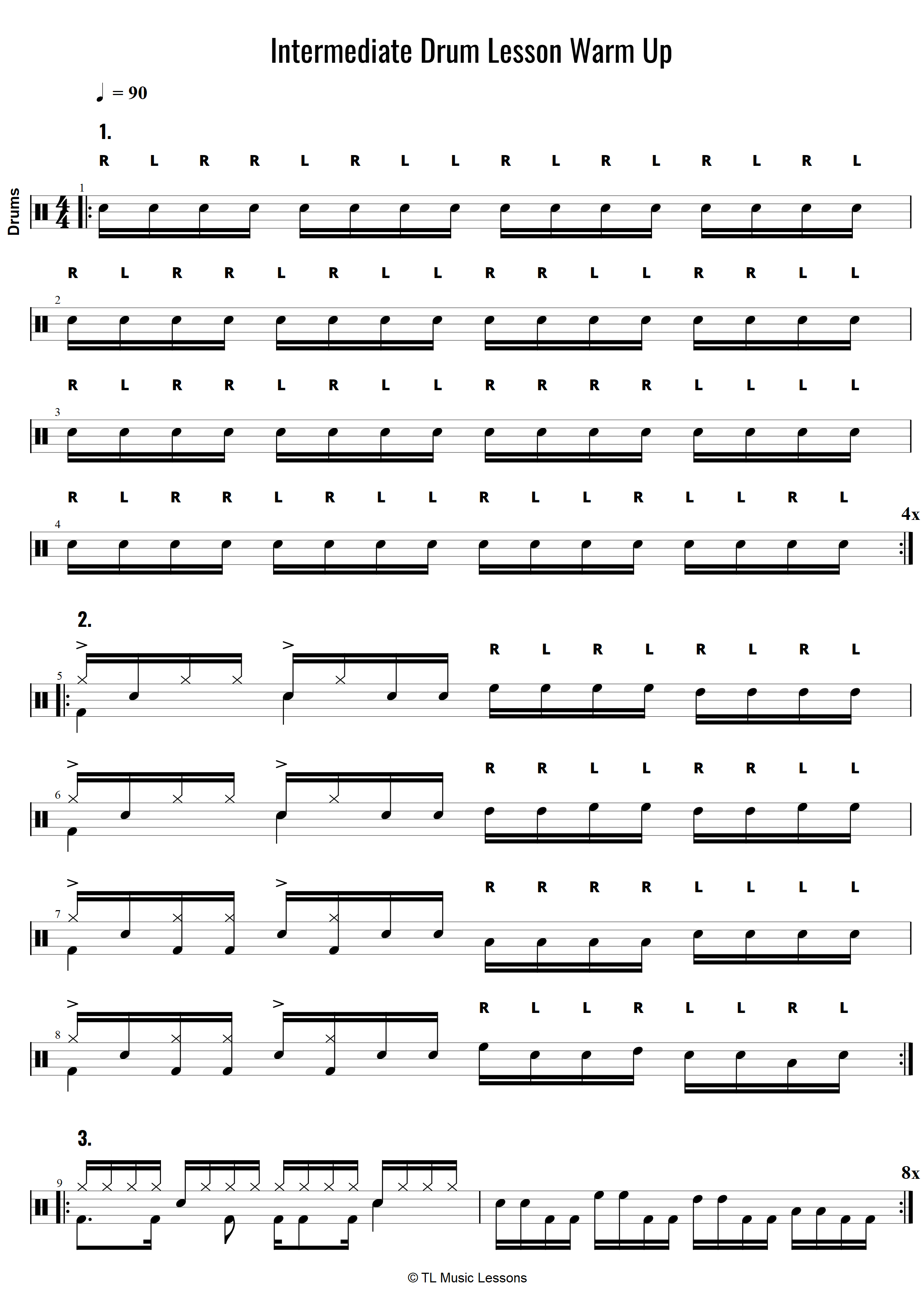
Following on from the Drum Lesson Warm Up posted a few days ago, this intermediate drum warm-up is for drummers that have reached a higher level of ability (about Grade 4-6 but could be used by higher grades too).

Exercise 1 – Intermediate Snare Warm-Up

Each of the 4 lines starts with a paradiddle, then the second half changes each time. The first line is singles, the second line is doubles, the third line is 4 with each hand and the 4th line is a 3-3-2 pattern (RLLRLLRL).

Intermediate Snare Warm Up

Exercise 2 – Paradiddle Drum Beat with Sticking Patterns on the Drum Fill

Using the sticking from exercise 1, we change the paradiddles into a drum beat by moving the right hand to the hi hat and the left hand to the snare drum. The drum fill then borrows the sticking we used in exercise 1, from the second half of each line.

ex2 - intermediate drum warm-up

Exercise 3 – Funk Rock Drum Beat and Drum Fill working on fast double bass drum with 1 foot

A rhythmic bass drum pattern with 16th note hi hats followed by a drum fill that works on the bass drum.

ex3 - intermediate drum warm up

Exercise 4-7

You can continue onto exercises 4-7 here: Intermediate Drum Warm-Up – Part 2.

Drum Lesson Warm Up

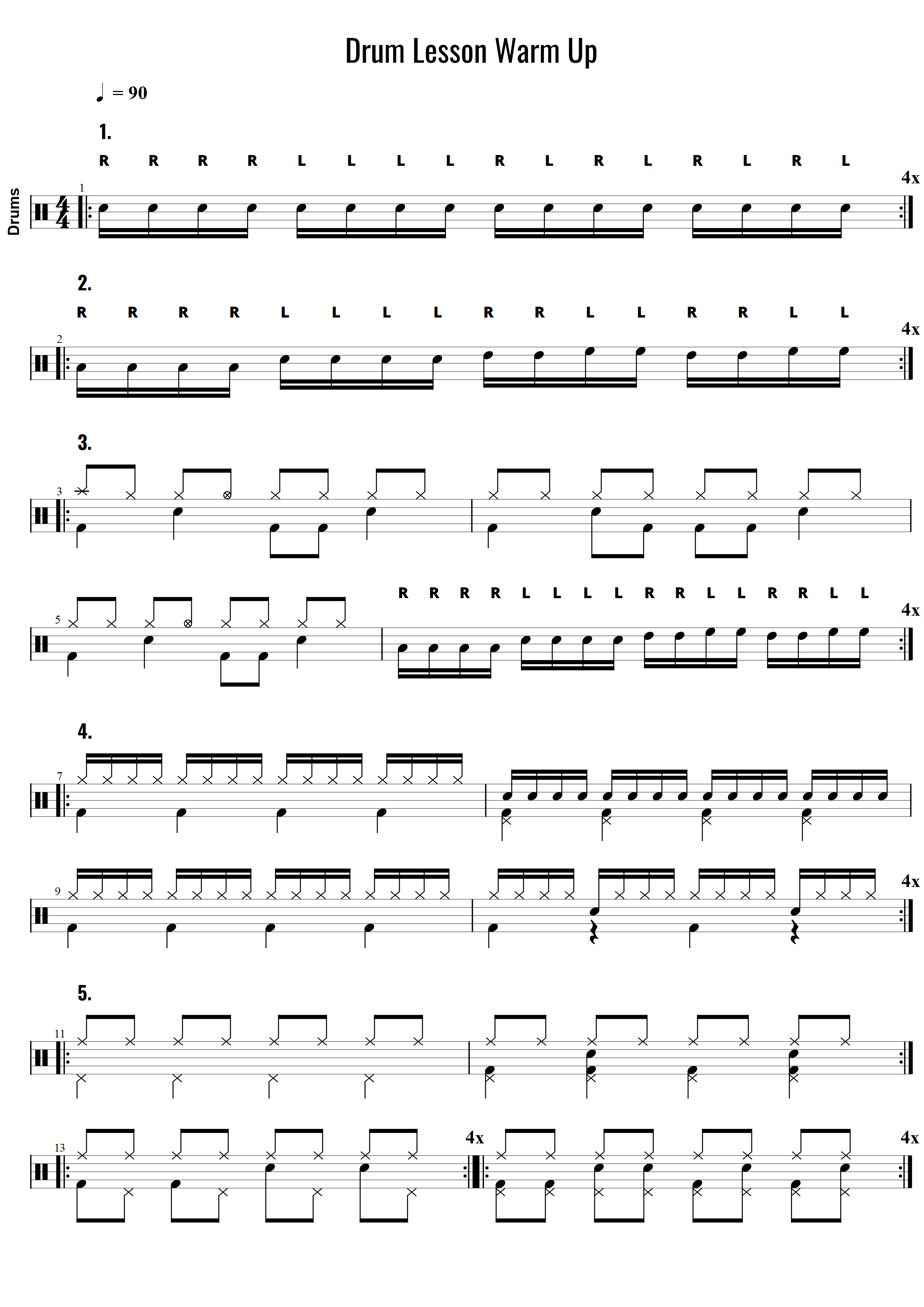
5 warm up exercises for the start of a drum lesson. Sticking patterns, drum beats, drum fills and beats with 4 way co-ordination.


These exercises that would be a good warm up at the start of a drum lesson or at the start of a drum practice session. Anyone from Grade 1 up to Grade 6 could use this as a warm up. It would be quite a challenge for grade 1. For a grade 6 player, they should be able to play through this quite quickly.

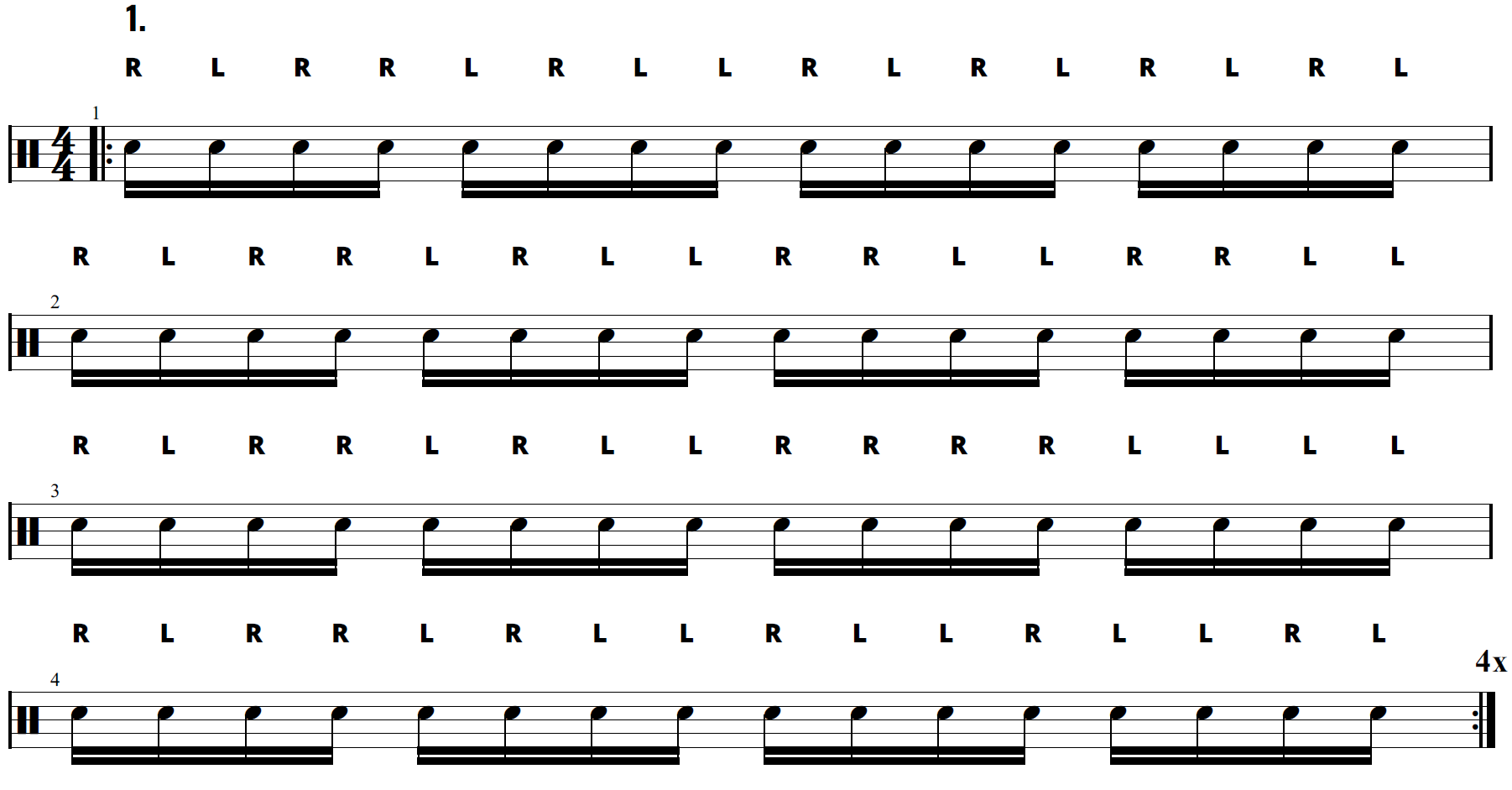
Exercise 1:

Snare drum exercise with a RRRR LLLL RLRLRLRL sticking pattern.

Snare drum exercise with a RRRR LLLL RLRLRLRL sticking pattern.

Exercise 2:

A drum fill exercise using a RRRR LLLL RRLLRRLL sticking pattern.

A drum fill exercise using a RRRR LLLL RRLLRRLL sticking pattern.

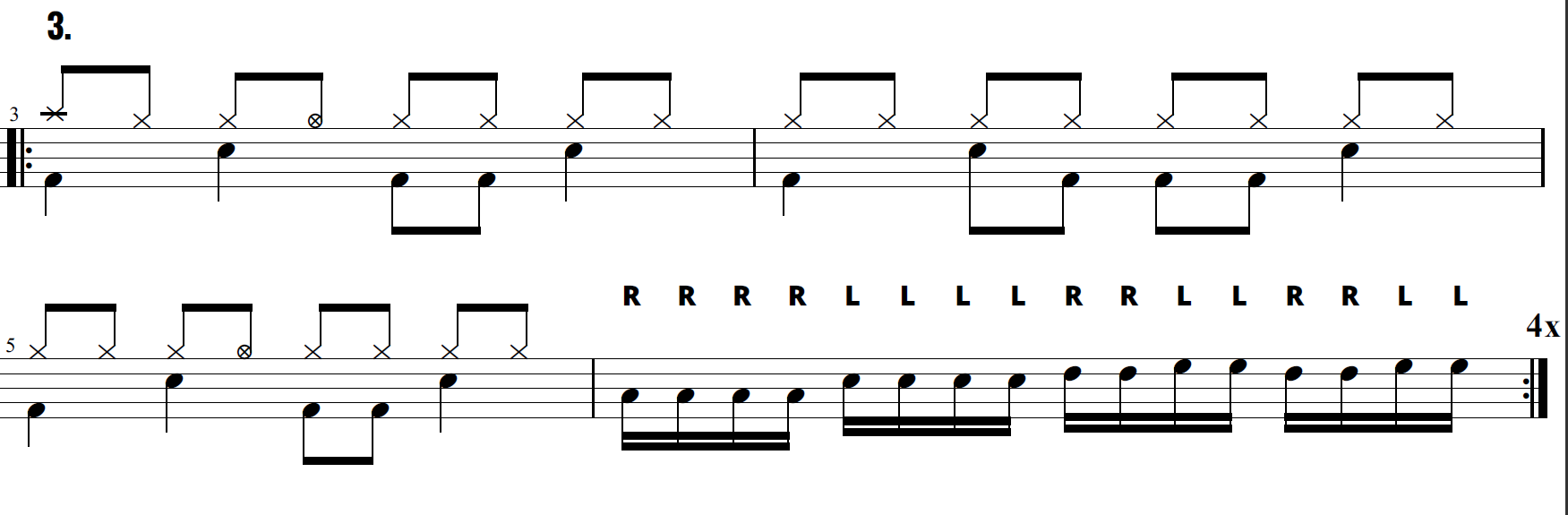
Exercise 3:

A 3 bar drum beat with open hi hats and drum fill exercise using Exercise 2 as the drum fill

A 3 bar drum beat with open hi hats and drum fill exercise using Exercise 2 as the drum fill

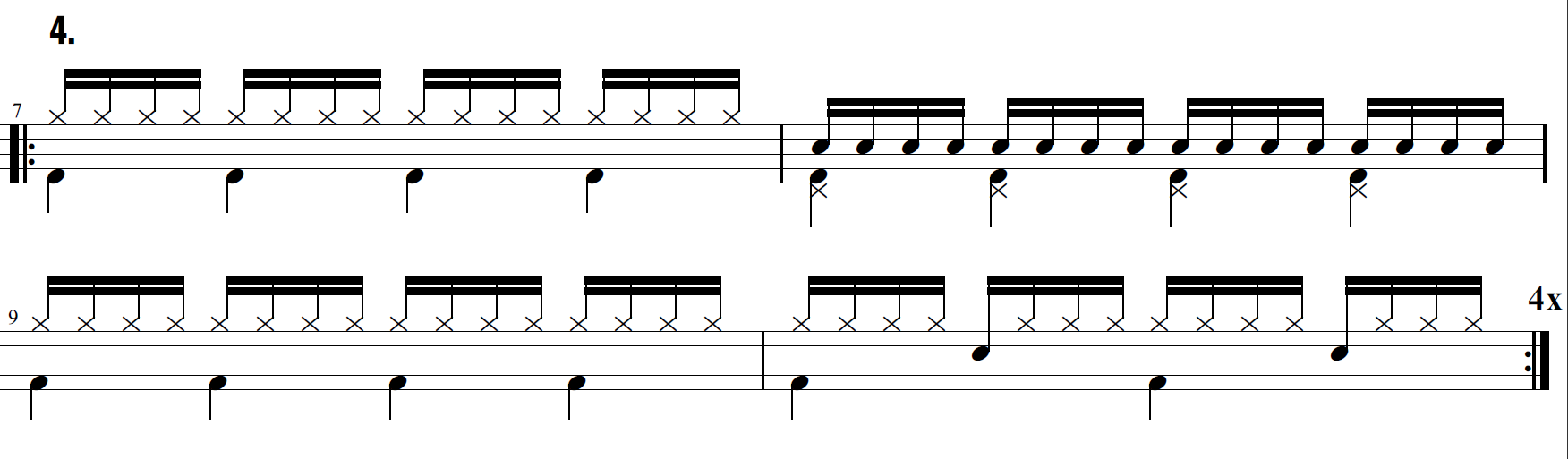
Exercise 4:

Working on a 16th note hi hat pattern and moving that to a snare drum whilst adding a stepped hi hat to work on 3 way co-ordination.

Working on a 16th note hi hat pattern and moving that to a snare drum whilst adding a stepped hi hat to work on 3 way co-ordination.

Exercise 5:

Drum grooves focusing on 3 way co ordination and 4 way co ordination between both hands and both feet.

5 warm up exercises to do at the start of a drum lesson

Grade 1 Rock Beats – Free PDF ebook

Get Free PDF Download →

This short ebook gives you 1 page of the break down of how a basic drum beat is contructed and then 3 pages with 10 rock drum beats on each page.

The first of the 3 core pages of beats is with 8th note closed hi hats. The second page is the same beats again but with open hi hats (the note heads with cirles around them). The 3rd page has different beats with quarter note hi hats (really has that rock sound), which can also be played as half open hi hats or closed hi hats.

I hope this free ebook is helpful for students and teachers looking for a few quick sheets to get them started with. I also hope that you will enjoy the quality of the free ebook enough to try some of the premium drum ebooks.

3 Simple Drum and Bass Steps – How to Play, With Notation and Variations

This is a guest blog post from Ryan Alexander Bloom.

An interesting style of drumming that has become popular recently is live breakbeats or human drum ‘n’ bass music. Bands like Nerve and Shobaleader One have been on the cusp of the movement and players like Johnny Rabb and Jojo Mayer have been using their considerable chops and applying them to electronic sounding, yet still very acoustic, beats for decades. Playing in this style can be a lot of fun because it is improvisational like jazz, technical and chops heavy like metal or prog, and very flashy with a prominent and featured drum part.

To get into this style you can start in a couple of places. Drum and Bass beats are traditionally either created by sampling existing music off of a turntable, or by programming rhythms into a drum machine. In this selection of exercises we will focus on recreating the drum machine sound, rather than the sampled sound. Programmed beats are sometimes called steps because of the 16 steps (16th notes on which you can apply sounds) of an old loop sequencer drum machine. These exercises all feature essentially the same 3 core steps. These are classic rhythms that permeate much of electronic music and can be embellished in many ways to come up with more interesting grooves. These first 3 patterns are demonstrated here:


https://youtu.be/ob1O6vqSTmY

Variations

The hi-hat or ride cymbal can be used with any of these steps. We can also change the value of the cymbal pattern from 8ths to quarters to change the feel. Try to work these basic beats up to at least 160bpm if not higher for an authentic sound.

For slower tempos, more cymbals keep up the energy level. 16ths would be the next logical step.

For a layered texture, add in hi hat with your foot. Drum machines can play lots of notes simultaneously, so layering in another cymbal pattern helps keep up the illusion of a programmed beat.

Keep in mind that drum machines have no soul. Counterintuitively, the less human feeling or groove you can impart to these patterns the better they will sound in a drum and bass context. Try to play all the cymbal notes at the same dynamic level and keep everything steadily right down the center of the beat. Once you master these patterns, you can begin to add ghost notes, hi hat openings, fills, and other elements to make things more interesting. More advanced step patterns, classic breaks, break manipulation strategies, and extended techniques, can be found in Live Drum & Bass – Breakbeats and Electronic Music for Real Drummers available from Hudson Music and Amazon.com


Buy from Hudson Music – https://hudsonmusic.com/product/live-drum-bass/

Buy from Amazon.com – https://www.amazon.com/Live-Drum-Bass-Breakbeats-Electronic/dp/154285864X

Sheet 2 – Easy Reading Beats & Fills

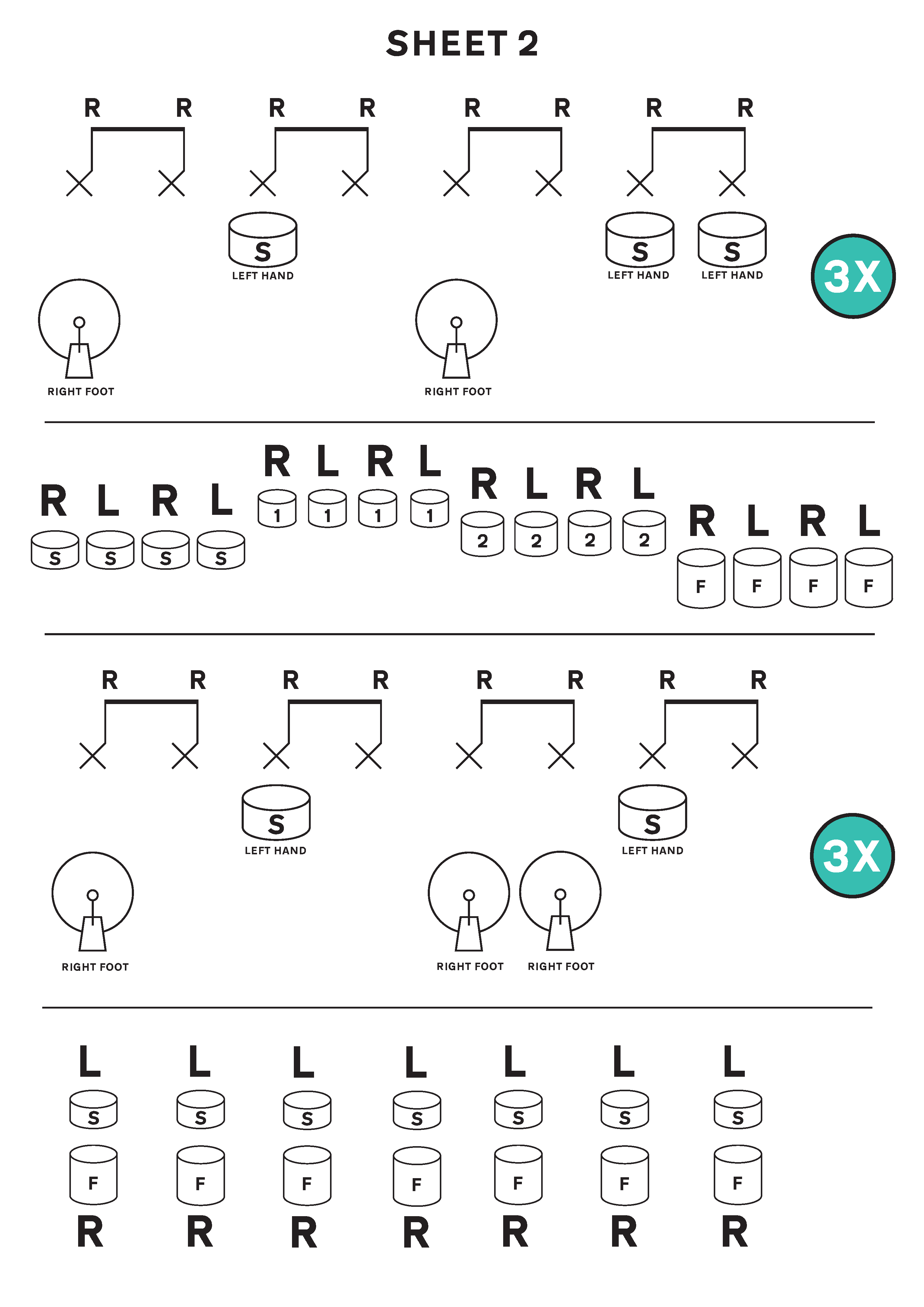
Here we have a drum beat repeated 3 times, then a fill, then another drum beat 3 times followed by another drum fill. The sheet can be then repeated around multiple times, or you could just repeat the first half around for a while and then focus on repeating the second half.

These are great for beginners and especially for those that haven’t moved on to reading drum sheet music properly yet. It will help those that struggle to read the drum music, for example young drum students.

Right handed drummers should play all of the hi hats with their right hand, and all of the snare drums with their left hand. Left handed drummers should do the opposite.


Related: Sheet 1 – Easy Reading Beats & Fills
Related (Premium): This free drum sheet is part of a premium ebook, which you can purchase here: First Drum Book – Easy Reading Beats & Fills

Sheet 1 – Easy Reading Beats & Fills

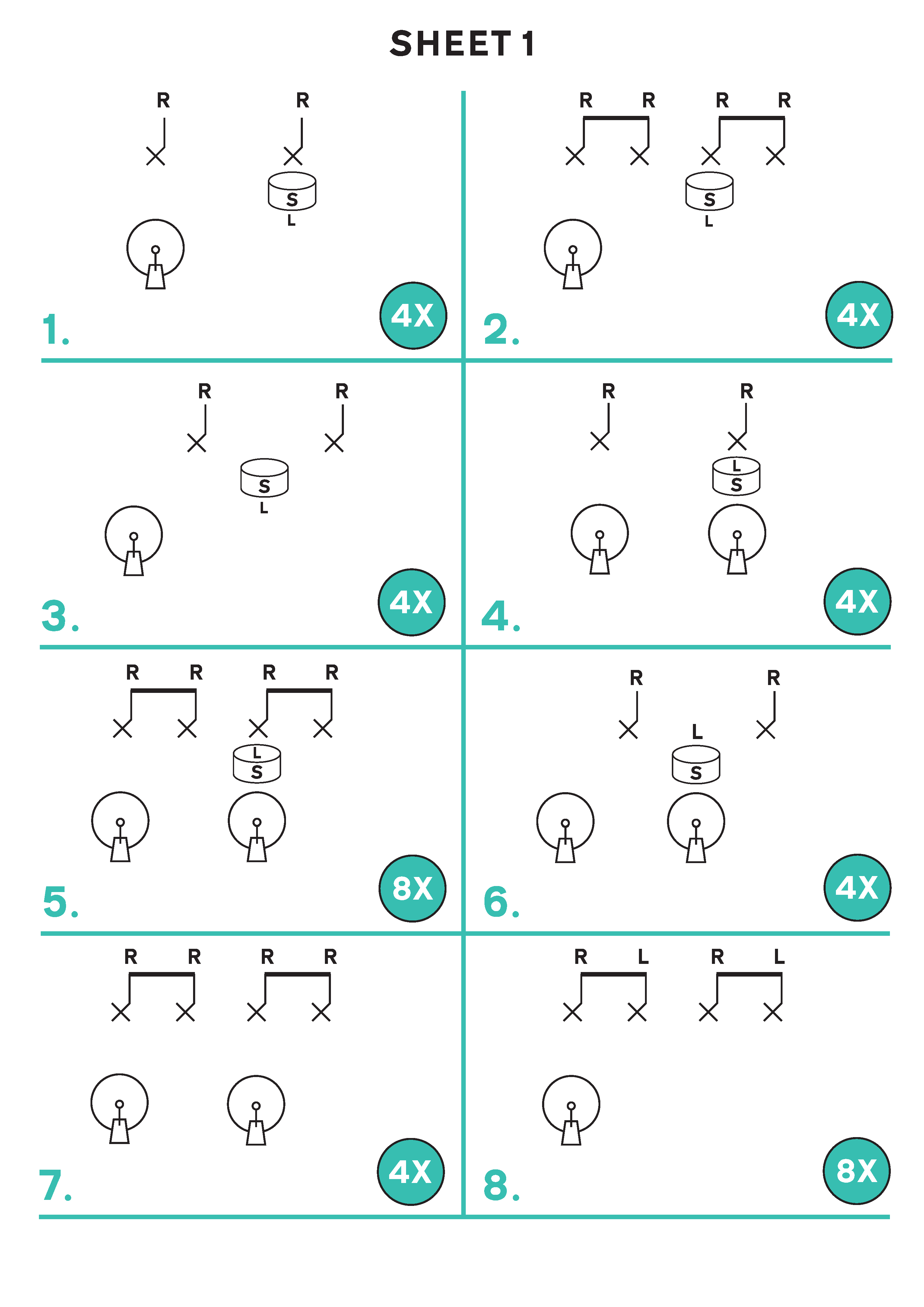
Here we have 8 drum beats, each lasting half a bar each. We’ll play them each 8 times, which will total 4 bars worth for each beat.

There are 3 drum voices; Hi Hat (the X‘s), Snare Drum (the drum with an S in it), and the Bass Drum / Kick Drum (the one that has a pedal attached to a circle).

These are great for beginners and especially for those that haven’t moved on to reading drum sheet music properly yet. It will help those that struggle to read the drum music, for example young drum students.

Right handed drummers should play all of the hi hats with their right hand, and all of the snare drums with their left hand. Left handed drummers should do the opposite.


Related: Sheet 2 – Easy Reading Beats & Fills
Related (Premium): This free drum sheet is part of a premium ebook, which you can purchase here: First Drum Book – Easy Reading Beats & Fills

Computer Games Music – PDF Ebook – Drum Sheet Music [includes Drum Loops Pack]

Get The Free Download (Audio & Sheet Music) from Bandcamp →

Also available for Guitar, Bass, and Ukulele

Full drum sheet music for 9 computer music songs transcribed from the MIDI drum loops used on the album ‘Computer Games Music’ by TL Music Lessons.

Also includes drum loops MIDI and Audio pack.

Audio on Spotify

About the Sheet Music

The drum sheet music has a wide range of ability levels from complete beginner (Canon in C), right up to grade 8 with some complicated syncopation at high speeds. All of the drum loops were created specifically for these songs, by me, a drummer! Hence, I tried to make the majority of the beats playable by a real drummer. I was able to transcribe and transpose most of the beats without altering them, but there were some that would need extra hands, such as the hand claps and clave polyrhythms, so these have been left out or modified where I thought appropriate.

I think this book would be usefuly for anyone wanting to enjoy playing drums along to music whilst reading drum sheet music at the same time. Whilst I can transcribe known songs, this was fun for me to do and release to you, without having to worry about copyright issues.

These could potentially be used as performance pieces in schools, or maybe even exams as a free choice piece if you ask an exam board. Feel completely free to use the audio as a backing track by downloading it from itunes or bandcamp etc and usin it to play along with.

Music makers and music producers can feel free to use the drum loops audio and midi as they wish. You may freely use them in your own compositions. School pupils may also use the drum loops pack as they wish for school projects or coursework – just ask your teacher if this is ok and within any guidelines.

About The Music

Last year I made an album of 10 songs to teach with, and created 6 ebooks for the instrument parts. This year, I made an album of 11 songs called ‘Computer Game Music’.

This year I exported the MIDI files from 8 of those songs, plus 3 new ones, and began adding synths to the MIDI in my music production software Abelton Live 9 to create music that I think would sound good in computer games. I found it quite easy, quick and enjoyable to do when I initially messed about with one of the songs for fun. I then decided to start the project, which only took about a month of spare time to create the new album of songs. I also added drums and bass guitar to the tracks to finish them off.

The drums were created by me in Abelton using the MIDI piano roll and a drum rack. I really enjoyed this! I then transcribed the drum loops into actual drum sheet music for people to learn to play along with the music if they wanted to.

The drum sheet music has a wide range of ability levels from complete beginner (Canon in C), right up to grade 8 with some complicated syncopation at high speeds. All of the drum loops were created specifically for these songs. I tried to make the majority of the beats playable by a real drummer. I was able to transcribe and transpose most of the beats without altering them, but there were some that would need extra hands, such as the hand claps and clave polyrhythms, so these have been left out or modified where I thought appropriate.

Music makers and music producers can feel free to use the drum loops audio and midi as they wish. You may freely use them in your own compositions. School pupils may also use the drum loops pack as they wish for school projects or coursework, if this is within the guidelines of the work.

I hope that the songs can be used by a range of abilities. I would say most or all ability levels would find challenges throughout the album, depending on which instrument you look at. They are all quite challenging in places.

I hope that the songs can be used by more advanced players. Initially the previous album of music was created for grades 1-3 (guitar and ukulele only), but now for this new one, I would say most or all ability levels would find challenges throughout the album, depending on which instrument you look at. They are all quite challenging in places.
I also hope that the songs can be used as backing tracks for performances, for example in schools, and possibly as part of marked school performances or maybe even as free choice pieces in grade exams.

I also hope that my students will enjoy listening to the album after getting to know the songs in their different style.

Whilst the songs have not been created for any particular computer game, I will try to get some of the music featured in actual games. I think they would work well with platform and retro type games.
8 beginners Jazz worksheets including bass drum and snare triplet patterns for comping ideas – FREE PDF

Get Free PDF Download →

There are 8 PDF files here with sheet music including Jazz drum beats. I thought rather than posting them seperately, I would rather group them all as one resource. They were created in 2010 near to when I started teaching and I used sibelius to make them.

Two of the sheets focus on the left foot hi hat and right hand cymbal ostinati.

Two of the sheets focus on only the left hand triplet based patterns used for comping.

Two of the sheets focus on the left hand snare drum and right foot bass drum, used for comping.

Two of the sheets (Full Jazz Grooves) bring it all together for 4 way coordination.

Get Free PDF Download →

Page 21 from ‘Grades 1-2 Beats & Fills Drum Book – Rock Pop Soul Funk’

Here is a free PDF of page 21 from the drum book ‘Grades 1-2 Beats & Fills Drum Book – Unit 1 – Rock Pop Soul Funk’.

The sheet music drum exercises are 2 bar loops containing drum beats with open hi hats that could fit into the styles of rock, pop, soul or funk, in a 6/8 time signature.

Once you are comfortable reading the drum beats in their repeating loops, try memorising the loop and continuing without reading it.

When teaching pupils that can cope with it, I also sometimes ask them to put emphasis on beats 1 and 4 to give it a blues feel.