Construction of a basic drum beat in 7 steps

We are going to learn a basic drum beat. It’s one that you will have heard before.

I’m going to break it down into one thing at a time, or two things, and show you how it’s constructed. It’s a great way for beginners to learn how to play it, and how to count it properly.

These are the instructions for each line of the sheet above:

  1. Let’s start by just playing the Hi Hat. Play it closed with your right hand, and count 1 + 2 + 3 + 4 +.
  2. Now just play the bass drum. Count 1 2 3 4, but only play the bass on beat 1 and 3. You can loop this round and around.
  3. Count 1 2 3 4 again, but this time play the snare drum on 2 and 4. Again, loop this until it’s easy.
  4. Now it’s going to start sounding like a beat. Count 1 2 3 4. Play the bass on 1 and 3, and the snare on 2 and 4. So it will go bass, snare, bass, snare. This is probably the most used sequence in drumming, so loop it and get really comfortable playing it.
  5. OK, let’s go back to the hi hat, and combine it with the bass drum. Hi hat on 1 + 2 + 3 + 4 +. Bass on 1 and 3.
  6. Just one more combo before the full drum beat. Hi hat on 1 + 2 + 3 + 4 +. Snare drum on 2 and 4.
  7. Finally, we will now combine everything we have learned, to make the most popular basic drum beat. Hi hat on 1 + 2 + 3 + 4 +. Snare drum on 2 and 4. Bass on 1 and 3.

Related: Construction Of A Basic 16th Note Hi Hat Drum Beat In 7 Steps

Related: 10 Basic Rock Drum Beats

Related (Premium): Grade 1 Rock Beats Ebook – The lesson you have just been through is featured in the ebook as an A4 printable handout for students.
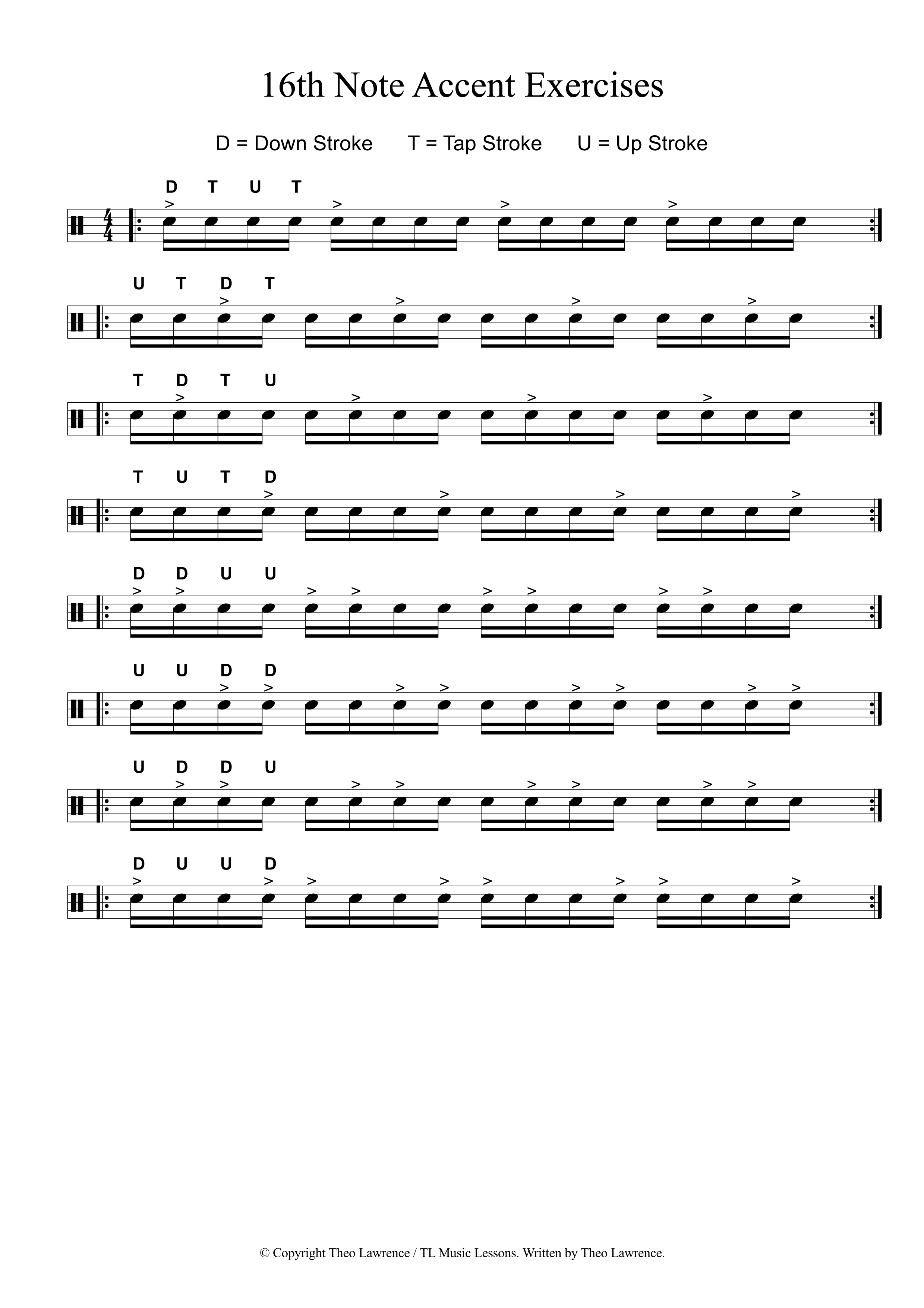
Accent Techniques – Down, Tap, Up, Full Strokes

When you play accents, you should ideally use 3 different stick strokes. These are tap stroke, up stroke, and down stroke.

Tap Stroke

You would play a tap stroke if you have just played a quiet note with that hand, and the next note with that hand is another unaccented note.

The tap stroke stick position should start about an inch or a few cms away from the snare drum. Move the stick straight down and hit the drum quietly, before coming straight back up and returning to the starting point.

Up Stroke

You would play a tap stroke if you have just played a quiet note with that hand, and the next note with that hand is an accent.

The up stroke should start in the tap position, and play a tap stroke, but instead of returning to the start position, the stick should end up much higher, somewhere between a 45 and 90 degree angle to the snare drum.

Down Stroke

You would play a Down stroke if you have just played an accent with that hand, and the next note with that hand is an unaccented note.

The stick position should start somewhere between a 45 and 90 degree angle to the snare drum. This stroke should be a loud stroke. Move the stick quickly to produce the loud stroke and finish in the starting position of the tap stroke.

The downstroke produces accents, which look like this: >

Full Stroke

You would play a Full stroke if you have just played an accent with that hand, and there is another accent to follow with that hand. The full stroke, which is played just like a down stroke, but instead of finishing in the tap position, the stick comes back to the starting position of the down stroke. So it plays a loud beat and comes straight back for another one.


Related:

→ The sheet in this post is Page 2 of this ebook: 10 Pages Of Accent Exercises With 16th Notes – PDF Ebook (includes double strokes exercises)
16th Note Hi Hat Grooves With Accents
Reading Buzz Rolls And Double Stroke Markings

What happens when you opt for gaffa tape instead of bass drum impact pads

Having visited various rehearsal studios around the UK, I have seen this happen so many times.

I believe that it is a common thought to skimp on buying a bass drum impact pad, and choose gaffa tape instead. Please don’t do this!!

The idea of the pads is to prolong the life of a bass drum skin, by adding an extra layer of material where the bass drum beater hits. The problem with using gaffa tape (aka gaffer tape, duct tape), is that it wears away very quickly and becomes extremely sticky after a day or so of drumming. This then causes your bass drum pedal beaters to stick to the drum when playing and leaves a residue on the beater heads. After the stickiness has worn off, you can play the bass drum like normal again without it being an issue.

In conclusion, putting gaffa tape on a bass drum skin only serves the purpose of wrecking the aesthetics of the bass drum skin, and spoiling the surface of your bass drum pedal beaters, and perhaps prolongs the life of the bass drum head by approximately 1 day.

16th Note Hi Hat Grooves With Accents

Here we have very basic snare and bass drum grooves, with challenging accented 16th note hi hat accent rhythms.

The Hi Hats should be played with 2 hands, with the leading hand moving over to the snare drum on beats 2 and 4.

Tip: You could play the accents on the Hi Hat edge, and the non-accents on the top of the Hi Hat, for a really good contrast in volume and tone.

These drum beats are good to play after spending some time working on the more rudimental type 16th note accent snare drum exercises like Accent Techniques – Down, Tap, Up, Full Strokes and 16th Note Accent Exercises ebook – 10 pages.


Related (Premium): The sheet from this post is included in this ebook – Grade 4 Drum Book with 17 Drum Lesson Sheets
Related: Accent Techniques – Down, Tap, Up, Full Strokes

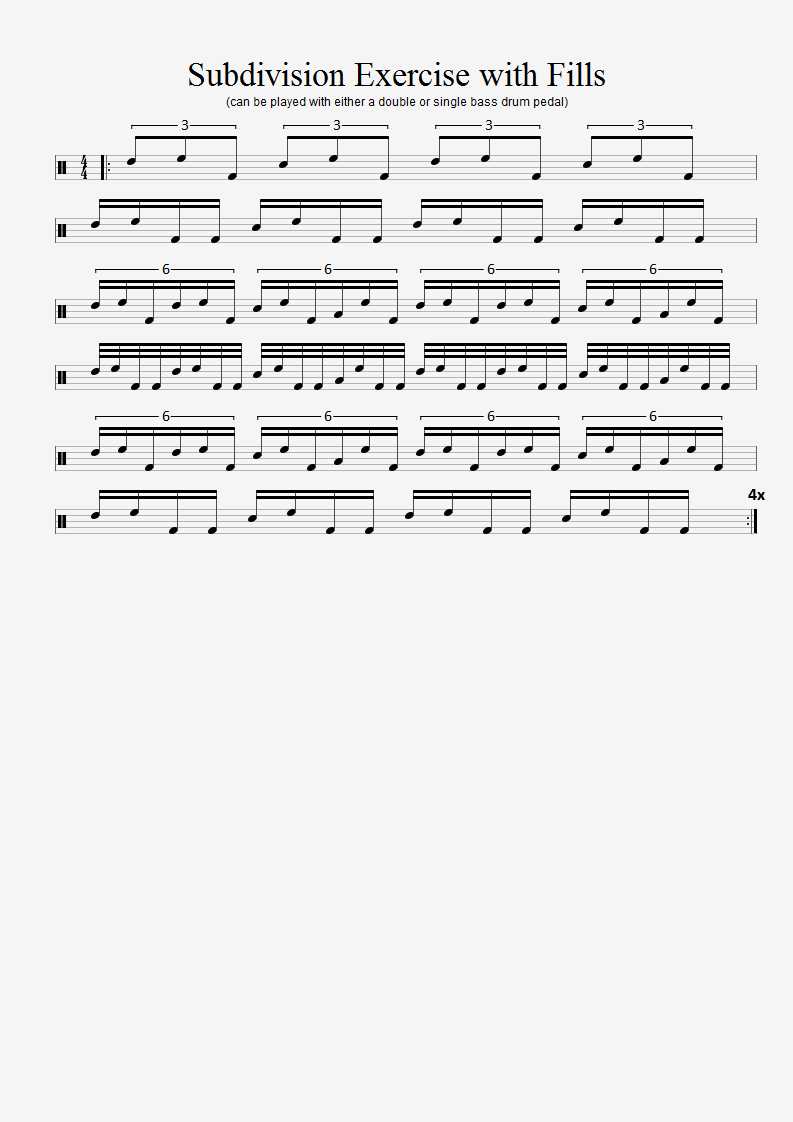
Subdivision exercise with linear drum fills

At grade 5-6 you should have good knowledge of triplets, 16th notes and sextuplets, and you will need to be able to switch seamlessly between them. This exercise works on changing between
triplets, 16th notes, and sextuplets like usual subdivision exercises, but with the twist of adding some interesting and challenging drum fills rather than just one one drum (usually just played as snare drum exercises).

(Premium) – 10 Pages of Accent Exercises with 16th notes – PDF ebook

Buy Now →

10 pages of 16th note accent exercises, which includes accents and doubles around the kit. This ebook is designed to help progress technique and explore creative concepts by moving sticking exercises around the kit in various different ways.

Most exercises in the ebook are suitable for all ability levels, played at varying speeds.

This ebook covers a lot of ability levels in just 10 pages. There is content from Grade 1 up to Grade 8 in there. You’ll be able to dip in and out of this ebook when you want to work on accents, fills and double strokes.


Recommended Reading for use with this ebook:
Accent Techniques – Down, Tap, Up, Full Strokes →
16th Note Hi Hat Grooves With Accents →
Reading Buzz Rolls And Double Stroke Markings →

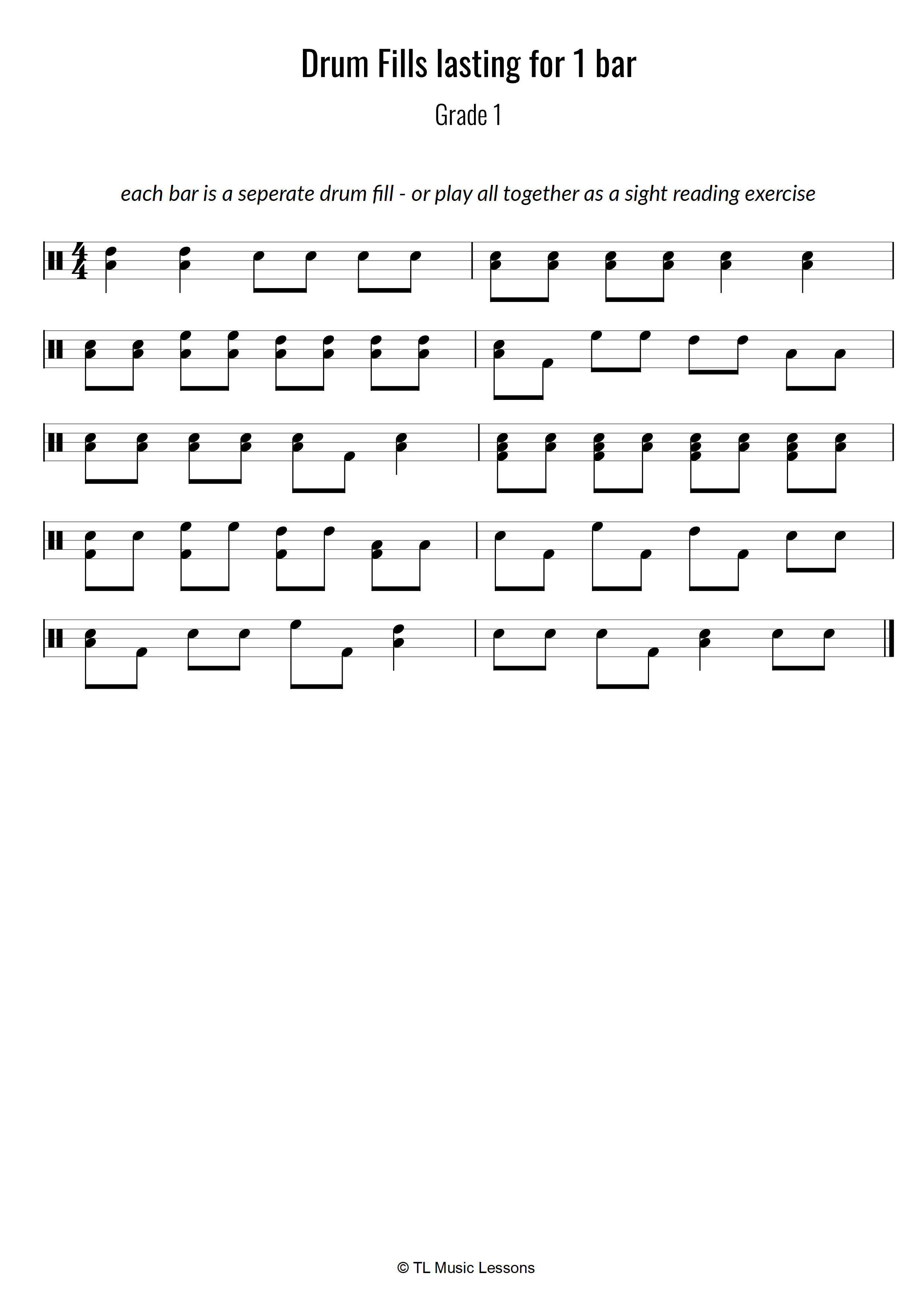
10 Drum Fills lasting 1 bar – Grade 1

Start going through the sheet slowly, and work up to being able to practice this sheet all the way through as one exercise.

You might want to brush up the Reading Drum Notation sheet to help with reading this sheet.


Related: 10 Beginners drum fills lasting 1 bar
Related (Premium): Beats and Fills Drum Book – Basic Beginners

10 Beginners drum fills lasting 1 bar

Play Right hand on all crotchets (1/4 notes), and Right Left on all of the Quavers (8th Notes) – (opposite for left handers).

Young beginners players could count the crotchets as Tea, and the quavers as “Cof-fee”.

You might want to brush up the Reading Drum Notation sheet to help with reading this sheet.


Related (Premium): Beats and Fills Drum Book – Basic Beginners

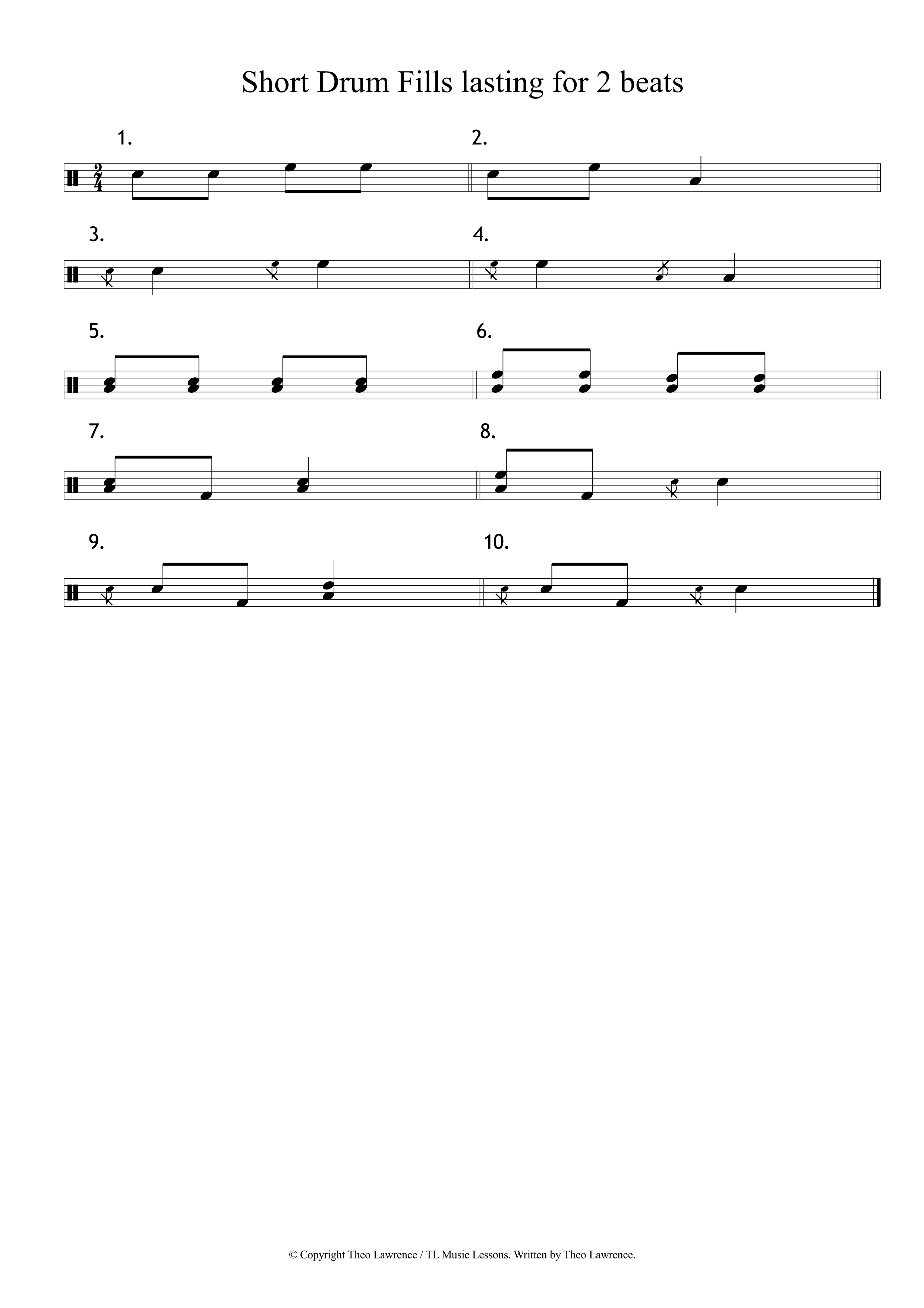
10 Short Drum Fills Lasting 2 Beats Each

  1. Slowly play the Snare twice then Tom 1 twice.
  2. Snare, High Tom, Floor Tom.
  3. To play this fill, you have to do a flam on the snare drum and then a flam on tom 1 for 1 beat each.
  4. To play this drum fill, play a flam on Tom 1 then a flam on the floor tom, lasting for 1 beat each.
  5. Play the floor tom with your right hand, the snare with your left and, and hit them both at the same time 4 times to create this short drum fill.
  6. Tom 1 and Floor tom together twice, then Tom 2 and floor tom together twice.
  7. Floor tom + snare together, then bass drum, then floor tom + snare together again.
  8. To play this drum fill, play the Tom 1 and floor tom together, then the bass drum, and then a flam on the snare drum.
  9. Play a flam on the snare, then a bass drum, and then tom 2 and the floor tom together.
  10. Flam on the snare, bass drum on it’s own, then flam on the snare.