Drum Practice Routines – Sheet 1 – Grade 1-2

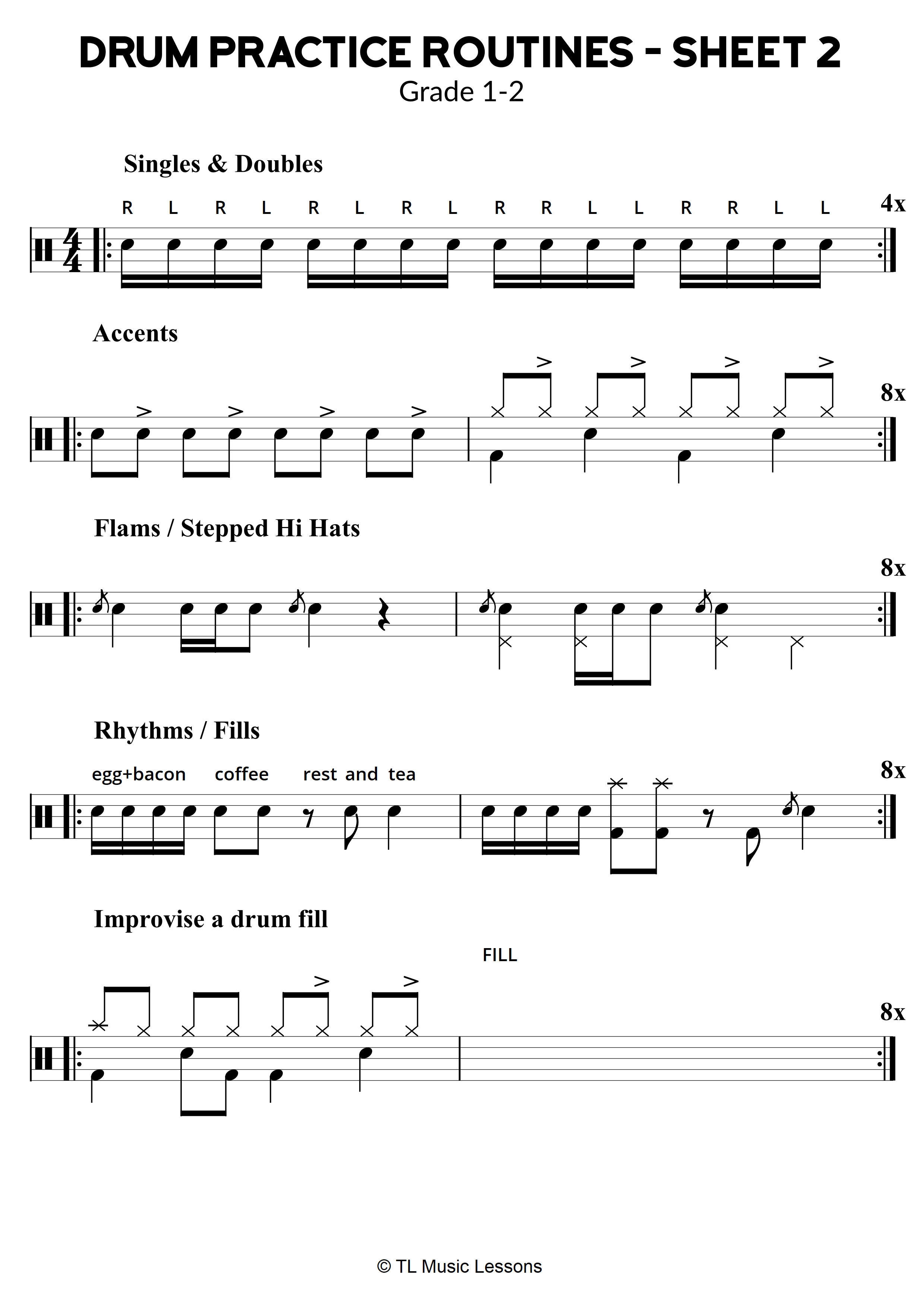
In this practice routine, we are covering many of the fundamental parts of grade 1 and grade 2 material. On the sheet we have a paradiddle 8 times (left handers need to play the opposite sticking).

There are accents on 8th note snare drums and then moving onto a basic drum beat, the accents are played in the same place but this time on the hi hat part of the drum beat.

The flams and stepped hi hat section has a classic rock feel to it and it is an easy way of introducing 4 way coordination into your playing.

For the rhythm/fills section, it’s the same rhythm on the drum fill as it is in the first bar on the snare drum, so it’s a nice exercise that flows, so we do that 8 times.


Related: Drum Practice Routines – Sheet 2 – Grade 1-2

Drum Practice Routines – Sheet 1

Here is a sheet that is ideal for drum teachers to give their grade 3-4 students to practice as ongoing homework for perhaps a half term, or 4-6 weeks. Rather than giving them something new each lesson to practice, this substantial sheet can be given to practice alongside a song or their homework for a grade they might be working towards.

There are several sections, covering many of the techniques and requirements of the Grade 3 level, and a lot of it crosses over to Grade 4 too, so I’d say Grade 3-4. The following techniques and exercises are included on the sheet: Paradiddles, Accents, Skip Beats, Flams, Stepped Hi Hats, 4 way coordination, Syncopated Rhythms, Drum Fills, Improvisation.

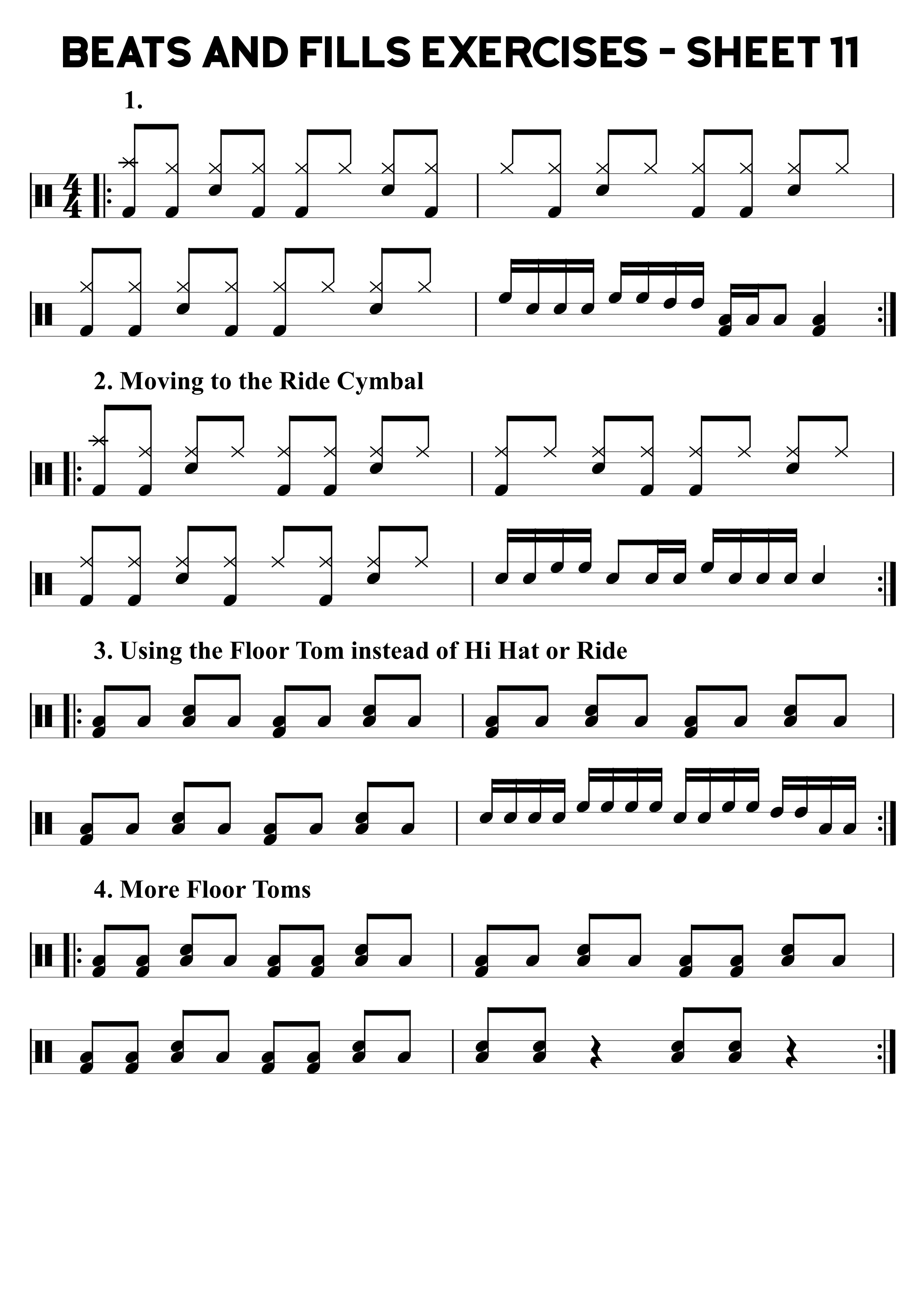
Beats and Fills Exercises – Sheet 11

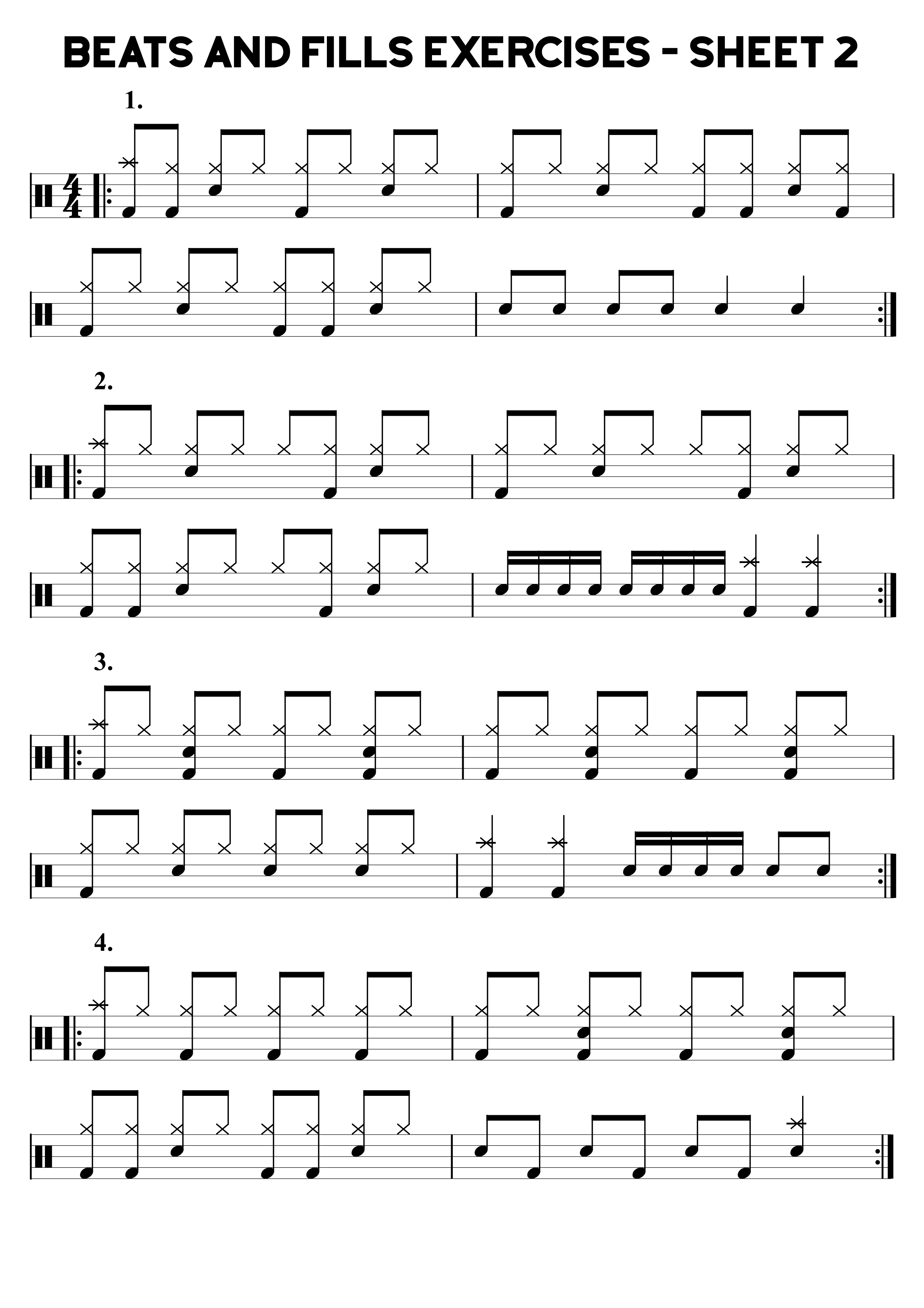
Sheets 1 to 10 are available as an ebook called 40 Beats and Fills Exercises Ebook, which consists of 10 drum exercise sheets with 4 exercises on each page.

In that book, the exercises are all based on beats using the Hi Hat and playing a drum fill on bar 4, and then repeating. The next step you could take is continuing those beats but moving the right hand (if you are right handed) onto the Ride cymbal or the Floor Tom, instead of playing the Hi Hats throughout the drum beats.

This, ‘Sheet 11’, is a continuation of this book, available for free, There are various directions you could go after the first book. I am also writing another book focusing on playing on the ride cymbal and using the stepped hi hat, which may become or feature as ‘Book 2’ of this series, or perhaps I will do a mixture and include sheets like this one too.

The drum music is written in an easy to read sort of way, where all of the drum voices (bass, snare, hi hat etc) are linked in one stem, rather than separating the cymbals from the rest of the drums. This way of writing and reading has proved very popular with my students and I think it’s a good way of reading drums to start with, before moving on to the regular way of writing and reading the music.

Drumming Session for Keeping Fit

Guest Blog Post: Mia Johnson


People don’t normally think of instruments when they consider ways to get fit. They’re usually left to the realm of artistic expression. You create music with them and that’s basically it. However, one instrument has proven itself worthy of also being called a tool for fitness: drums. If you’ve ever looked at some of the best drummers in the world, you might have noticed that they are extremely lean. This is because drumming is a surprisingly good way to get in shape. It can be a very dynamic exercising tool with a bunch of fitness benefits. Here are some reasons why you might want to incorporate drumming into your fitness regime.

1. It’s a fast-paced instrument

If you had to pick one instrument to help you stay fit, drums would stand out as the obvious choice. They’re arguably the most fast-paced instruments that you can get your hands on. Drumming sessions involve constant hand movements that push players arm muscles to their limits.

Songs that are focused on drums usually sound extremely dynamic, which means that playing them will further motivate you to commit to the workout. When playing the drums, you can consider yourself an endless source of workout pump songs.

If you prefer slow songs that sound smooth, you won’t lose out on the exercise potential of drumming. You’d be surprised at how many movements are required to keep up even a slow hat pattern while other parts of the drum kit are working. Drums are very consistently dynamic when they’re used in songs.

Even if you’re not following the tempo of a specific song, but rather creating rhythm from scratch, you will still naturally aim for a higher tempo to test your skill and push your body to its limits.

2. Easy to get into

Many instruments have a very steep learning curve. For example, new musicians playing the violin will sound horrible until they get to a certain point where they might sound bearable. Even the simplest of instruments require quite a bit of practice before they can be used to create something that is appealing to listen to.

Drums are a bit easier to play in this regard. You get a lot of payoffs relatively quickly into the learning process. The learning curve isn’t as steep as some more melodic instruments. You can start with some very simple rhythms made up of two sounds and it will already be easy to listen to, although it might be horribly boring at first.

You don’t need to hire tutors to give you lessons in playing the drums. Using it as a way to exercise will help motivate you to learn more. After all, practice and repetition are what makes someone a good instrumentalist. You will unwittingly use your drum workout sessions as a way to get a lot better at playing them.

3. An endless source of fun

If you’re a fan of rock music, drums can give you the opportunity to bring some of that hardcore energy directly to your own room. Popular rock songs often have drum patterns that are just as recognizable as their guitar melodies. This means you can get the emotional rush of playing the song rather easily.

Drums are pretty unique instruments because their focus isn’t on creating a melody or chord progression, but rather keeping up a rhythm. It requires just as much skill as other instruments, but you might find that it gives you a lot more leeway and satisfaction than most other instruments. Drumming is all about improvising and going wild when you figure out a rhythm that suits your current state of mind. Once you get going, it can be hard to stop because it’s so ridiculously fun to play them.

4. It’s a cardio exercise

The constant and rhythmic movements of drumming help make it an ideal cardio exercise. You’re using a lot of your muscles for stability, which means much of your upper body is getting a hefty workout. The consistency at which drumming movements have to be done also affects your heart. It’s almost like having a run but using your upper body for the movements. In fact, there are various studies that compare the effects of drumming for cardio exercise versus running for long periods of time. It has been shown to be as effective as playing soccer for ninety straight minutes.

Drumming is a lot more adaptable than running or walking. People of all ages and skill levels can enjoy the perks of using it as a way to exercise. It doesn’t depend on the weight and it doesn’t give you any joint pain. Best of all, it’s going to help you keep your heart rate up no matter how good you are at playing them. Even if you make mistakes and have to have a do-over, it’s still going to be a very effective workout.

5. It’s an art

There are very few exercises that also qualify as an art form. Drumming allows you to create new music while also getting a wonderful workout. You don’t expect to get sweaty while playing the guitar or bass.

When you get better at playing the drums, you will find that your movements are much smoother and more precise. This is complemented by the same kind of improvement in terms of drumming as a workout. Your muscles get stronger and they allow you to make more precise movements with less energy being wasted. Your improvement as a musician will be followed by your fitness level and vice versa.

There’s a degree of emotional payoff when you play the music that you enjoy. At the same time, your body will get a rush of endorphins from the workout that drumming provides. Together, these two effects make playing the drums a very enjoyable physical and artistic experience

6. Drumming builds muscles

Most exercises fit into two different categories. You have aerobic exercises which consistently increase your heart rate and get blood pumping throughout your entire body. These include running, sprinting, and riding a bicycle. Basically, things that require constant movement. On the other hand, anaerobic exercises are sudden and powerful movements which tear a few muscle fibers and make way for muscle growth. Just about any weight-lifting exercise fits this criterion very well. Exercises like squats are considered anaerobic.

Surprisingly, drumming can fit both of these criteria rather well. Not only does it take your breath away, but it also paves the way for an increase in muscle mass for most of your upper body. You can expect to get chiseled hands the longer you play the drums. The harder you move the drum stick, the more stability your back needs to make that movement, which means that even your back muscles get bigger and stronger over time.

The muscle-building aspect of drumming shouldn’t be understated. It causes a lot of fibers to break and it leaves your body craving for protein and rest. After a long drumming session, you should always eat well and take a break. If you want to keep drumming for longer periods of time, you might want to keep your True Protein shakes near your drum kit. Without a constant intake of protein, you’ll very quickly get fatigued and you won’t be able to continue playing at the same level.

7. You can do it with friends

Working out with your friends is a great way to get your mind off of being tired. When you go out for a run, it’s a lot more fun to bring someone along with you. You can have a chat and make the workout session much more than just a bit of running. Hitting the gym with your buddy lets both of you enjoy the rest period after a tough workout.

Drumming is no different, you can easily work out while you’re spending time with your friends. It’s even encouraged that you get some like-minded individuals to play some instruments alongside you. You don’t even have to join a band to get the whole musical experience. People enjoy getting together to create spontaneous jamming sessions. There’s something about creating freestyle music that appeals to most musicians.

If you want to create something bigger than the sum of its parts, you could become part of a band. Rock music is traditionally made in a band environment, but it isn’t an absolute must. Some famous acts such as the White Stripes, have only two members that are multi-instrumentalists. Still, a band environment can help you meet new people and improve your talents as a musician and song creator.

Conclusion

Drumming has proven itself to be a ridiculously effective way to keep your body fit. It combines some of the best elements of various workout regimes while also being a really fun activity overall. You hardly even notice that it’s a workout. You can consider it an artistic expression that just happens to keep you fit the better you get. There’s no better way to combine art and fitness in one powerful and effective package.

5 Ways to Improve your Drumming Speed

Photo Credit: Mark Latham

Guest Blog Post by: NetSoundsMusic.com


Playing drums requires a little bit more physical effort than many other instruments. While many instruments require correct breathing and fingering techniques, and some utilize pedals as well, drummers are constantly using their whole body, including not just fingers or hands, but the whole arms and both legs. This is why drumming for prolonged times is very draining, especially at higher speeds.

Certain genres of music have high tempos as a defining trait. Speed metal, techno, trap and some types of folk music require you to consistently play 16th notes (or even 32nd notes!) at very high BPMs. But even classic rock or chillstep songs can have faster passages, sometimes known as speed-bursts, or a very intricate drum solo that is hard to execute because of the combination of speed and unpredictable, almost pattern-less lines.

Getting up to speed is not exactly easy. It is required that you physically practice playing at higher speeds, that you understand how muscles work, and to mentally recognize, feel and hear the 16th notes even at very high speeds. It is definitely a steep learning curve.

So, where to start? How about relaxing a little bit first.

1) Learn to play slow and precise:

This is a tip that has been repeated so often that it has completed its route from being the most popular advice to being the most hated one. Yes, learning to play slow will not increase your speed directly, but that is not the point. The point is to hear the beat and to get accustomed.

By playing slow, we mostly mean playing at slower tempos. Keep in mind that while playing at slower tempos, you can still add in speed bursts in form of 16th or even 32nd notes. That means that at a lower BPM, you can still play faster than when you play a high BPM. 16th notes of a lower BPM are still faster than many 8th notes of a high BPM. The low BPM simply makes it easier to get into the whole speed-game and it enables you to actually feel what you’re playing.

2) Relax your muscles as much as possible:

The second reason why you are supposed to slow down at first is to learn to relax. At higher speeds, we tend to tense up, and tension slows us down. So, to be able to play fast, you need to learn to control your movement, breathing, and tension. This requires a lot of mental effort and will take some time to get accustomed to.

Playing relaxed doesn’t mean playing quietly or slowly, though. It means that you are simply not straining a much as you probably do right now.

3) Start off slow and increase the BPM:

This is another widely repeated advice that is not wrong and that it is helpful, but please keep in mind that this is only part of the whole learning process. Learning a song part at a lower BPM, then increasing it is going to help you track your movement and get the precision down before getting the speed under control.

You can even take songs that you know and “over practice” them to get them down properly. Many rock acts play their songs at higher tempos live, which is both a way to reduce the duration of the venue and fit in more songs, but also gives a certain kick to the songs that are increasing the unique feeling of a live concert. Practicing along recordings of live performances might be a good idea for you.

4) Practice smaller parts at high tempos:

While learning how to play a hard drum solo slowly and then working your way up the metronome, another way is to learn the solo part by part with very small segments played at the correct tempo.

This will help you get down the movements at the correct time and then all you have to do is put them together. This is very effective and becomes even more useful once you get better and playing fast because you will be able to learn and master solos this way much faster.

5) Practice speed bursts and double the amount of notes:

Another way to use lower BPMs is to practice speed bursts. Add to your patterns a small and short solo line or bridge that lasts only for one bar or even less. Or double the number of notes.

This can be done by simply doubling what you are playing. For example, instead of a single kick, you can either play with a double bass drum set very fast or use a double bass drum pedal to add a second kick to the first one.

You can also create more solo-like lines from time to time. Lastly, you could try to consistently add a cymbal throughout the whole song, essentially changing the 8th note feel to a 16th note feel, though doing this consistently might not be very musical and also very difficult to pull off.

6) Be comfortable with your gear (Bonus)

As mentioned in the beginning, being relaxed is very important. This includes being used to your gear. Make sure you find the correct type of sticks and the best throne that fits your needs.

Experiment with different drum setups and don’t be afraid to change up your layout. Getting two bass drums or a double kick pedal might seem like a big change, but everything can be learned and mastered. Some setups work better for faster styles than others, so make sure to check out and draw inspiration from jazz, prog, and metal drummers to see how they are dealing with faster parts.

Summary:

Learning to play fast cannot be done in a day, and mastering high BPMs can take a very long time. One thing that is sure is that it can be done with enough practice and patience. Try out different methods and don’t be afraid to search for inspiration out of your comfort zone. There are many different genres that utilize fast drum lines, so try expanding your musical repertoire. And should you get stuck, don’t panic.

Stagnation is a normal phase that we all go through from time to time and sometimes it can feel that you haven’t progressed in weeks or even months. But this will go away. Play fun songs that you are comfortable with and with each song, your brain and muscle memory will passively pick up certain details that will help you increase your speed later on.

Peter has a passion for music since he was 12 years old. Enjoying jamming and teaching, he runs Net Sounds Music, a space to learn and get involved with music.

[Premium] – 40 Beats and Fills Exercises Ebook

I’ll start by saying I’m really pleased with this ebook! It’s a compilation of half a year’s work, which started out as making some fun and useful exercise sheets for my drum students. I would make one sheet every every couple of weeks or so and it eventually finished at sheet 10, not just because it’s a round number, but because I was ready to start introducing other things that wouldn’t neccesarily fit in neatly with this ebook. I’m very pleased with the book because it’s very focussed on the fundamentals of drumming that every drummer should be learning to start with at least.

Buy Now →

Introduction

This drum ebook is a good set of exercises for the beginner drummer that has learned how to read and play very basic beats and fills already. All 40 exercises are laid out in the same way so it’s a focussed effort on building up your core drum beat beat and drum fill skills.

  • For beginners Grade 1-2 level drummers.
  • 10 Exercise sheets with 4 exercises per sheet.
  • Improve your drum beats and drum fills and practice changing from one to the other.
  • Exercises consist of 3 bars of a drum beat and 1 bar of a fill, repeated.
  • It’s a fun ebook to work through quickly or slowly. 1 sheet per week would work well for some.

The layout is slightly different to my other books so far. Usually the cymbals are notated separately (stems pointing up) to the rest of the drums (pointing down), but in this book everything is pointing in the same direction (usually up, although it doesn’t matter which way they go). I find that at this beginners / grade 1 stage, it all makes more sense this way to learners because otherwise you get rests appearing sometimes in the bottom part of the stave when there are still hi hats playing, and this almost always causes confusion with beginners young and old. It’s important to learn the other way too and move onto that, and it’s like that in most of my other books.

For beginners, but not straight away

A complete beginner could start this book early on, but not straight away. They can follow the book either with a teacher or on their own if they are a quick learner. Self taught learners may need to look some things up because not everything is explained for the complete beginner. A good book to start with for complete beginners is First Drum Book – Easy Reading Beats & Fills, which is especially good for younger learners. Another ebook that has content for complete beginners in is Beats and Fills Drum Book – Basic Beginners – PDF Ebook. That book goes beyond complete beginner too and has similar ability level content to this book, so it can be used in addition.

The usual info

  • When you purchase, you get a pdf file to keep. Please do not redistribute the file, unless you are a teacher sending it to students to practice with.
  • Drum teachers can print the book or single sheets as required for their students.
  • Drummers can teach themselves following on from a strong basic foundation in reading and playing

I hope you enjoy the ebook!

Free Preview

Buy Now →

Drumming for Mental Health: How Playing Drums Can Help Relieve Stress and Anxiety

Photo credit: Lindsey Bahia on Unsplash

Guest Blog Post: Patrick Bailey

A note from learndrumsforfree.comMany thanks to Patrick for writing this article. I can certainly say that playing drums helped me get through my teenage years. I also think as an adult, stresses can get intense in many different ways and that drumming is an excellent and fun way of releasing stress. Before you read the article, I would like to draw attention to the word ‘Relieve’ in the title, because it’s important to note that this isn’t going to be a total fix, but it could be one of the things that helps. One point that I would like to add is that if you already can play the drums and haven’t been playing them much for a while, and you have stress and anxiety in your life, then I can’t think of a better reason to get into a regular practice routine. See if it helps.


There’s meditation, exercise, and holistic diets to help people with mental health issues–but one overlooked hobby to help reduce stress is playing a musical instrument, particularly drums. What are some of the mental health benefits of playing drums? Read to find out more.

When people think of musical instruments, they immediately associate it with talents or passion. A person usually plays drums because it’s their life calling–though it can be an exaggeration at times, this is true for the most part.


However, playing drums can also serve not just as a hobby or passion, but rather as a catalyst for change in terms of mental health. With mental health problems on the rise such as anxiety and depression, people are trying to find healthy, non-medicated ways to deal with their condition.


The current state of mental health problems

Anxiety disorders are considered one of the most common mental illnesses in the United States. Almost 20% of the country’s population have been diagnosed with anxiety disorders, and the numbers continue to rise. This also excludes people who show anxiety or depressive disorders without going through a proper medical diagnosis.


Mental health problems can be quite a challenge to detect and manage because unlike physical diseases, their symptoms can be subtle or deliberately hidden from others. Some people who go through mental health issues can often be scared to come out due to the negative stigma associated with conditions such as anxiety or depression.


Some of the common signs of anxiety and depression include:


  • Constant rumination of worries that snowball and get bigger and bigger
  • Breathing problems
  • Panic attacks
  • Feelings of paranoia
  • Lack of interest in daily activities
  • Overeating or loss of appetite
  • Feeling hopeless, down, or distressed for prolonged periods of time
  • Thoughts of self-harm
  • Irritability towards others
  • Easily agitated
  • Difficulty coping with responsibilities


Remember that the symptoms of anxiety and depression can overlap. Since anxious people are often depressed, they also tend to seek unhealthy coping methods such as addictions or self-harm. If you think that you or a loved one’s life may be at risk, don’t hesitate to seek help right away.


The best way to deal with mental health problems is to seek medical attention as soon as possible. A psychiatrist will be able to recommend specific strategies, both through medical interventions and therapeutic strategies to help address the condition. Some of the most common strategies to help people with anxiety is through pursuit of hobbies and interests. Anxiety disorders can be relieved through art, music, or movement.


How does playing drums help relieve stress and anxiety?

Vibrations and beats can help reduce stress levels in the body.

Although drums are not considered part of the melody and you can’t really think of notes and tunes, it is true that vibrations and beats can still help reduce stress levels in the body. This is because the rhythm being introduced auditorily helps release the antibodies called immunoglobin A. Immunoglobin A is a substance that helps reduce cortisol levels. Cortisol is a responsible trigger for stress and anxiety.


When cortisol levels are continuously high, the body responds through various physical and mental symptoms. You may be prone to more infections, be at risk for cardiovascular diseases, and also develop anxiety disorders. Playing drums and learning to follow through rhythms can help boost antibodies for your overall wellness.


Drumming is a physical activity.

It’s no longer a mystery with how physical activity can help relieve mental health problems. This is because when we exercise, our bodies release neurochemicals such as dopamine and serotonin which are considered “feel-good” substances. These chemicals are naturally released in the body which provides us with vitality and elevated moods.


Thus, drumming can also be an option for people who want to hit three birds in one stone–those who want to relieve mental tension, learn a new skill, and burn calories all at the same time! One hour of drumming can help burn about 250 calories for an 180 lb individual. Some common cardio exercises like indoor cycling, running, or dancing can produce identical results. If you’re musically inclined but want to be physically active, then drumming might just be the perfect hobby for you.


Playing drums is also a mindfulness exercise.

One of the roadblocks to curing anxiety and depression is constant rumination of past experiences or worries that are in the far future or non-existent. Mindfulness is the principle that helps people think of the present moment to release their thoughts and feelings from forming irrational responses.


Playing the drums means learning how to tap or respond to the rhythm being played, or being able to set a consistent pace. This requires the brain to think of the present with complete focus in order to avoid losing the beat. In a way, playing the drums can be a great way to include as a part of one’s mindfulness routines for treating anxiety and depression.


Playing through rhythmic music can make you smarter.

It may be puzzling to see a connection here, but it is good to know that researchers saw a correlation with increased intelligence scores and playing to rhythmic music such as tapping the drums. It is apparent that keeping a steady beat helps develop the brain’s problem solving skills.


Often, people with anxiety or depressive mood disorders can have a lack of self-worth. They would often feel unaccomplished or unable to ‘match up’ to other people in terms of their skills and accomplishments in life. Playing the drums can serve as a way to boost one’s confidence and motivation to continuously pursue a potential musical passion.


Playing the drums can be a social activity.

Music is a universal language–it transcends language barriers and helps people connect despite their diversities. Listening to music, playing music, and enjoying music together is one of the best social activities one can engage in.


When people play drums, it can be an open door to form friendships, share life experiences, and simply enjoy the presence of others through music. Thus, it can be a helpful social activity that can reduce anxiety and depression.


Drum your stresses away

Sometimes, passions are discovered in the moment. If you are on the fence about the exploring the wonderful world of drumming, perhaps you can give the hobby a try as a stress reliever. Who knows? It can help give a sense of fulfillment that you may not have experienced if it weren’t for picking up that drumstick or trying out that first tap.


Other instruments can help too. Read here about the surprising benefits of playing guitar.

The Role Of A Drum Throne For Correct Drumming Posture

Photo Credit: Unsplash

Guest Blog Post by Drum Helper


Lots of drummers are all too happy to play without much consideration for proper drumming posture. After all, it’s not as much fun to take a sensible and well thought out approach before wailing away at the drums!

However, it is very important. This is because injury prevention is the single best way to ensure you remain healthy, fit and active. Improper posture can cause back injuries, hypertension and poor mobility.

Not only is it important for promoting positive physical health, but also for improving performance. Playing the drums with correct form and posture will allow a drummer to play with greater fluidity and exercise better control behind the drum set.

Being able to play the drums comfortably will translate to how you perform for each rehearsal and performance.

The foundation of correct drumming posture lies with the drum throne and the height it is set at.

Drum Throne Height

This is the most overlooked aspect of maintaining a good drumming posture, and I see far too many drummers sitting at an incorrect height (in correlation to their own frame) whilst playing the drums.

The drum throne is required to be positioned according to a drummer’s own height. This means if you are 6 foot you will position yourself much higher than someone who is only 5 foot 5. Drum thrones have a large range of height adjustment so don’t be afraid to experiment and see what works best for you.

Frequently I see tall drummers sitting far too low down and because their legs are far more extended out and then find themselves having to reach further to play the toms and cymbals within the drum set.

As a general rule, you will want to have your knees sloping downwards at a slight angle. You will want your spine and lower back sitting above your knees. So this means avoiding having a 90-degree angle for your legs.

Being sat at the correct height means you can also comfortably reach all the drum set components whilst conserving energy.

Once the drum throne is a correct height, the pedals will be required to be positioned to exactly where the feet fall naturally. And the batter head of the snare drum should sitting around 1 or 2 inches above the knees.

Invest in a Supportive Drum Throne

Good quality drum thrones offer superior comfort and support to cheaper alternatives. Quality thrones feature high-density foam cushions that support weight evenly and retain its original mass and shape for years without warping, breaking, or become uneven over time.

The base of a good quality drum throne is far more stable compared to cheaper drum thrones and this is vital for good posture. Cheap stools wobble and make a drummer unbalanced and unstable around the pelvis area and this can pose a huge risk to injury.

There are high quality drum thrones available to suit all different levels of budgets. Even if you have a small budget, there are supportive and comfortable options to choose from.

Drum Throne Height Adjustment

Drum thrones across the board will all feature different height adjustment mechanisms to raise and lower the height of the stool accordingly. Here are the various types of height adjustment mechanisms found in drum thrones:

Nut & Bolt-Lock (Avoid)

This is a mechanism exclusively found in insufficient, low quality thrones that are to be avoided at all cost. Every single cheap stool will use this type of height adjustment and you can guarantee it will wobble and break. They provide terrible posture and have very limited height options.

Sliding Tube & Memory Lock:

This type of mechanical height adjustment is fairly straightforward. It’s the same as found in cymbal stands. You are easily able to loosen a clutch that rests underneath the seat and you are able to slide up or down the metal tube to your desired height.

Spindle Adjustment:

The threaded spindle adjustment is a popular mechanism for drum thrones. It is very simple to use, you are able to adjust the height with a single hand by spinning the seat top either clockwise or anticlockwise depending on if you would like to raise or lower the height. This is the easiest and most popular mechanism offering unlimited height adjustment.

Final Thoughts

A drum throne and its settings are sadly a very overlooked aspect of drumming that is, in my opinion, essential to allow a drummer to play at his best. And perhaps more importantly minimizing the risk of injury caused by poor posture.

Good drum thrones offer a wide range of adjustment, so I would encourage you to experiment with heights and seeing what works best. I find that more often than not the problems are with drummers sitting too low down as opposed to being higher up.

When raising the height of a drum throne you will also be required to raise the height of the drum set components including snare drum, hi hats and cymbals so you aren’t stooping lower to have to reach them.

I have personally found that sitting higher has improved my playing, allowed me to be more relaxed and has put less stress on my legs and shoulders.

And of course, develop good habits by remembering to sit up straight with your shoulders held back and relax your arms whilst you play.

Blurb

Gideon Waxman is a London based drummer with over 13 years experience, and is the drummer of metal outfit Familiar Spirit. You can find more of his tips at Drum Helper – a free online resource dedicated to helping drummers achieve more from their playing.

Choosing Your First Drum Kit Made Easy

Image credit: Alexander Lesnitsky from Pixabay.

In cooperation with consordini.com.


When picking out or setting up a drum set, a lot of people run into challenges during the process. Unfortunately, this is because they do not know what to look for.

People struggle with how much money to spend, what they should be concerned with, and what will make their experience the best one possible.

With many newbies never playing drums in their life before, they do not even know what sound they are going for with their drum set. This can be a very, overwhelming experience.

So, instead of being frustrating with your drum kit experience, enjoy the time you spend on picking the best drum set for you and your lifestyle.

Drumhead Decisions

Drumheads are one of the most overlooked parts of the drum set. In reality, the thicker the drum head, the darker the sound becomes. In turn, there is a low amount of resonance, but a higher pitch overall. Currently, some of the head options you could look into include Evans and Remo.

On the other hand, if you are someone who likes the sounds of a thinner head, then you probably like a bright sound. With extra resonation, these drum heads do not need much to make an incredible sound. Drummers, who use these types of heads, usually are playing in a quieter atmosphere, where the drums do not need to be played loud.

One of the last drumhead decisions you should consider is whether or not you want a coating on your drumheads. Having a coating is great for adding a darker sound, so pairing with a thick drumhead can create amazing controlled action. Without a coated head, you can expect a great attack and bright sound. Usually, coated drumheads are seen on the snare drum.

The Right Size

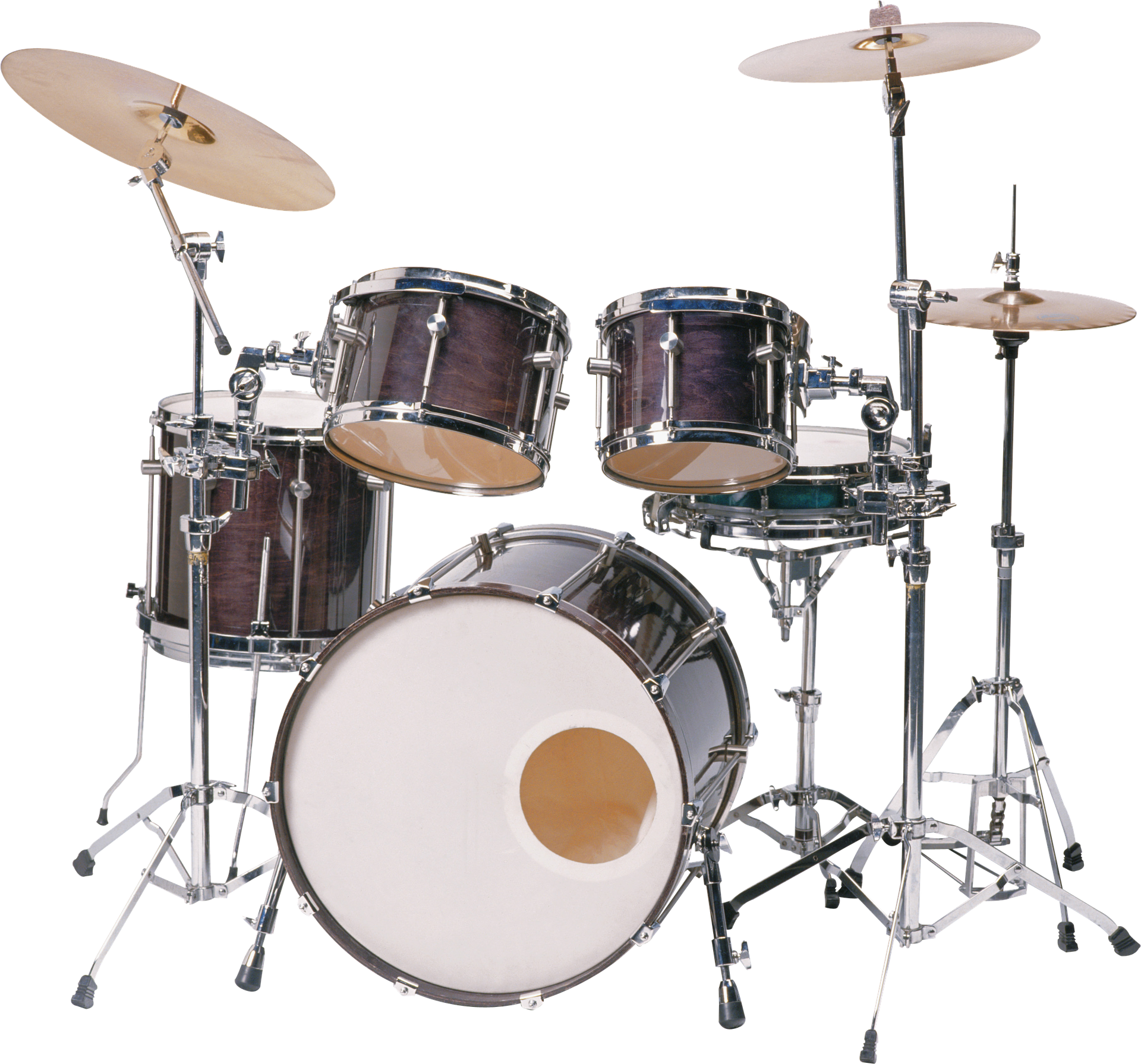
Some people may see a drum set and just expect it to be good, but there are actually a few decisions that will make your drum playing experience a great one. If you are into jazz music, a four-piece trap will do the trick nicely. The bass drum needs to be either 18” or 20”, the toms can be 10” or 14”, and a 14” snare is best.

Other kits, like the 5-piece variety, usually have a bass drum at 22”, toms at 12” and bigger, and a 14” snare, similar to the jazz trap set-up. With a bigger sized drum kit, drummers will not be limited to one style, but a multitude of styles.

Not everyone is up for a 6-piece set, but you might be interested. If you are looking for great flexibly, you can add a 16” tom for the floor to play any style of music on the planet.

Marvelous Materials

With anything, some people are not really concerned with what things are made of, but rather if the product works and if it is efficient for what it is used for. However, you should be aware of what shell material your drums are made out of.

Let’s start with maple. This material is perfect for jazz and acoustic sets. If you are looking for a material that brings the punch, birch is the material for you. Additionally, there are hardwoods, like mahogany, that provide a great tone, too.

In terms of price, birch and maple material will be the most expensive, so some first-time drum buyers might steer clear because of the cost. Before purchasing, consider demoing the material and then make your crucial decision. This can be a fun, yet informative experience that will only take an hour or so.

Extra Hardware

Drum heads and drum material barely scratches the surface with any drum set. You will still need to purchase things like the throne, stands, and pedals. With the throne, this is an item that gets a lot of use. Make sure that you pick a throne that is comfortable to sit on. Your backside will appreciate it. Look into thrones like Tama, Roc N Soc, and Pork Pie.

A high-end bass pedal should also be on your radar. This type of pedal can adapt to any type of style, and it can last a lifetime. Look into brands like Tama, Mapex, and Pearl to help you on your way.

The last hardware of importance should be the stands that hold your drums and cymbals. Sure, many of the sets that are purchased today come with stands, but usually they are low-end.

Upgrading this part of your set can go a long, long way. Some people look for durability in their stands. This is when double-braced legs are your best friend. If you move your trap around a lot, use legs that are single-braced.

Sensational Cymbals

The last piece of the puzzle involves cymbals. Picking the right cymbals really personalizes your set. There are two different cymbal materials to choose from: bronze that is casted and sheet bronze. Casted bronze has a wide-ranging tone, while sheet bronze is more inexpensive with less tones to account for.

When it comes to casted bronze, check out brands like Sabian and Zildjian. On the other hand, for sheet bronze, identify brands like Paiste, Zildjian, and Sabian. By investigating these brands, you will have a group of cymbals that mess well with one another, depending on your decision.

The Big Finish

With all the information above, you will definitely not be frustrated with your first-time drum buying experience. Ultimately, remember that your best option is to check out sound demos, go to a local shop, or try a friend’s trap out for good measure.

Do not just go through the process in a hurry. The more time you take, the better you will feel about your purchase. Then, you can just enjoy your drums and get to work honing your drum skills.


Find more articles like this at consordini.com
Hybrid Drums – The Fusion Between Acoustic and Electronic Drums

Photo Credit: Mark Latham

Guest Blog Post by: Electronic Drum Advisor

Acoustic drum sets are very difficult to replicate electronically in both presence and sound. However, they do not always contain enough variety to meet the sonic expectations of modern audiences.

This poses a problem for modern bands. Full electronic drum sets are often ruled out as an option for many valid reasons, but what about getting the best of both worlds? This is where Hybrid drums come in.

Hybrid drums are the fusion between acoustic and electronic drums. Drummers simply augment their current drum kit with electronic elements such as triggers, pads, and drum modules.

These setups can get very interesting, particularly when you interface the electronic drumming elements with other music gear and DAW software on your computer using MIDI.

This article also explains the benefits of hybrid drumming for live sound, particularly when it comes to the punch of your bass drum for smaller live performances.

Using electronic elements in your drum set

Hybrid drum kits do not often come as one big package. The items are generally purchased and organized separately. This is all about creativity and personalization.

Electronic drum pads are a great and simple option to start implementing electronic sounds. You can place pads such as the Roland SPD-SX or Yamaha Multipad right next to your drum set and hook it up to the PA system.

These types of pads can produce a very wide variety of sounds, such as claps, percussion, bass notes, synth loops and much more. You can also import your own custom sounds or hook the pads up to other gear or production software using MIDI.

Another fantastic option is through the use of drum triggering technology. These simple items attach to drum heads and can trigger external sounds on other music gear. You can usually even connect them to your sample pads.

One of my best tips is to mount a dual-trigger to your snare drum. This makes the snare rim a separate triggering surface that you can use to produce a clap or other effect sound.

Trigger bars and pads are useful for electronic elements that you can place in convenient locations around your drum set. These can be great for discrete electronic additions to your kit.

Triggers and pads require a sound source. This can be done using an electronic drum module, a drum trigger module, a sample pad, or other music gear.

If you already own an electronic drum set, you could use the ‘drum brain’ from this as your sound source.

Combining elements in the live mix

Acoustic and electronic elements can be combined nicely in your live mix using hybrid drum setups. For example, you can set up microphones on your acoustic drums while also amplifying sounds from your pads and triggers.

If you are mixing two sounds together, it is useful to blend the electronic sound in. For example, a good quality drum trigger modules allow you to alter the pitch of the electronic sample to match the sound of the drum head.

The most practical use for this is the kick drum in live performances. Drummers that need a serious punch sound out of their kick drum are often disappointed by small venue sound systems. Blending a triggered, club-style electronic kick sound can often achieve very impressive results.

Many metal drummers have been using triggers on their drum heads for years. However, this has caused some controversy because drummers have been using them to compensate for lack of power when executing fast double-kick strokes.

The best music genres for hybrid drumming

Genres that contain strong electronic elements such as pop and dance are perfect candidates for hybrid drum sets. Drummers can trigger samples and effects that are relevant to the style.

Hybrid elements are especially interesting for experimental acts and live electronic music producers. The modular nature of these items often fit very nicely with these setup types.

However, more subtle uses of hybrid elements can be used across a wide variety of music styles. For example, drummers for wedding and cover bands could opt to trigger their drums instead of using microphones. This could improve their live sound, as well as making sound check and pack down a whole lot easier.

Using a full electronic drum set

The majority of drummers do not consider electronic drum sets as an option for playing drums live. However, top-end sets can actually simulate standard drum sets extremely well. They also work great in spaces where an acoustic set is simply not an option.

If you are in doubt, try out the current top-end electronic drum sets such as the Roland TD-50 or the Yamaha DTX900 in a local music store. These resemble nothing like the kid’s toy image you might conjure up when thinking of an electronic drum set.

These might set you back a lot of money, but they are the closest we currently have to electronically simulating a full drum kit. Check out this guide on Electronic Drum Advisor to explore these options.

Conclusion

There are some disadvantages of electronic drums over regular kits. The cymbal pads can sound a little fake and the kick pad can lack the presence of a 22-inch bass drum.

However, combining what’s great about electronic drum sounds with your acoustic drum kit is the best of both worlds.

Using electronic elements can improve the range and quality of sounds for your live performances. You can start with a few small items and then expand the sound of your kit from there.


This guest blog post was written by Electronic Drum Advisor.