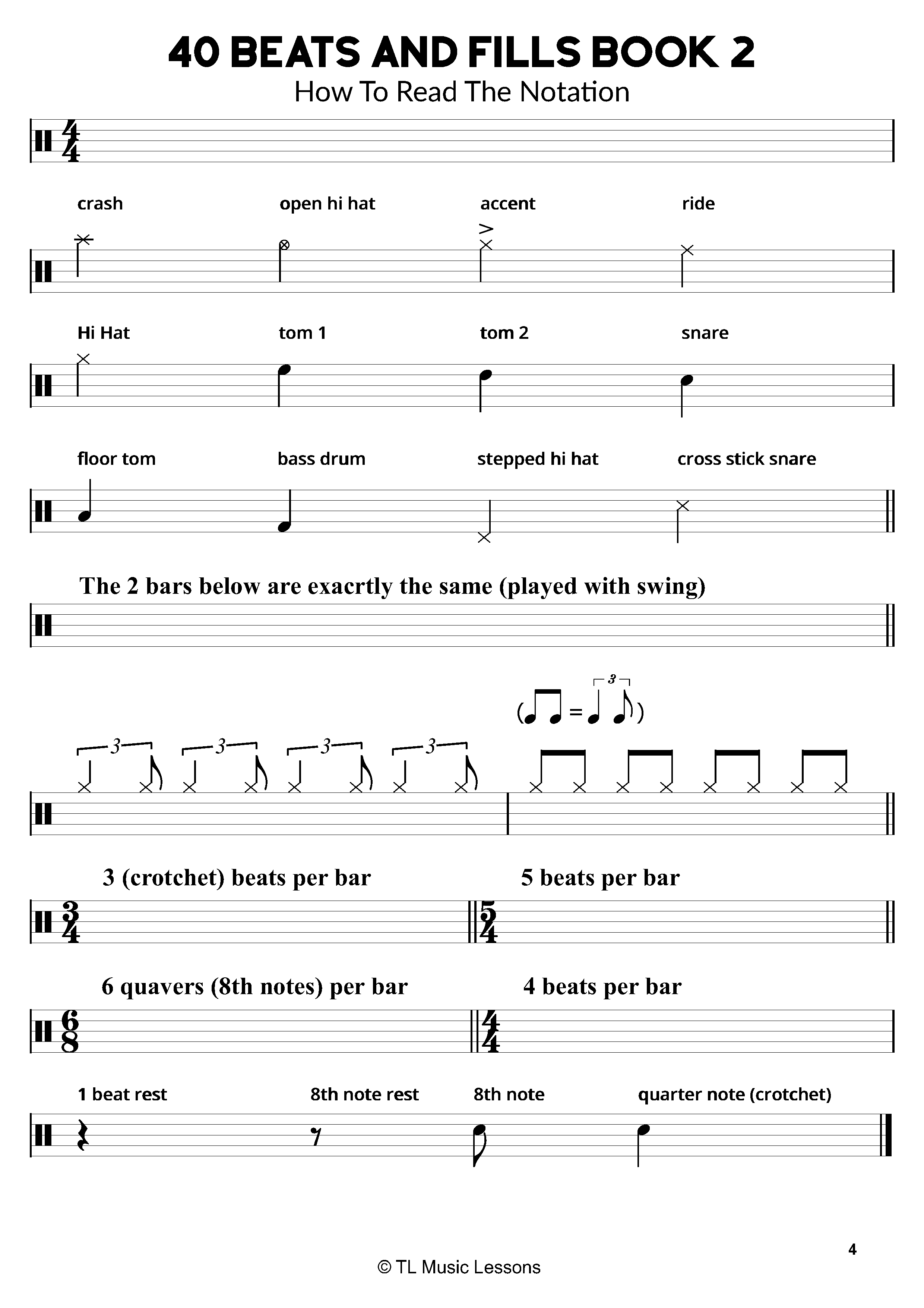
As you can see in the featured image, this post is showing you how to read the drum notation in the book. This is going to to be quite hard to understand without any prior knowledge or tuition, but I have made a video (see below) that shows you which drums are which and how to read and play the swing, rests, basic notes, and time signatures.
Here are all of the drum voices and notation markings on the sheet: crash cymbal, open hi hat, accent, ride cymbal, closed hi hat, tom 1 (small tom), tom 2 (medium tom), snare drum, floor tom, bass drum, stepped hi hat, cross stick snare drum, triplet swing, 3/4 bar, 5/4 bar, 6/8 bar, 4/4 bar, crotchet rest, quaver rest, quaver, crotchet.
There are more free pages like this one, use the the navigation below to view them.
This book contains drum beats and drum fills in the styles of pop, rock, blues, musical theatre, jazz, heavy metal, hard rock, punk rock, and indie, as well as covering fundamental techniques such as stepped hi hat, open hi hats, 16th note hi hats, 4 way coordination and time signature changes. The book ranges from grade 1 to 3.
The last book focused on grades 1-2, so this book is focusing on the high end of grade 1 and up to grade 3 level. The book would be an ideal add on for anyone studying Grades 1-3, and in particular grads 2-3. To achieve grade 3 and possibly grade 4 level, the exercises would need to be played precisely, with correct dynamics, speed and fluidity.
Demonstration Video
There is a video accompaniment with timestamps for every exercise in this book here: https://youtu.be/jMT9UHOBHNM
About the book
This is the second book in the series, following directly on from “40 Beats and Fills Exercises (Grade 1-2)”. There are 40 exercises over 12 sheets, and a bonus sheet 13. There is also a warm up sheet, which can be played at the start of a lesson if you are studying some of the book.
Final Thoughts
I hope you enjoy working on this book or teaching with this book. Stick the metronome on and get into each exercise. Aim to repeat each exercise at least 2 times (ideally 4 or more). You could do 4, or keep repeating until you are happy with it. If you have done the sheet a few times before, perhaps 2 times each would be sufficient. Start without the metronome first if you are needing to slow down and learn each one. Slow it right down if it’s tricky and really make sure to play it properly. It’s better than trying to messily play it too fast.
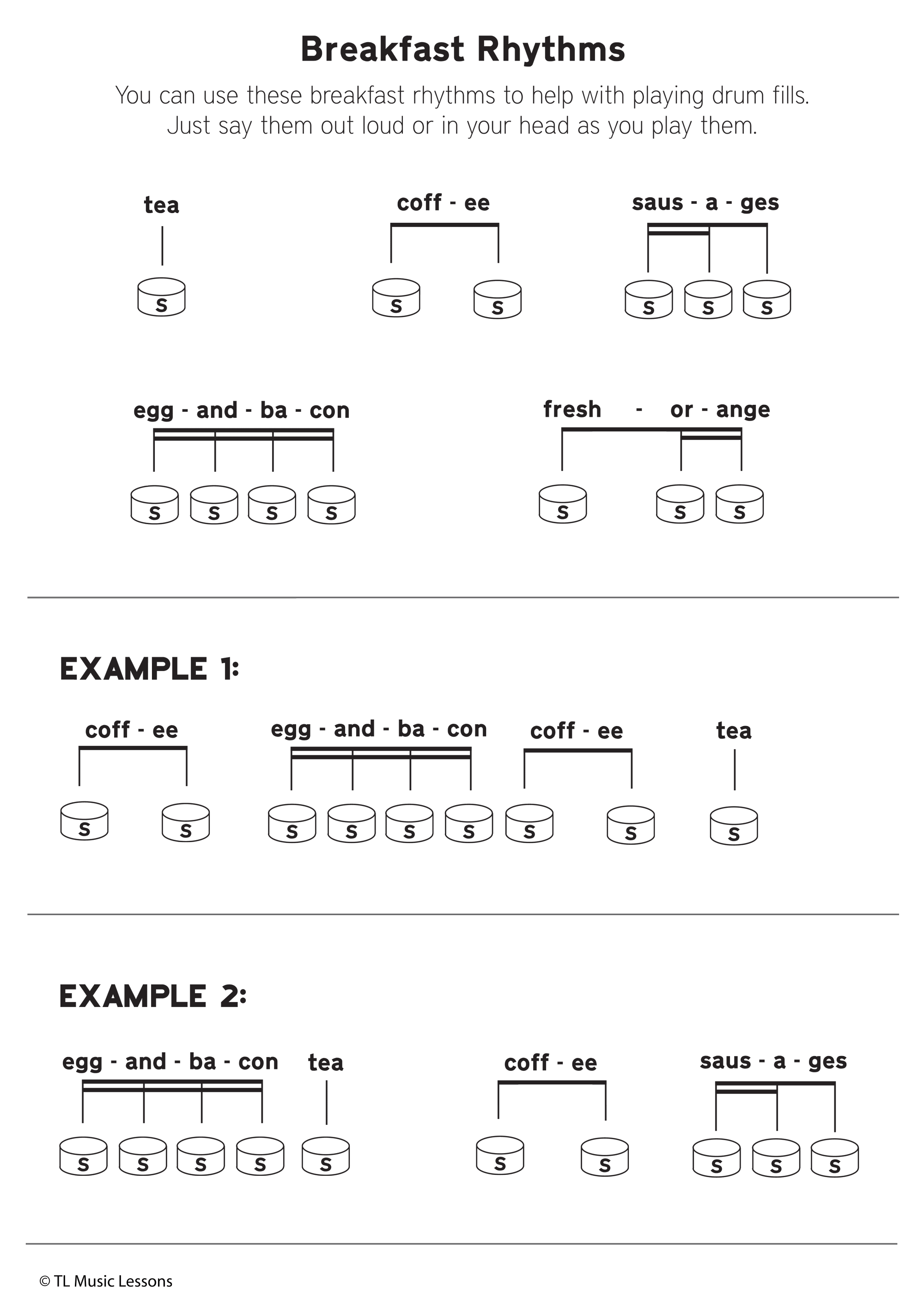
Breakfast rhythms are great for all primary school ages, and they can be fun for high school and adult ages too to help with the initial barrier of learning the rhythms. By saying the rhythm and seeing it at the same time, you will be associating the sound with how it looks on paper, so eventually you will know that two 16th notes and an 8th note sounds like the word “sausages”, so in the future you may not think of the word sausages but you will know how the rhythm goes instantly when you see them combined on the sheet music.
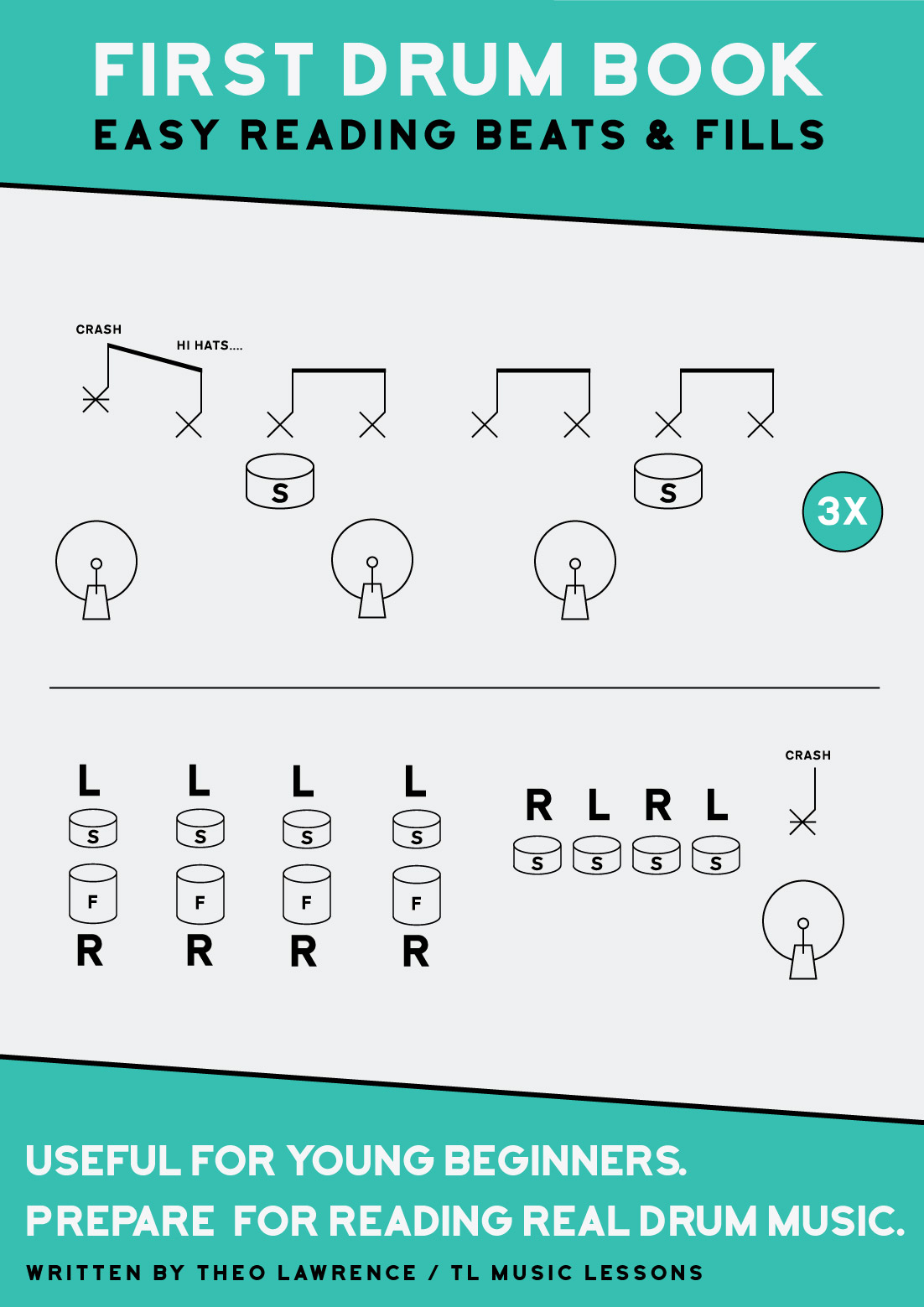
This sheet is an accompaniment for a book I have made called “First Drum Book – Easy Reading Beats & Fills” (it’s a premium download). This page is not in the book yet but I’m currently going through the book again to improve parts of it. If you download the book now, you’ll get a notification to download the latest version for free when it’s ready.
This sheet will also be very helpful for any of the free snare drum exercises or snare drum sheet music I have posted and also for any of the beats and fills exercises, for help with reading the drum fills.
For this exercise sheet, you will need some basic beginners reading knowledge of drum beats and drum fills.
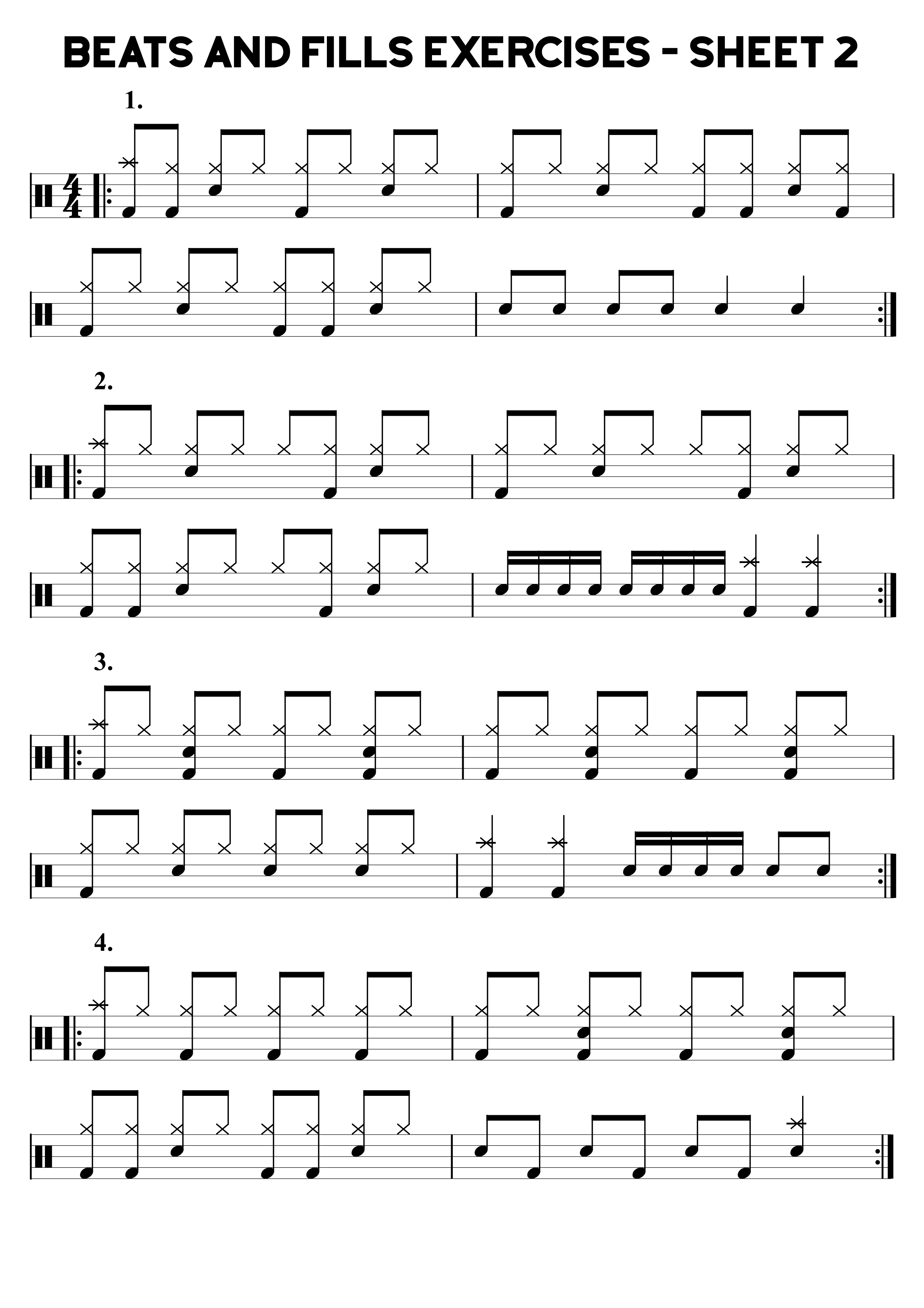
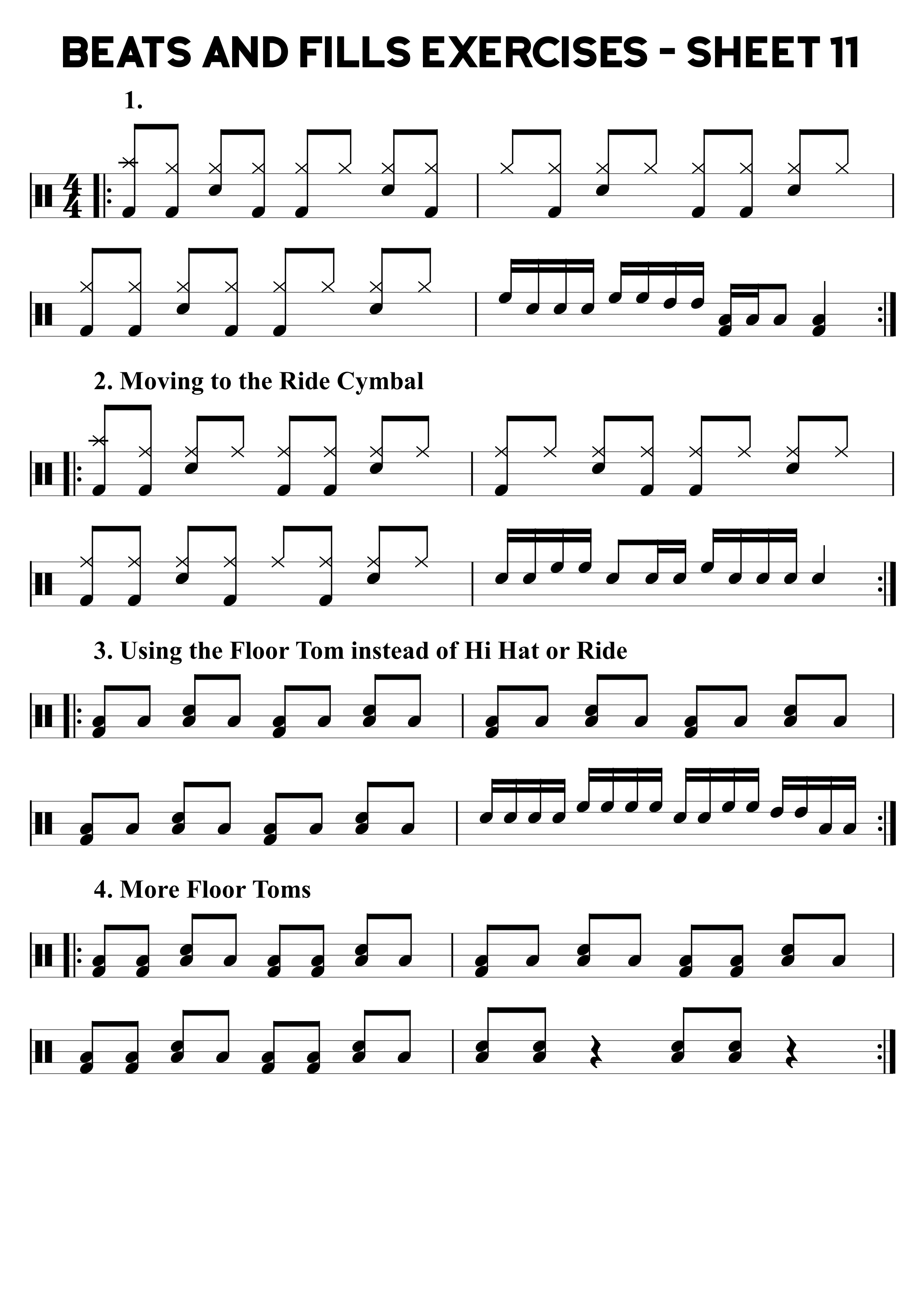
In the exercises, you will play 3 bars of drum beats, 1 bar of a drum fill and then repeat the exercise. There are 4 exercises on the sheet and each one can be played twice, or more times if you like and perhaps the sheet can be revisited on over several practice sessions if needed.
On the first 3 exercises, there are times when there are 2 hi hats on their own with no bass drum or snare drum, so it’s helpful to especially listen out for these two hits whilst playing to avoid missing one of them out, as some learners can do by accident.
All of the drum fills are played on the snare drum only. If there are 2 lines attaching the notes, they are played as 4 fast notes. If there is 1 beam attaching the notes, they are 2 medium speed notes, and if there is one single note on it’s own, it’s 1 single hit lasting for 1 beat. There is also a rests for 1 beat that look like a squiggle on the 3rd exercise’s drum fill, so for that you don’t play anything, and wait for 1 more beat before continuing.
Sheets 1 to 10 are available as an ebook called 40 Beats and Fills Exercises Ebook, which consists of 10 drum exercise sheets with 4 exercises on each page.
In that book, the exercises are all based on beats using the Hi Hat and playing a drum fill on bar 4, and then repeating. The next step you could take is continuing those beats but moving the right hand (if you are right handed) onto the Ride cymbal or the Floor Tom, instead of playing the Hi Hats throughout the drum beats.
This, ‘Sheet 11’, is a continuation of this book, available for free, There are various directions you could go after the first book. I am also writing another book focusing on playing on the ride cymbal and using the stepped hi hat, which may become or feature as ‘Book 2’ of this series, or perhaps I will do a mixture and include sheets like this one too.
The drum music is written in an easy to read sort of way, where all of the drum voices (bass, snare, hi hat etc) are linked in one stem, rather than separating the cymbals from the rest of the drums. This way of writing and reading has proved very popular with my students and I think it’s a good way of reading drums to start with, before moving on to the regular way of writing and reading the music.
I’ll start by saying I’m really pleased with this ebook! It’s a compilation of half a year’s work, which started out as making some fun and useful exercise sheets for my drum students. I would make one sheet every every couple of weeks or so and it eventually finished at sheet 10, not just because it’s a round number, but because I was ready to start introducing other things that wouldn’t neccesarily fit in neatly with this ebook. I’m very pleased with the book because it’s very focussed on the fundamentals of drumming that every drummer should be learning to start with at least.
This drum ebook is a good set of exercises for the beginner drummer that has learned how to read and play very basic beats and fills already. All 40 exercises are laid out in the same way so it’s a focussed effort on building up your core drum beat beat and drum fill skills.
For beginners Grade 1-2 level drummers.
10 Exercise sheets with 4 exercises per sheet.
Improve your drum beats and drum fills and practice changing from one to the other.
Exercises consist of 3 bars of a drum beat and 1 bar of a fill, repeated.
It’s a fun ebook to work through quickly or slowly. 1 sheet per week would work well for some.
The layout is slightly different to my other books so far. Usually the cymbals are notated separately (stems pointing up) to the rest of the drums (pointing down), but in this book everything is pointing in the same direction (usually up, although it doesn’t matter which way they go). I find that at this beginners / grade 1 stage, it all makes more sense this way to learners because otherwise you get rests appearing sometimes in the bottom part of the stave when there are still hi hats playing, and this almost always causes confusion with beginners young and old. It’s important to learn the other way too and move onto that, and it’s like that in most of my other books.
For beginners, but not straight away
A complete beginner could start this book early on, but not straight away. They can follow the book either with a teacher or on their own if they are a quick learner. Self taught learners may need to look some things up because not everything is explained for the complete beginner. A good book to start with for complete beginners is First Drum Book – Easy Reading Beats & Fills, which is especially good for younger learners. Another ebook that has content for complete beginners in is Beats and Fills Drum Book – Basic Beginners – PDF Ebook. That book goes beyond complete beginner too and has similar ability level content to this book, so it can be used in addition.
The usual info
When you purchase, you get a pdf file to keep. Please do not redistribute the file, unless you are a teacher sending it to students to practice with.
Drum teachers can print the book or single sheets as required for their students.
Drummers can teach themselves following on from a strong basic foundation in reading and playing
Some snare drum sheet music writes out buzz rolls with a Z through the stem. I don’t write it like that because my software doesn’t have that feature, but many others write it my way too anyway so I’ve got used to writing using 3 slashes instead (3 slashes like this /// through a stem line like this |).
Tremolo in Other Instruments
So, the slashes through the notes are also used in other pitched instruments as a tremolo marking. Violins have plenty of tremolo, which is achieved by moving the bow back and forth quickly. You’ll hear the sound in movies where the violins sound intense and brooding by playing 1 note for ages repeatedly. See the video below for an example of this. You’ll hear this more in old programs and films such as in the original Thunderbirds series’.
Tremolo Markings in Drums (The ‘/‘ slashes through the stems)
On each line that the 1st bar has what you see in sheet music and the 2nd bar of each line shows you the method of playing it. I have chosen to write slashed 16th notes rather than write 32nd notes in the second bars because that’s how I teach drummers to count their buzz rolls, by playing 16th notes and buzzing each hand. So, for a 1 beat buzz roll, you would play “R L R L” 16th notes, and each hand will be buzzed, so it will actually be something like this: RR LL RR LL, or RRR LLL RRR LLL if you play several notes with each hand. For snare drum sheet music with multiple bouncing, I encourage more bounces so it has more of a drum roll feel to it.
Here’s how to play the multiple bounce roll:
When you see 16th notes with slashes in, during regular drum sheet music especially, I would say this always should be assumed as ‘use precice doubles’ if you can manage it with the double stroke technique. For example, the hi hats may have 16th notes but some of the hits are doubled, and these would be played with a strong double stroke technique. In this Samba Funk Grooves sheet you can see that the hi hats have been written as 32nd notes, but they could also have been notated with slashed 16th notes. You can see double strokes played on the hi hat in a groove in this video:
When you see slashed 16ths on the snare drum, this means to play them as 32nd notes, with double strokes (RRLLRRLL for 4 slashed 16th notes).
This video by Ryan Alexander Bloom shows how I play all of my precise doubles. I didn’t realise it was called the ‘Push Pull’ method until I looked up videos on it! At drum college they were just taught as the ‘double stroke technique’. Please make sure to watch the full video if you want to learn double strokes properly, it’s only a couple of mins…
For a free preview of the ebook, click Buy Now and then click ‘Preview’ at the top left of the cover image.
28 Pages
20 Drum Lesson Exercise Sheets
Introduction
People that might find this book useful
All ages will be able to enjoy this book as the drumming content will be a challenge for any beginner.
Beginners at ages 5-11 should benefit the most from these sheets when starting out, as they take away a lot of the initial reading difficulties.
Drum teachers can print the book or single sheets for their students. They can be taught to beginners of any age and also to very young beginners that wouldn’t otherwise understand some of the standard drum notation – especially the drum fills.
Drummers can teach themselves to play the drums using the easy to read music
About the book
This ebook has been created after nearly 9 years of teaching the drums and after many of these years developing my own way of writing drum music for beginners so that they could focus on the drumming rather than getting stuck working out which drum to hit. I noticed this problem with almost all of my drum students of school ages from ages 5 to 11 especially (these are the ‘Primary School’ ages in the UK).
After planning to write this book over a year ago, I have been handwriting similar types of sheets and photocopying them for my students to test the water and see which exercises work best. It’s really quick to write out your own sheets and I do encourage writing out your own by hand if there is something that you want to either teach or remember for yourself to play, that doesn’t appear in this book. All you need to do is draw out the symbols as they appear in this book, just on a blank sheet of A4 with any type of pen (I like using a think pen like a permanent marker so it stands out).
Following on from honing the hand drawn drum exercises, they have been recreated using Adobe Illustrator to give them a clean look and so that they are easy to read and well presented as an ebook.
This ebook should get students familiar with how real drum music is laid out, because I have kept everything the same really. So, when moving on to trying to read real drum sheet music, it should start to make sense a lot quicker than usual. My next ebook to try after this might be Beats And Fills Drum Book – Basic Beginners because it covers most of the content again in a different way but this time with real drum sheet music notation.
You are freely welcome to print this ebook for personal use or for giving a copy to your students if you are a teacher, but please do not redistribute the .pdf file online.
Here is a list of dynamic markings you might encounter in drum sheet music. This list will be updated as more dynamic markings are thought of, and will start out as a basic list of fundamental dynamics notation.
pp (pianissimo = very soft/quiet)
p (piano = soft/quiet)
mp (mezzo piano = medium quiet / medium soft)
mf (mezzo forte = medium loud)
f (forte = loud)
ff (fortissimo = very loud)
a wide version of this shape: < (crescendo = gradually getting louder)
a wide version of this shape: > (diminuendo = gradually getting quieter)
> these arrows above the notes are accents, which indicate that you play loud on this note only.
– Drum teachers can print the book or single sheets for their students.
– Drummers can teach themselves following on from a strong basic foundation in reading and playing
Contents Highlights
Subdivisions, Counting Methods, Drum Fills, Skip Beats, 16th Note Hi Hat Accents, Double Kick Drum.
Full Contents
4 – Subdivision drum solo / warm up exercise
5 – 16th note counting exercises
6 – Snare drum piece with counting exercise
7 – Short fills to start a song or sections of music
8 – Bass drum skip beats
9 – Snare drum skip beats
10 – 10 rock drum beats with 16th note bass drum combinations
11 – Snare and bass drum skip beat practice beats – with open hi hats
12 – Snare and floor tom piece with sextuplets
13 – Grooves and fills piece in 6/8
14 – 10 drum fills with 6 stroke rolls
15 – 6 drum beats and drum fills exercises
16 – 10 snare drum accent exercises
17 – Part 1 – 9 drum grooves with 16th note hi hat accents
18 – Part 2 – 9 drum grooves with 16th note hi hat accents
19 – 8 beginners double kick drum beats
20 – Intermediate double kick drum beats
About the book
This ebook is a Grade 4 level compilation of 8 years of preparation work for teaching drums. It consists of drum lesson sheets that I have prepared and revised many times to be the best they can be for teaching with. To create the book I selected only the best sheets from my selection of drum sheet music lesson handouts. I printed them all out on my office floor and arranged them into a coherent order.
I have included only the sheets, rather than add lots of teaching text. This is partly to limit the amount of pages printing, and also to give teachers using the books freedom to put their own take on the lesson sheets. This will probably make it harder for self taught players, so to anyone getting stuck reading the book I would recommend building up their reading and counting knowledge online. The 16th note counting exercises on page 5 and 6 should help, and can be used when playing skip beats to help with reading and playing them.
Reading skills are really important if you are teaching yourself with this book. Further to counting 16ths like on page 5 and 6 to snare drum rhythms, you can also use them in drum beats. It’s really helpful when you learn how to do it. To give an example of counting 16ths in beats; on Page 8, Bass Drum Skip Beats, on the first bar you could count “1 & 2 & a 3 & 4 &” to help with the timing. The second bar would be counted “1 & 2 e & a 3 & 4 &”. The kick drum skips are therefore on the ‘a’ after beat 2 on the first bar, and on the second bar the skip beat kicks are on both the ‘e’ and ‘a’ after beat 2. This probably sounds complicated if you’ve never done this before. It’s how many teachers explain note placements, and it’s still how I count new beats that need working out or extra practice.
Contains information related to marketing campaigns of the user. These are shared with Google AdWords / Google Ads when the Google Ads and Google Analytics accounts are linked together.
90 days
__utma
ID used to identify users and sessions
2 years after last activity
__utmt
Used to monitor number of Google Analytics server requests
10 minutes
__utmb
Used to distinguish new sessions and visits. This cookie is set when the GA.js javascript library is loaded and there is no existing __utmb cookie. The cookie is updated every time data is sent to the Google Analytics server.
30 minutes after last activity
__utmc
Used only with old Urchin versions of Google Analytics and not with GA.js. Was used to distinguish between new sessions and visits at the end of a session.
End of session (browser)
__utmz
Contains information about the traffic source or campaign that directed user to the website. The cookie is set when the GA.js javascript is loaded and updated when data is sent to the Google Anaytics server
6 months after last activity
__utmv
Contains custom information set by the web developer via the _setCustomVar method in Google Analytics. This cookie is updated every time new data is sent to the Google Analytics server.
2 years after last activity
__utmx
Used to determine whether a user is included in an A / B or Multivariate test.
18 months
_ga
ID used to identify users
2 years
_gali
Used by Google Analytics to determine which links on a page are being clicked
30 seconds
_ga_
ID used to identify users
2 years
_gid
ID used to identify users for 24 hours after last activity
24 hours
_gat
Used to monitor number of Google Analytics server requests when using Google Tag Manager

![[Premium] – 40 Beats and Fills Exercises Ebook](https://learndrumsforfree.com/2019/wp-content/uploads/2019/04/40-Beats-and-Fills-Exercises-Cover.png)