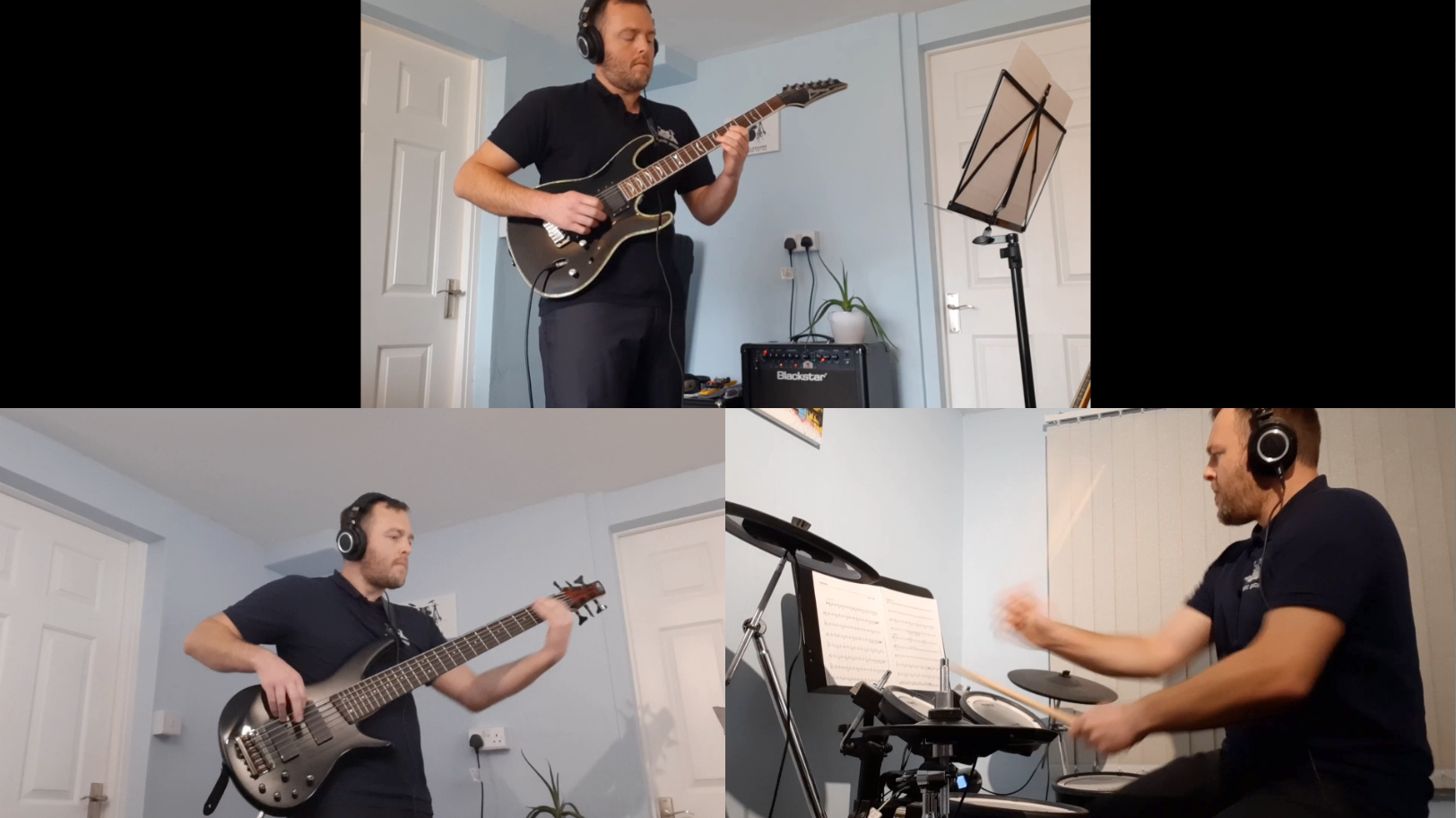
Guitar Drums and Bass performance of ‘Indecisive’ – Rockschool Grade 3 Piece

Many of my students have learned this piece and passed their exams. It’s an enjoyable piece to play with lots of energy and it’s deceptively hard to perform the whole song without mistakes.

The videos were recorded using a phone camera and a Zoom HD1 microphone.

I think these performances would get a fairly good mark out of 20 in an exam. Maybe 19 out of 20 each. I think the guitar performance was probably the strongest out of the 3, as there were small misakes in the others. But overall, I hope this is a good demo of the song and a good chance for students to see how the songs are played by each instrument, and give examples of the type of solos you could play in the song.

Accent Practice Exercise for Snare Drum

This exercise was created to support the learning of playing paradiddles with accents along with a metronome at 70bpm in the Grade 2 Rockschool technical exercises 2012-18 syllabus. I have also suggested to try practicing the sheet between 60 and 120bpm, with or without a metronome. 75-120bpm would be pushing the ability level up to at least Grade 3-4.

It can be hard to play paradiddles with a metronome at first, and if you haven’t worked with a click much before it’s also hard for 16th notes and 8th notes. This exercises works on playing 16th notes with a right, left, right, left sticking to get used to this. Then when you take away the left hand, you are left with right hand 8th notes, which is why they are the foundation of this exercise (first and 3rd line).

On the second line, the R L R L sticking on the 16ths prepares the drummer for the transition to 16ths from 8th notes before going from 8ths to paradiddle 16th notes in line 4. Then with the repeat the first 2 lines are there to settle in to the transitions again. By the end of the exercise the paradiddles exercise should become much easier. The actual grade 2 drums rockschool technical exercise is line 4 played twice.

Developing rock grooves with quarter note hi hats – Grade 2-3

I wrote this sheet initially to give students an idea of the type of things they could do to start off developing the drum beat for the guitar solo in a Grade 3 Rockschool song called Overrated (2012-18 syllabus). This sheet is also good for learning to develop the bass drum around a standard quarter note hi hat rock ostinato.

Start off by learning each bar separately before attempting a full run through. The hands will be playing the same beat in every bar apart from a crash half way through, and a drum fill in the last bar.

Every hi hat is to be played fairly open – enough to get that nice sizzley or slushy sound on the hi hats. You could play them more closed but with a slightly open feel, so they sound more crunchy – this would give a more hard rock sound.

These drum grooves would work well with classic rock and modern rock styles, and would fit with other styles in some situations, like for a slow metal groove or breakdown section, or played in a lively way in soul music, or in pop music (closed hi hats would also work well for pop).

How To Tune Drums – Exam Question

When tuning your drum skins you need to make sure to tighten the tuning pegs evenly (1/4 of a turn each time). In addition, make sure to tune the pegs in the correct order (see picture below) so that the tightening pressure on the drum head is distributed evenly. The key word to remember here is ‘Star Shape‘. This is the word that they look for in drum exams, (rockschool) when asked in the general musicianship questions.

You should ideally tune your drums regularly to keep them sounding nice.

Q: How do you tune a snare drum?

A: In a star shape, tighten or loosen the lugs with 1/4 turns or less until you reach the sound you are looking for.

Q: How do you replace a snare drum head?

A: Loosen all the lugs and take them out before taking off the snare rim and the old head. Clean out the snare if needed, then put the new snare head onto the drum, and then feed through the metal lugs and finger tighten them. Press down in the centre of the head to settle it into place. Next go round the lugs in a star shape tightening with quarter turns. After a few times around the star shape press the head again to stretch it a bit. Tap next to the lugs and make small adjustments if some sound tighter than others. Then keep going around in the star shape with quarter turns until it’s sounding how you like it. Finally push down hard in the centre for a couple of seconds, and then fine tune the lugs with tiny turns if you think they need it. Tap next to the lugs to check if any are too tight or loose.

Touring

When you set up your drums for a show, make sure to fine tune the drums if there are any wobbling tones on your drums.

Studio Recording

When recording in a studio, make sure you spend extra care to get the right tuning for the music you are recording before you actually go there. Again, you can fine tune when you are set up in the studio, but you don’t want to be spending studio time doing this for too long if you are on a budget as it’s probably going to be costing a lot of money. If your band mates see you wasting time tuning, they’ll probably get annoyed if they are splitting the cost with you.

Some players fine tune for each song, or tune to specific musical notes on the toms when recording.
5 Sight Reading Example Tests for Rockschool Grade 3 Drums – Unofficial Practice Tests

These 5 practice tests are to help with practicing for grade 3 sight reading on drums. This is aimed at the 2006-12 syllabus, so when this is out of date, you should if the grade 3 sight reading is still snare drum based and in the same sort of format. Update: The 2012-18 syllabus has the same format.

For each test, play the metronome for 4 clicks so you know how fast you will be going. Prepare each exercise in 70bpm, 80bpm and also 90bpm, but you can randomly pick one of those for each exercise you do. Give yourself up to 90 seconds to practice, as it says in the exam book, and then try to play it with the metronome.

Example Test 1

Example Test 2

Example Test 3

Example Test 4

Example Test 5

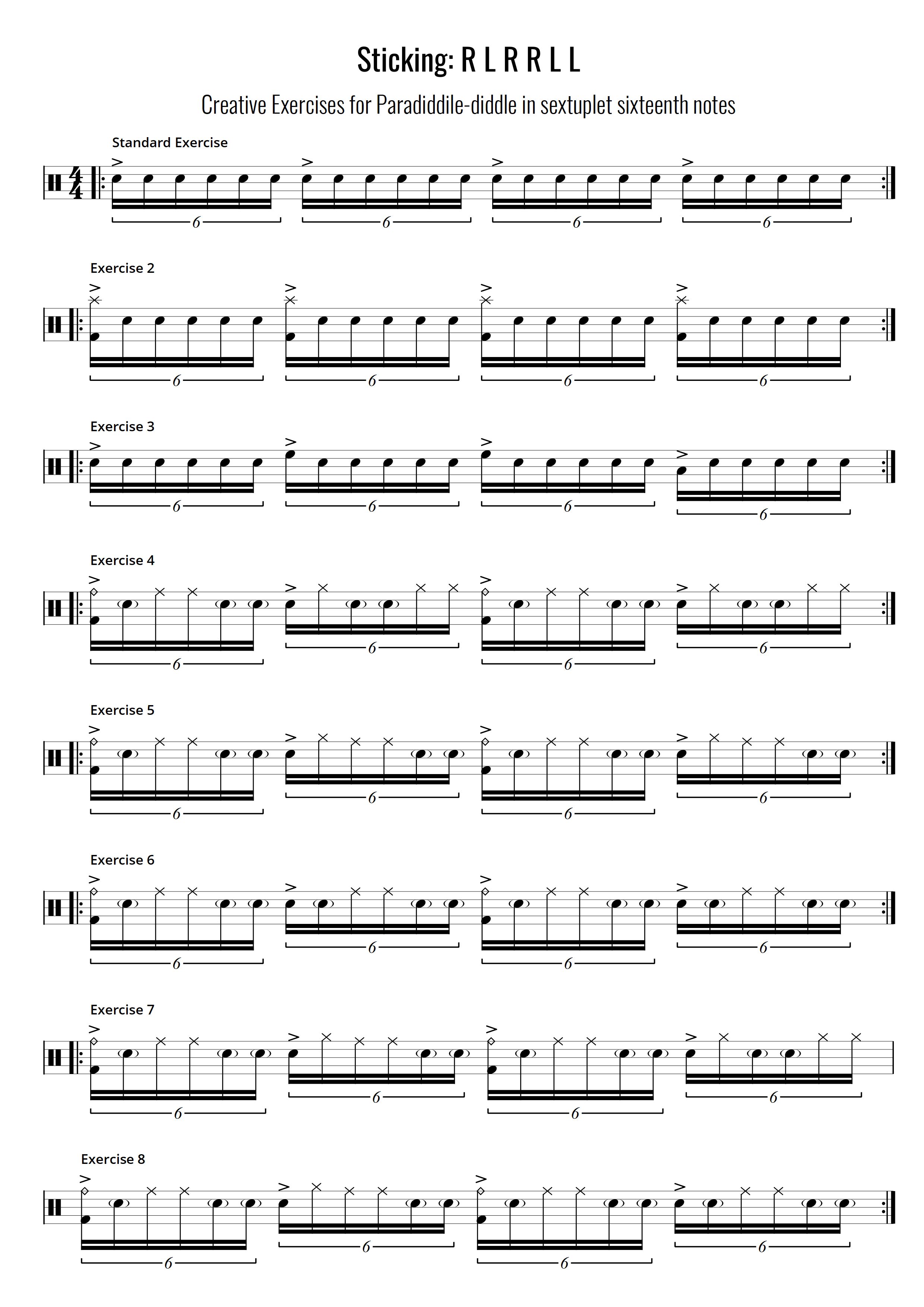
Creative Exercises for Paradiddile-diddle in sextuplet sixteenth notes

Here are some creative examples of how you can expand on the ‘Paradiddile-diddle in sextuplet sixteenth notes’ exercise 1 from Grade 7 technical exercises.

There are accents (>) underneath each line of rhythms to watch out for. There are also ghost notes (brackets around the notes), which means to play quiet taps. The diamond shape on the ride cymbal line is the Ride Bell. Play this with the shoulder of the stick to the left hand side of the bell (opposite for left handers).


Related: Drum Solo Exercises Using Six Stroke Roll With RLLRRL Sticking

Improvisation Test examples and ideas for Rockschool Grade 1 Drums exam

Students should improvise in the exam (don’t memorise this sheet). This sheet is for if you are stuck for ideas on how to improvise, then these should help you to learn the type of things to do. Imagine the sheet above with only the first bar of each line shown as written, and the other 3 bars of each line left blank. That is what it will look like in the exam, and you will have to make up the rest. The 4th bar must be a drum fill. It’s not too bad though, because it’s only 1 line, not a whole page like this. Drum teachers are welcome to print these excercises out and teach them to your pupils in drum lessons.

Drum Solo Exercises Using Six Stroke Roll With RLLRRL Sticking

This is an exercise that can be used in your practice schedule, and can be used as drum fills in your playing. This 6 Stroke Roll rudiment (played on the snare drum) is part of the technical exercises in Rockschool Grade 7 (Alternative paradiddle-diddle in sextuplet sixteenth notes), and is a good excercise for becoming more comfortable with playing it. This six stroke roll exercise can also be used / modified for drum soloing.


Related: Creative Exercises for Paradiddile-diddle in sextuplet sixteenth notes

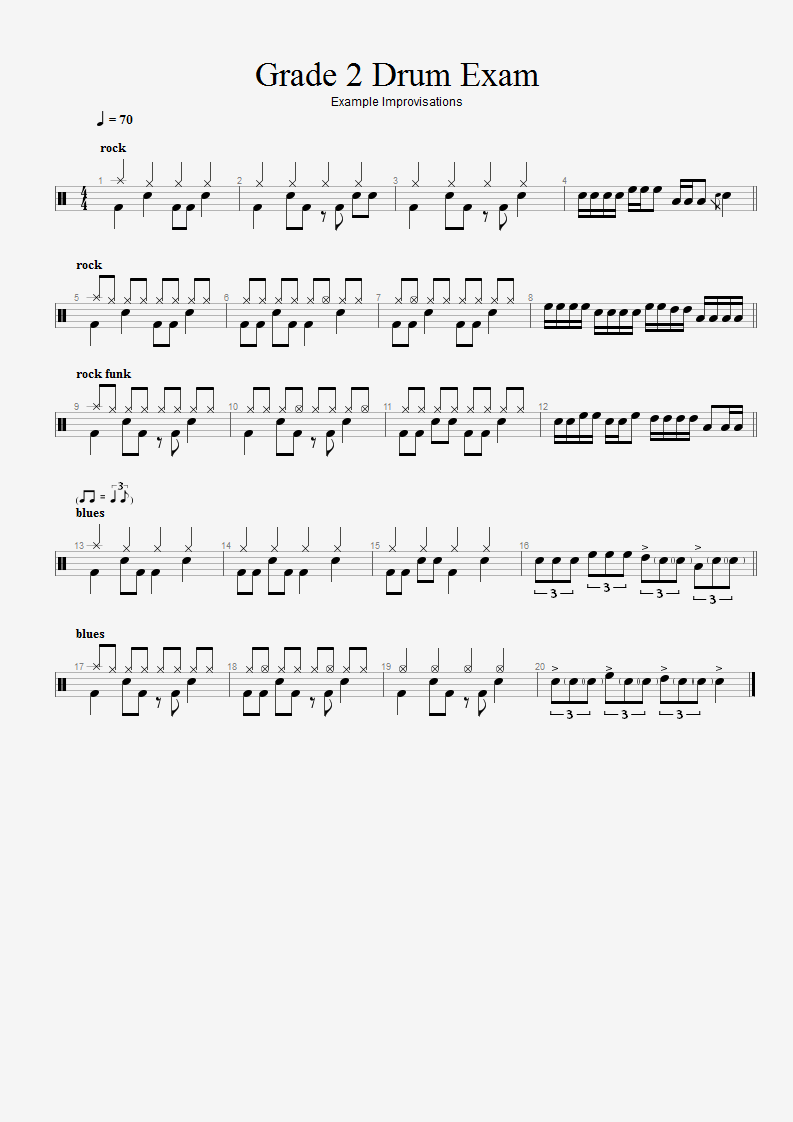
Improvisation Test examples and ideas for Rockschool Grade 2 Drums exam

Unofficial rockschool preperation ideas for improvisation part of the Grade 2 drum exam.

Students should improvise (make up your own on the spot), but if you are stuck knowing what to do for bars 2-4 on the improvisation practice before the exam, then these should help you. Drum teachers are welcome to print these excercises out and teach them to your pupils in drum lessons.

You will get given 1 bar of a drum beat, then 2 blank bars to improvise drum beats in and then 1 blank bar for a drum fill to be played in.

The last drum fill should be played as R L L R L L R L L R, with accents on the Right hands and ghost notes (very quiet taps) on the left hands. Reverse sticking for left handed players.