10 Practice Pad Exercises – beginners to intermediate

These 10 practice pad exercises are redesigned and edited exercises from the ebook Beginners Drum Book 2023. I have designed these to be useful for reading on a mobile screen as well as for any other device. It also looks good printed out, which you can do if you purchase 10 Practice Pad Exercises (PDF).

  • Can be used as warm ups or for drum lesson content
  • Many of the exercises can be played slowly by beginners and faster by intermediate players
  • Use with and without a metronome
  • For practice pad or snare drum
Continue reading “10 Practice Pad Exercises – beginners to intermediate”

Beginners Drum Book 2023

To Drummers,

I have a new drum book available for pre order, which includes some of the sheets that will be in the book when you pre order. I’m putting the price low, it’s only £1 to pre order and when it’s ready (by September this year), you’ll get the full copy sent by email. I’m going to be working on it over the summer and hopefully it will be an enjoyable book for teachers, students and anyone else to use, ready for the new school year in September. I’ll also make a video to help out with reading the contents of the book so that self taught drummers can follow along with ease.

Pre Order for £1: https://payhip.com/b/Rq2i9

Theo

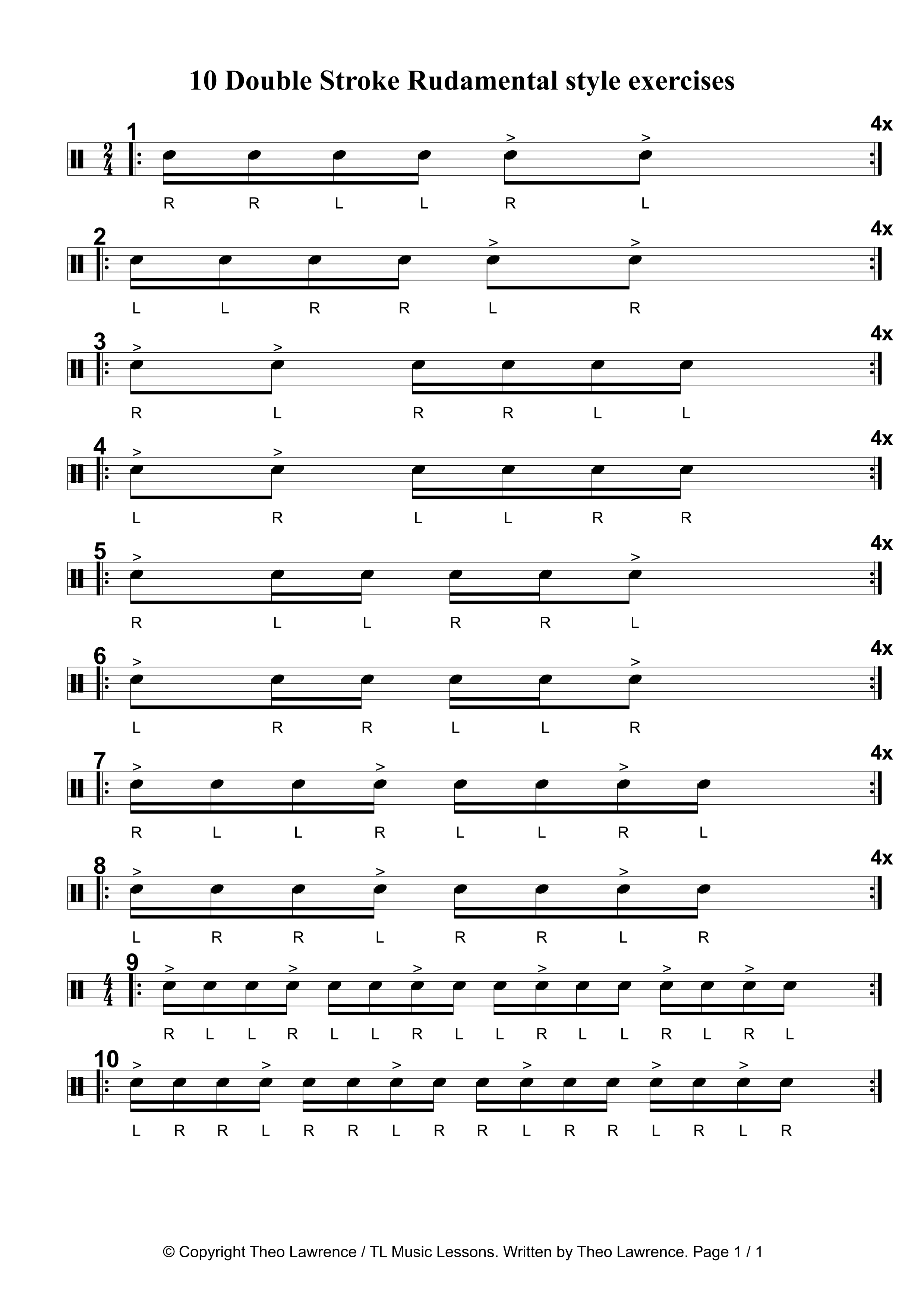
10 Double Stroke Rudamental style exercises

Video showing Exercise 1 & 2:

There are quite a few double stroke rudiment exercises in the 40 official drum rudiments, but none of these are in them. While the ’40 drum rudiments’ cover many of a drummers needs, in terms of practicing, there are many more double stroke exercises that are useful to learn.

The 10 rudiment – style snare drum exercises here are all involving double strokes. These snare drum exercises are all rhythms that I use quite often in my drumming, so to me they are quite essential I believe.

When learning rudiments, I was always taught that they are preparing you for possible eventualities in drumming – for example by learning and practicing the flam with different leading hands, you have prepared for using it in drum fills in songs, in a variety of situations. So to me, all of these 10 rudiment exercises are essential patterns that you will need at some point as a drummer, so to master these, will be beneficial to you for when you meet the patterns elsewhere.

Here is how all of the exercises sound:

Intermediate Drum Warm-Up – Part 1

You may also be interested in this drum book: Intermediate Beats Fills and Exercises, which focusses on Rock, Pop, Funk, and progressive styles.


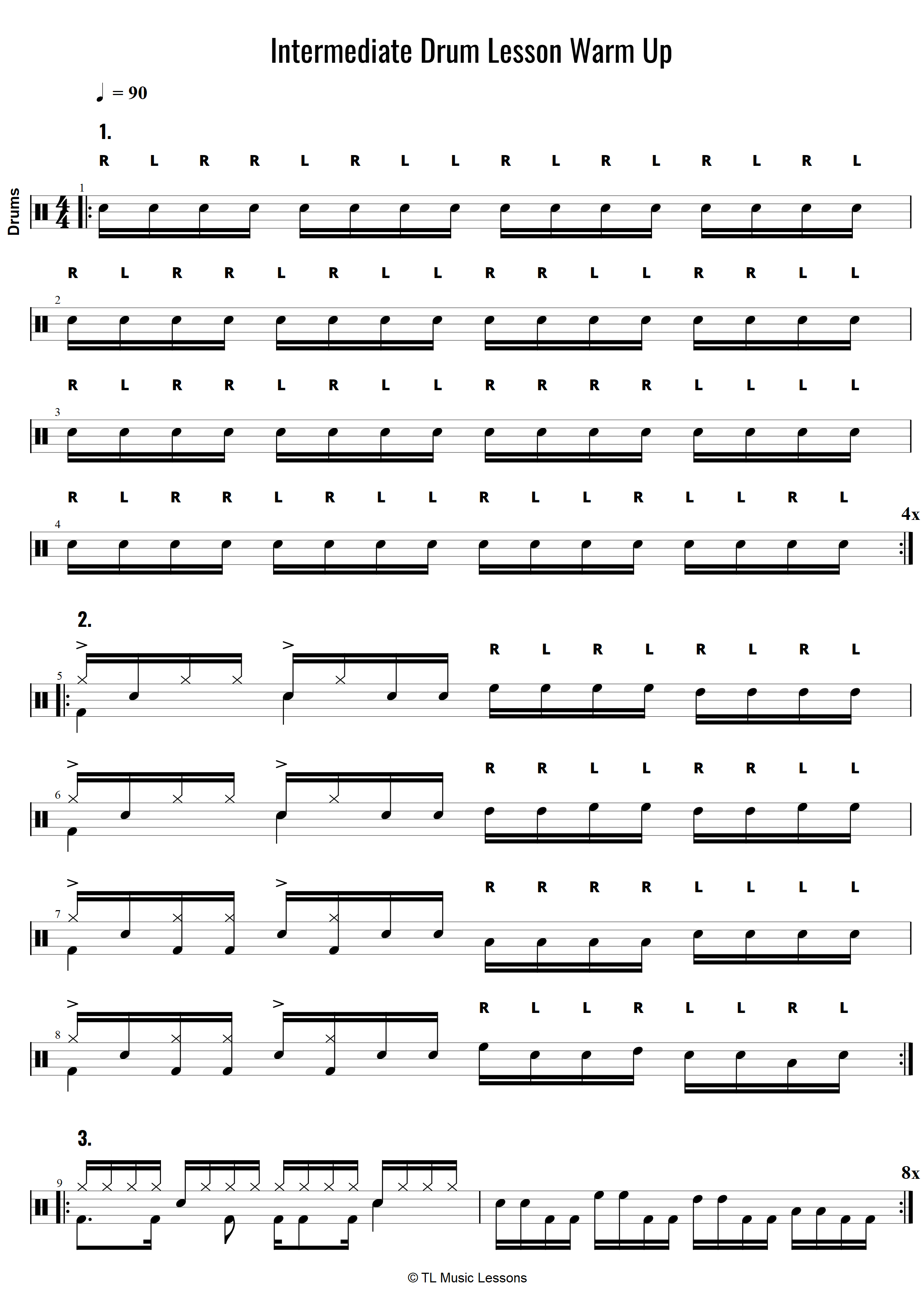
Following on from the Drum Lesson Warm Up posted a few days ago, this intermediate drum warm-up is for drummers that have reached a higher level of ability (about Grade 4-6 but could be used by higher grades too).

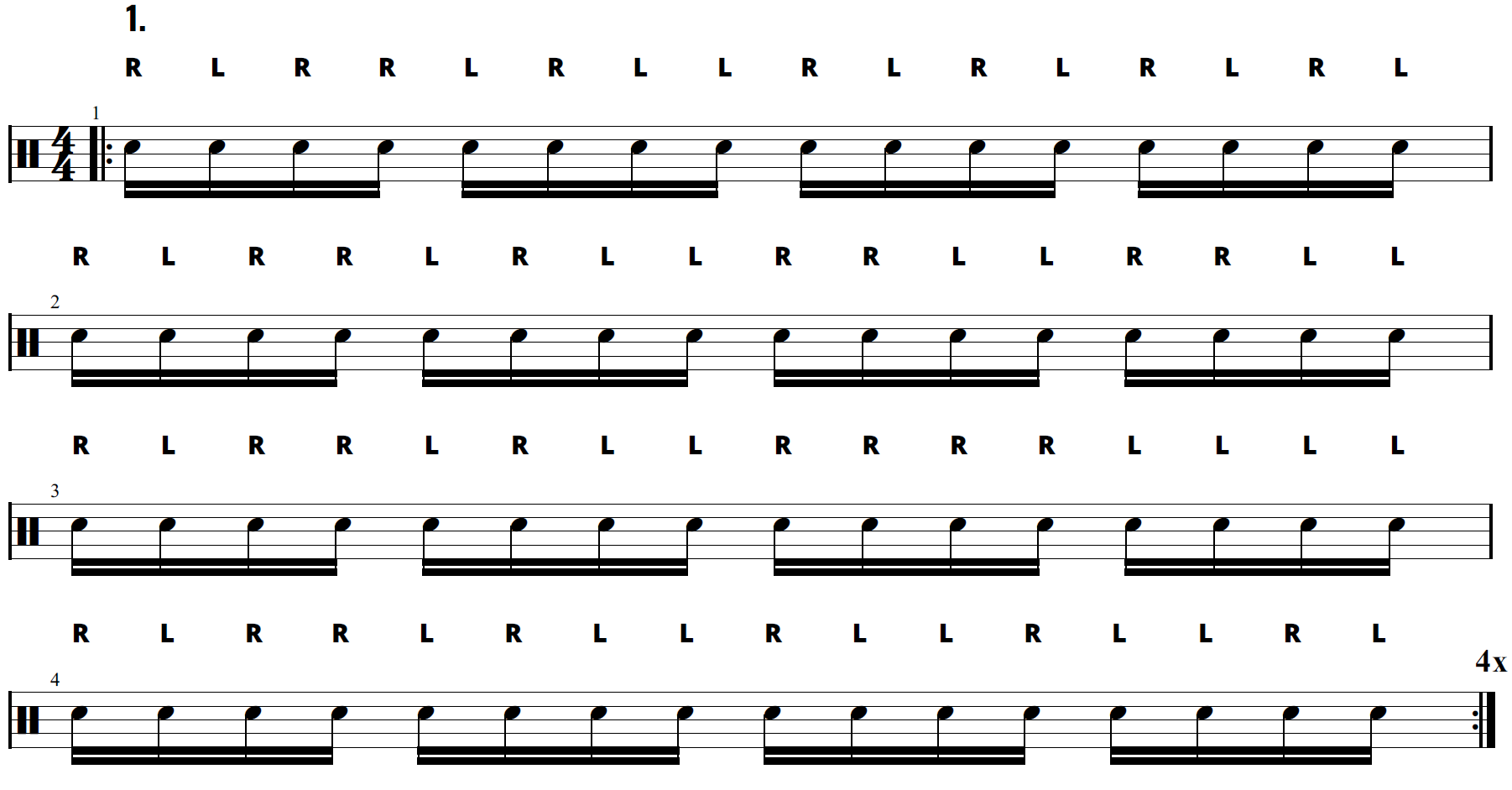
Exercise 1 – Intermediate Snare Warm-Up

Each of the 4 lines starts with a paradiddle, then the second half changes each time. The first line is singles, the second line is doubles, the third line is 4 with each hand and the 4th line is a 3-3-2 pattern (RLLRLLRL).

Intermediate Snare Warm Up

Exercise 2 – Paradiddle Drum Beat with Sticking Patterns on the Drum Fill

Using the sticking from exercise 1, we change the paradiddles into a drum beat by moving the right hand to the hi hat and the left hand to the snare drum. The drum fill then borrows the sticking we used in exercise 1, from the second half of each line.

ex2 - intermediate drum warm-up

Exercise 3 – Funk Rock Drum Beat and Drum Fill working on fast double bass drum with 1 foot

A rhythmic bass drum pattern with 16th note hi hats followed by a drum fill that works on the bass drum.

ex3 - intermediate drum warm up

Exercise 4-7

You can continue onto exercises 4-7 here: Intermediate Drum Warm-Up – Part 2.

Paradiddle Exercises Moving Accents To Toms and Cymbals

The Paradiddle. The most popular drum rudiment.

So dramatic! Could be the flam actually.

I’ll never look at the paradiddle in the same way, after a student asked a sporadic question “who created the paradiddle?”. I replied quickly with “Jerry Paraddidle”. After some chuckles at the name and then the rest of the lesson passing, I had to admit at the end that it was a joke! I still don’t know who did, but I’m sure there is info out there.

But is the paradiddle boring?

Well yes and no. It’s how you look at it really. Practicing paradiddles can be boring if you focus on just repeating RLRRLRLL for 10 minutes with a metronome. However, when you look at it as a pattern to unlock a different path to the regular RLRLRLRL, then it’s more interesting because you can move the left and right hands onto different drum voices and make some interesting sounds.

The popularity of the paradiddle can also be limiting in the sense that it’s the go to rudiment. It’s important to keep an open mind with composing and to remember that you can make up your own patterns, in a similar way to the paradiddle, but different. Let’s take the idea of the paradiddle and make new rudiments, new patterns, new standards. Surely there’s other patterns we can be playing. OK let’s give it a go. RRLLLRLRRRL. Any good? Maybe it’s amazing played in an 11/8 time signature. I’ve not tried it, but do you get what I mean?

So anyway, let’s get onto the point of the post. This exercise sheet works with the popular paradiddle and shows how you can make practicing it interesting by moving the accents to toms and cymbals and making up different exercises with it.

The first 3 exercises are all seperate ideas, and then the 4th exercise combines all 3.

The paradiddle features in most of the Rockschool drum grades, so it’s not going away any time soon. You can work on these exercise at any level really, which is why I’ve specified a non specific ’60 to 120bpm’ as the speed. Basically, practice these with or without a metronome at what ever speed seems manageable and then try to increase it each time you go through it, or do it faster next time.

Free Downloads

PDF: Paradiddle Exercises Moving Accents To Toms and Cymbals

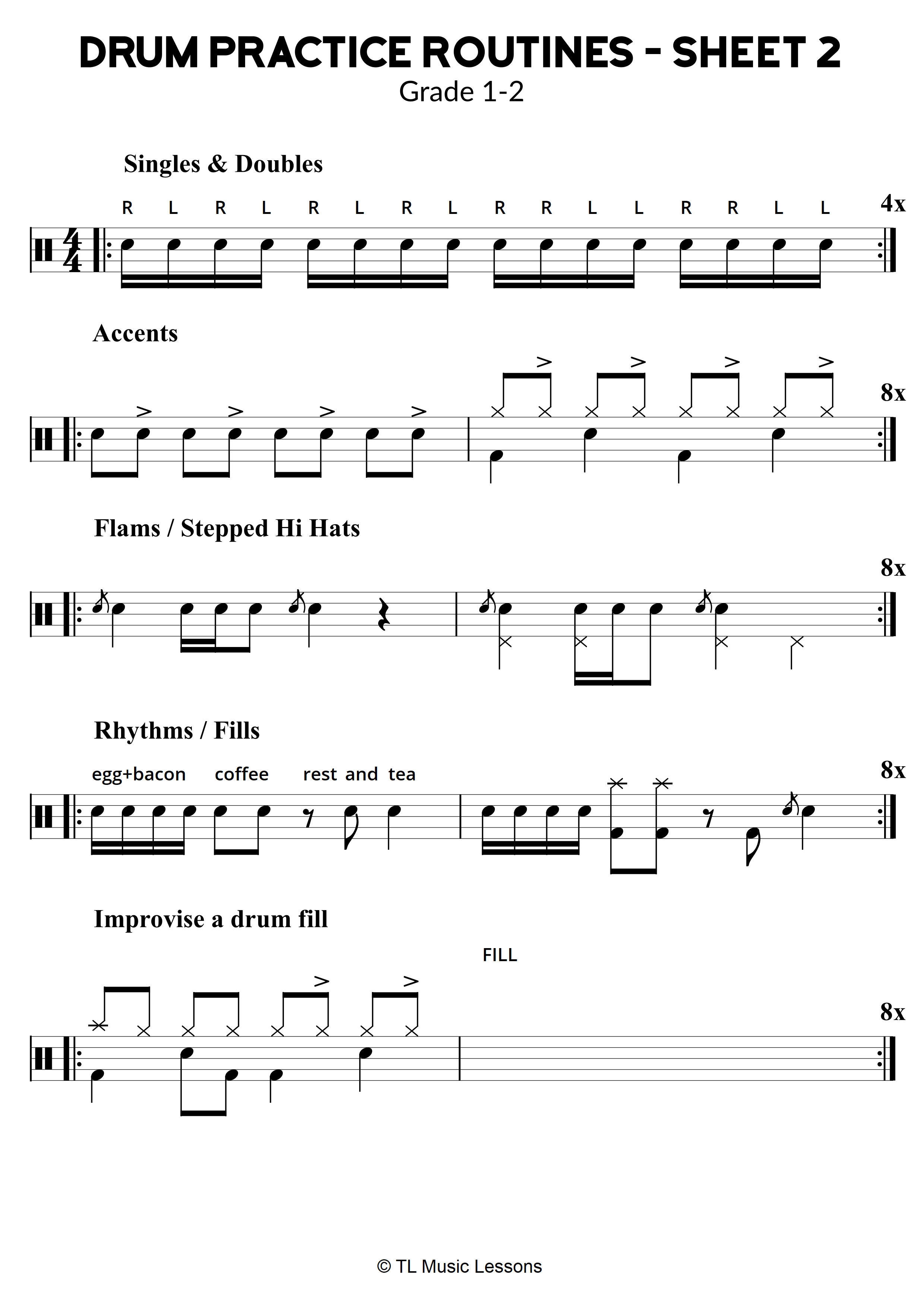
Drum Practice Routines – Sheet 2 – Grade 1-2

Free PDF Download:

Drum Practice Routines – Sheet 2 – Grade 1-2


It’s still the summer holidays and most people are taking a well deserved break. I’ve been on holiday and I’m fully relaxed but I have a few lesson days coming up so I’m keeping on with lesson prep and making new material like this. I have made this sheet for some of my drum students to learn and practice over the holidays, which can be done in about 5 minutes and can be easily practiced several times per week.

In this practice routine, we are covering many of the fundamental parts of grade 1 and grade 2 material. First on the sheet we have singles and doubles (left handers need to play the opposite sticking to the ones shown). Whilst we don’t usually learn a proper double strokes technique until about grade 5 level, we still play doubles to get used to it, and you will just be hitting the drum with the same technique as you would for a single hit.

Secondly, we will be accenting (playing louder) the ‘off beat’, which means it’s not on the 1 2 3 4, it’s in between those. You could cound 1 + 2 + 3 + 4 +. The accents would then be on every +. Then, moving onto a basic drum beat in the second bar, the accents are played in the same place but this time you play them on the hi hats.

The flams and stepped hi hat section is for building up your stepped hi hat coorination aswell as for practicing the all important flam. Make sure the stick height for the quiet note in the flam is kept quite close to the drum (2 to 4 inches depending on the volume). The stick can start at a much higher position for the loud note in the flam.

For the rhythm/fills section, I have included ‘breakfast rhythm’ counting to help. If you say the words at the same time as playing the rhythm, it should help you. The rhythm on the drum fill is the same as the one in the first bar on the snare drum, so it’s a nice exercise that flows.

Lastly, many students complain about improvisation, so it’s important to practice this until confidence is higher. Start off with really easy drum fills lasting for 1 bar and build up your confidence with each practice.


Related: Drum Practice Routines – Sheet 1 – Grade 1-2

Drum Practice Routines – Sheet 1 – Grade 1-2

In this practice routine, we are covering many of the fundamental parts of grade 1 and grade 2 material. On the sheet we have a paradiddle 8 times (left handers need to play the opposite sticking).

There are accents on 8th note snare drums and then moving onto a basic drum beat, the accents are played in the same place but this time on the hi hat part of the drum beat.

The flams and stepped hi hat section has a classic rock feel to it and it is an easy way of introducing 4 way coordination into your playing.

For the rhythm/fills section, it’s the same rhythm on the drum fill as it is in the first bar on the snare drum, so it’s a nice exercise that flows, so we do that 8 times.


Related: Drum Practice Routines – Sheet 2 – Grade 1-2

Accent Practice Exercise for Snare Drum

This exercise was created to support the learning of playing paradiddles with accents along with a metronome at 70bpm in the Grade 2 Rockschool technical exercises 2012-18 syllabus. I have also suggested to try practicing the sheet between 60 and 120bpm, with or without a metronome. 75-120bpm would be pushing the ability level up to at least Grade 3-4.

It can be hard to play paradiddles with a metronome at first, and if you haven’t worked with a click much before it’s also hard for 16th notes and 8th notes. This exercises works on playing 16th notes with a right, left, right, left sticking to get used to this. Then when you take away the left hand, you are left with right hand 8th notes, which is why they are the foundation of this exercise (first and 3rd line).

On the second line, the R L R L sticking on the 16ths prepares the drummer for the transition to 16ths from 8th notes before going from 8ths to paradiddle 16th notes in line 4. Then with the repeat the first 2 lines are there to settle in to the transitions again. By the end of the exercise the paradiddles exercise should become much easier. The actual grade 2 drums rockschool technical exercise is line 4 played twice.

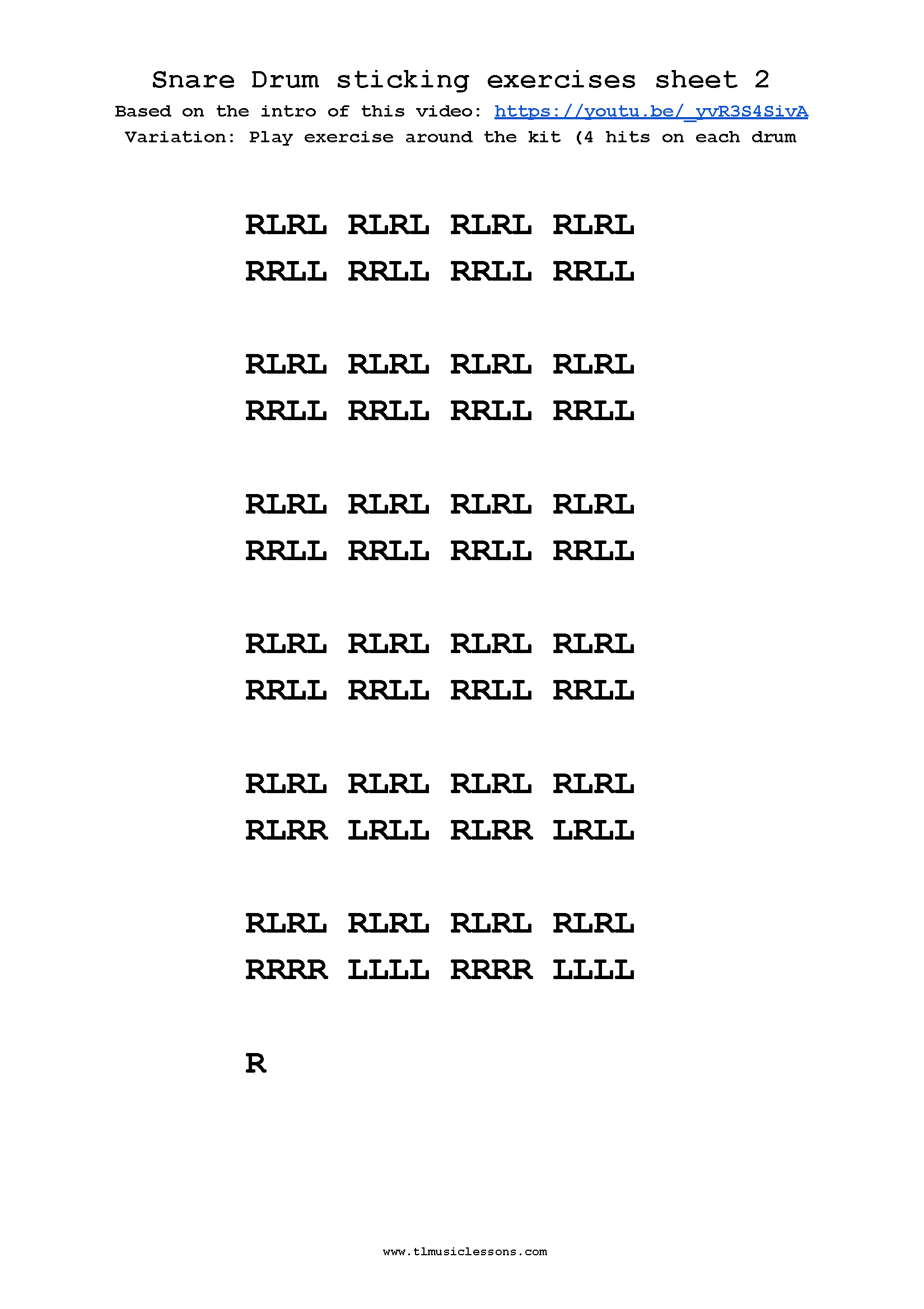
2 Snare Drum Sticking Exercise Sheets

The first exercise sheet was written to help my drum students build up their coordination and sticking techniques for the snare drum.

The second exercise sheet was transcribed directly from this excellent Hit Like A Girl 2017 entry video by Jenn Proos. The entire ‘sheet 2’ is what she is playing up to 30 seconds. Please watch the video below to see it: