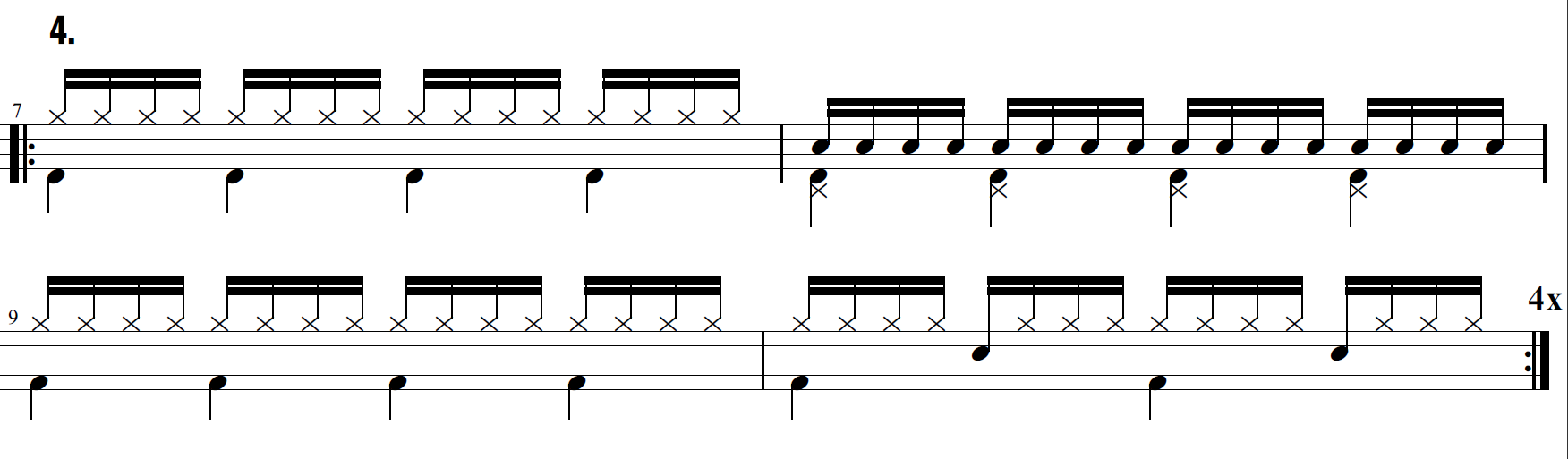
These 10 practice pad exercises are redesigned and edited exercises from the ebook Beginners Drum Book 2023. I have designed these to be useful for reading on a mobile screen as well as for any other device. It also looks good printed out.
Can be used as warm ups or for drum lesson content
Many of the exercises can be played slowly by beginners and faster by intermediate players
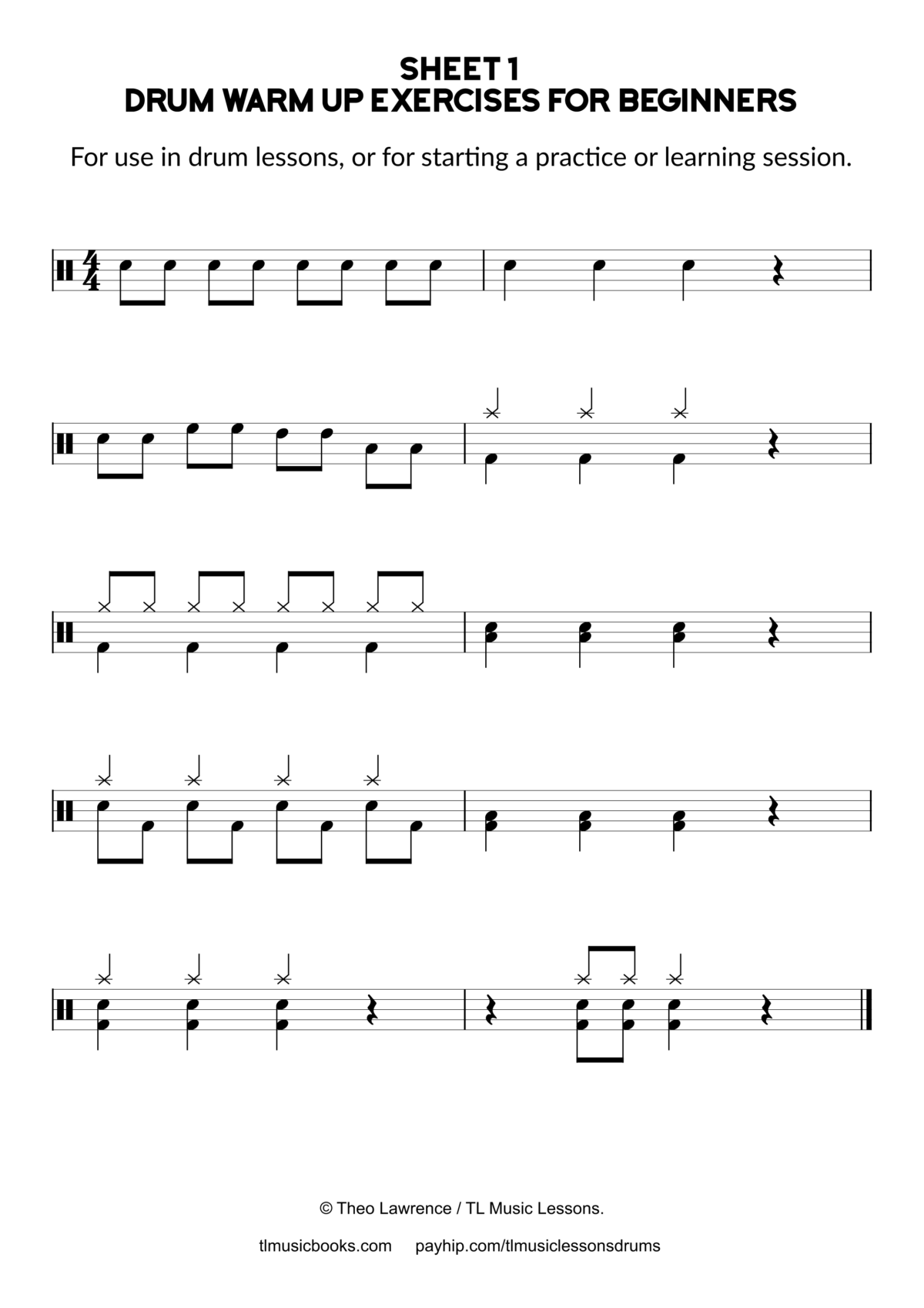
This 10 bar warm up sheet is for beginner drummers to learn and practice with at the start of a drum lesson or at the start of a practice routine. Once the sheet has been roughly learned, the drummer should try to play all of the way through the sheet in one go. No repeats are neccesary unless you want to.
Advanced beginners drum warm up exercises for use in drum lessons, or for starting a practice or learning sessions.
Advanced beginners drum warm up exercises for use in drum lessons, or for starting a practice or learning sessions.
This is the first sheet in a collection of drum warm up exercises that will be made into a pdf ebook. You can use and print the main image on this website for educational use, or you also have the option of purchasing a PDF copy of Drum Warm Up Exercises for Advanced Beginners – Sheet 1.
In the sheet there is a snare drum rhythm exercise that has be made to sound good when repeated. Drummers should aim to increase the speed once comfortable with the rhythms. Likewise for the other exercises too. Start off slow and build up confidence and ability before going fast.
The flams exercise should be played by playing R L R L on all 8th notes, which is why one of the flams is played with the left hand playing the louder part of the flam, because it’s on one of the off-beat 8th notes. The second bar could be played R L R L or the 8th notes could be changed into paradiddles, meaning the second flam would be played with the left hand on the stronger note. Left handers will need to do the opposite to all of this.
The swing beat could easily be made harder but this could be the first time some drummers have been introduced to it so I’ve kept it fairly simple. The 8th notes are to be played with swing on the ride cymbals. If you don’ know what that means, have a listen to The Pink Panther theme tune and listen to the ride cymbals.
Drum lesson warm up for advanced beginners and early intermediate levels.
Since posting this, I have focussed on creating an ebook with similar content, so the title has changed a little bit and it’s now the 2nd exercise sheet of the book. You can use the image on here and print it if needed, or you can also purchase PDF of Sheet 2 – Drum Warm Up Exercises for Advanced Beginners to Early Intermediate.
This Drum lesson warm up for advanced beginners and early intermediate levels is a summary of some of the exercises I worked on today with my students. This will probably be of use to any drummers wanting some original exercises to work on as part of a drum lesson or to self learn.
There are two exercises with sextuplets, accents and the use of a paradiddle-diddle (RLRRLL).
There are exercises based on one drum beat with examples of how you can develop it.
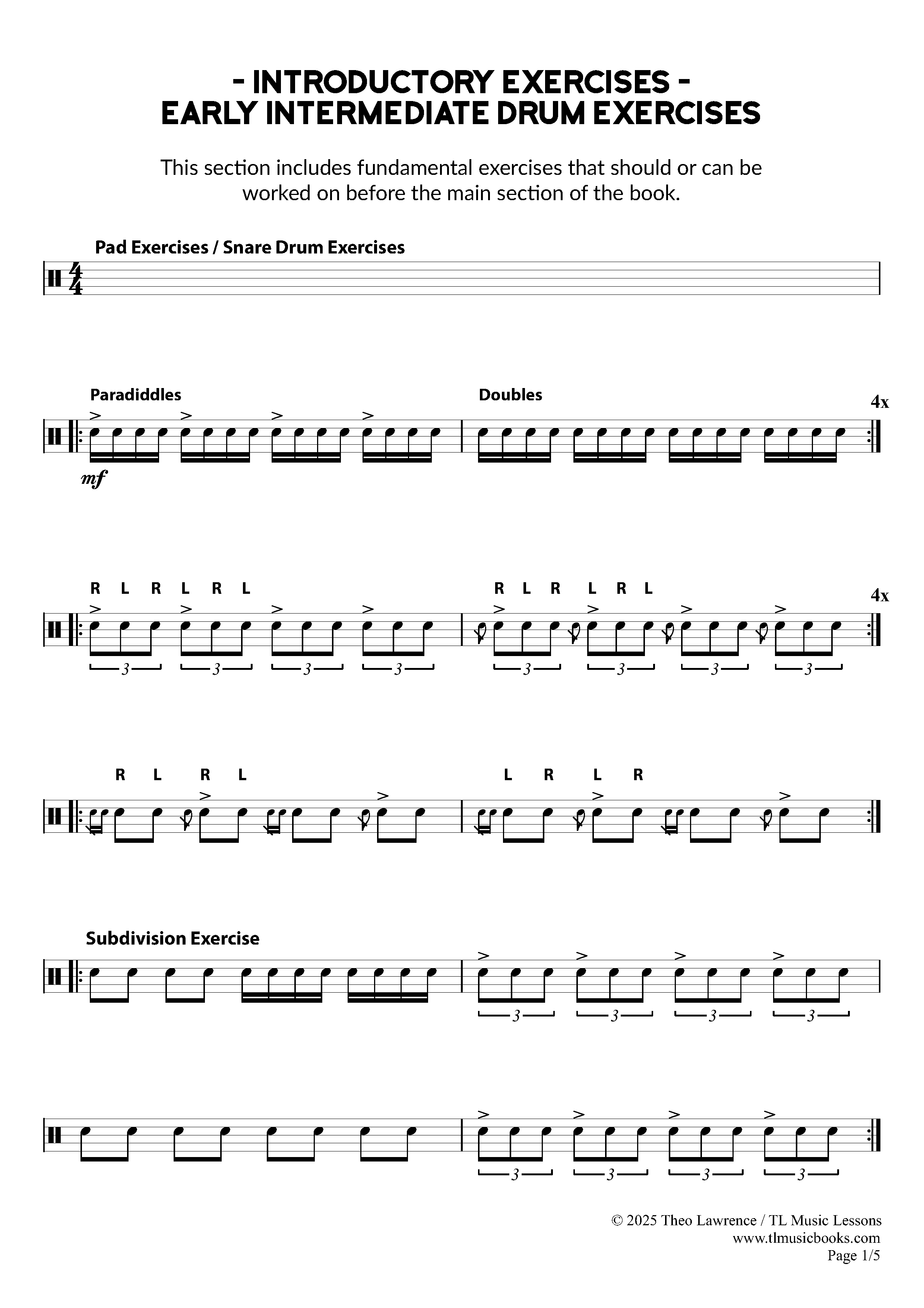
This is a free pdf download for the 5 page introductory section of the ebook ‘Early Intermediate Drum Exercises’. You need to follow the link and then click the ‘Preview’ link to get the free 5 page pdf of early intermediate drum exercises. This includes snare drum and practice pad exercises, subdivision exercises, co ordination exercises and drum beats to work on for grade 3-5 level drummers. There are some useful exercises such as moving from hi hat based drum beats to ride cymbal beats with stepped hi hats. There are also rudimental exercises, blues, funk, reggae and jazz styles, and 16th note hi hat beats.
I have a new drum book available for pre order, which includes some of the sheets that will be in the book when you pre order. I’m putting the price low, it’s only £1 to pre order and when it’s ready (by September this year), you’ll get the full copy sent by email. I’m going to be working on it over the summer and hopefully it will be an enjoyable book for teachers, students and anyone else to use, ready for the new school year in September. I’ll also make a video to help out with reading the contents of the book so that self taught drummers can follow along with ease.
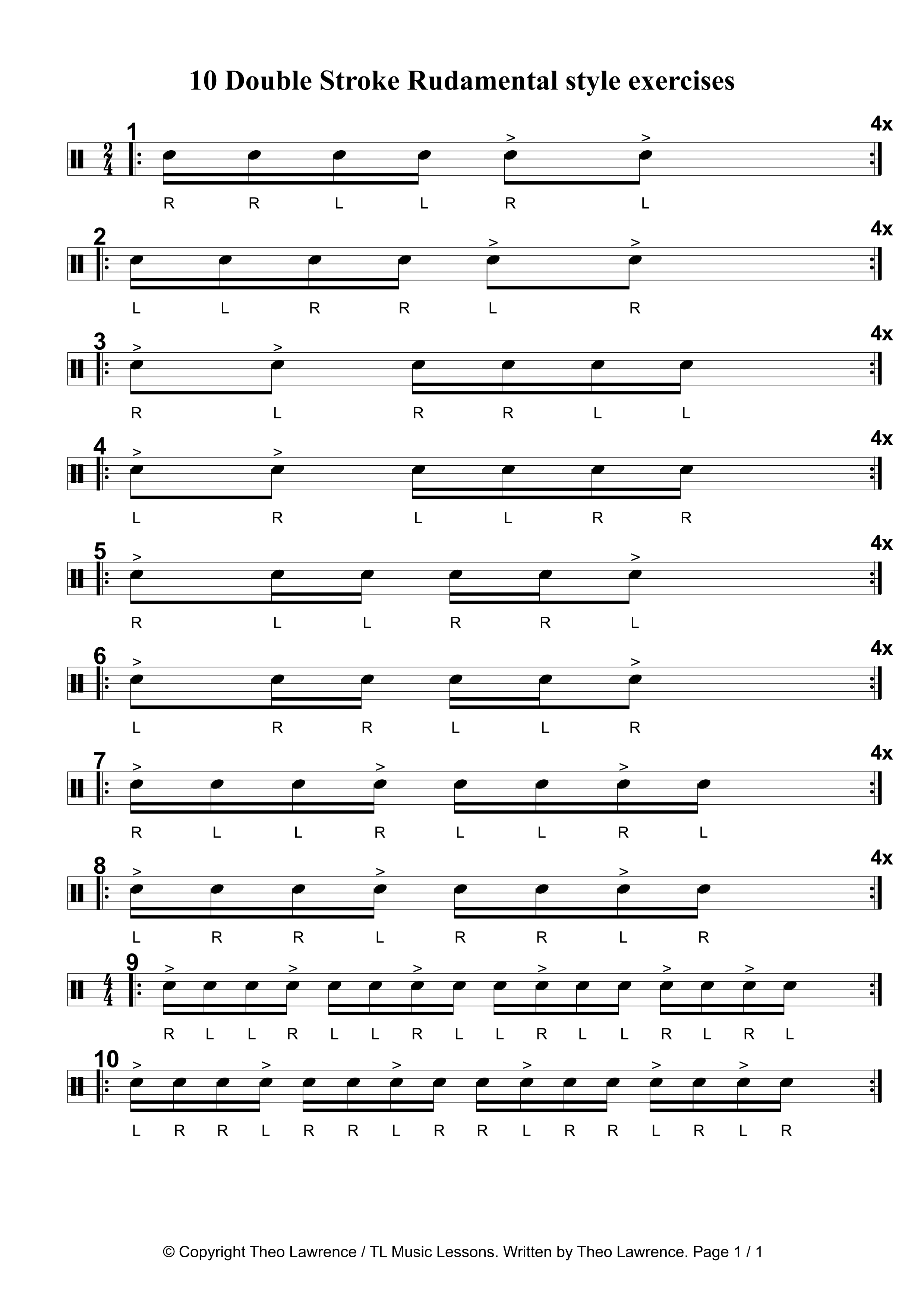
There are quite a few double stroke rudiment exercises in the 40 official drum rudiments, but none of these are in them. While the ’40 drum rudiments’ cover many of a drummers needs, in terms of practicing, there are many more double stroke exercises that are useful to learn.
The 10 rudiment – style snare drum exercises here are all involving double strokes. These snare drum exercises are all rhythms that I use quite often in my drumming, so to me they are quite essential I believe.
When learning rudiments, I was always taught that they are preparing you for possible eventualities in drumming – for example by learning and practicing the flam with different leading hands, you have prepared for using it in drum fills in songs, in a variety of situations. So to me, all of these 10 rudiment exercises are essential patterns that you will need at some point as a drummer, so to master these, will be beneficial to you for when you meet the patterns elsewhere.
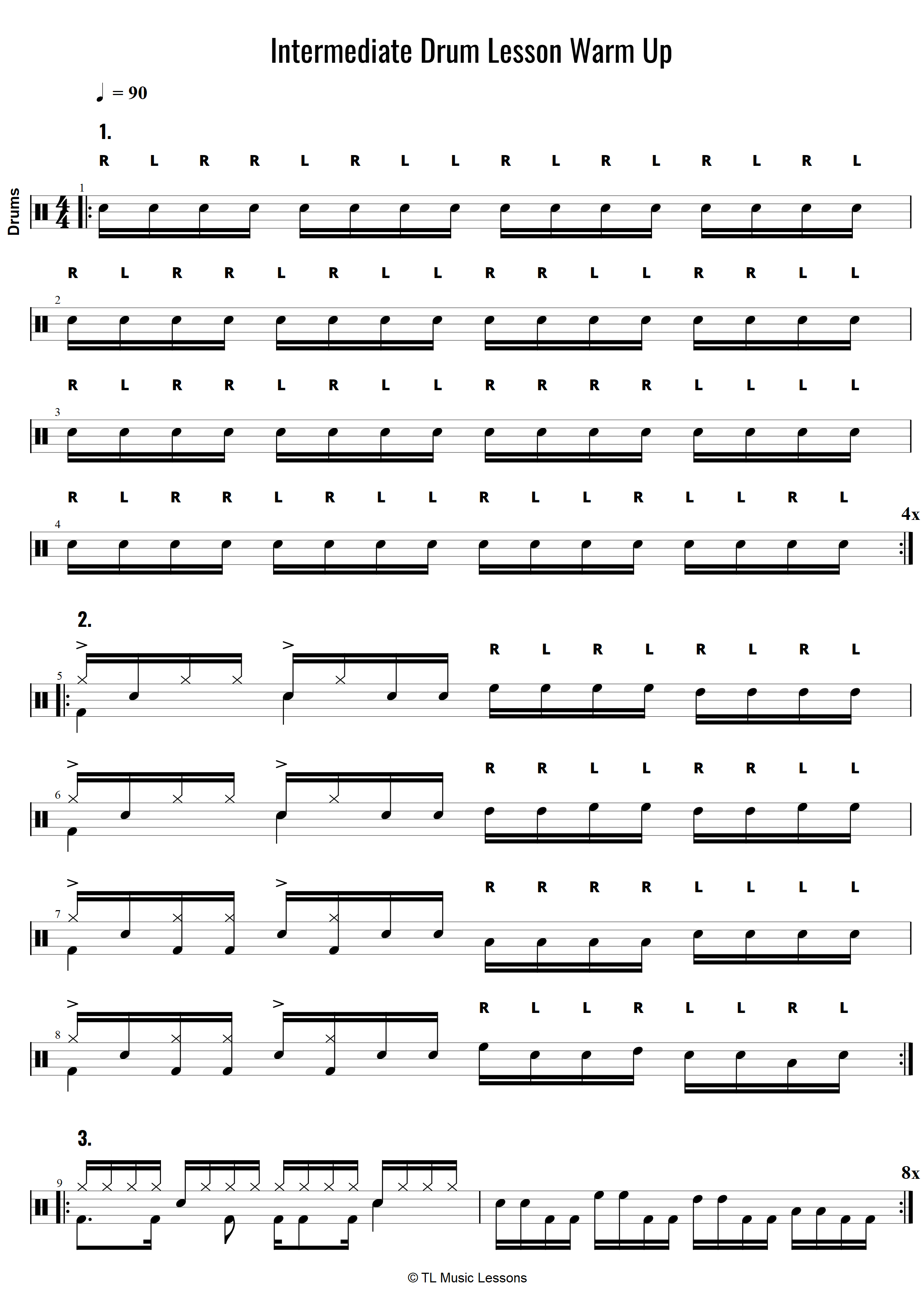
Following on from the Drum Lesson Warm Up posted a few days ago, this intermediate drum warm-up is for drummers that have reached a higher level of ability (about Grade 4-6 but could be used by higher grades too).
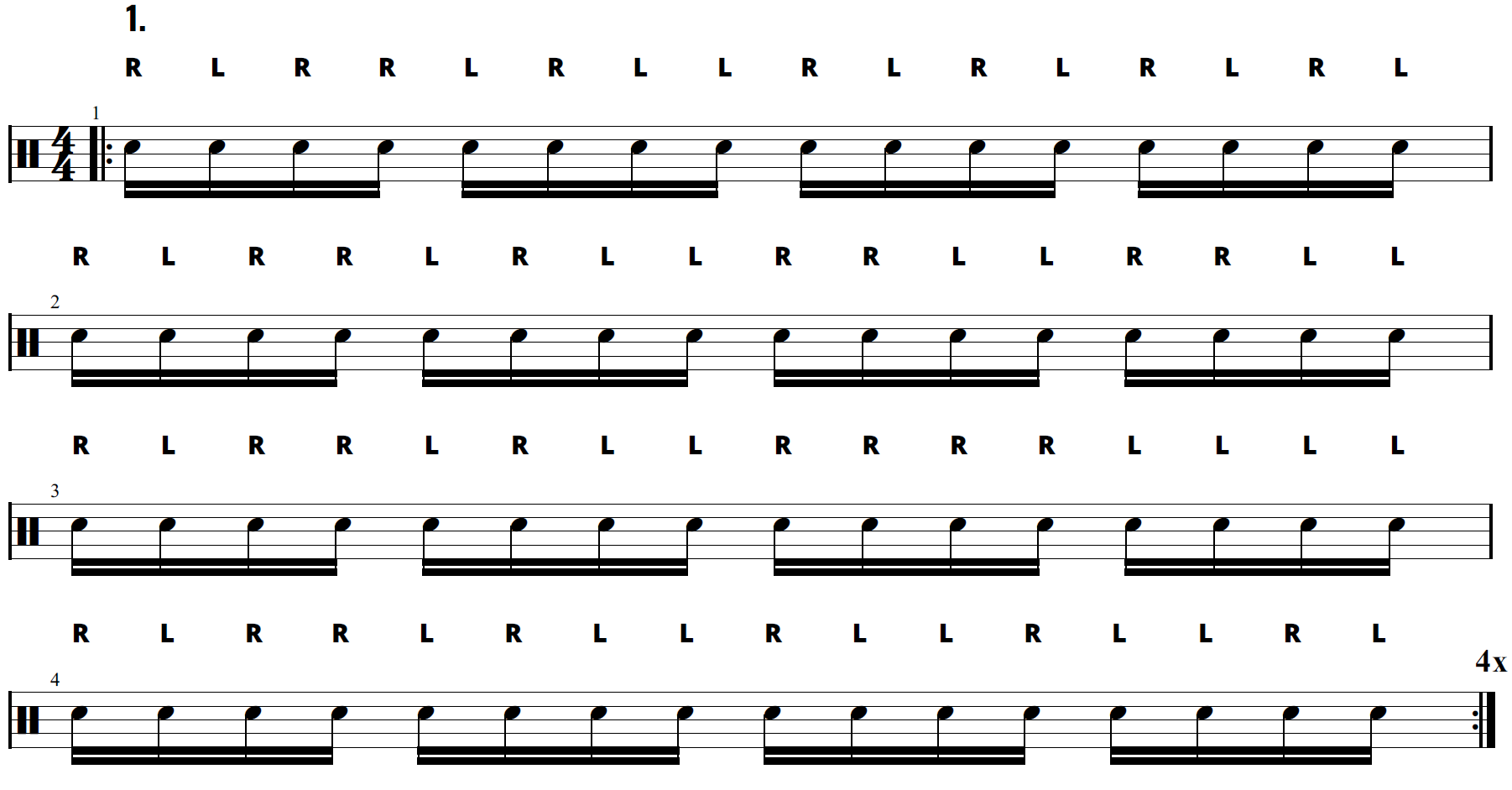
Exercise 1 – Intermediate Snare Warm-Up
Each of the 4 lines starts with a paradiddle, then the second half changes each time. The first line is singles, the second line is doubles, the third line is 4 with each hand and the 4th line is a 3-3-2 pattern (RLLRLLRL).
Exercise 2 – Paradiddle Drum Beat with Sticking Patterns on the Drum Fill
Using the sticking from exercise 1, we change the paradiddles into a drum beat by moving the right hand to the hi hat and the left hand to the snare drum. The drum fill then borrows the sticking we used in exercise 1, from the second half of each line.
Exercise 3 – Funk Rock Drum Beat and Drum Fill working on fast double bass drum with 1 foot
A rhythmic bass drum pattern with 16th note hi hats followed by a drum fill that works on the bass drum.
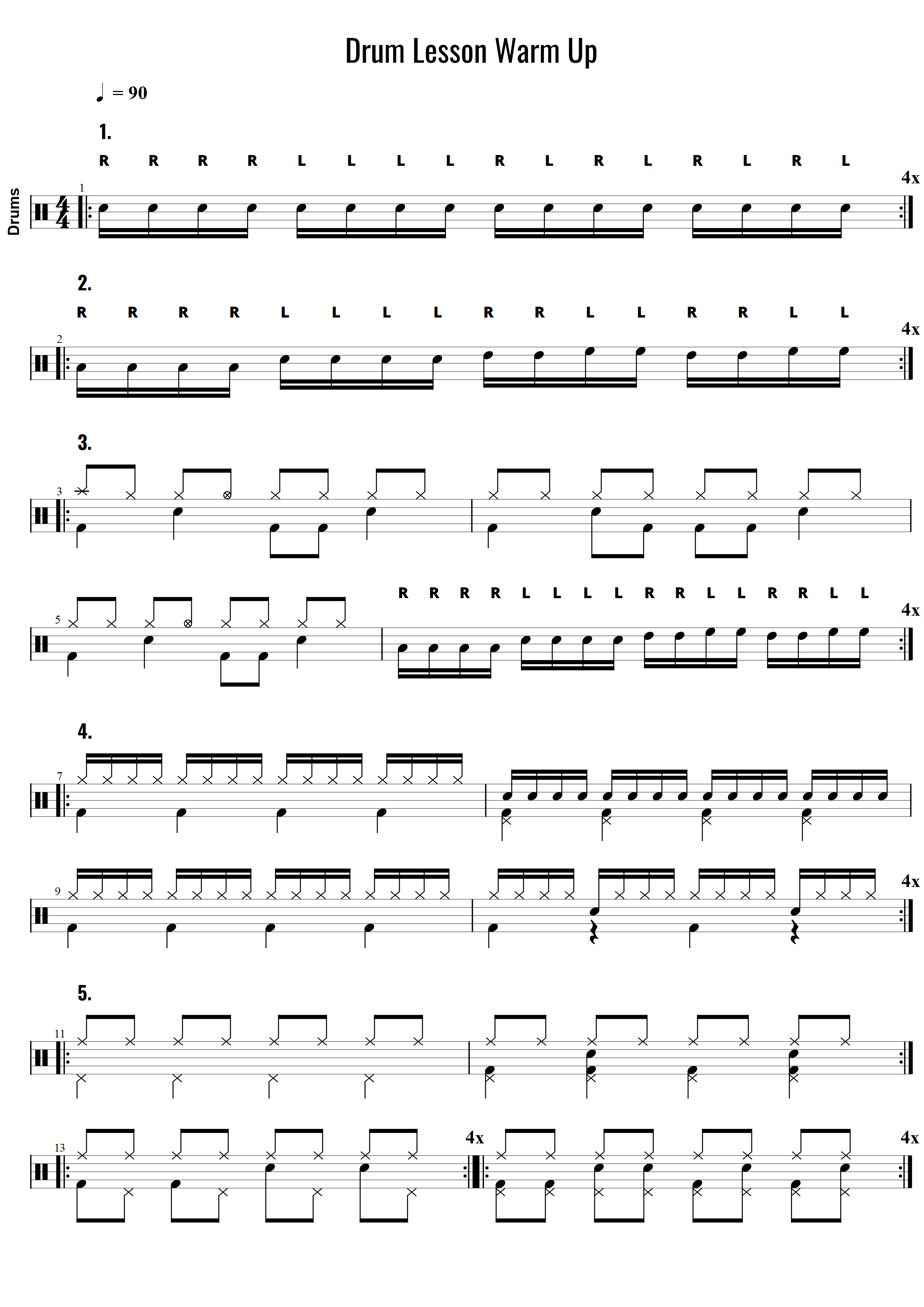
5 warm up exercises for the start of a drum lesson. Sticking patterns, drum beats, drum fills and beats with 4 way co-ordination.
These exercises that would be a good warm up at the start of a drum lesson or at the start of a drum practice session. Anyone from Grade 1 up to Grade 6 could use this as a warm up. It would be quite a challenge for grade 1. For a grade 6 player, they should be able to play through this quite quickly.
Exercise 1:
Snare drum exercise with a RRRR LLLL RLRLRLRL sticking pattern.
Exercise 2:
A drum fill exercise using a RRRR LLLL RRLLRRLL sticking pattern.
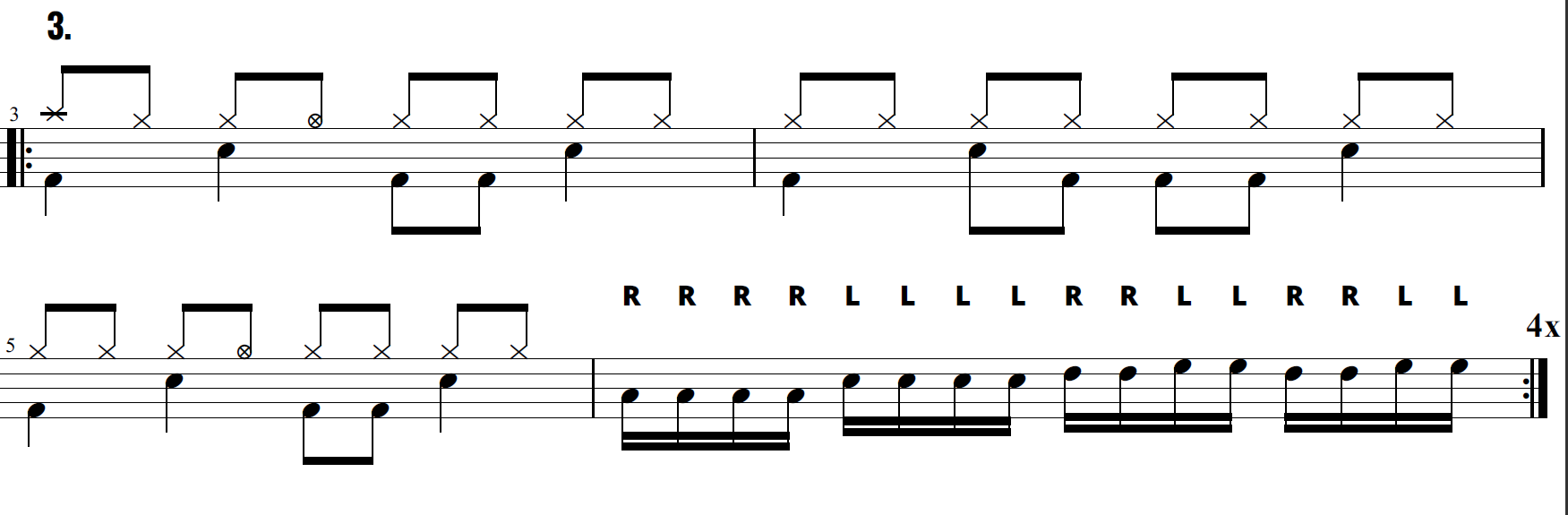
Exercise 3:
A 3 bar drum beat with open hi hats and drum fill exercise using Exercise 2 as the drum fill
Exercise 4:
Working on a 16th note hi hat pattern and moving that to a snare drum whilst adding a stepped hi hat to work on 3 way co-ordination.
Exercise 5:
Drum grooves focusing on 3 way co ordination and 4 way co ordination between both hands and both feet.
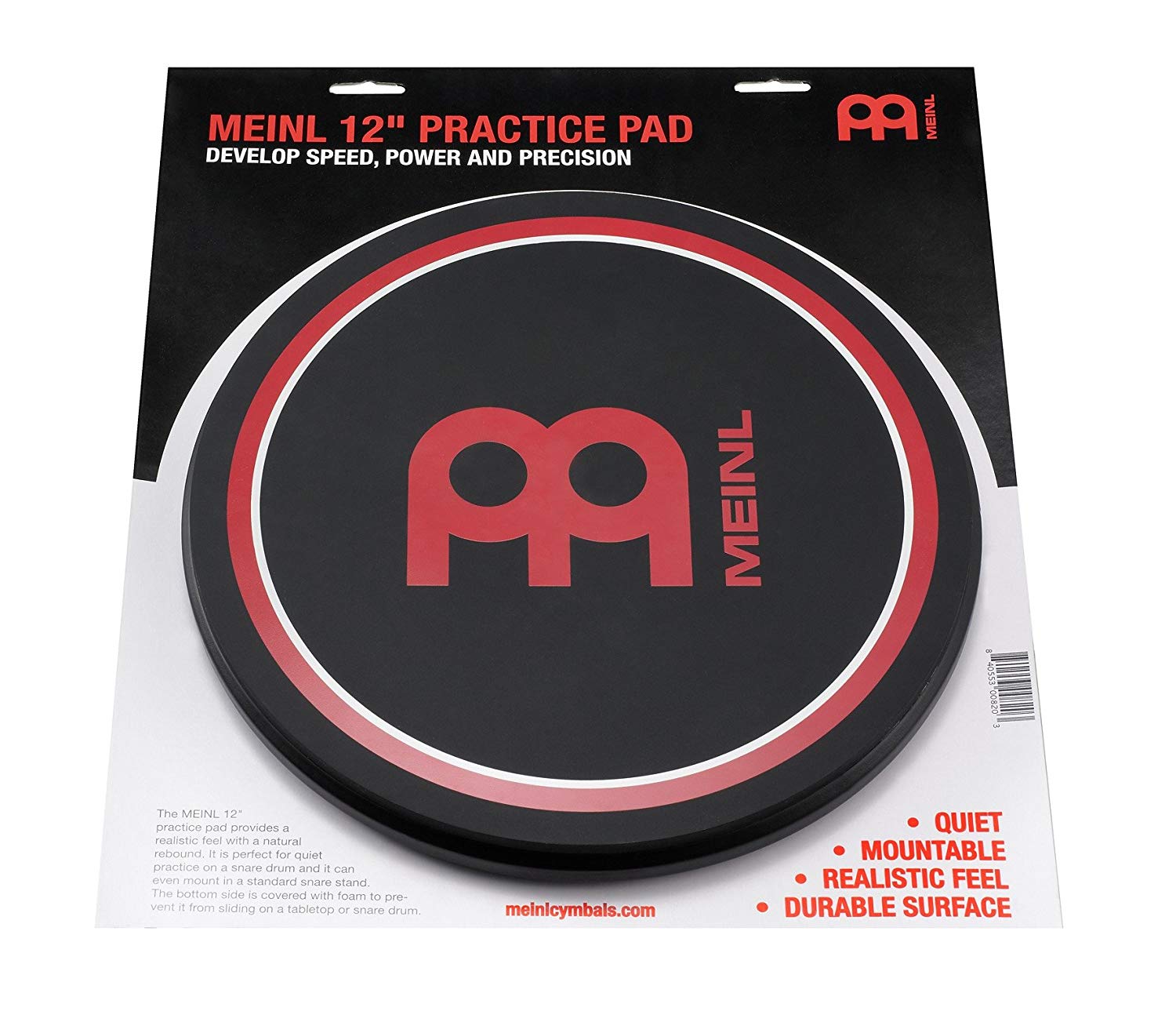
The Meinl MPP-12 practice pad is quiet but loud enough that it’s satisfying to play. The rubber surface has some give to it so it’s not like hitting hard plastic. The bounce is realistic and similar to a tightly tuned snare.
I bought this pad to use with a youth snare drum group I tutor in the UK. It’s sort of a Snare Line, but I’m just a normal drummer adapting bits from what I’ve seen drumlines do for my group, and creating something different. We spend a large part of the weekly session on warm ups and exercises using the practice pads before then moving onto the snare drums to play pieces nearer the end of the session. I fell in love with this Meinl practice pad instantly when it came just by how nice it looks, and how it’s made. I was worried the playing surface might be too hard, but it’s not. When I started playing it, I knew this pad was a great choice.
The drum pad can sit on a table or on top of a snare drum just fine without moving around and with the volume staying about the same. It can also be attached to a snare drum stand. Meinl do sell a 6″ one that has a screw hole for attaching to a cymbal stand. I prefer the 12″ one because it can sit on a table or a snare drum and feels more sturdy than on a cymbal stand, which can wobble around. The 6″ pad is also less solid on a table or snare drum and is likely to move around a lot. I have attached a 6″ pad to a snare drum stand before an I can report it’s not good because the 3 parts where the stand grips the pad can get in the way of your sticks and you really have to crank up the screw thing underneath to get it to fit (annoying if you are switching between pad and snare often).
You can also get signature models such as the Thomas Lang practice pad seen in the video below. The video mentions it not being for practicing marching snares but I personally disagree because for the marching snare pads I’ve seen, such as the Ahead 14″ S-Hoop Marching Pad, I don’t think it’s good for people’s hands and arms to be hitting carbon fibre. My drum teachers in college always said it was dangerous to have practice pads that are hard because it can cause tendonitis. So I would say, these Meinl pads would be good for marching practice and general snare drum practice, but check with your drumline / drumming group before buying, because they might prefer something else. The sound of the 12″ pad has a nice crisp sound, not dissimilar to a marching snare.
Cookie Consent
We use cookies to improve your experience on our site. By using our site, you consent to cookies.
Cookie Preferences
Manage your cookie preferences below:
Essential cookies enable basic functions and are necessary for the proper function of the website.
Name
Description
Duration
Cookie Preferences
This cookie is used to store the user's cookie consent preferences.
30 days
Statistics cookies collect information anonymously. This information helps us understand how visitors use our website.
Google Analytics is a powerful tool that tracks and analyzes website traffic for informed marketing decisions.
Contains information related to marketing campaigns of the user. These are shared with Google AdWords / Google Ads when the Google Ads and Google Analytics accounts are linked together.
90 days
__utma
ID used to identify users and sessions
2 years after last activity
__utmt
Used to monitor number of Google Analytics server requests
10 minutes
__utmb
Used to distinguish new sessions and visits. This cookie is set when the GA.js javascript library is loaded and there is no existing __utmb cookie. The cookie is updated every time data is sent to the Google Analytics server.
30 minutes after last activity
__utmc
Used only with old Urchin versions of Google Analytics and not with GA.js. Was used to distinguish between new sessions and visits at the end of a session.
End of session (browser)
__utmz
Contains information about the traffic source or campaign that directed user to the website. The cookie is set when the GA.js javascript is loaded and updated when data is sent to the Google Anaytics server
6 months after last activity
__utmv
Contains custom information set by the web developer via the _setCustomVar method in Google Analytics. This cookie is updated every time new data is sent to the Google Analytics server.
2 years after last activity
__utmx
Used to determine whether a user is included in an A / B or Multivariate test.
18 months
_ga
ID used to identify users
2 years
_gali
Used by Google Analytics to determine which links on a page are being clicked
30 seconds
_ga_
ID used to identify users
2 years
_gid
ID used to identify users for 24 hours after last activity
24 hours
_gat
Used to monitor number of Google Analytics server requests when using Google Tag Manager