(Premium) – 10 Snare Drum Pieces – Book 1 – Levels 1-3 (PDF ebooks)

Introduction

After a year of teaching a local youth group of drummers aged between 8 and 12, ranging from beginners to intermediate players, this collection of 10 snare drum pieces was created as an archive of this body of work.

The MYM Snare Drumline Group is an adaption of Snare Line / Drumline groups, tribal drumming, military drumming, Drum Corps, and film score music.

There are many areas left to explore for the drum group. This first book focusses on building a foundation of simple and short snare drum pieces to help give the group confidence and develop a strong sense of rhythm, timing and pulse. There is also a very small amount of dynamic use, repeats, and drum rudiments.

Demonstration of Pieces 6, 2 and 3 from the book

Here is a video of the girls in the group performing pieces (in order) 6, 2, and 3 from this snare drum book, which is an entry for the 2017 competition ‘Hit Like A Girl‘. The girl on your left is performing the level 2 pieces and the other 3 are playing from the level 3 book. At the time of video, 1 of the level 3 girls is studying grade 2 rockschool and the other two playing level 3 are studying grade 3 rockschool drums.

Level 1 Book

The Level 1 book is designed for complete beginners, or ‘basic beginners’ level. This level could also be played by players of other instruments that are new to drums.

Level 2 Book

Level 2 is designed for grade 1-2 level. The rhythms are more complex, but there are no buzz rolls or drags.

Level 3 Book

Created for grade 2-3 level drummers. It encorporates buzz rolls, drags, flams, and harder rhythms.

These books are primarily intended for groups of drummers or differing abilities. Teachers may print entire books for the students, or pick and choose pieces to suit them. Teachers or students may also use these sheets or books for single snare drum playing. Teachers may purchase this book online and print out unlimited copies for their students.

Buy Now →

FREE PREVIEW OF THIS EBOOK: Group Snare Drum Piece with 3 difficulty levels (Piece 2, Book 1)
FREE PREVIEW OF THIS EBOOK: Group snare drum piece with 3 difficulty levels (Piece 5, Book 1)


Recommended reading for use with this ebook:
Accent Techniques – Down, Tap, Up, Full Strokes
Reading Buzz Rolls And Double Stroke Markings
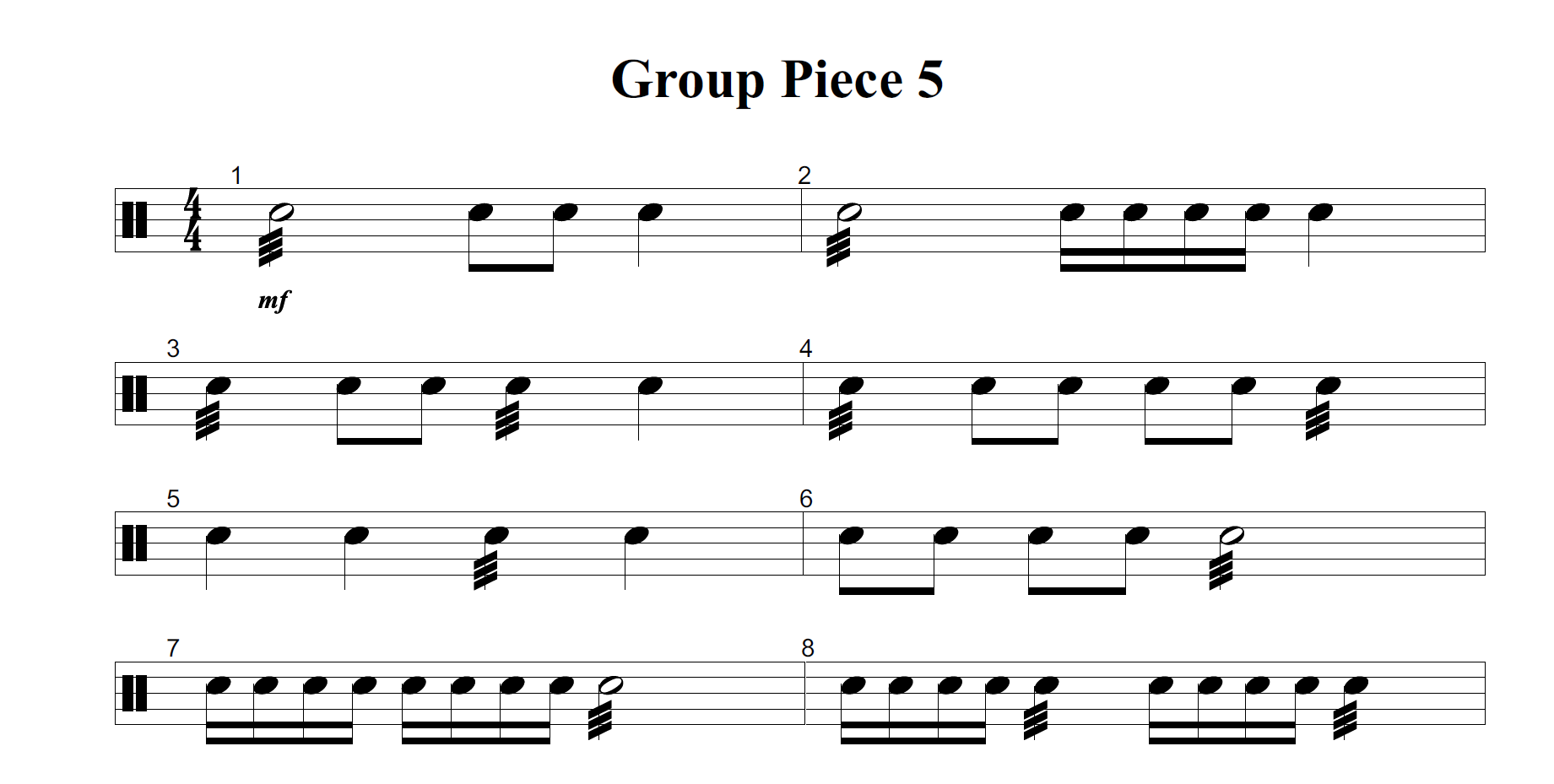
Group snare drum piece with 3 difficulty levels (Piece 5, Book 1)

This snare drum piece could be played by a single drummer, or as part of a group of drummers. The snare drum piece is an example of a short piece with two snare drum parts of different ability levels. There are 2 difficulty levels; beginners up to grade 1, and grade 2 level.

I run a youth snare drumline group, and regularly produce snare music for various ability levels. The piece could also be adapted to a full drumline if extra parts are written – if you run a drumline please feel free to use this and to write extra parts for it.

Level 1

Level 2

Level 3


Related: Group Snare Drum Piece with 3 difficulty levels (Piece 2, Book 1)
Related: (Premium) 10 Snare Drum Pieces – Book 1 – Levels 1-3

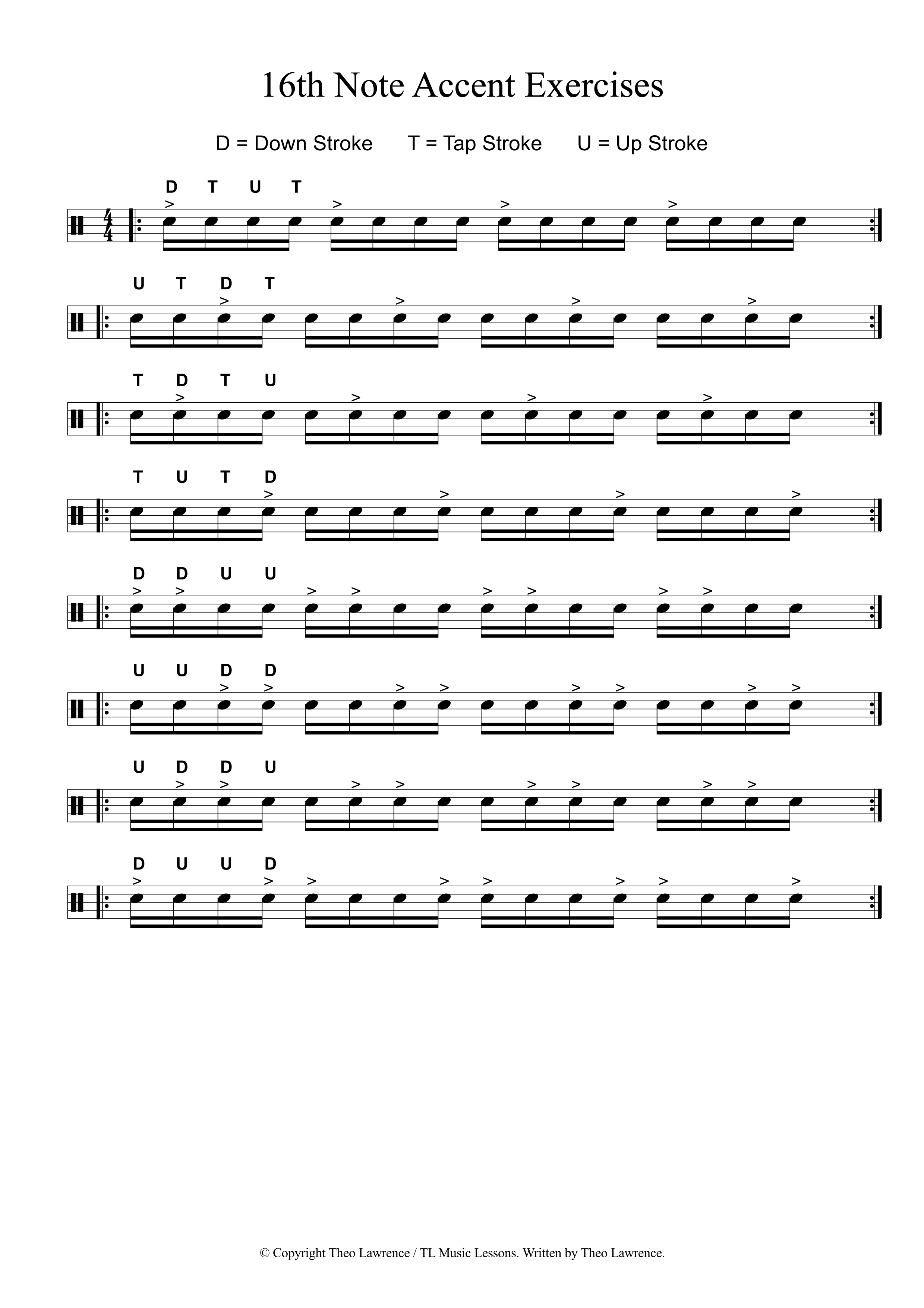
8 Technique Exercises for Accents and Ghost Notes

These snare drum or practice pad exercises are similar to drum rudiments. The drum exercises work on possible sticking and dynamic eventualities that you may encounter in drum beats and grooves, drum fills, and snare drum sheet music. The exercises also could be used as a warm up, especially from playing snare drum sheet music.

While beginners will be able to play these exercises at their level, advanced players should be aware of using Up Strokes, Tap Strokes, Down Strokes, and Full Strokes so that there is a greater continuity of volume and attack.

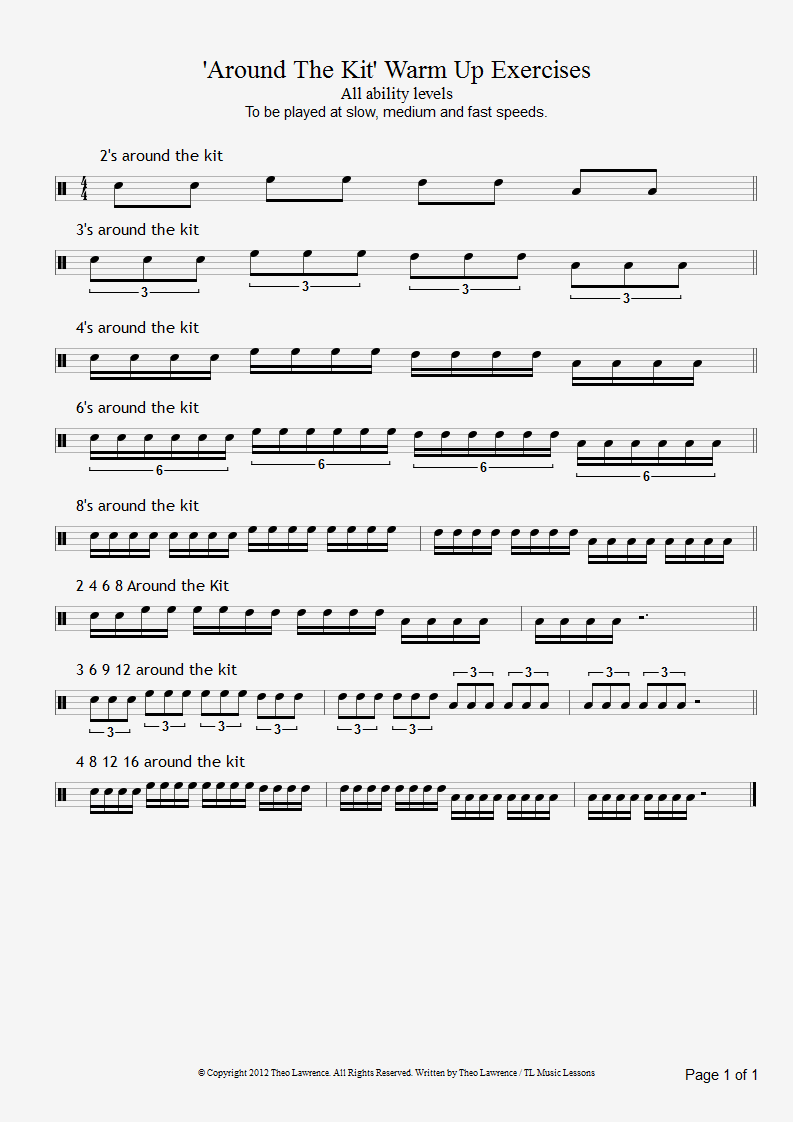
8 advanced warm up exercises for drums with patterns and subdivisions

The exercises on the drum notation are for grade 5-8 players. By reading the list of exercise below, you can begin to see clearly how easy they are. This exercise sheet can be used as a continuous warm up exercise.

The ability level would be measured on timing and speed. All drummers should begin slowly before building up the speed. A metronome is recommended.

The 8 Warm Up Exercises: Based on a drum setup with snare, tom 1, tom 2, and floor tom

Each exercise should be repeated as necessary, and could be started slowly and speeded up on repeat.

  1. Play 2 hits on each drum
  2. Play 3 hits on each drum
  3. Play 4 hits on each drum
  4. Play 6 hits on each drum
  5. Play 8 hits on each drum
  6. Play 2 hits on the snare, 4 hits on tom 1, 6 hits on tom 2, and 8 hits on the floor tom
  7. Play 3 hits on the snare, 6 hits on tom 1, 9 hits on tom 2, and 12 hits on the floor tom
  8. Play 4 hits on the snare, 8 hits on tom 1, 12 hits on tom 2, and 16 hits on the floor tom

10 Bar Snare Drum Piece with Dynamics – Beginners Grade 1-2

There is a free PDF download with this post, which you may use to print out the sheet music.

Instructions

The first line contains a mixture of 16th notes, 8th notes, and quarter notes, and the dynamic is p, which means quiet.

On the second line, there is a long crescendo, which means to gradually get louder. The rhythms are the same in both bars, so focus is definitely on playing the crescendo correctly.

On the third line, the dynamics increase to mf, which means medium-loud. On the second bar, there are rim hits on the snare drum, which is achieved by hitting the rim of the snare drum with the drum stick. This is not to be confused with a cross stick snare drum, which would be hard to play in relation to the rest of the bar.

On the fourth line, there is a mini crescendo from quiet to medium loud, which is then repeated exactly the same. The second bar with the divide symbol means to ‘repeat the previous bar’.

On the last line, the dynamics carry on as medium loud. There are accents (the arrows above the notes), played on the snare rim. This means to play the rim as before, but hit them a bit harder than normal.


Related (Premium): 10 Snare Drum Pieces – Book 1 – Levels 1-3
Related: 16 bar Snare Drum Exercise – with dynamics – Grade 1-2

16 bar Snare Drum Exercise – with dynamics – Grade 1-2

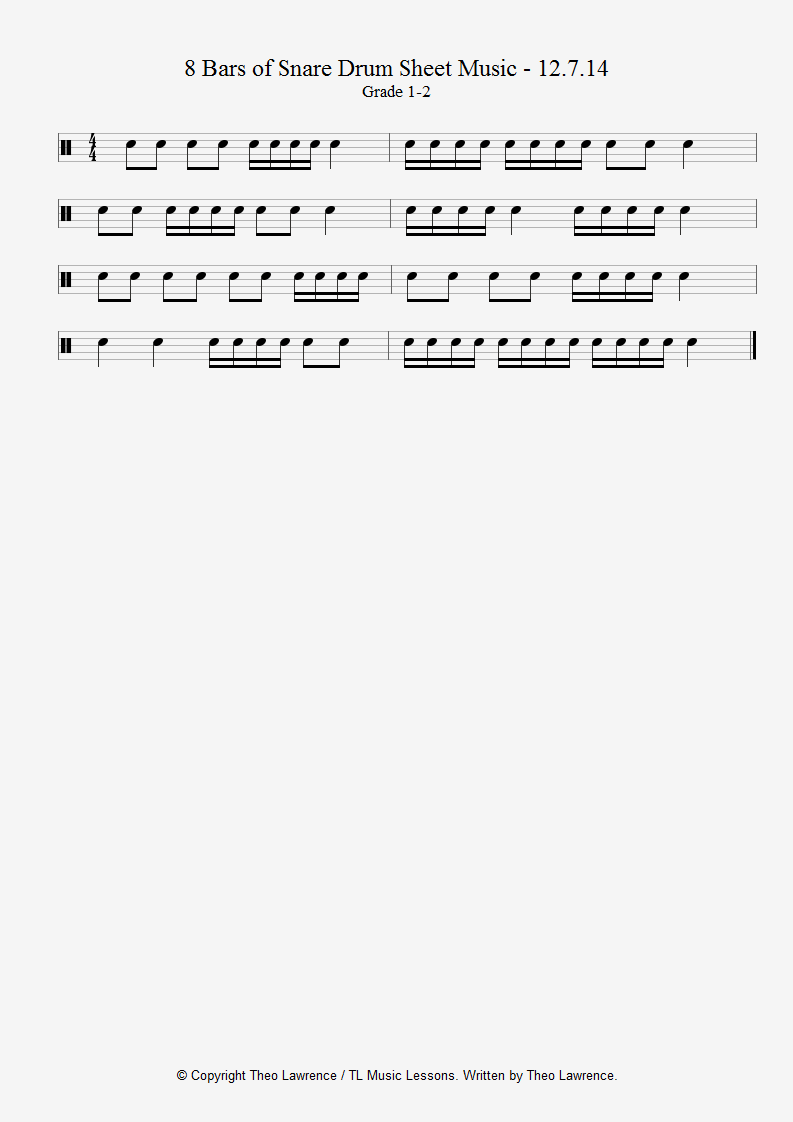
This is a short snare drum piece lasting 16 bars consisting of grade 1 and grade 2 level snare drum rhythms.

The snare drum sheet music focuses on using plenty of dynamics, which are for volume changes in the music.

The dynamics include:

p (piano = soft/quiet)
mf (mezzo forte = medium loud)
f (forte = loud)
< a wide version of this shape is a ‘crescendo’ (gradually getting louder)
> these arrows above the notes are accents, which indicate that you play loud on this note only.


Related (Premium): 10 Snare Drum Pieces – Book 1 – Levels 1-3
Related: 16 bar snare drum piece – Grade 1-2 Snare Drum Exercise

16 bar snare drum piece – Grade 1-2 Snare Drum Exercise – Snare Drum Sheet Music

This free 16 bar snare drum piece is for grade 1-2 drums.

In the rhythm, there is a mixture of quarter notes, 8th notes, 16th notes, 8th note rests and quarter note rests.

For the dynamics, it could be played any volume, but i would recommend mp to mf, leaving plenty of room for the accents to stand out, which are featured in the last 8 bars.

When learning, take it a bar or a line at a time to get it right, but eventually play the whole piece in one go.

For the speed, aim to get up to about 95bpm or higher, but start off at about 60bpm.


Related (Premium): 10 Snare Drum Pieces – Book 1 – Levels 1-3
Related: Grade 1-2 Snare Drum Sheet Music – Practice Piece

Accent Techniques – Down, Tap, Up, Full Strokes

When you play accents, you should ideally use 3 different stick strokes. These are tap stroke, up stroke, and down stroke.

Tap Stroke

You would play a tap stroke if you have just played a quiet note with that hand, and the next note with that hand is another unaccented note.

The tap stroke stick position should start about an inch or a few cms away from the snare drum. Move the stick straight down and hit the drum quietly, before coming straight back up and returning to the starting point.

Up Stroke

You would play a tap stroke if you have just played a quiet note with that hand, and the next note with that hand is an accent.

The up stroke should start in the tap position, and play a tap stroke, but instead of returning to the start position, the stick should end up much higher, somewhere between a 45 and 90 degree angle to the snare drum.

Down Stroke

You would play a Down stroke if you have just played an accent with that hand, and the next note with that hand is an unaccented note.

The stick position should start somewhere between a 45 and 90 degree angle to the snare drum. This stroke should be a loud stroke. Move the stick quickly to produce the loud stroke and finish in the starting position of the tap stroke.

The downstroke produces accents, which look like this: >

Full Stroke

You would play a Full stroke if you have just played an accent with that hand, and there is another accent to follow with that hand. The full stroke, which is played just like a down stroke, but instead of finishing in the tap position, the stick comes back to the starting position of the down stroke. So it plays a loud beat and comes straight back for another one.


Related:

→ The sheet in this post is Page 2 of this ebook: 10 Pages Of Accent Exercises With 16th Notes – PDF Ebook (includes double strokes exercises)
16th Note Hi Hat Grooves With Accents
Reading Buzz Rolls And Double Stroke Markings

Snare Drum Subdivisions Exercise – 8ths, Triplets & 16th Notes

8th note Subdivisions

You need to play 2 snare drums per beat. Put a metronome on a slow tempo (60-80) and try to play the right hand on every click.

Then with your left hand, try to add a beat in between the right hands. When you do that you will be playing 2 snares for every 1 metronome click.

Count 1 + 2 + 3 + 4 + when you play this. The left hand falls on all the + counts, and the right hand will be with all the numbers.

Triplet Subdivisions

These are trickier. Think of them as groups of 3.

  • The 1st group is R L R (right left right).
  • The 2nd group is L R L (left right left).
  • The 3rd group is R L R (right left right).
  • The 4th group is L R L (left right left).

You should count “1 trip let 2 trip let 3 trip let 4 trip let”

If played with metronome, the click would land on all the numbers.

So it’s not just the right hand that lands on the click this time, it swaps onto the left hand for the 2nd and 4th group. That’s what makes it hard!

16th note Subdivisions

These are actually easier than triplets. You will need to play these twice as fast as 8th notes.

The counting for these is:

” 1 E + a 2 E + a 3 E + a 4 E + a “

I’ve written capital E and small a for a reason here. The E is pronounced as a capital E. and the ‘a’ is said like ‘a’ rather than ‘A’.

The sticking is R L R L all the way through.

With a metronome click, again the click lands on the numbers, and everything else should be played in between. So you get 4 notes (R L R L) per click.

Subdivision Exercise

You need to master the subdivisions seperately first before trying the exercise.

In a song you are likely to be changing between subdivisions frequently, as you move between fills and beats and sections in the music. This exercise prepares you for these changes.

In the exercise you will play 2 bars of a subdivision, before moving straight to the next without stopping. Take practice time to work on keeping the pulse the same when you change from one to the next. Make sure to practice with a metronome after you get comfortable with the changes.

The subdivision exercises are featured in Rockschool exams all the way up to grade 8, as part of the technical exercises. More subdivisions are added further on, but the core principles of changing from one to another remains. So spend time mastering this, it’s a valuable skill to have as a drummer.