4 way co ordination pop drum beats with quarter note stepped hi hat – Step by step guide

Anyone who has some knowledge and experience playing essential beginners drum beats can give this a go. Moderate to fast speed and playing accuracy should be mastered first.

The left foot stepped hi hat

The left foot should quickly close the hi hat to make a sound similar to when you play a normal clised hi hat with the stick.

Beat 1

Step 1

Start by playing the ride, bass and the stepped hi hat all together.

Step 2

Then play the ride, snare and stepped hi hat all together.

Step 3

The next two beats are the same as the first two. Then the bar repeats (for as long as you like).

Beat 2

Step 1

Start by playing the ride, bass and the stepped hi hat all together.

Step 2

Next just a ride on it’s own.

Step 3

Then play the ride, snare and stepped hi hat all together.

Step 4

Next just a ride on it’s own.

Step 5

The next two beats worth are the same as the first two. Then the bar repeats (for as long as you like).

Beat 3

Step 1

Start by playing the ride, bass and the stepped hi hat all together.

Step 2

Then play the ride, snare, bass drum, and stepped hi hat all together.

Step 3

The next two beats are the same as the first two. Then the bar repeats (for as long as you like).

Beat 4

Step 1

Start by playing the ride, bass and the stepped hi hat all together.

Step 2

Next just a ride on it’s own.

Step 3

Then play the ride, snare, bass and stepped hi hat all together.

Step 4

Next just a ride on it’s own.

Step 5

The next two beats worth are the same as the first two. Then the bar repeats (for as long as you like).

Beat 5


Try not to get confused with the rests in this one, just ignore them.

Step 1

Start with a bass drum and closed hi hat together.

Step 2

Then play the ride on it’s own.

Step 3

Play the snare and closed hi hat together.

Step 4

Then play the ride on it’s own.

Step 5

The next two beats worth are the same as the first two. Then the bar repeats (for as long as you like).

Beat 6

Step 1

Start with a bass drum and closed hi hat together.

Step 2

Then play the ride on it’s own.

Step 3

Play the snare, bass and closed hi hat together.

Step 4

Then play the ride on it’s own.

Step 5

The next two beats worth are the same as the first two. Then the bar repeats (for as long as you like).


Related: 10 rock and pop drum beats with quarter note stepped hi hats – 4 way co ordination
Related: Drums Warm Up Exercise with 4 way co-ordination

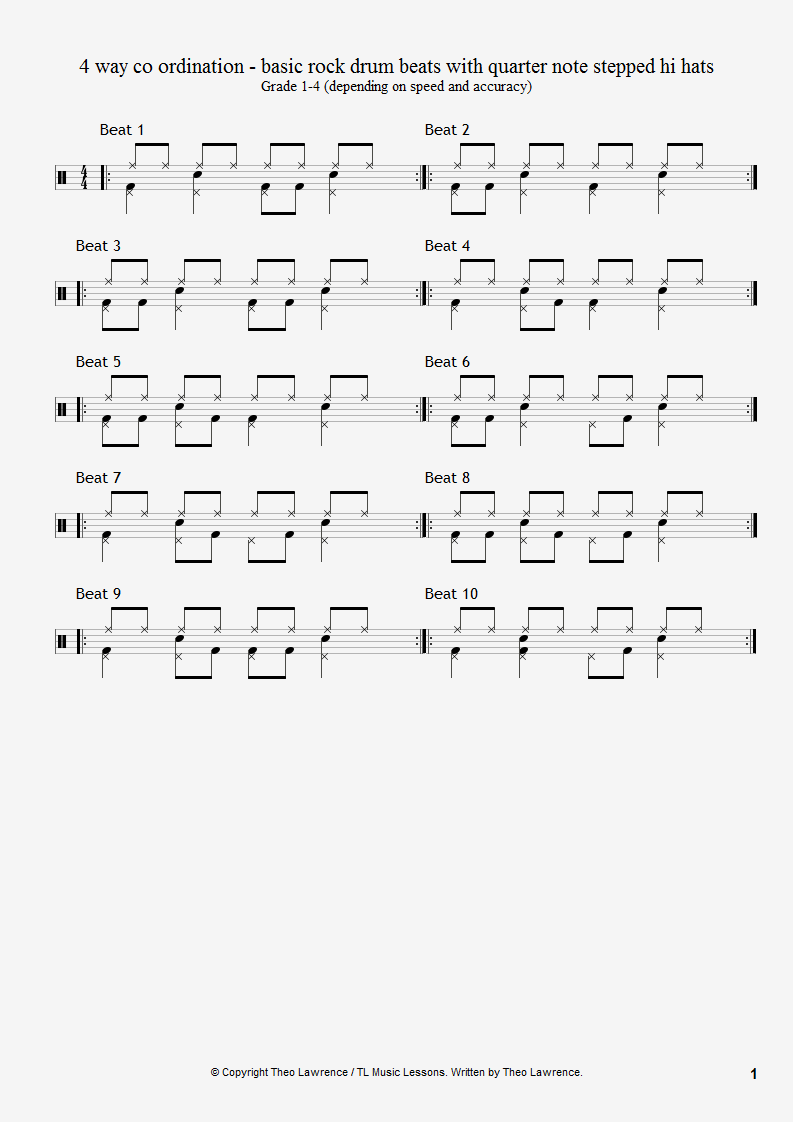
10 rock and pop drum beats with quarter note stepped hi hats – 4 way co ordination

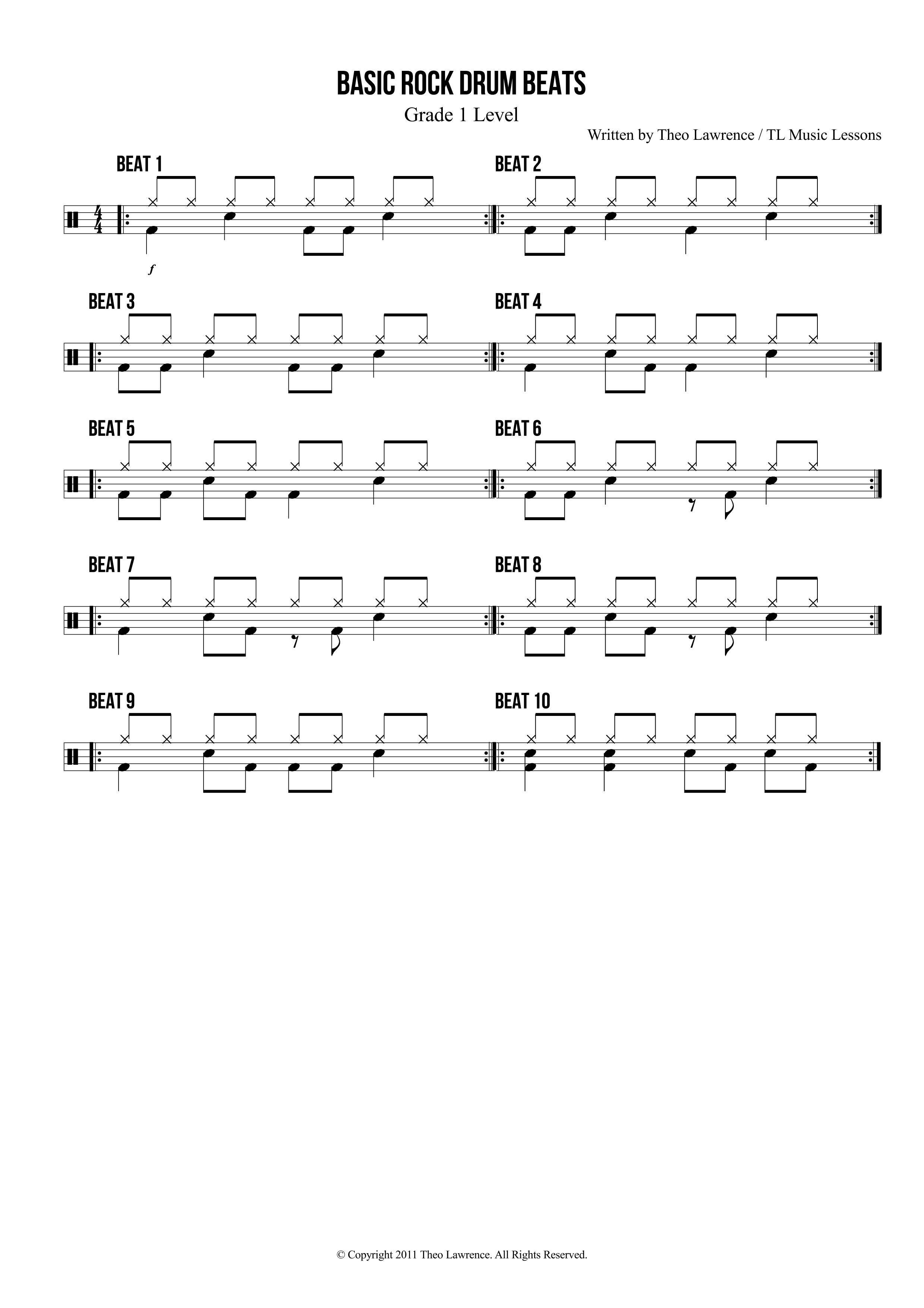
This exercise sheet features most of the drum beats from page 3 of the Grade 1 Rock Beats ebook, by adding a quarter note stepped hi hat ostinato.

Anyone who has some knowledge and experience playing basic drum beats can give this a go. Moderate to fast speed and playing accuracy should be mastered before entering Grade 5 level.

Left foot hi hat ability is often overlooked or ignored by many pop and rock drummers. Don’t be one of them! I was and I spent ages as an adult going back and learning and practicing with the left foot. Even though I played double kick, my left foot hi hat technique was still weak in beats, in paticular for syncapated funk beats and latin styles.

Get stuck onto these exercises and give your left foot a much needed boost!


Related: Drums Warm Up Exercise with 4 way co-ordination

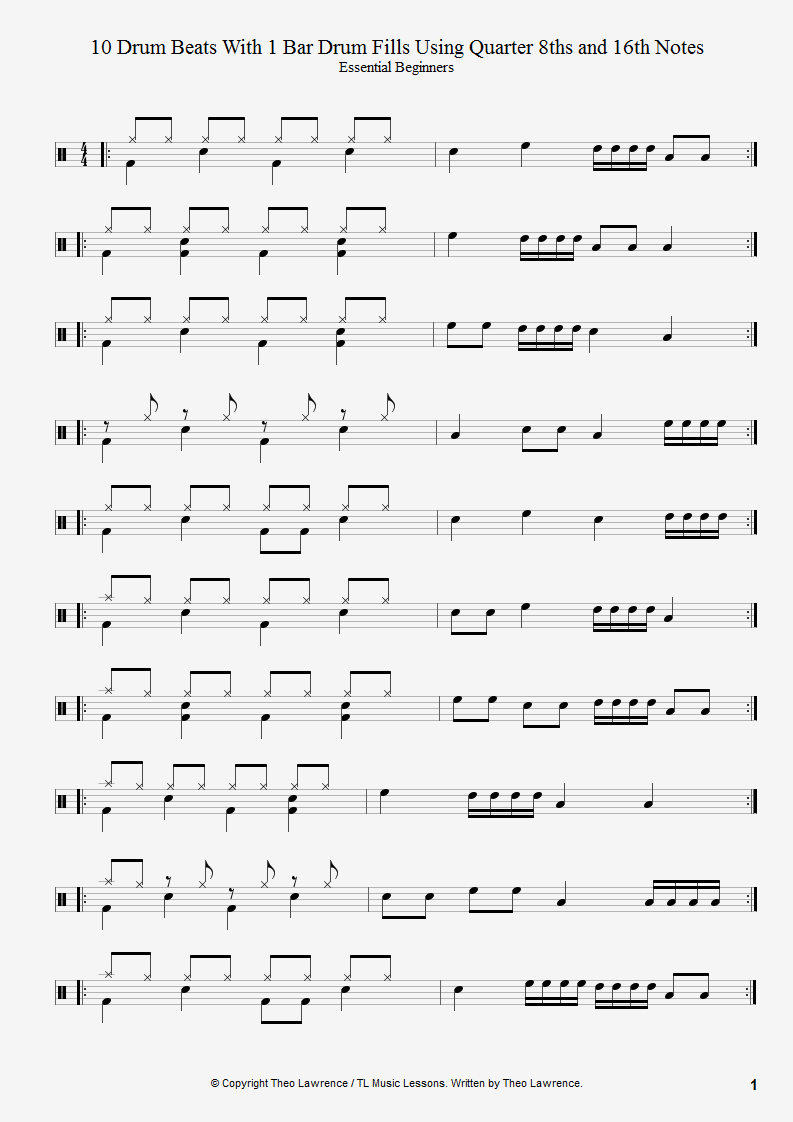
10 Drum Beats With 1 Bar Drum Fills Using Quarter 8ths And 16th Notes

These exercises are great for putting together drum beats and drum fills, like they would appear in a song. Well, in a song the fills would happen less often than this, but the beats have been shorten so as to practice both fairly equally.

The drum fills are ideal for those quite new to playing drum fills. Some subdivision knowledge of quarter notes, 8th noets and 16th notes is useful.

The drum beats may be hard for complete beginners, so some experience of playing them first is recommended before mixing them with the fills, which are a bit easier than the drum beats.


Related: 10 beginners drum beats with 2 beat drum fills exercises
Related (Premium): Beats and Fills Drum Book – Basic Beginners

Blank drum sheet music for hand writing drum music – Free PDF

Get Free PDF Download →

Download the free PDF file to get unlimited access to printing your own blank drum sheet music. You can use this to hand write your own drum beats, drum fills, or for writing out the drums for a song. Teachers can use these to write out drum music for their students. Composers and arrangers can print these off in order to hand write a quick drum score.

There are no annoying watermarks or footer text – it’s just plain blank drum sheet music staves with no writing.

Please don’t distribute the PDF file on any other website or via email – please just link to this page if you want to share it.


Related: Blank Guitar, Ukulele and Bass Sheet Music For Hand Writing Guitar Tab or Chord Charts – Free PDF

6 Beginners Drum Beats in Pop, Rock, Funk, Jazz, Reggae and Blues styles

A variety of 6 different musical styles in the form of drum beats.

Objective: To develop an awereness of different styles of music and to be able to play the basic drum beats.

With this sheet, although there are no repeats, you should repeat each line multiple times and get into the rhythm and groove. Aim for evenly spaced notes at a slow speed. Repeat slowly for a while and get into the beat. Then you can try speeding it up a little bit, and then a bit more and gradually more until it’s fast. Then onto the next beat.


Related: Reading Drum Notation

10 Beginners 1 Bar Drum Beats With 1 Bar Drum Fills

These exercises are great for putting together drum beats and drum fills, like they might appear in a song, although usually there are more drum beats than fills in a song. These exercises have a 1 bar drum beat and 1 bar of a fill, so that each type is practiced equally.

The drum fills are ideal for those playing drum fills for the first time. The drum beats are quite hard for complete beginners, so some experience of playing them first is recommended before mixing them with the fills, which are a bit easier than the drum beats.

One thing that could be a stumbling block to playing the drum fills, is reading the drum notation and knowing which lines of the staves the toms are on. Here is a useful reference sheet for this: Reading Drum Notation.

Beginners Drum fills lasting for 2 beats – Half bar drum fills

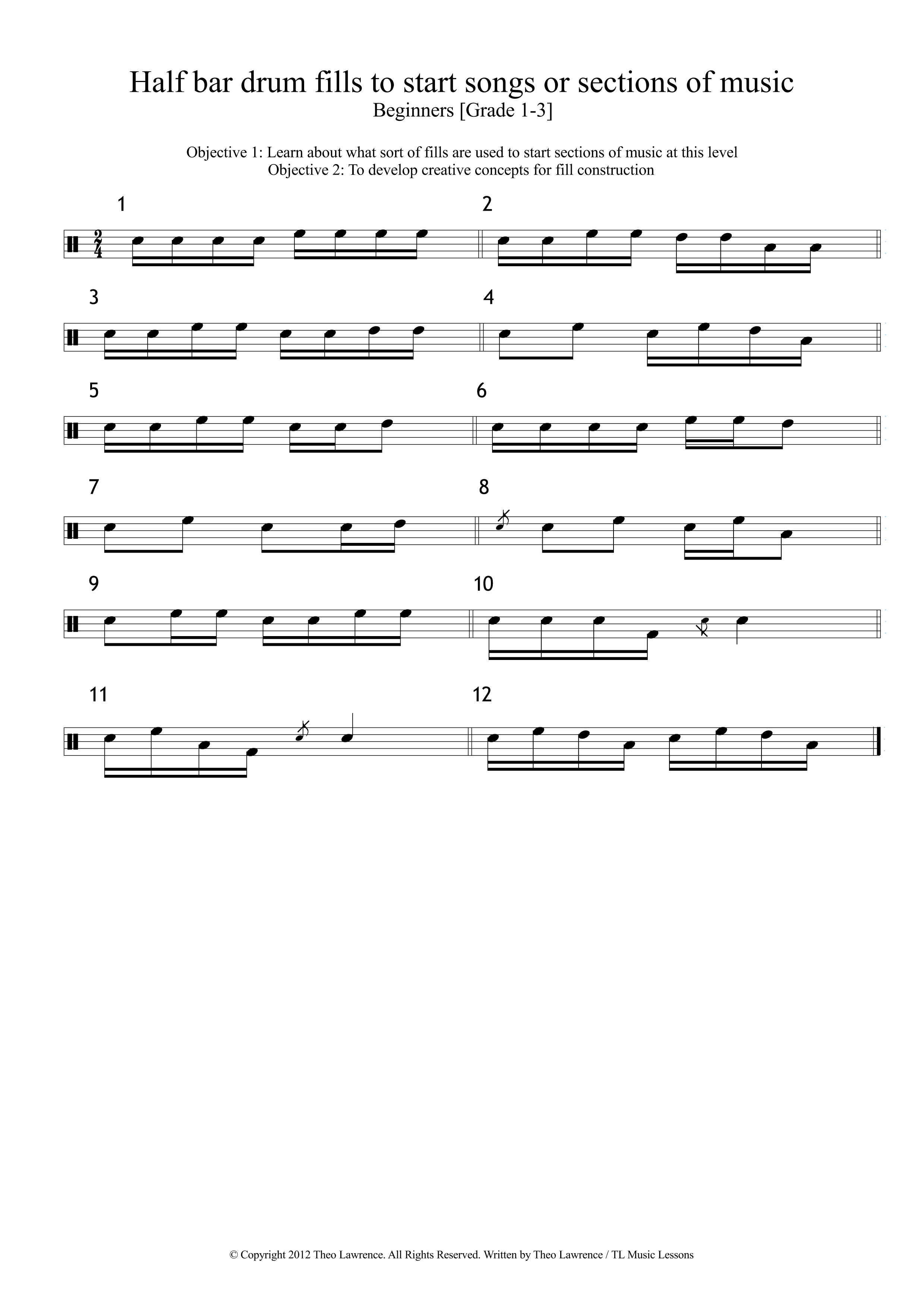
The drum fills last for 2 beats, or half a bar of 4/4. They are all made up of combinations of 16th notes and 8th notes, and 1/4 note flams. There are 12 drum fills.

The drum fills could be used in the final bar of a section. For example, play 7 and a half bars of drum beats, and then insert one of these drum fills – and then repeat. To finish off the exercises after repeating, you could play a crash and bass together.

The fills could also be used to start off a song or before playing through some drum beats.

Mix and match the fills to create 1 bar fills lasting 4 beats.

10 beginners drum beats with 2 beat drum fills exercises

The structure for these drum exercises is: One and a half bar of a drum beat, then half a bar drum fill – and repeat.

These drum exercises are for practicing drum beats and fills, similar to what you would do in a song environment, by playing the drum fills before and after drum beats.

The exercises have been limited to 2 bars, with a single repeat, so that the drum beats and drum fills are practiced fairly equally, rather than playing the drum beat for longer like in a song. Therefore the skill of playing the beat for longer and counting bars like 7 and a half, or 15 and a half before playing the fill is not being exercised here, but should be practiced another time.

This sheet could be used by beginner students up to grade 1 or grade and even grade 3 students could find these useful and challenging by playing them very quickly.

For a variation on the drum beats, you could swap the hi hats for a ride cymbal, or even a floor tom. You could also add in open hi hats (or ride bells) for quick drum beat variations.


Related: 10 Drum Beats With 1 Bar Drum Fills Using Quarter 8ths And 16th Notes
Related: 1 Beat Snare Drum Fills with drum beats exercises
Related (Premium): Beats and Fills Drum Book – Basic Beginners

1 Beat Snare Drum Fills with drum beats exercises

Sometimes in drum sheet music you will see parts of the music that aren’t written. There may be a space in he music, with an instruction such as ‘develop’, ‘ad lib’, ‘cont. sim’ or ‘fill’. In these examples, there are spaces marked out for drum fills to be played for the duration of 1 beat at the end of the bar.

There are 4 different drum fills to choose from for each exercise. You could pick any fill and mix and match with any exercise.

By learning and playing through these exercises, you will build up an understanding of the type of fills you could add in as short little breaks in the drum beats to add interest to your drumming. 1 beat fills could be used at the end of a section, or during a section of music for a bit of variation in the groove.


Related: 10 beginners drum beats with 2 beat drum fills exercises

10 Drum Beats in a 6/8 Time Signature

Objective: To develop a vocabulary of various bass drum and snare variations that are usable when playing in the 6/8 time signature.

Variations: The right hand could be moved to the floor tom or ride, and accents / ride bell / open hi hats could be added

About the drum beats in 6/8

The first drum beat is the standard beat to play for many when playing in 6/8 and is a good place to start. The bass drum is on the first beat of the bar, and the snare drum is on the 4th quaver beat of the bar – these are the beats where the emphasis is in 6/8. You tend to count it with emphasis like 1 2 3 4 5 6.

The hi hats are playing on all 6 quaver beats of the bar, which is the same on all of these drum beats.

About the 6/8 time signature

Beat 3, 4, 5 and 6 all give a strong indication of a ‘swing’, or ‘shuffle’ feel to the beats. This is easy to do in 6/8 because it can easily feel like you are playing triplets, with a perceived time signature of 2/4 or 4/4. This is why the 6/8 time signature is sometimes used in blues and jazz music. It is also a popular time signature in musicals, especially in slower pieces where the crotchet beat would be too slow if notated with triplets. The same goes for blues, where instead of having a very slow “1 trip let 2 trip let” feel, the slow 1 2 3 4 5 6 is sometimes preferred, especially if staying in that feel for the whole song. Going back to musicals, and also for classical songs or any groups with a conductor, a 6/8 time signature is more efficient and clear for a conductor to beat, than a slow piece in 2/4 or 3/4.


Related (Premium): Grades 1-2 Beats & Fills Drum Book – Unit 1 – Rock Pop Soul Funk – PDF ebook
Related: Practice sheet for learning to play drum beats in 6/8 time