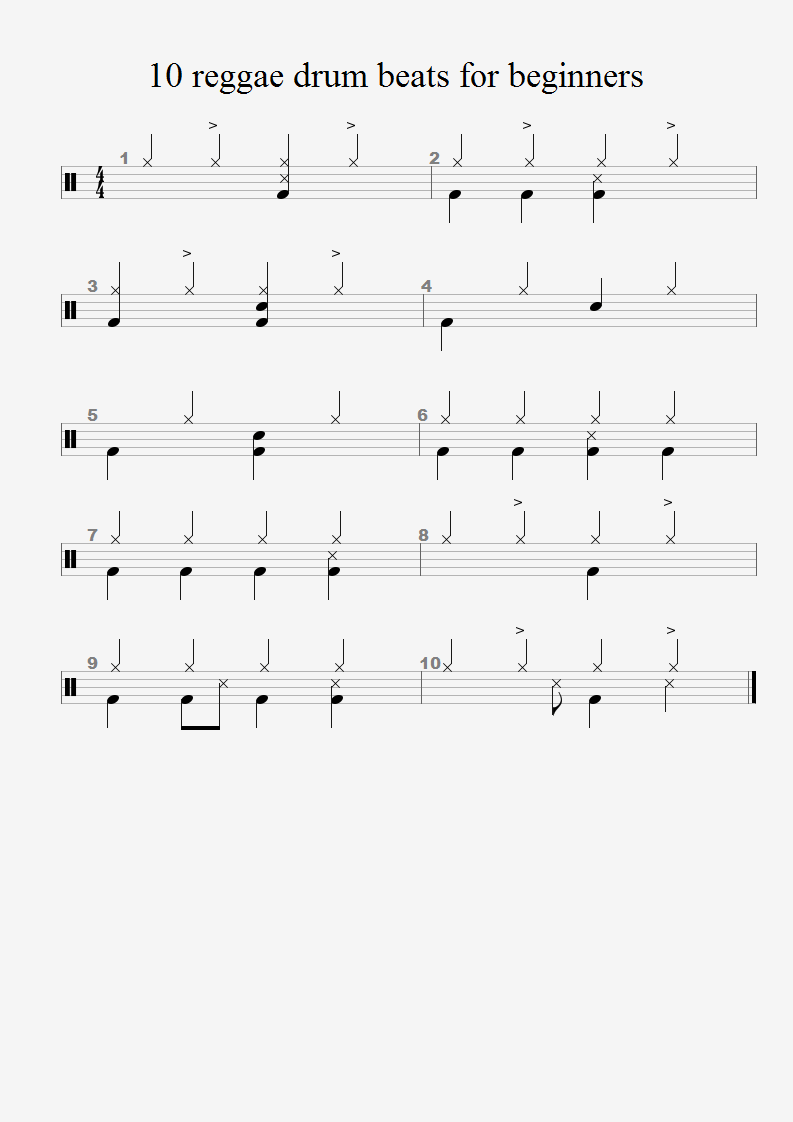
10 Reggae Drum Beats for Beginners

These drum beats are for any ability, even complete beginner. I would however recommend learning pop and rock first. For example: 10 Basic Rock Drum Beats.

Reggae beats often have an emphasis on beat 3 of the bar. Usually this is from the bass drum or bass drum and cross stick snare. Accents are often used on the hi hats to play louder on beat 2 and 4. In more advanced reggae hi hat work, they adopt a swing feel similar to blues, jazz or country. The cross stick snare is used instead of the full snare sometimes or much of the time if the song is fairly laid back and chilled, which it usually is with reggae! Normal snare hits, or hitting the snare head and rim simultaneously are used in reggae drum fills. You can see some reggae fills in the video below.

10 Latin American Drum Grooves – Guest Post by Paulo Goncalves – Do Re Mi Studios

Welcome to the first ever guest post on learndrumsforfree.com!

The author of this post is Paulo Goncalves from Do Re Mi Studios in Australia. It is also his first ever guest post. The idea came about following this article that linked to learndrumsforfree at the end: ‘Five Drum Grooves Every Drummer Must Know’.

The guest post offers a lesson on Latin American drumming, which I don’t usually post about so I hope this will be useful and interesting to my readers.

Please also find attached a free PDF version of the post, which you may print out.

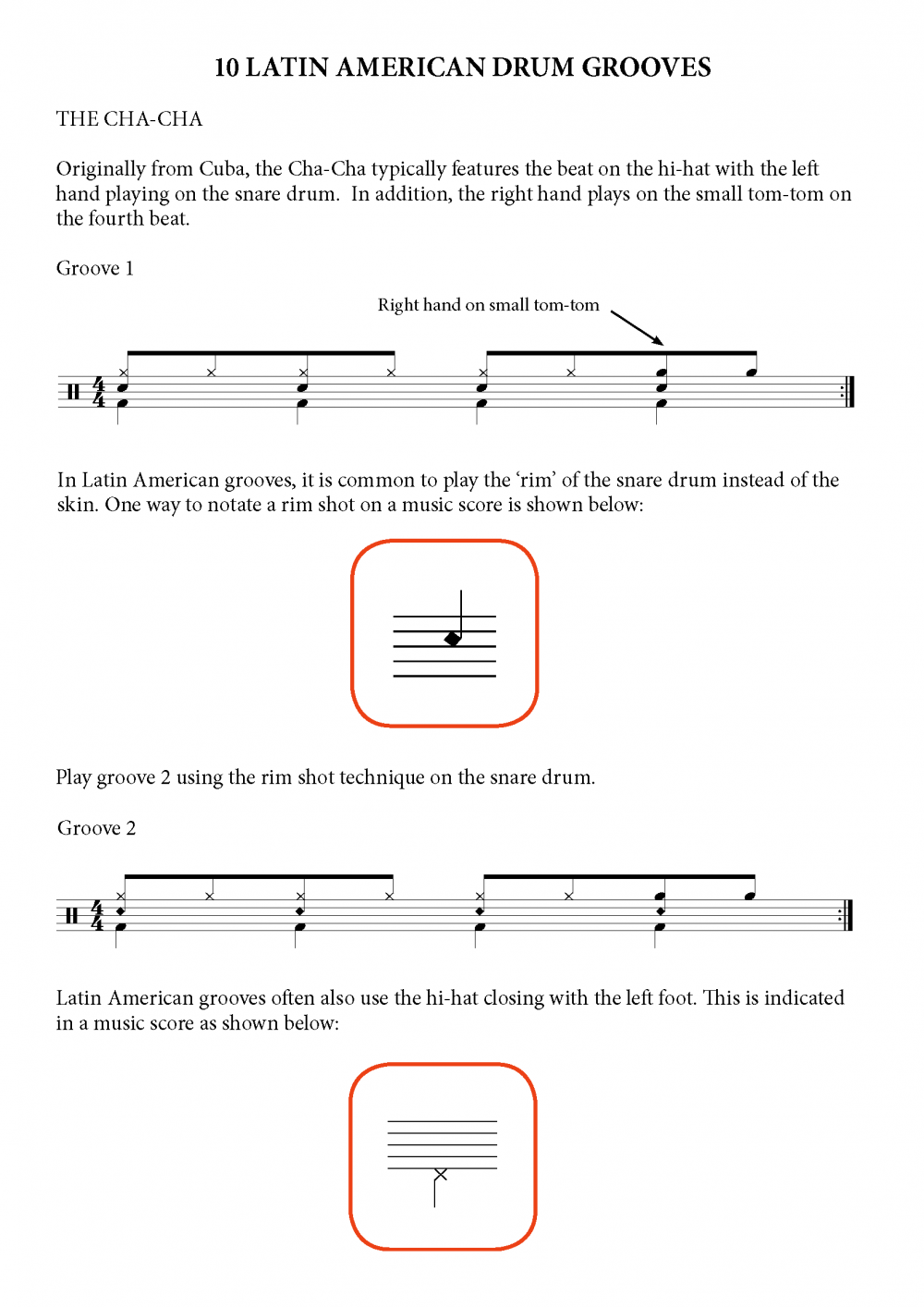
THE CHA-CHA

Originally from Cuba, the Cha-Cha typically features the beat on the hi-hat with the left hand playing on the snare drum. In addition, the right hand plays on the small tom-tom on the fourth beat.

Groove 1

In Latin American grooves, it is common to play the ‘rim’ of the snare drum instead of the skin. One way to notate a rim shot on a music score is shown below:

Play groove 2 using the rim shot technique on the snare drum.

Groove 2

Latin American grooves often also use the hi-hat closing with the left foot. This is indicated in a music score as shown below:

Play grooves 3 and 4 with the hi-hat closing with the left foot on each beat of the bar. The right hand plays the ride cymbal throughout the rhythm.

Groove 3

Groove 4

THE MAMBO

In a typical mambo groove, the ride cymbal pattern is broken up around the tom-toms and snare drum. The hi-hat closes on the second and fourth beats.

Groove 5

Groove 6

ROCK AND ROLL MAMBO

In grooves 7 and 8, the hi-hat also closes on the second and fourth beats. The cymbal pattern is played on the ride cymbal with the right hand.

Groove 7

Groove 8

THE SAMBA

Originally from Brazil, Samba grooves are played fairly fast. In the groove below, play the tom-tom notes with the right hand.

Groove 9

THE BOSSA NOVA

Like the Samba, the Bossa Nova is also originally from Brazil. Bossa Nova grooves feature the snare and bass drum playing syncopated rhythms.

Groove 10

Written by Paulo Goncalves. For more of his articles check out http://www.doremistudios.com.au/blog/
Funk Grooves – Grade 5

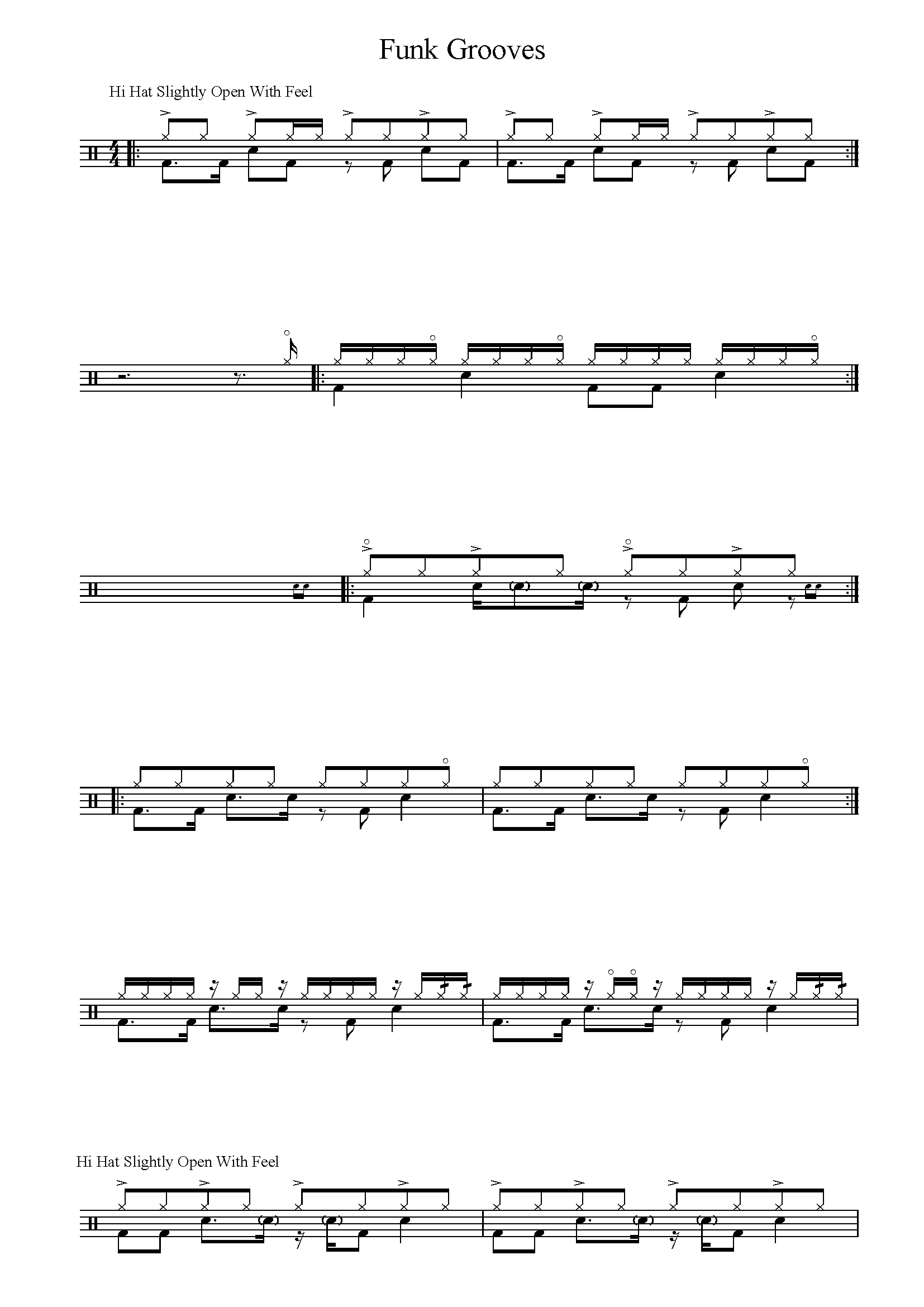
You’ll need to be able to read the sheet music to play these funk drum grooves.

These funky beats are versatile and can be played in various scenarios or even different styles of music.

Use these funk drum beats for some new inspiration or ideas for adding flare to basic funk beats.

  1. The first beat adds accents on the hi hat to add some dynamic depth.
  2. The second beat adds in open hi hats – the hi hat should be played with the right hand only (or left if you’re a lefty).
  3. The third beat has quiet drags on the snare, slightly open hi hats and accents, and ghost note skip beats.
  4. The fourth beat has just skip beats and open hi hats.
  5. The fifth beat uses two hands for the hi hats, and the ones with the slashes through are doubled up using the double stroke technique.
  6. The sixth and final beat has a similar style to the third beat.

5 beginners classic rock drum beats with counting method

These 5 rock drum beats with quarter note hi hats were written to support my students learning the drum beats on Page 13 of Grades 1-2 Beats & Fills Drum Book – Unit 1 – Rock Pop Soul Funk – PDF Ebook, or as a standalone exercise sheet prior to starting the book.

Each of the drum beats has a quarter note hi hat pattern, so often there are kick drums out on their own with no other drum voice played (normally played with a hi hat). This can be tricky for beginners, so that’s why counting is a good idea.

Use the audio examples to hear what they are meant to sound like, and try your best to replicate how evenly spaced all of the drum beats are. Make sure to use the counting guide written above each drum beat until you start to get it – then try without counting.

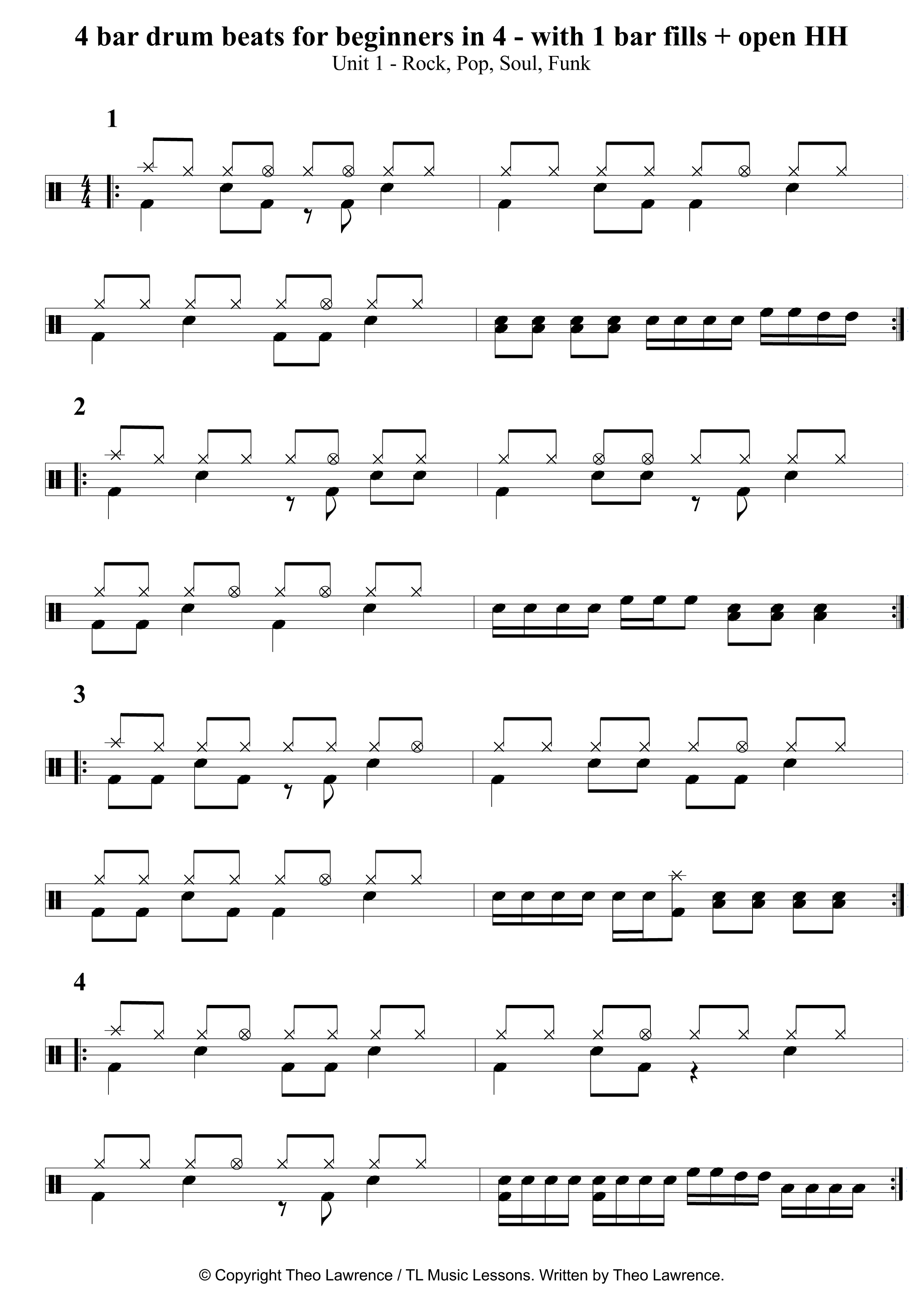
3 bars of drum beats in 4 with open hi hats + 1 bar fills

The drum fills now last for a whole bar, so we are now only playing 3 bars of drum beats. This prepares the student for another real world example of a different length of fill within a drum beat phrase.

You’ll need to be able to sight read these because they will be difficult to memorise. Feel free to try and memorise them if you have time, as this will also be good practice.

Here is a list of the 5 free sheets, released as a series of posts:


These 5 sheet are from the following premium ebook:
Related (Premium): Grades 1-2 Beats & Fills Drum Book – Unit 1 – Rock Pop Soul Funk

4 bars of drum beats in 4 with open hi hats + 2 beat fills on 4th bar

This section is only a slight a variation on the previous. The drum fills now last for two beats, which means the 4th bar only has half a bar of the drum beat. This prepares the student for another real world example of a different length of fill within a drum beat phrase.

You’ll need to be able to sight read these because they will be difficult to memorise. Feel free to try and memorise them if you have time, as this will also be good practice.

Here is a list of the 5 free sheets, released as a series of posts:


These 5 sheet are from the following premium ebook:
Related (Premium): Grades 1-2 Beats & Fills Drum Book – Unit 1 – Rock Pop Soul Funk

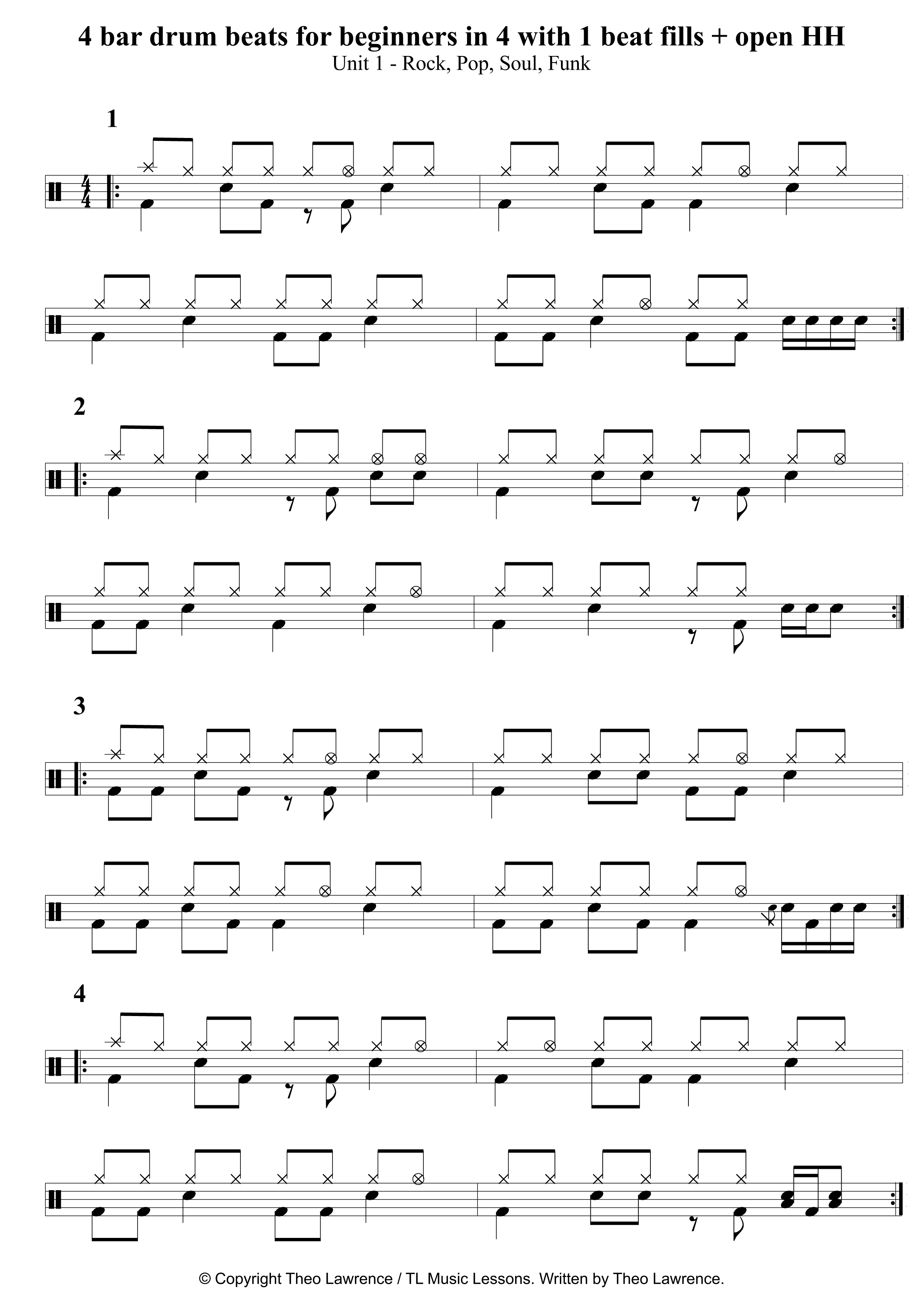
4 bars of drum beats in 4 with open hi hats + 1 beat fills on 4th bar

Much like in the first two sections, there are 16 different exercises with drum beats in 4/4. This time, the phrase is over 4 bars and there is a short drum fill on the 4th bar before repeating. You’ll need to be able to sight read these because they will be difficult to memorise. Feel free to try and memorise them if you have time, as this will also be good practice.


Here is a list of the 5 free sheets, released as a series of posts:


These 5 sheet are from the following premium ebook:
Related (Premium): Grades 1-2 Beats & Fills Drum Book – Unit 1 – Rock Pop Soul Funk

2 bar drum beats in 4 with open hi hats

Much like in section 1, there are 16 different exercises with drum beats in 4/4, each with open hi hats placed within the beats, but this time it’s double the length. You’ll need to read these or really work hard to memorise them to play without reading.

Here is a list of the 5 free sheets, released as a series of posts:


These 5 sheet are from the following premium ebook:
Related (Premium): Grades 1-2 Beats & Fills Drum Book – Unit 1 – Rock Pop Soul Funk

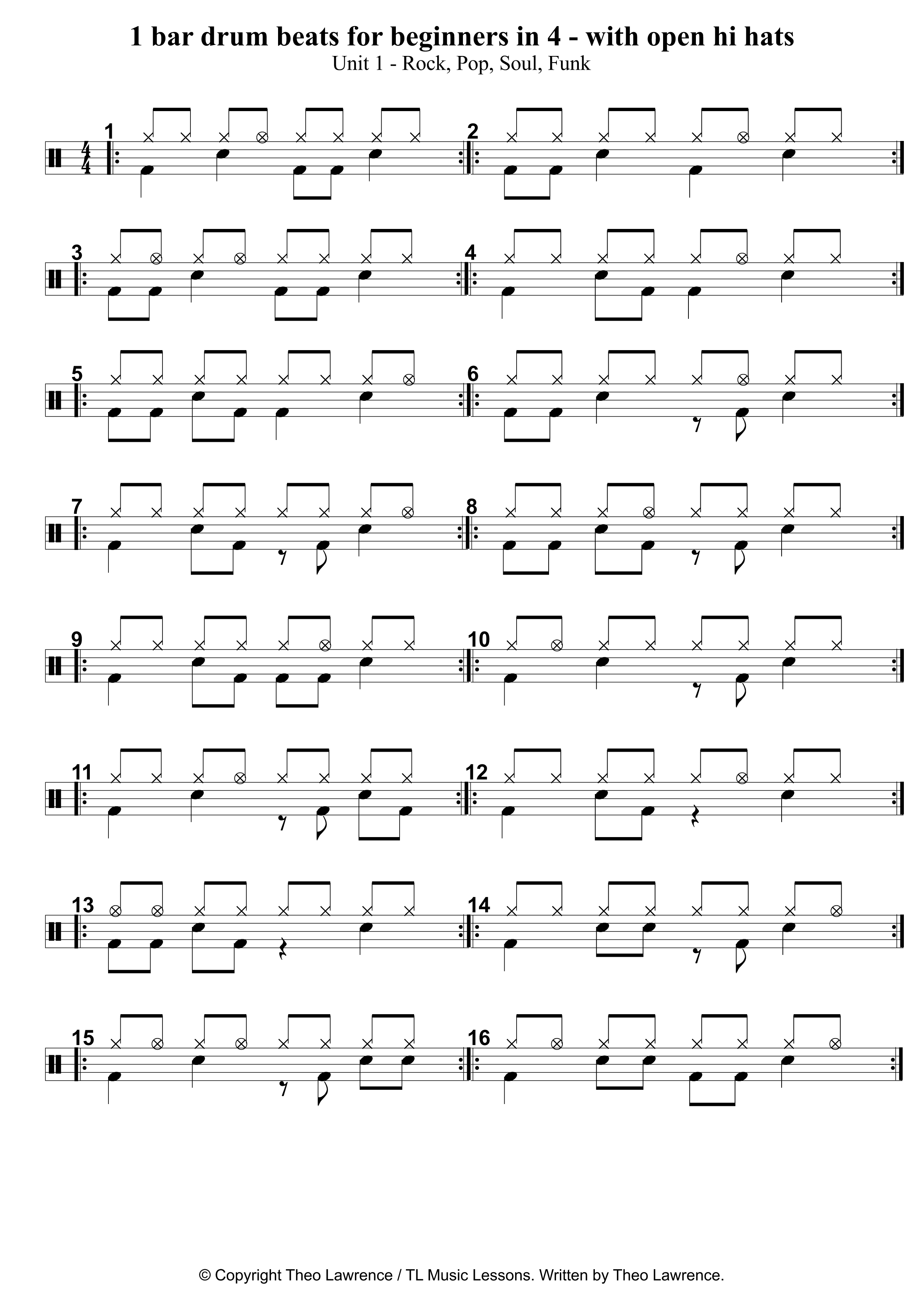
1 bar drum beats in 4 with open hi hats

There are 16 different drum beats in 4/4, each with open hi hats placed within the beats. The open hi hats are marked with a circle around the X note head. These drum beats have been written for beginners between grade 1 and grade 2.

In this series of 5 free PDF drum sheets, we will be covering content from section 1 to 5 of the full ebook, focusing on the topic of drum beats with open hi hats in 4/4 timing.

Here is a list of the 5 free sheets, released as a series of posts:


These 5 sheet are from the following premium ebook:
Related (Premium): Grades 1-2 Beats & Fills Drum Book – Unit 1 – Rock Pop Soul Funk

Beginners snare skip beats

Here we have 7 basic pop/rock drum beats with an added ‘skip beat’ snare hit, which slots in between the 8th note hi hats. It’s in the same place on each drum beat. It’s on the ‘a’ of counting “2 + a“.

The counting would then be 1 + 2 + a 3 + 4 +. Some drummers don’t count that way. It’s useful to start doing that and it makes sense after a little while. You count the 8th notes as 1 + 2 + 3 + 4 +, and for 16ths you count 1 e + a 2 e + a 3 e + a 4 e + a. You pronounce the e as a capital E and the a as the sound of the small letter a, which sounds like a short ‘ah’.

The skill level for these exercises is about grade 2-3, or higher if played fast.

The beats could be used in a range of styles including pop, rock and funk.


Related: Snare Drum Skip Beats