Grade 1 Rock Beats – Free PDF ebook

Get Free PDF Download →

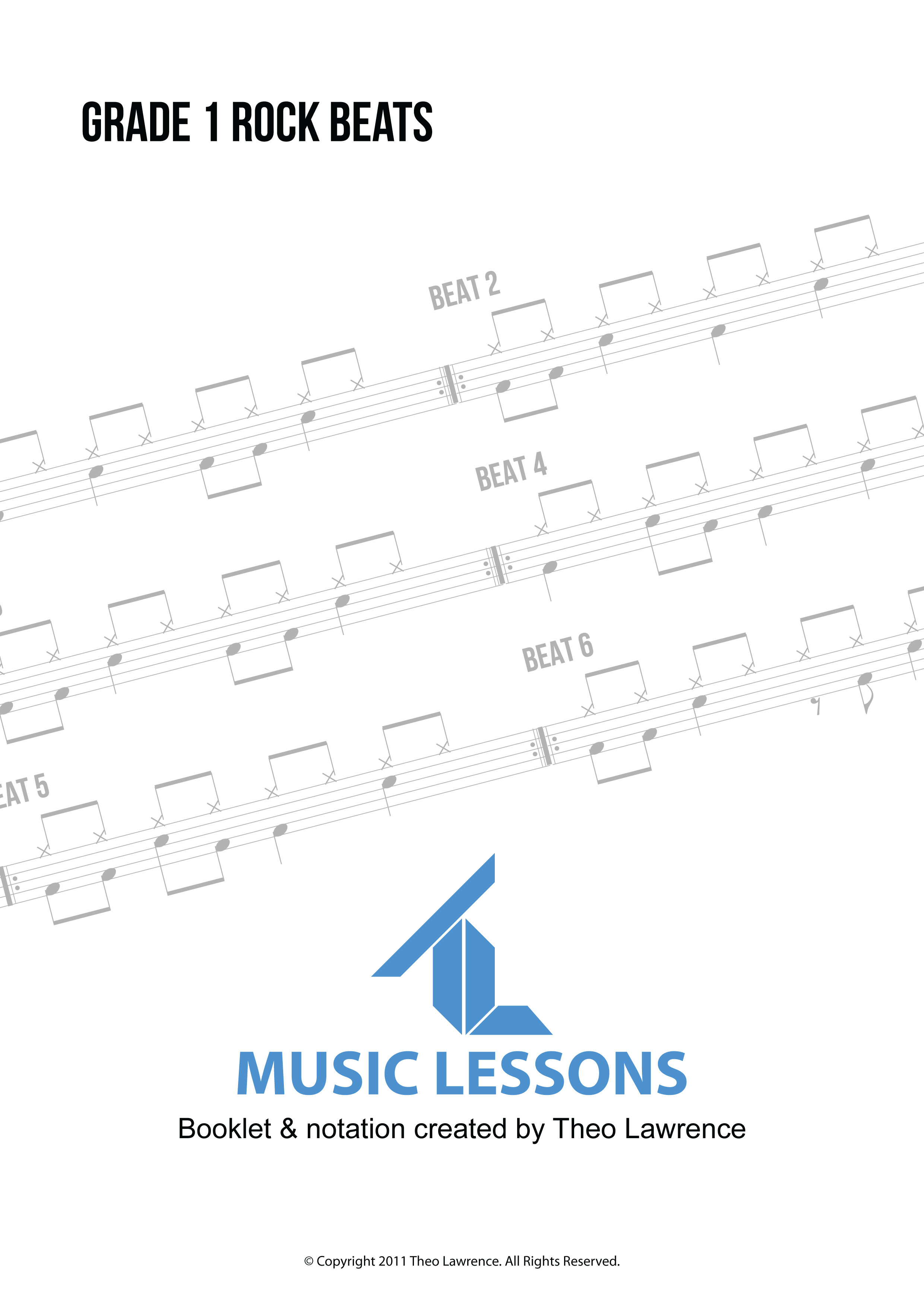
This short ebook gives you 1 page of the break down of how a basic drum beat is contructed and then 3 pages with 10 rock drum beats on each page.

The first of the 3 core pages of beats is with 8th note closed hi hats. The second page is the same beats again but with open hi hats (the note heads with cirles around them). The 3rd page has different beats with quarter note hi hats (really has that rock sound), which can also be played as half open hi hats or closed hi hats.

I hope this free ebook is helpful for students and teachers looking for a few quick sheets to get them started with. I also hope that you will enjoy the quality of the free ebook enough to try some of the premium drum ebooks.

3 Simple Drum and Bass Steps – How to Play, With Notation and Variations

This is a guest blog post from Ryan Alexander Bloom.

An interesting style of drumming that has become popular recently is live breakbeats or human drum ‘n’ bass music. Bands like Nerve and Shobaleader One have been on the cusp of the movement and players like Johnny Rabb and Jojo Mayer have been using their considerable chops and applying them to electronic sounding, yet still very acoustic, beats for decades. Playing in this style can be a lot of fun because it is improvisational like jazz, technical and chops heavy like metal or prog, and very flashy with a prominent and featured drum part.

To get into this style you can start in a couple of places. Drum and Bass beats are traditionally either created by sampling existing music off of a turntable, or by programming rhythms into a drum machine. In this selection of exercises we will focus on recreating the drum machine sound, rather than the sampled sound. Programmed beats are sometimes called steps because of the 16 steps (16th notes on which you can apply sounds) of an old loop sequencer drum machine. These exercises all feature essentially the same 3 core steps. These are classic rhythms that permeate much of electronic music and can be embellished in many ways to come up with more interesting grooves. These first 3 patterns are demonstrated here:


https://youtu.be/ob1O6vqSTmY

Variations

The hi-hat or ride cymbal can be used with any of these steps. We can also change the value of the cymbal pattern from 8ths to quarters to change the feel. Try to work these basic beats up to at least 160bpm if not higher for an authentic sound.

For slower tempos, more cymbals keep up the energy level. 16ths would be the next logical step.

For a layered texture, add in hi hat with your foot. Drum machines can play lots of notes simultaneously, so layering in another cymbal pattern helps keep up the illusion of a programmed beat.

Keep in mind that drum machines have no soul. Counterintuitively, the less human feeling or groove you can impart to these patterns the better they will sound in a drum and bass context. Try to play all the cymbal notes at the same dynamic level and keep everything steadily right down the center of the beat. Once you master these patterns, you can begin to add ghost notes, hi hat openings, fills, and other elements to make things more interesting. More advanced step patterns, classic breaks, break manipulation strategies, and extended techniques, can be found in Live Drum & Bass – Breakbeats and Electronic Music for Real Drummers available from Hudson Music and Amazon.com


Buy from Hudson Music – https://hudsonmusic.com/product/live-drum-bass/

Buy from Amazon.com – https://www.amazon.com/Live-Drum-Bass-Breakbeats-Electronic/dp/154285864X

Reading and Playing Buzz Rolls and Double Strokes

Some snare drum sheet music writes out buzz rolls with a Z through the stem. I don’t write it like that because my software doesn’t have that feature, but many others write it my way too anyway so I’ve got used to writing using 3 slashes instead (3 slashes like this /// through a stem line like this |).

Tremolo in Other Instruments

So, the slashes through the notes are also used in other pitched instruments as a tremolo marking. Violins have plenty of tremolo, which is achieved by moving the bow back and forth quickly. You’ll hear the sound in movies where the violins sound intense and brooding by playing 1 note for ages repeatedly. See the video below for an example of this. You’ll hear this more in old programs and films such as in the original Thunderbirds series’.

Tremolo Markings in Drums (The ‘/‘ slashes through the stems)

These tremolo markings in drums can be played with precise double strokes, or with a multiple bounch technique, which sometimes yeilds more than a double with each hand, but thats ok. This article talks further about the ambiguity of multiple bouncing vs precise doubles when reading.

About the Music Sheet (featured image)

On each line that the 1st bar has what you see in sheet music and the 2nd bar of each line shows you the method of playing it. I have chosen to write slashed 16th notes rather than write 32nd notes in the second bars because that’s how I teach drummers to count their buzz rolls, by playing 16th notes and buzzing each hand. So, for a 1 beat buzz roll, you would play “R L R L” 16th notes, and each hand will be buzzed, so it will actually be something like this: RR LL RR LL, or RRR LLL RRR LLL if you play several notes with each hand. For snare drum sheet music with multiple bouncing, I encourage more bounces so it has more of a drum roll feel to it.

Here’s how to play the multiple bounce roll:

When you see 16th notes with slashes in, during regular drum sheet music especially, I would say this always should be assumed as ‘use precice doubles’ if you can manage it with the double stroke technique. For example, the hi hats may have 16th notes but some of the hits are doubled, and these would be played with a strong double stroke technique. In this Samba Funk Grooves sheet you can see that the hi hats have been written as 32nd notes, but they could also have been notated with slashed 16th notes. You can see double strokes played on the hi hat in a groove in this video:

When you see slashed 16ths on the snare drum, this means to play them as 32nd notes, with double strokes (RRLLRRLL for 4 slashed 16th notes).

This video by Ryan Alexander Bloom shows how I play all of my precise doubles. I didn’t realise it was called the ‘Push Pull’ method until I looked up videos on it! At drum college they were just taught as the ‘double stroke technique’. Please make sure to watch the full video if you want to learn double strokes properly, it’s only a couple of mins…

After letting Ryan know that his video was featured here, we arranged for him to write a guest blog post for this website, which you can read here: 3 Simple Drum and Bass Steps – How to Play, With Notation and Variations


Related:

Snare Drum Piece – Jan 2018
Group Snare Drum Piece with 3 difficulty levels (Piece 2, Book 1)
Group snare drum piece with 3 difficulty levels (Piece 5, Book 1)
(Premium) – 10 Snare Drum Pieces – Book 1 – Levels 1-3 (PDF ebooks)
10 Pages Of Accent Exercises With 16th Notes – PDF Ebook (includes double strokes exercises)
Accent Techniques – Down, Tap, Up, Full Strokes

How Personal Trainer Sessions and Gym Workouts helped me to be a better drummer after ACL Knee Surgery

Photo Credit: Louish Pixel

I’ll start by saying I am very glad that I chose to have the ACL reconstruction operation after injuring my leg playing football and for anyone considering not having it done after injury I will say that it’s very much worth doing. There are risks as with any operation but they are fairly minimal and I certainly wouldn’t have wanted to go the rest of my life with an unstable knee. Whilst I’m not glad I injured it in the first place, I do see it as a blessing in disguise with how my life has changed following the operation.

When I injured myself playing football, the leg gave way when I pivoted to pass the ball with a lot of sideways momentum. I had ironically been pushing myself hard that week to get fitter so maybe some of my supporting muscles were a bit fatigued, which made it vulnerable.

After about 9 months of being misdiagnosed by physiotherapists and doctors, I contacted the doctor’s again and was referred to a senior physio who then referred me to get an MRI scan as a precaution but still thought it would be fine. At a similar time someone that had my injury before said exactly what it was following my description to them. After I later found out that this was correct it did surprise me that 3 physiotherapists and 2 had failed to pick up on even the possibility of it being the ACL (Anterior Cruciate Ligament). One said it could have been a dislocated knee cap or that I just jarred the muscles. I did tell them my leg went out to the side and back in again and then huge swelling and pain but unfortunately, no dice.

Up to the point of the MRI scan my knee had given way a few times under general moving about too quickly or attempting to jog. I kept on with the drums though because drumming with the legs is all straight line movements to the kick pedals, so it giving way was not really an issue.

The MRI scan was great. As a musician I wished I had declined the headphones used to distract me from the sounds because I wasn’t able to move at all to take them off during. The sounds were loud so I still heard them though. The sounds were a bombastic mix of what sounded like sine, square and saw waves from a primitive synth bellowing out at me.

When I met with the surgeon to discuss the results, I wasn’t prepared at all to hear that I needed a hamstring graft to reconstruct my ACL ligament through my knee, which would include harvesting my hamstring, braiding it together and drilling it into a bone in my lower leg with a dissolvable screw and then afterwards the rehab would be 6 months where I would also have to be careful not to damage the work done before it starts to morph into my body with blood flow etc and be strong enough to act like a normal ACL. There would also be risks during the op like blood clots and would be scars (they are barely visible now). Oh and repair my medial meniscus cartilage at the same time but that it may not be repairable and if so need some chopping out. I must have asked for about 3 glasses of water and also for the window to be opened because I felt nauseous.

I decided there and then to go for it after a short time of thinking about bailing and not doing it. At this point I was told to be very careful not to make it worse or the cartilage damage may worsen, so I decided to tell my band I can’t play for a while. I debated keeping going but I was so worried at this point of injuring it beyond repair. We had just released an album and preparing tour dates so it was pretty devastating for all, because it was a couple of months ‘til the operation and then at least several additional months before I would return. I did agree to go ahead with our video shoot though so that we had something else to promote at least online for a while.

The operation process was easy and I was in good hands with the excellent (albeit stretched) NHS and my surgeon was highly regarded from what people were saying.

I was in a lot of pain afterwards and I couldn’t really do much for myself for the first 2 weeks. It was so hard washing and moving around and I was heavily dosed up on painkillers. After week 3 I returned to teaching on crutches and I was kindly driven around by Mum, who took some time out to be there for me. After about 4 weeks I could drive (you have to be able to emergency stop) but walking was still hard and painful.

My physiotherapist assigned to me for the rehab is amazing and she really guided me through the recovery. I have to drive 30 mins each way to go weekly rather than the ones in my hometown but it has been worth it.

I was also offered to be part of a research study, which tests the benefits of building up the good leg along with the injured leg, which I signed up for. I’m not sure if I still would have gotten all the physio sessions if I didn’t, but I’m not sure on that.

The weekly physio sessions started me off into a regular routine of going once a week and then going to the gym for 2 or 3 more sessions in between. It sort of forced me into a healthy routine that I now stick to over 6 months after starting.

Before the operation I had got talking to someone at a wedding that I knew was a personal trainer so asked him what he thought about it all. He said I’d really done a number on it! More importantly he opened me up to thinking about the recovery. He said that the rehab after the operation was so important to get right because if you don’t put in the hard work it won’t recover and might not be as good in the long run.

Following that chat, I was inspired enough to go ahead with booking some PT sessions provisionally for when my leg was able to start taking on extra exercises to the physio’s homework I would get.

After the first 3 months of the 6 month rehab period it gets easier. The first 3 are hard graft and progress is notable but slow. The second 3 months you can really open up and start to do more but still have to be careful of twisting to aggressively and things like that.

Now for me it’s been 6 months and 3 weeks since the operation. I played my first return drumming gig 3 months ago and I’ve been having Personal Trainer sessions for 4 months. I play in a metal band so I use the double kick using both legs but my bad leg is not my lead leg – it’s the hi hat leg. So introduced my bad leg slowly to full double pedal stuff and it was not until 4 months after the operation I felt ready to give it the full beans.

During the time of being cautious with my bad leg I was having the PT sessions and physio too and all the while it was improving, and so was my ‘good leg’.

When I was a teenager I used to have issues with knee pain playing football and it’s only since this rehab process that I have realised that I needed to build up my upper leg muscles to protect my knee. The VMO muscles are key to this from what I have found out.

My PT sessions have really worked on my legs and core muscles and my physio was also focused on general strength including upper body and progressed onto agility work and running / cardio.

I feel that without this injury I never would have got into all this training. Now I can feel my body changing, getting stronger, and I have much more general endurance. Especially for metal drumming. It’s not so much the power but the endurance that is needed to maintain the speed playing, along with good technique.

My quads and calf muscles have been built up quite a bit and now when I drum at gigs I feel I can really rely on my muscle power and endurance to play the parts without fatiguing and feeling pain right at the top of the leg near the groin like I did before all of this.

This has given me confidence to push myself when writing new beats for songs. Before I had been tempted not to push myself too much as it would be hard to play in a long set but now I can really lean on my new found confidence and push the envelope like I did 15 years ago when I was a teenager, with all the energy in the world.

I feel like I’m getting my old abilities back but now I am so much tighter with my experience of recording and gigging, so right now I’m enjoying being better than I ever have been on the drums and feel confident to push it further.

Last week I played a gig and came off stage dripping with sweat and I knew I had never played so hard, with so much energy. I remember hard bits being quite easy and also really unleashing on some sections, throwing out energy to the audience and the band. I think that was my best ever performance, 22 years on from first starting to play the drums.

I will definitely keep up my gym work, and with the guidance of a personal trainer it helps with my motivation to keep it going and to keep everything fresh too. I’ve started to have joint PT sessions with a friend to make it more affordable and sustainable too.

There is so much you can do for free if money is tight, so I really recommend getting stuck into a range of workouts like cardio, weights, agility work using online resources. Don’t just do one – it’s important for men and women to do a mixture of cardio and strength work.

I hope to have inspired you in some way. Don’t wait to get an injury to find the motivation to work on your fitness like I did! Seeing the change in me and how far I’ve progressed from hobbling in severe pain to running in slaloms and doing things like barbell back loaded squats, box jumps and calf raises in months has inspired my partner and friends to get into a regular workout routine too.

I’ve still got some work to do on my knee, hamstring and calf muscles and I’ve only been doing the gym work for a relatively short time so I look forward to seeing what I can do over the next year and onwards.

So now it’s over to you. Unlock more creativity as a drummer by building up your strength and endurance to improve the confidence you have in your own abilities and potential.

Self Recording Drums – The Basics

Photo Credit: Marc Wathieu

Guest blog post by Subreel. Please check out their website for more audio equipment reviews, how-to guides and loads of other musical information.

Being a drummer can make your life awkward, especially compared to other instruments. Your instrument is the hardest to transport, requires a lot of maintenance and expense, and as you may expect, drums are the hardest of the mainstream instruments to record. That said, it has become more simple in recent years and many drummers are taking the opportunity to lay down demos, create backing tracks and self-record for a variety of reasons. We’re covering the basics of doing so, and how you can get started in this article.

The main difficulty when it comes to recording drums is the fact that you need multiple microphones. The various different drums and cymbals, and the huge variety of sounds they create mean that recording them with one mic isn’t going to do it justice, and certainly won’t be usable for professional records. Many musicians have turned to USB microphones in recent years, but that is possibly the more difficult option for drums.

Microphones

You will need a minimum of three microphones.
• At least one overhead mic, and often two. A matched pair of Condenser microphones are standard, this can be as luxurious as AKG C414s, or their cheaper alternative the C214. Alternatively, a budget model such as the MXL990 can do a good job.
• One snare mic. This can be as simple as a Shure SM57 or a similar dynamic microphone. SM57s pick up the frequencies required very well and they’re very durable, so they’re not likely to break if they take an accidental hit or two.
• One kick drum mic, this is normally an AKG D112 due to its immense ability to pick up bass frequencies.

You will probably then want to add more microphones to get more detail in your recording, and more importantly to gain more control. If you record with one microphone you can’t adjust the volume of individual parts of the kit, so your kick drum might disappear, for instance. For this, you are going to need either a small mixing desk (4-8 inputs as a minimum) which you can run your microphones into. Alternatively, drum brands such as Sabian have started providing audio interfaces for your drums, the Sabian Sound Kit. These are a brilliant way to get four of five different mic inputs going straight into your laptop or computer for editing.

Acoustics

When it comes to home recordings, this is the most overlooked aspect. Unless you are lucky enough to live in Abbey Road, you’re going to need to treat the room you are recording in. Acoustics can be incredibly complicated, but just some simple basics can make a huge amount of difference. The room you are recording in should have a lot of absorption. Acoustic treatments are ideal, but if you can’t afford these then simply hanging up some blankets or duvets and filling the room with furniture will do a lot to deflect and diffuse the reverberations of the sound. Even if you think the room sounds ‘nice’, you want the recording to be as flat and dead as possible, reverb, EQ and other effects can be added later but if you get an unwanted reverb you won’t be able to get rid of it.

Mixing and Compression

Without control of the volumes, things can get chaotic pretty quickly. The mixer will serve to allow you to alter the volumes to your liking, and avoid the problem of suddenly having a very loud floor tom, but a disappearing snare. The main thing to worry about during recording is that you get a good, strong signal from every microphone. The levels can be tweaked in software afterwards.

Another essential aspect of a drum recording is compression. Simply put, compression brings the level of the sound to a more ‘even keel’. The louder aspects of the sound will be leveled out and the quieter aspects slightly boosted. In drums, this means that a lot more of the ‘body’ of the sound is brought out and the transients (the sound of the sticks hitting the drums) will be more subtle. Compressors have different presets and controls to allow you to tweak things. You can choose to compress individual tracks or even the whole kit, but our ears are used to hearing compressed drums, and this simple step can greatly enhance your overall sound.

Recording Alone?

Even in professional studios and full-band recording sessions, overdubs and editing are commonplace. There are a few things to consider when recording alone. You don’t have to get it exactly perfect for the whole duration of the song, and replacing missed hits and bum notes is not uncommon, nor is it selling your soul! To make life easier when it comes to layering, recording to a click track (metronome) will help you to stay perfectly in time. This is helpful not only for editing (some will even loop sections of good drumming) but it is helpful for those of us who are liable to speed up or slow down throughout a song.

Practice

Recording is as much of an art as your drumming. You don’t have to become a pro audio engineer to get good recordings, but practicing and experimenting is the best way to get to grips with things and create a sound you are happy with. Different mic positions will work better, different combinations of microphones and experimental room mics can all make a difference to your sound, and the best way to get the best sound is to invest the time into getting it right.


Guest blog post by Subreel. Please check out their website for more audio equipment reviews, how-to guides and loads of other musical information.

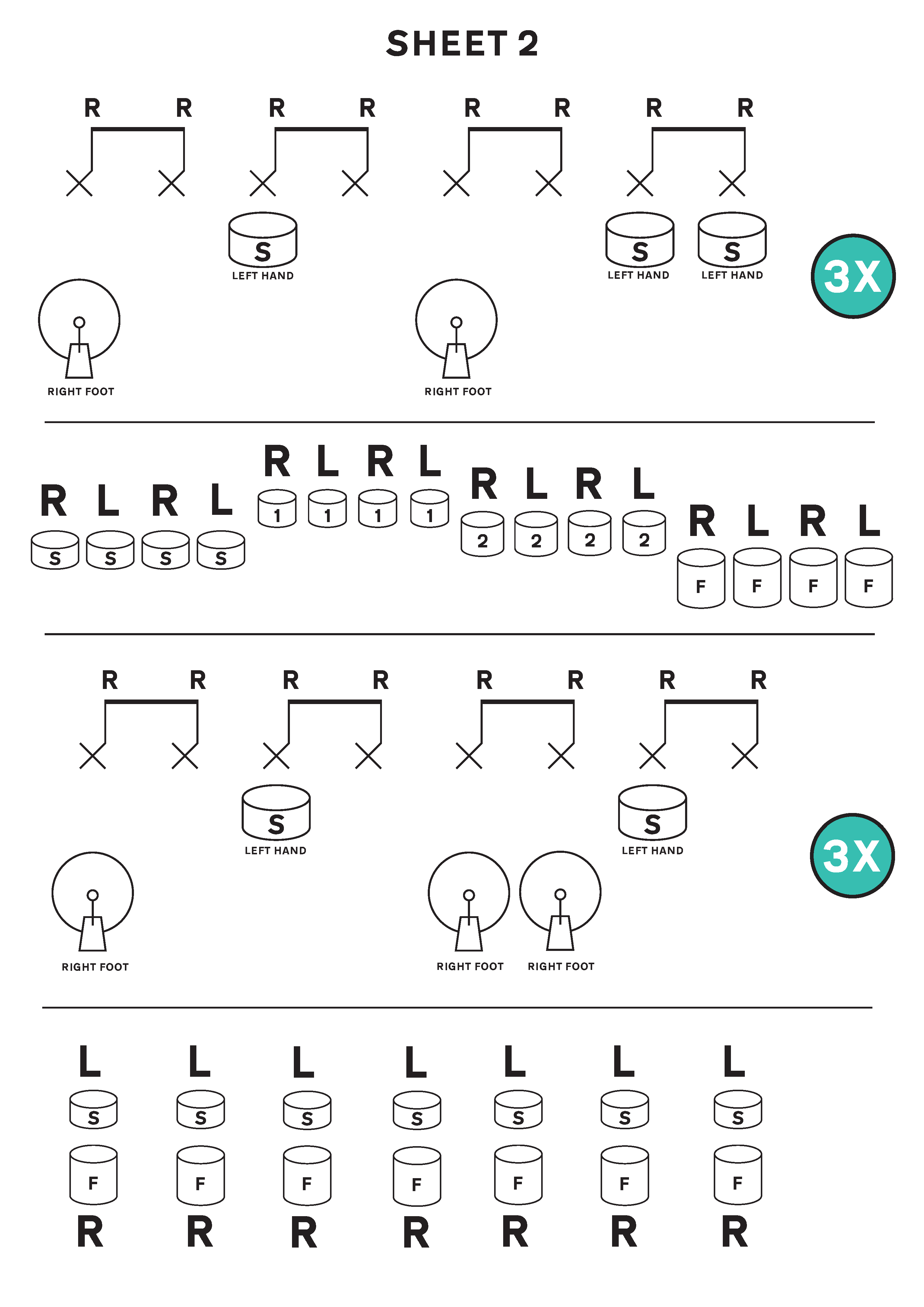
Sheet 2 – Easy Reading Beats & Fills

Here we have a drum beat repeated 3 times, then a fill, then another drum beat 3 times followed by another drum fill. The sheet can be then repeated around multiple times, or you could just repeat the first half around for a while and then focus on repeating the second half.

These are great for beginners and especially for those that haven’t moved on to reading drum sheet music properly yet. It will help those that struggle to read the drum music, for example young drum students.

Right handed drummers should play all of the hi hats with their right hand, and all of the snare drums with their left hand. Left handed drummers should do the opposite.


Related: Sheet 1 – Easy Reading Beats & Fills
Related (Premium): This free drum sheet is part of a premium ebook, which you can purchase here: First Drum Book – Easy Reading Beats & Fills

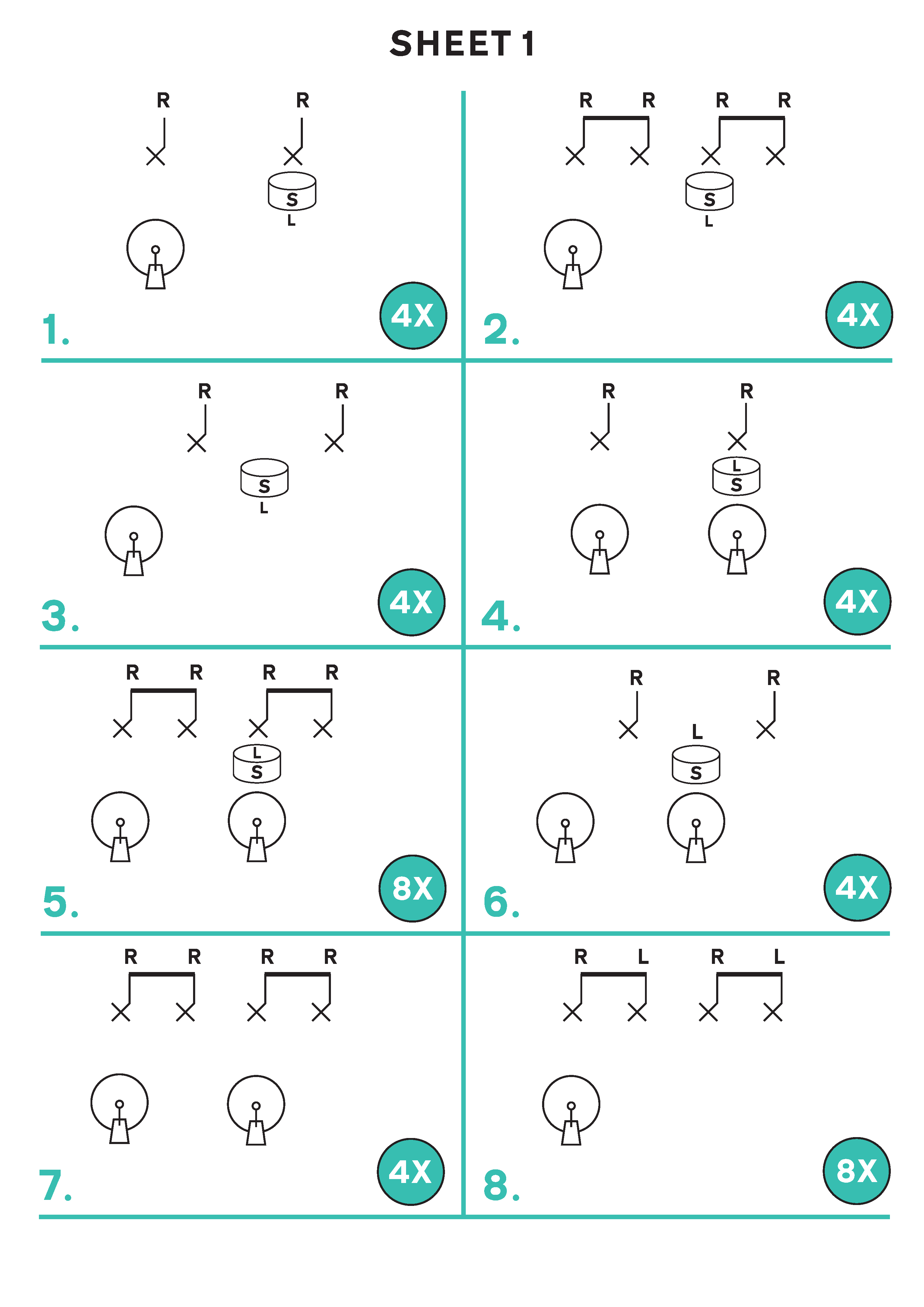
Sheet 1 – Easy Reading Beats & Fills

Here we have 8 drum beats, each lasting half a bar each. We’ll play them each 8 times, which will total 4 bars worth for each beat.

There are 3 drum voices; Hi Hat (the X‘s), Snare Drum (the drum with an S in it), and the Bass Drum / Kick Drum (the one that has a pedal attached to a circle).

These are great for beginners and especially for those that haven’t moved on to reading drum sheet music properly yet. It will help those that struggle to read the drum music, for example young drum students.

Right handed drummers should play all of the hi hats with their right hand, and all of the snare drums with their left hand. Left handed drummers should do the opposite.


Related: Sheet 2 – Easy Reading Beats & Fills
Related (Premium): This free drum sheet is part of a premium ebook, which you can purchase here: First Drum Book – Easy Reading Beats & Fills

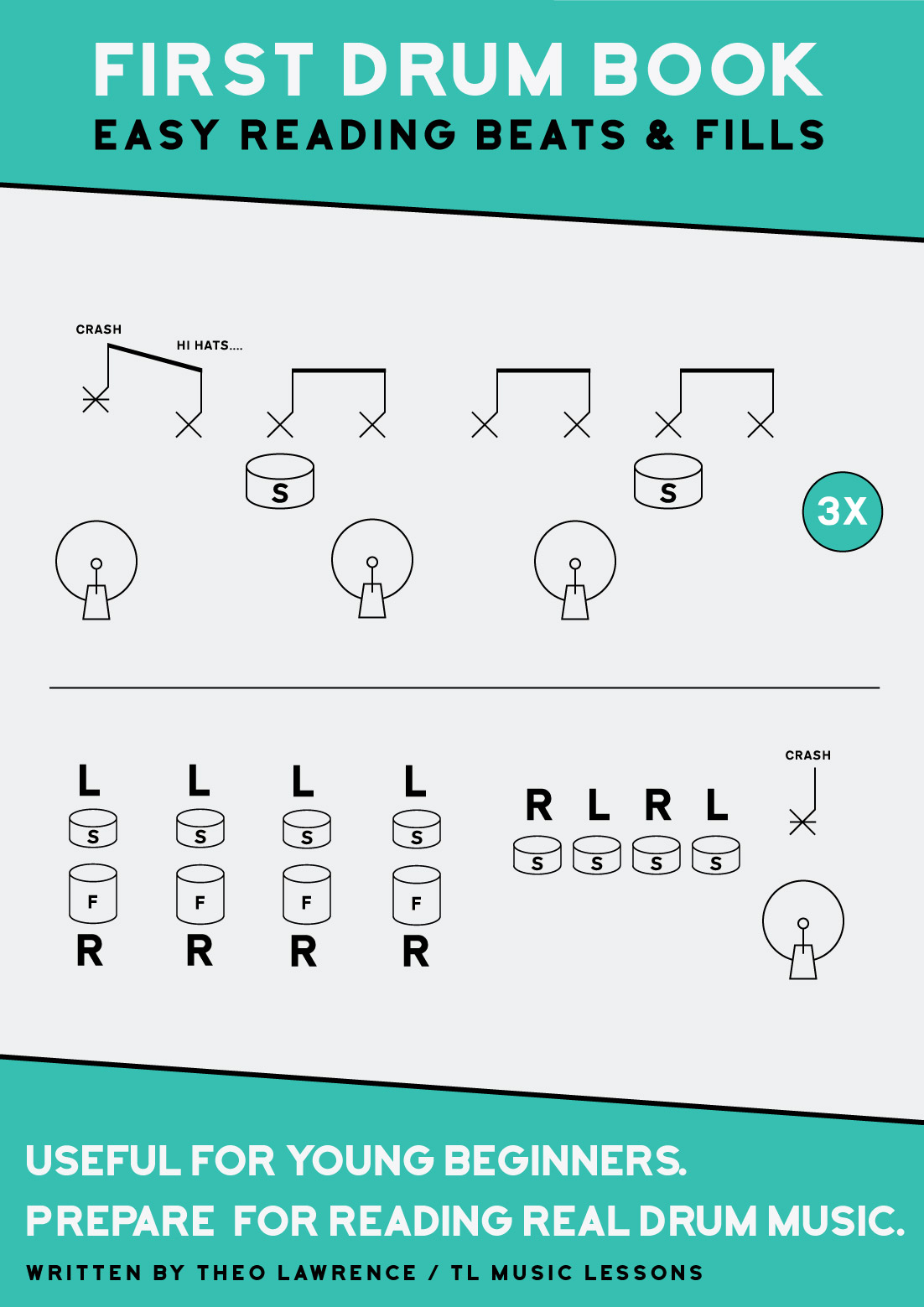
(Premium) – First Drum Book – Easy Reading Beats & Fills

Buy Now →

For a free preview of the ebook, click Buy Now and then click ‘Preview’ at the top left of the cover image.

  • 28 Pages
  • 20 Drum Lesson Exercise Sheets

Introduction

People that might find this book useful

  • All ages will be able to enjoy this book as the drumming content will be a challenge for any beginner.
  • Beginners at ages 5-11 should benefit the most from these sheets when starting out, as they take away a lot of the initial reading difficulties.
  • Drum teachers can print the book or single sheets for their students. They can be taught to beginners of any age and also to very young beginners that wouldn’t otherwise understand some of the standard drum notation – especially the drum fills.
  • Drummers can teach themselves to play the drums using the easy to read music

About the book

This ebook has been created after nearly 9 years of teaching the drums and after many of these years developing my own way of writing drum music for beginners so that they could focus on the drumming rather than getting stuck working out which drum to hit. I noticed this problem with almost all of my drum students of school ages from ages 5 to 11 especially (these are the ‘Primary School’ ages in the UK).

After planning to write this book over a year ago, I have been handwriting similar types of sheets and photocopying them for my students to test the water and see which exercises work best. It’s really quick to write out your own sheets and I do encourage writing out your own by hand if there is something that you want to either teach or remember for yourself to play, that doesn’t appear in this book. All you need to do is draw out the symbols as they appear in this book, just on a blank sheet of A4 with any type of pen (I like using a think pen like a permanent marker so it stands out).

Following on from honing the hand drawn drum exercises, they have been recreated using Adobe Illustrator to give them a clean look and so that they are easy to read and well presented as an ebook.

This ebook should get students familiar with how real drum music is laid out, because I have kept everything the same really. So, when moving on to trying to read real drum sheet music, it should start to make sense a lot quicker than usual. My next ebook to try after this might be Beats And Fills Drum Book – Basic Beginners because it covers most of the content again in a different way but this time with real drum sheet music notation.

You are freely welcome to print this ebook for personal use or for giving a copy to your students if you are a teacher, but please do not redistribute the .pdf file online.

Buy Now →

How To Read Dynamics in Music

Here is a list of dynamic markings you might encounter in drum sheet music. This list will be updated as more dynamic markings are thought of, and will start out as a basic list of fundamental dynamics notation.

  • pp (pianissimo = very soft/quiet)
  • p (piano = soft/quiet)
  • mp (mezzo piano = medium quiet / medium soft)
  • mf (mezzo forte = medium loud)
  • f (forte = loud)
  • ff (fortissimo = very loud)
  • a wide version of this shape: < (crescendo = gradually getting louder)
  • a wide version of this shape: > (diminuendo = gradually getting quieter)
  • > these arrows above the notes are accents, which indicate that you play loud on this note only.

(Premium) – 10 Snare Drum and Floor Tom Pieces – Book 1

Buy Now →

Summary

This book was written over the course of 1 year for a group of youth drummers (Montgomeryshire Youth Music Drumline) in Powys, Wales. I have compiled the year’s pieces into an ebook that can be used by other drum teacher, or by self taught drummers. The pieces are similar to Snare Drum Sheet Music style pieces, but with the added timbre of a floor tom. You can achieve quite an epic cinematic sound by combining the two drum voices in unison. Difficulty levels from Grade 1 to Grade 3-4.

People that might find this book useful

  • Drum groups, drum workshops and drum ensembles – Youth groups or adults
  • Drum teachers are completely free to print the book or single sheets for their students.
  • Drummers can teach themselves following on from a strong basic foundation in reading and playing
  • Drummers that need to perform for school or competition etc.
  • Drummers looking to improve their rhythms for drum fills and snare drum sheet music
  • Groups of drummers can perform together using a snare and floor tom each, or by using any other two drums

Rules for sharing this content

When you purchase the book, you will receive a .pdf file that you can keep and use forever.
You can email the .pdf file privately to your students
You can print out unlimited copies for your students or for yourself
You cannot resell the .pdf or distribute the .pdf file online in any way (not even for free). This also applies to exported images, photos or scanned copies of the book

About the book

The 10 pieces are performance pieces for drums, with no backing. Drum groups, or individual drummers can perform these pieces. They have been written to sound good as standalone pieces – they are not just practice exercises. The pieces do not focus on many dynamics, but they do cover many techniques, rhythms and some rudiments, from quarter notes to sextuplets and triplets, and from flams to drags and buzz rolls.

Some of the pieces have multiple parts, which may be played together. So, if your group has varying ability levels, some can play part 1, some part 2, and some part 3. Not all the pieces have 2 or 3 parts. Please check the contents page to match up the pieces. I have compiled the book in order of difficulty. The levels go from about grade 1 up to grade 3-4 level.

Reading Tip: I developed the writing over the year. For pieces with two stave lines – the top line is the snare and the bottom line is the floor tom.

Final Thoughts

This book is a follow on from “10 Snare Drum Pieces – Book 1”, written in 2015. That book was for snare drum only, and in the last 2 years has been purchased by 60 people from all around the world, many of which are teachers themselves who are using the book to teach their students or drum groups with.

I hope this new ebook will inspire more groups of this type. I’m sure it’s not the first time it’s been done with groups of drummers, each playing a snare and floor tom, but I do think it is very rare to see it. I hope to inspire other groups to adopt this idea. I’m sure this won’t be the first and last book of it’s kind, because I intend to continue teaching the MYM Drumline for many years to come, and I will be writing new pieces for the group regularly.

Recommended reading for use with this ebook:
Accent Techniques – Down, Tap, Up, Full Strokes
Reading Buzz Rolls And Double Stroke Markings

Buy Now →