30 essential productivity apps, business management tools and other apps or websites that help to run an online business and a local music teaching business

Here is a list of 30 essential productivity apps, business management tools and other apps or websites that help to run an online business and a local music teaching business.

The list here is what suits me and keeps me going as an individual business. There are other things I use but these are the main ones. These may not be suitable for everyone but they are all things that I happily recommend to others. Some are obvious, like the google products, but you might find a few that you haven’t heard of in the list.

Below the list is more information about how I use the things in the list to operate my businesses.

1. Google Calendar & synced to phone calendar (scheduling and also useful for setting reminders at specific times)
2. Google Docs / Spreadsheets (for creating invoices, records of who has paid, income spreadsheets). For offline and advanced database use, Libre Office Sheets and Calc are free and are just as good as Word and Excel imo.
3. Google Drive (access everything on the move; lesson plans, ebooks, records of who has paid invoices)
4. Google Keep (for saving photos or notes on the move)
5. Gmail (email)
6. Google Maps & Belkin Phone Holder (replaced sat nav)
7. Google Contacts (can group contacts into categories such as school names)
8. Remember The Milk (to do list, web and mobile app)
9. Mailchimp (mailing lists)
10. Payhip (for selling ebooks)
11. Paypal (payment processing)
12. Bandcamp (for audio downloads)
13. Ditto Music (digital distribution for music)
14. Sentric Music / Hit Licence (pitching music to tv / film etc)
15. BBC Weather Web / App (Try to dress for the weather)
16. WhatsApp (Reluctantly stay in close contact for certain projects)
17. Adsense (advertisement revenue)
18. Phone’s native clock, countdown timer and calculator
19. Heart Internet Web Hosting and Domains (to power the websites)
20. Drupal & WordPress (CMS for websites)
21. Spotify (always have access to songs that I need to teach)
22. DaTuna app (tune guitars using phone – android)
23. Justin Guitar metronome app
24. Abelton Live 9 (Suite) – Education Price (DAW for making music)
25. Dropbox or Wetransfer.com (sending / sharing large files)
26. Landr (Cheap and Easy Mastering Service)
27. Adobe Photoshop & Adobe Illustrator (for all artwork needs such as posters, music artwork, ebook covers, web banners etc.)
28. Adobe Acrobat Pro (for creating ebooks from single pdf files)
29. Guitar Pro (for creating lesson plans and sheet music for ebooks)
30. Quickbooks Self Employed (Used for Invoicing students’ parents every half term and for forwarding email receipts to record them in Quickbooks. It is basic, but it suits my needs.)


I do most of my work from a desktop computer. It’s pretty old school I know but actually I like sitting down at the desk and getting immersed and then being able to walk away and leave it, rather than have the temptation of trying to work on the sofa (I know some people that prefer the sofa though!). I keep my mobile contract slim and use a cheap to mid range phone, which is a smart phone, but it doesn’t cost loads.

My bookkeeping, teaching schedules, invoices, paid lists, have all been done using my own system of documents and spreadsheets that are quite refined and easy to use for my business now. I have recently moved onto Quickbooks Self Employed for invoices, which has made writing and sending them easier. My process to record payments for school lessons used to be to input it into a spreadsheet, then copy and paste into a ‘paid’ documents file for each given half term and school, and delete the pupil’s name that has been paid for. I would then check who still needs to pay. My invoices use a template I made and I had a copy of that in the same folder as the paid file for each half term and school name. The invoices always include payment info and at the top of that list is bank transfer details because that form of payment has the least admin for me. I then export that as a pdf file and email the parents at the start of a half term. Mostly I have to make different ones for each half term and ammend for different pupils if they have missed lessons or have not paid for a half term.

I also have a spreadsheet of all of my pupils in each school and their instrument and time details, and rows of checkboxes so I can print them off and use them as a rota for the half term. In high schools the rotas need to have time slots added to the rota. For primary schools, they are too hectic and unpredictable to make rigid timetables for, so I don’t bother. At the start of a new half term, I will copy over all the files from the previous half term and begin editing them for the next one. Usually the amount of weeks per half term changes so there is always something to change. I leave an extra list of pupils per school in the paid files so that I can copy them into a fresh ‘unpaid’ area below, and then I can delete them off as they pay.

I keep an up to date copy of parents’ email addresses in Google contacts and group them into different schools and also give them instrument tags incase I need to email all of the guitarists for something at once. I always try to email the parents using the bcc send field, and this is easy on a computer with a mouse because you can select all the contacts from google contacts, and click to send email, then drag all the addresses into the bcc field. I also have a mailchimp list but it’s not easy to keep that updated as well so I tend not to use it. I do for my website subscribers though.

For my websites www.learndrumsforfree.com and www.learnguitarforfree.com most of the files are hosted on the websites. I learned how to make websites before starting to teach, which has really given me the tools to build an online business too. I learned html and css using an O’Reilly book and the rest followed from there. Actually it all started from the coding features on myspace when bands could change the styles on their pages and adding in banners etc. My sister does web design and artwork in the music industry and she said that probably started her off too, or gave her the coding bug. I use dreamweaver to edit code because the colours are useful, but other free ones are available, and filezilla for ftp file transferring.

I use payhip for all of my pdf ebooks, which is the best I have found. It links to paypal for payments and it has just added a feature to automatically add customers to mailchimp lists. People that download free ebooks are added to my regular subscriber list for upadtes of free blog posts, and paying customers are added to a special list, which I send info of new ebook products to when they are released. Bandcamp is used in a similar way for audio and music, although their mailing list integration is not as good so I can’t really use that effectively at the moment unless I set up more accounts and then export email addresses to the appropriate subscriber lists.

I have found that social media is pretty much a waste of time for my online business at the moment but the mailing list is great, and actually pinterest generates the most hits, so I do chose to get rid of all but the pinterest. It’s all about finding what works for your business and choosing the right platforms to get the most out of your time and effort.

I get many hits per day on both sites quite often and almost all the traffic is organic from search engines. It’s taken years to build up so it really is a lot of hard work but adding to it “little and often” really helps build up a huge site over time. Most of my ebook sales follow searching for free stuff from organic google searches and then discovering the ebooks. I believe this is called a “fremium” business model. When I launch a new ebook and send it to my paying customers mailing list, I usually get quite a few sales from them, so that is really useful for me and them.

Hopefully this gives gives you ideas for your own online business. I tried in the past setting up my own ubercart shopping cart and hosting everything myself, but I had to switch to payhip due to new EU tax rules on digital products. It was too hard to manage myself but payhip and bandcamp both sort sll this out for you. For every ebook sale, payhip takes off the tax, which is different depending on each country, from the money I receive, so they literally take care of everything without me needing to register to pay tax in every country. It completely took the hassle away from thiose new laws.

I also make music and play in a band so I have an unlimited ditto music subscription to release to spotify and itunes etc. whilst bandcamp is the best, not all customers are used to that so you kind of have to make things available where the customers are.

Guitar Pro is the best in my opinion! I’ve tried Sibelius but that’s probably only better for orchestral stuff. Guitar Pro is amazing for most instrumentsl sheet music writing, including guitar, drums, ukulele, bass and even instruments such as flute and piano. I always use it for all of my sheet music. I even use it to export midi to Abelton sometimes, rather than using the piano roll to input midi.

Abelton has been great for making music from midi, recording my own music, making backing tracks, and for teaching other music production. The education price helped me to buy it. Landr is a quick, easy and cheap way to finish off tracks so they are ready to release. The mastering is pretty good. I subscribe for a month and then cancel it when I am done.

All of the chaos that is my schedule is fairly organised with Remember The Milk and Google Calendar. Both can set tasks and appointments to repeat weekly or as often as needed, which is really useful. I use both services on the desktop and synced to my phone. My email is also really important for my business. I sometimes send emails to myself with important TO DO list items for that day, so I can’t possibly miss them.


Related: 10 tips and advice for running your own drum teaching business

Computer Games Music – PDF Ebook – Drum Sheet Music [includes Drum Loops Pack]

Get The Free Download (Audio & Sheet Music) from Bandcamp →

Also available for Guitar, Bass, and Ukulele

Full drum sheet music for 9 computer music songs transcribed from the MIDI drum loops used on the album ‘Computer Games Music’ by TL Music Lessons.

Also includes drum loops MIDI and Audio pack.

Audio on Spotify

About the Sheet Music

The drum sheet music has a wide range of ability levels from complete beginner (Canon in C), right up to grade 8 with some complicated syncopation at high speeds. All of the drum loops were created specifically for these songs, by me, a drummer! Hence, I tried to make the majority of the beats playable by a real drummer. I was able to transcribe and transpose most of the beats without altering them, but there were some that would need extra hands, such as the hand claps and clave polyrhythms, so these have been left out or modified where I thought appropriate.

I think this book would be usefuly for anyone wanting to enjoy playing drums along to music whilst reading drum sheet music at the same time. Whilst I can transcribe known songs, this was fun for me to do and release to you, without having to worry about copyright issues.

These could potentially be used as performance pieces in schools, or maybe even exams as a free choice piece if you ask an exam board. Feel completely free to use the audio as a backing track by downloading it from itunes or bandcamp etc and usin it to play along with.

Music makers and music producers can feel free to use the drum loops audio and midi as they wish. You may freely use them in your own compositions. School pupils may also use the drum loops pack as they wish for school projects or coursework – just ask your teacher if this is ok and within any guidelines.

About The Music

Last year I made an album of 10 songs to teach with, and created 6 ebooks for the instrument parts. This year, I made an album of 11 songs called ‘Computer Game Music’.

This year I exported the MIDI files from 8 of those songs, plus 3 new ones, and began adding synths to the MIDI in my music production software Abelton Live 9 to create music that I think would sound good in computer games. I found it quite easy, quick and enjoyable to do when I initially messed about with one of the songs for fun. I then decided to start the project, which only took about a month of spare time to create the new album of songs. I also added drums and bass guitar to the tracks to finish them off.

The drums were created by me in Abelton using the MIDI piano roll and a drum rack. I really enjoyed this! I then transcribed the drum loops into actual drum sheet music for people to learn to play along with the music if they wanted to.

The drum sheet music has a wide range of ability levels from complete beginner (Canon in C), right up to grade 8 with some complicated syncopation at high speeds. All of the drum loops were created specifically for these songs. I tried to make the majority of the beats playable by a real drummer. I was able to transcribe and transpose most of the beats without altering them, but there were some that would need extra hands, such as the hand claps and clave polyrhythms, so these have been left out or modified where I thought appropriate.

Music makers and music producers can feel free to use the drum loops audio and midi as they wish. You may freely use them in your own compositions. School pupils may also use the drum loops pack as they wish for school projects or coursework, if this is within the guidelines of the work.

I hope that the songs can be used by a range of abilities. I would say most or all ability levels would find challenges throughout the album, depending on which instrument you look at. They are all quite challenging in places.

I hope that the songs can be used by more advanced players. Initially the previous album of music was created for grades 1-3 (guitar and ukulele only), but now for this new one, I would say most or all ability levels would find challenges throughout the album, depending on which instrument you look at. They are all quite challenging in places.
I also hope that the songs can be used as backing tracks for performances, for example in schools, and possibly as part of marked school performances or maybe even as free choice pieces in grade exams.

I also hope that my students will enjoy listening to the album after getting to know the songs in their different style.

Whilst the songs have not been created for any particular computer game, I will try to get some of the music featured in actual games. I think they would work well with platform and retro type games.

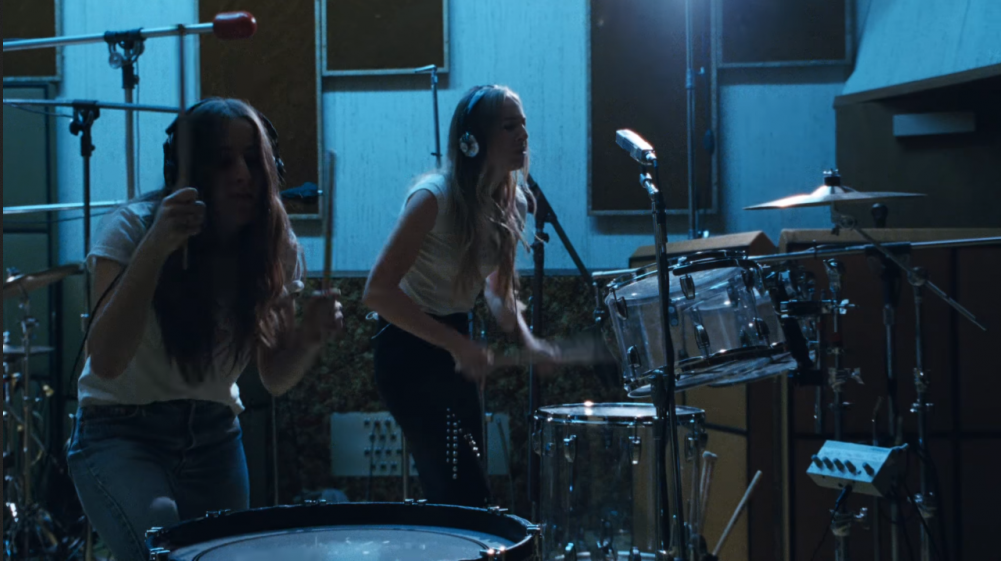
HAIM uses Bass Drum, Toms and Rims to interesting effect in this supurb live music video

The drums in this video are towards the end of the song, but if you have time, watch it from the start because the drums have more effect when you’ve got into the song.

When you hear layered drums on recordings, this is a visual representation of how these types of sounds are acheived. What you see in the video is the actual audio you hear too, much to my suprise and delight because so many other music videos are usually mimed to a studio recorded song. After tentatively reading the comments for the video, it appears to be general consensus that this ‘live version’ is better than their other studio recorded version (later released), which to me is a reference to live music being the winner over studio production.

So, enjoy this video, in all it’s glory, of a truely live recording executed supurbly.

WATCH:

(Premium) – Drum Book PDF – 10 drum solo performance pieces grade 1-3

Buy Now →

Audio Examples


download the audio examples for free here

Contents

10 Drum Solo Performance Pieces Grade 1-3

Pages

2. Contents
3. Introduction
4. Grade 1 Drum Solo 1
5. Grade 1 Drum Solo 2
6. Grade 1 Drum Solo 3
7. Grade 2 Drum Solo 1
8. Grade 2 Drum Solo 2
9. Grade 2 Drum Solo 3
10. Grade 3 Drum Solo 1
11. Grade 3 Drum Solo 2
12. Grade 3 Drum Solo 3
13. Grade 3 Drum Solo 4

This 1st Edition ebook was published in 2017 by Theo Lawrence / TL Music Lessons.
Front Cover Artwork Template by RogueSkins. Modified by Theo Lawrence.
Front cover illustration by Rich Orr.

People that might find this book useful

  • Drum teachers can print the book or single sheets for their students
  • Drummers can teach themselves following on from a strong basic foundation in reading and playing
  • Drummers that need to perform for school or competition etc.
  • Building ideas for you own drum solos

Contents Highlights

The 10 pieces are performance pieces for drums, with no backing. They have elements of actual drum solos that you would perhaps find at grade 1-3, but they are extended to be about 1 minute each, so there is more of a mixture of grooves and beats too so that they can be performed without backing instruments and still be interesting.

About the book

The book is split into 3 pieces for each grade, with an extra one for the grade 3 level.

At the moment I teach a lot of primary school students. All of my school teaching is primary, and then I have some older students in the evenings. Some of the primary school students have completed the other books I have written so far at this level, and are ready for a new challenge, so I have prepared this for them. It will be ideal for some of them to perform at their school concerts, as it would for others around the world that download this.

This book will definitely provide new challenges to those that have only followed the first few drum books, because there is much more focus on drum fills. The other books were about 70% beats and 30% fills. This one is about 70% fills and non regular groove playing bits.

Final Thoughts

I really hope this ebook gives young players and novice older players the confidence to perform drum solos. I hope it gives them ideas for making their own solos too. Being good at any instrument is all about the confidence in knowing you can do something. I also hope that the focus on drum fills and drum solos in this ebook will help drummers in their Rockschool exams (other exam boards are available!), when they need to ‘develop’ or ‘cont. sim.’ or ‘drum solo’. I’ve seen drummers shut down at the sight of these things, and it’s vital to break through that. Good luck!

– Theo Lawrence / TL Music Lessons

Buy Now →

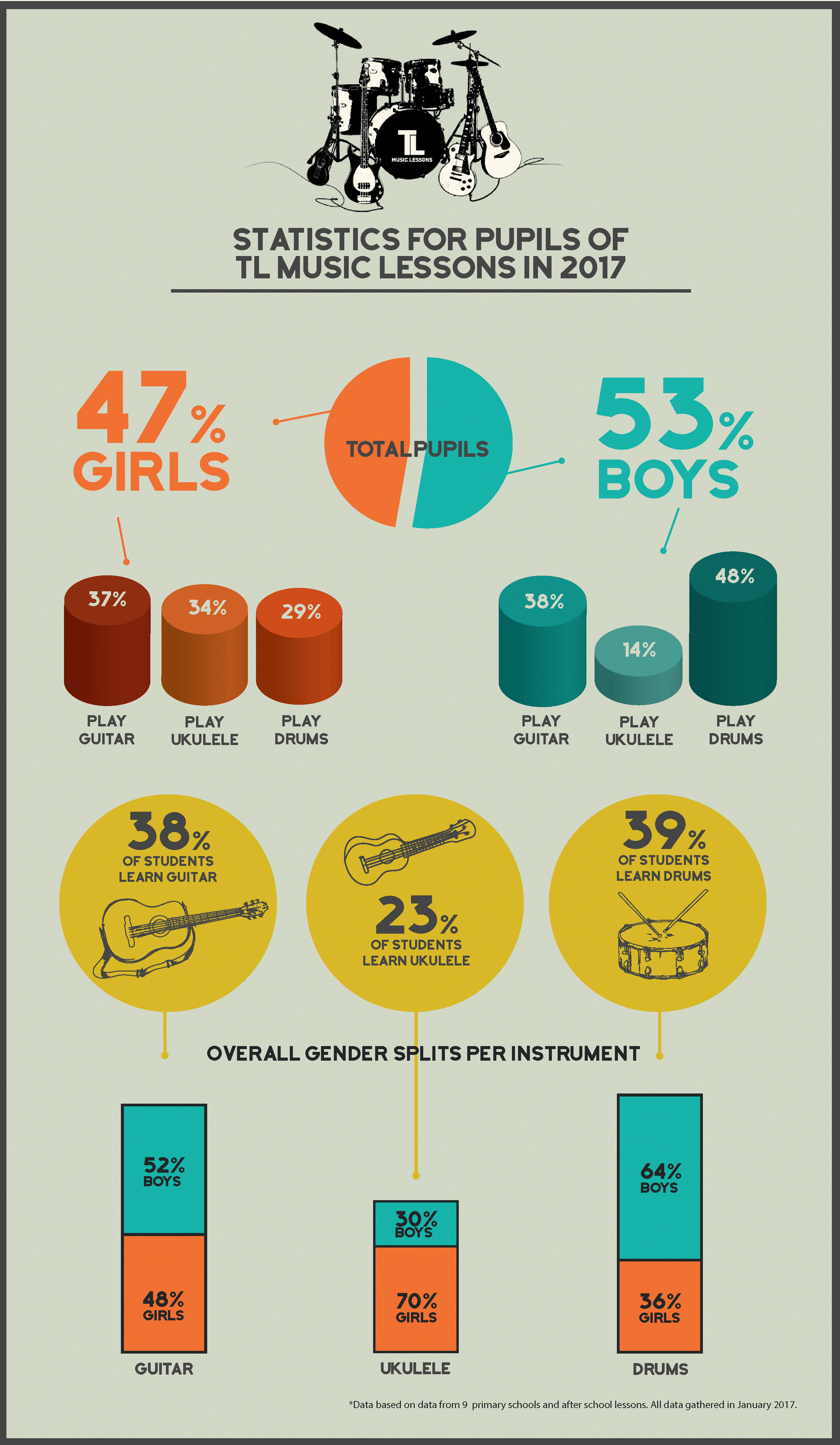
INFOGRAPHIC – Girls vs Boys stats for Guitar, Ukulele, Drums – TL Music Lessons 2017

Make of it what you will and feel free to use this for your own research projects. These are reals stats from all of my students, most of which are of primary school age, and some are high school and adult ages.

The stats are an open look at how many girls and boys tend to learn guitar, drums and ukulele. The aim of these stats really is to show that the numbers are either fairly equal, or not too far apart, despite the apparent unequal representation in the music industry.

8 beginners Jazz worksheets including bass drum and snare triplet patterns for comping ideas – FREE PDF

Get Free PDF Download →

There are 8 PDF files here with sheet music including Jazz drum beats. I thought rather than posting them seperately, I would rather group them all as one resource. They were created in 2010 near to when I started teaching and I used sibelius to make them.

Two of the sheets focus on the left foot hi hat and right hand cymbal ostinati.

Two of the sheets focus on only the left hand triplet based patterns used for comping.

Two of the sheets focus on the left hand snare drum and right foot bass drum, used for comping.

Two of the sheets (Full Jazz Grooves) bring it all together for 4 way coordination.

Get Free PDF Download →

Page 21 from ‘Grades 1-2 Beats & Fills Drum Book – Rock Pop Soul Funk’

Here is a free PDF of page 21 from the drum book ‘Grades 1-2 Beats & Fills Drum Book – Unit 1 – Rock Pop Soul Funk’.

The sheet music drum exercises are 2 bar loops containing drum beats with open hi hats that could fit into the styles of rock, pop, soul or funk, in a 6/8 time signature.

Once you are comfortable reading the drum beats in their repeating loops, try memorising the loop and continuing without reading it.

When teaching pupils that can cope with it, I also sometimes ask them to put emphasis on beats 1 and 4 to give it a blues feel.

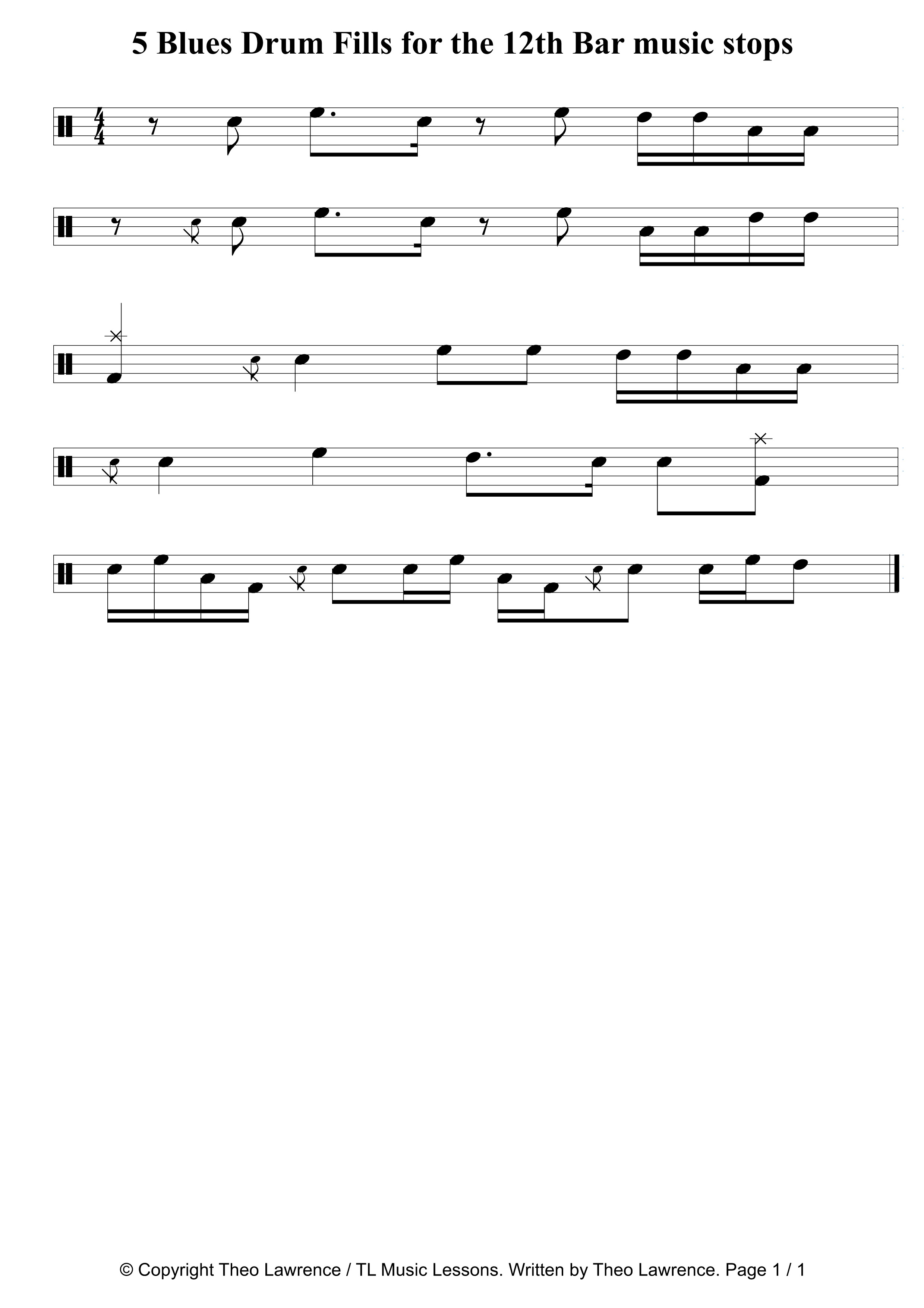
5 Blues Drum Fills for the 12th Bar music stops

These are some quick drum fills we came up in a lesson with for use with ‘Mean Jumper Blues’ (Grade 2 Trinity Rock & Pop). There is one bar that asks you to make up a drum fill, which is at the end of a blue progression. Often the music stops on the 12th bar and this is where the drummer can put in a fill before repeating around the 12 bar groove.

Just a note on this, Grade 2 Trinity Rock & Pop has strong elements of Grade 3 Rockschool. It is a blend of Grade 2 and 3 really. The fills on this sheet could also be heard in Rockschool Grade 3 level, especially the final drum fill on the last line.

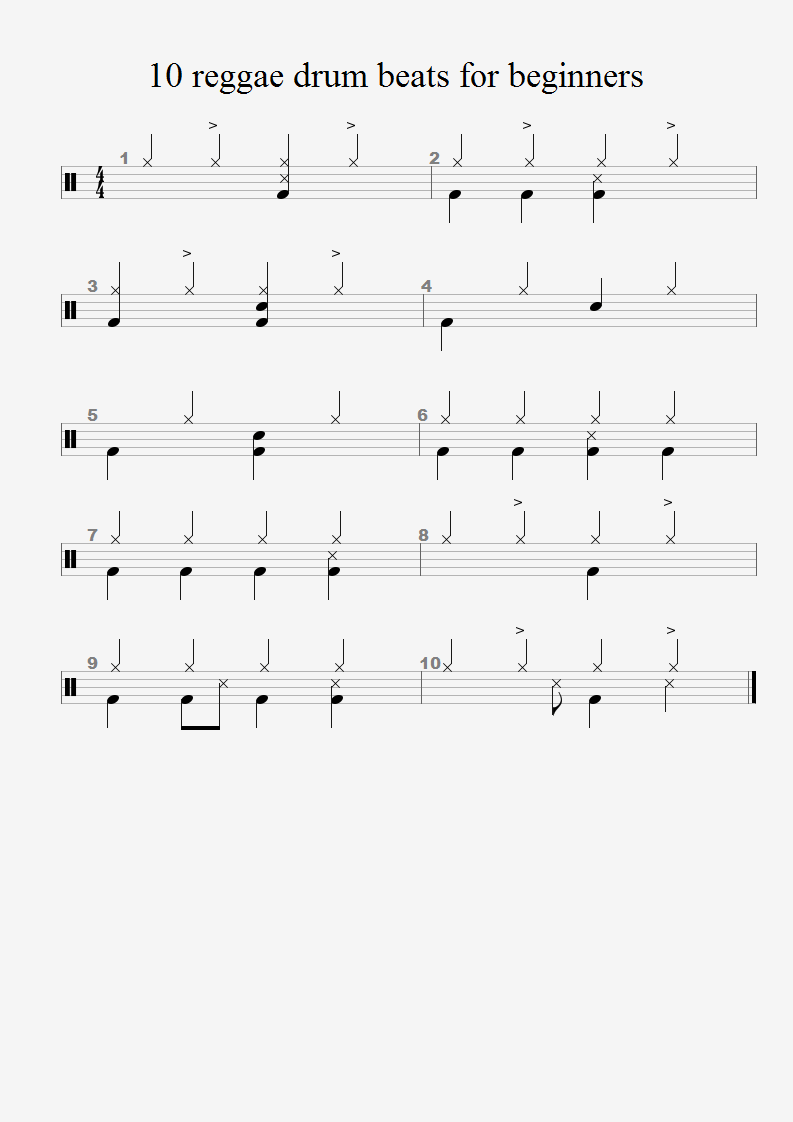
10 Reggae Drum Beats for Beginners

These drum beats are for any ability, even complete beginner. I would however recommend learning pop and rock first. For example: 10 Basic Rock Drum Beats.

Reggae beats often have an emphasis on beat 3 of the bar. Usually this is from the bass drum or bass drum and cross stick snare. Accents are often used on the hi hats to play louder on beat 2 and 4. In more advanced reggae hi hat work, they adopt a swing feel similar to blues, jazz or country. The cross stick snare is used instead of the full snare sometimes or much of the time if the song is fairly laid back and chilled, which it usually is with reggae! Normal snare hits, or hitting the snare head and rim simultaneously are used in reggae drum fills. You can see some reggae fills in the video below.

(Premium) – Grade 3-4 Drum Book with 17 Drum Lesson Sheets

Buy Now →

People that might find this book useful

– Drum teachers can print the book or single sheets for their students.
– Drummers can teach themselves following on from a strong basic foundation in reading and playing

Contents Highlights

Subdivisions, Counting Methods, Drum Fills, Skip Beats, 16th Note Hi Hat Accents, Double Kick Drum.

Full Contents

4 – Subdivision drum solo / warm up exercise
5 – 16th note counting exercises
6 – Snare drum piece with counting exercise
7 – Short fills to start a song or sections of music
8 – Bass drum skip beats
9 – Snare drum skip beats
10 – 10 rock drum beats with 16th note bass drum combinations
11 – Snare and bass drum skip beat practice beats – with open hi hats
12 – Snare and floor tom piece with sextuplets
13 – Grooves and fills piece in 6/8
14 – 10 drum fills with 6 stroke rolls
15 – 6 drum beats and drum fills exercises
16 – 10 snare drum accent exercises
17 – Part 1 – 9 drum grooves with 16th note hi hat accents
18 – Part 2 – 9 drum grooves with 16th note hi hat accents
19 – 8 beginners double kick drum beats
20 – Intermediate double kick drum beats

About the book

This ebook is a Grade 4 level compilation of 8 years of preparation work for teaching drums. It consists of drum lesson sheets that I have prepared and revised many times to be the best they can be for teaching with. To create the book I selected only the best sheets from my selection of drum sheet music lesson handouts. I printed them all out on my office floor and arranged them into a coherent order.

I have included only the sheets, rather than add lots of teaching text. This is partly to limit the amount of pages printing, and also to give teachers using the books freedom to put their own take on the lesson sheets. This will probably make it harder for self taught players, so to anyone getting stuck reading the book I would recommend building up their reading and counting knowledge online. The 16th note counting exercises on page 5 and 6 should help, and can be used when playing skip beats to help with reading and playing them.

Reading skills are really important if you are teaching yourself with this book. Further to counting 16ths like on page 5 and 6 to snare drum rhythms, you can also use them in drum beats. It’s really helpful when you learn how to do it. To give an example of counting 16ths in beats; on Page 8, Bass Drum Skip Beats, on the first bar you could count “1 & 2 & a 3 & 4 &” to help with the timing. The second bar would be counted “1 & 2 e & a 3 & 4 &”. The kick drum skips are therefore on the ‘a’ after beat 2 on the first bar, and on the second bar the skip beat kicks are on both the ‘e’ and ‘a’ after beat 2. This probably sounds complicated if you’ve never done this before. It’s how many teachers explain note placements, and it’s still how I count new beats that need working out or extra practice.

Final Thoughts

This ebook covers many of the Grade 4 elements, but it’s by no means all-encompassing. There are other ebooks that I have made for Grade 3-4 and I’m sure there will be more. This book is a leap on from “Grades 1-2 Beats & Fills Drum Book”, but there will be a Grade 3-4 beats and fills ebook soon. This book can also be used either side of these ebooks I have already created in the Grade 3-4 level: “10 Pages Of Accent Exercises With 16th Notes” and “90 Intermediate Drum Beats Focusing On The Bass Drum”.

Theo Lawrence / TL Music Lessons

Buy Now →