Drum Warm Up Exercises for Advanced Beginners – Sheet 1

Advanced beginners drum warm up exercises for use in drum lessons, or for starting a practice or learning sessions.

Advanced beginners drum warm up exercises for use in drum lessons, or for starting a practice or learning sessions.

This is the first sheet in a collection of drum warm up exercises that will be made into a pdf ebook. You can use and print the main image on this website for educational use, or you also have the option of purchasing a PDF copy of Drum Warm Up Exercises for Advanced Beginners – Sheet 1.

In the sheet there is a snare drum rhythm exercise that has be made to sound good when repeated. Drummers should aim to increase the speed once comfortable with the rhythms. Likewise for the other exercises too. Start off slow and build up confidence and ability before going fast.

The flams exercise should be played by playing R L R L on all 8th notes, which is why one of the flams is played with the left hand playing the louder part of the flam, because it’s on one of the off-beat 8th notes. The second bar could be played R L R L or the 8th notes could be changed into paradiddles, meaning the second flam would be played with the left hand on the stronger note. Left handers will need to do the opposite to all of this.

The swing beat could easily be made harder but this could be the first time some drummers have been introduced to it so I’ve kept it fairly simple. The 8th notes are to be played with swing on the ride cymbals. If you don’ know what that means, have a listen to The Pink Panther theme tune and listen to the ride cymbals.
View Sheet 2 →

50 Beginners Drum Beats

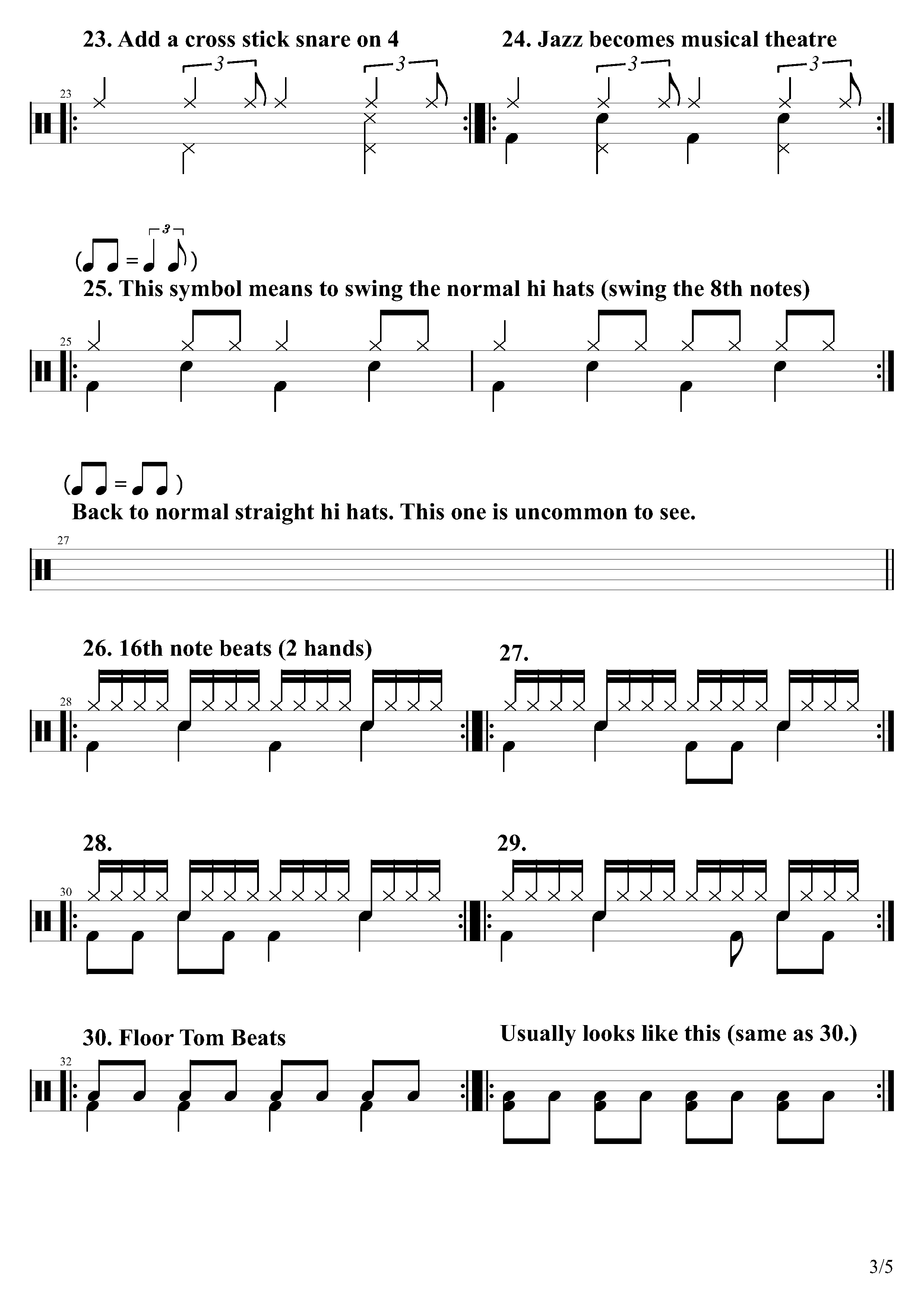
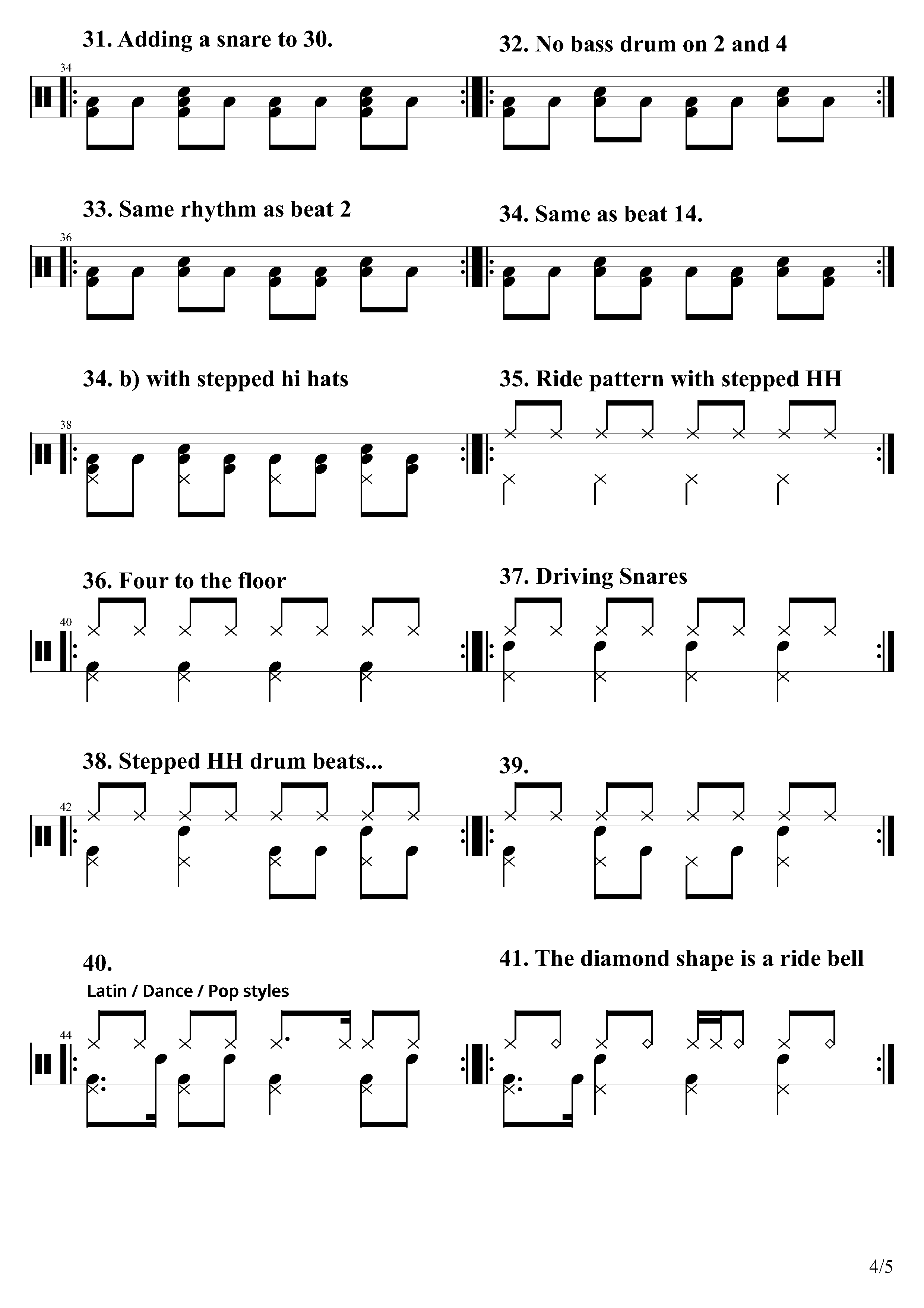
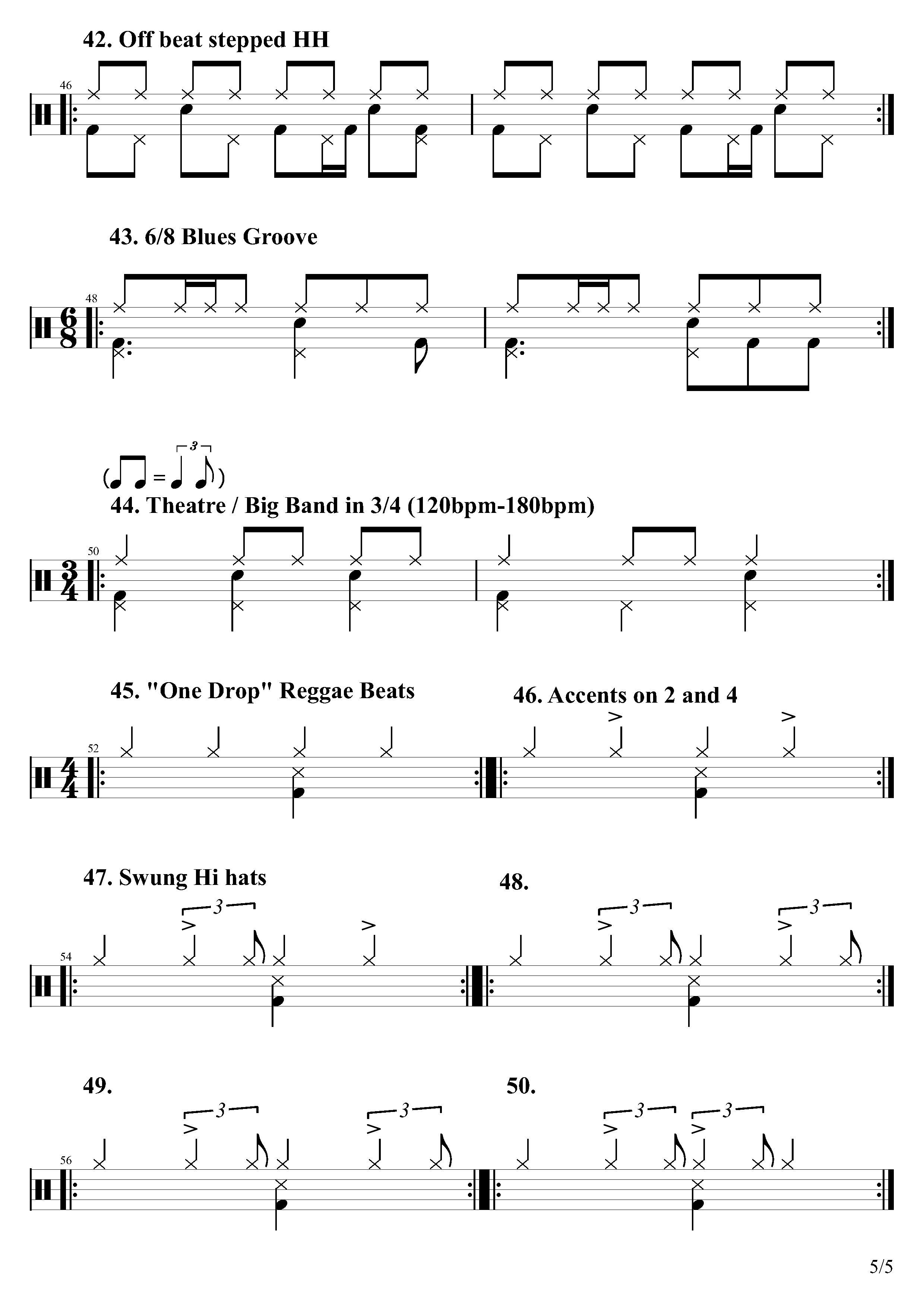
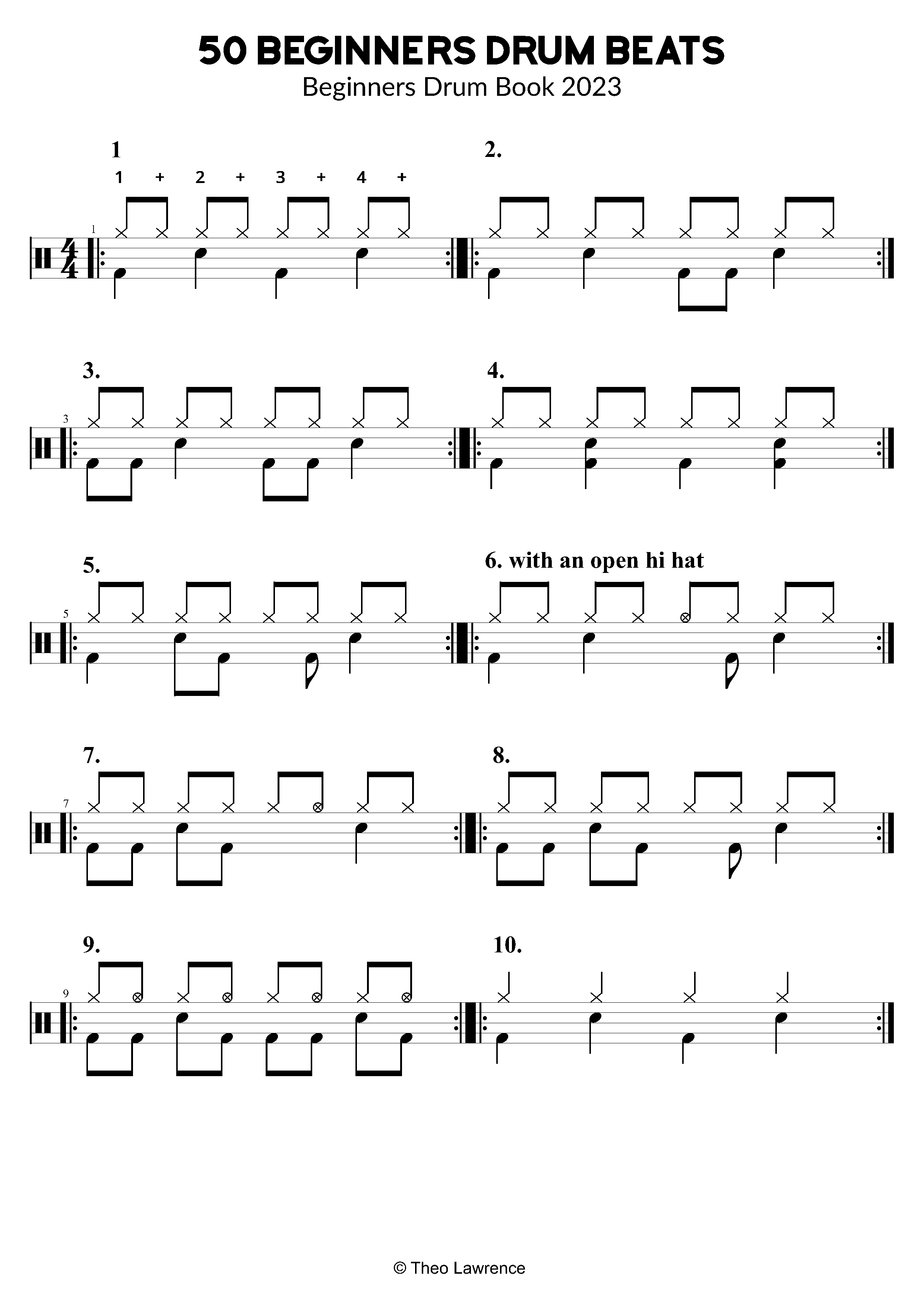
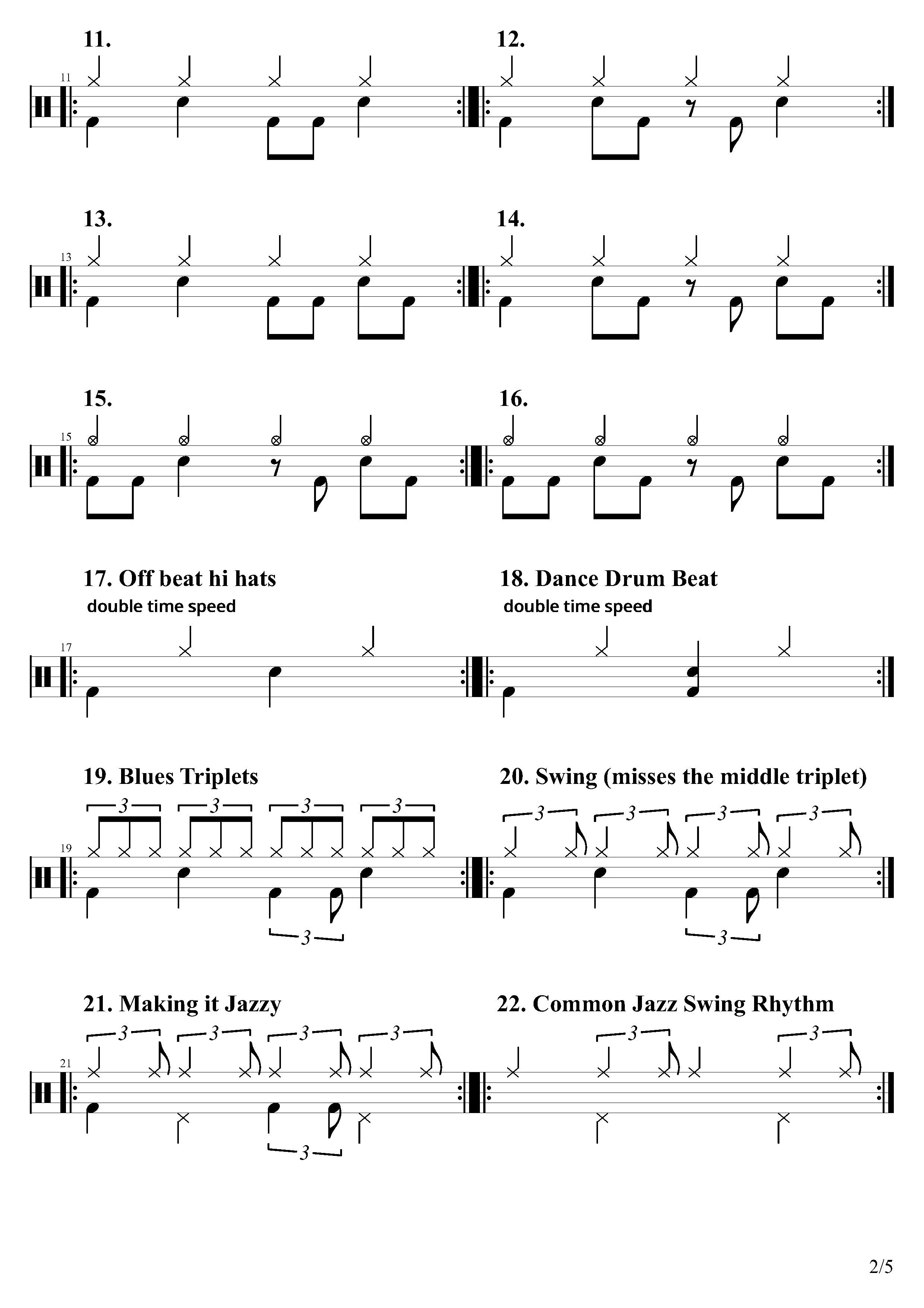
This collection of 50 beginners drum beats features in my ebook Beginners Drum Book 2023. I am planning to update this book at some point so the 50 beats may change or become more than 50, but if I do create a newer version, the 2023 version will still be included as a pdf ebook. We start off fairly easy and by beat 21 the beats do get quite hard, learning Jazz beats with 4 way co-ordination. This selection of 50 beats can be learned as one topic, or it can be something to dip in and out of. Here are all of the sheets with all 50 beats, but if you would like the printable pdf, then you will need to purchase that here.


drum notation containing beginners drum beats
Drum Beat Exercises 11-22

drum notation containing beginners drum beats
Drum Beat Exercises 23-30

drum notation containing beginners drum beats
Drum Beat Exercises 31-41

drum notation containing beginners drum beats
Drum Beat Exercises 42-50


Musical Theatre Drum Beats and fills – Sheet 5 – 40 Beats and Fills Book 2

PDF Ebook Buy Now →

Next Page: Sheet 6 →

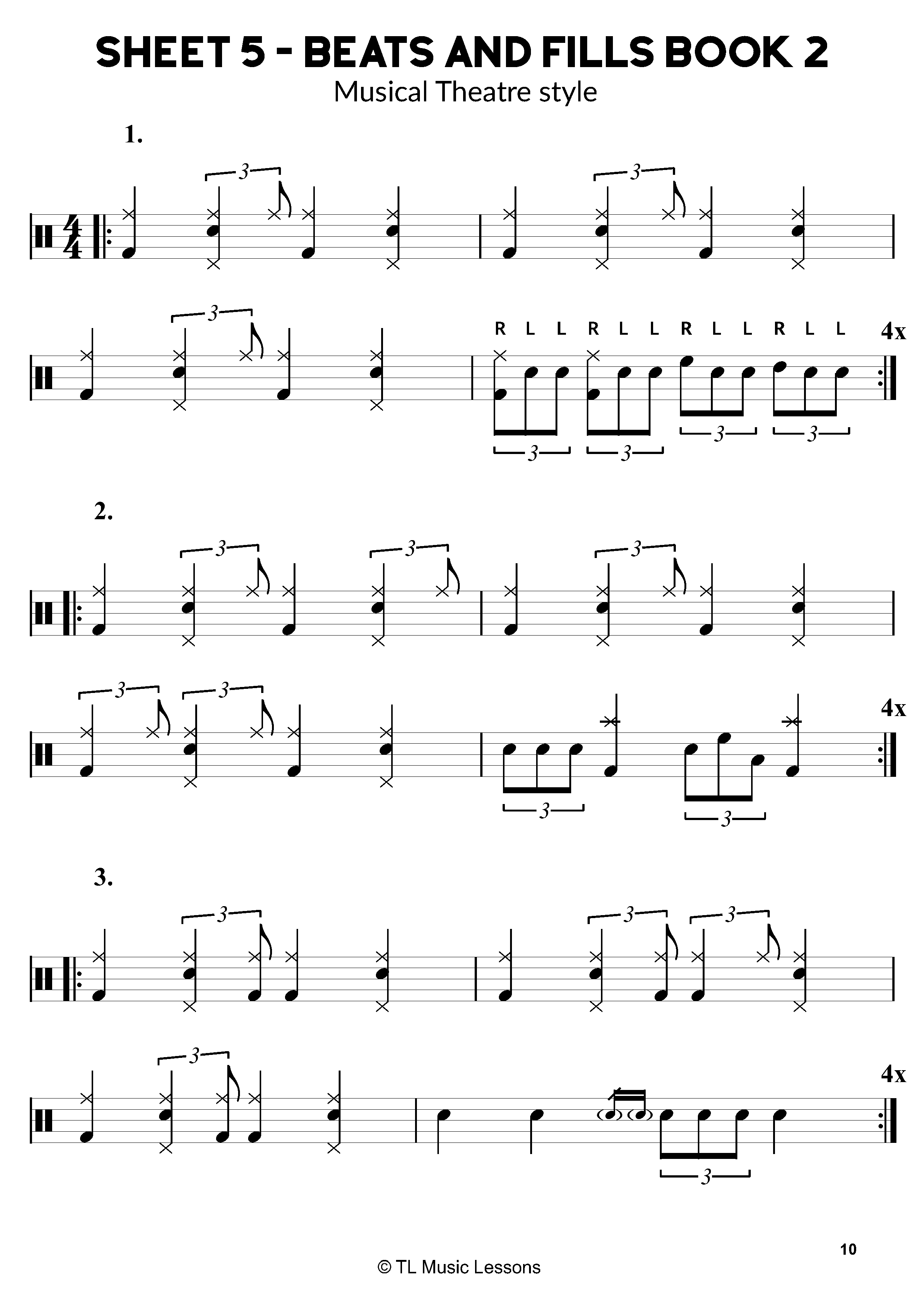
Here is Exercise Sheet 5 from 40 Beats and Fills Exercises Book 2.

Musical Theatre drumming generally has elements of swing, jazz, big band, blues, pop and rock. Unlike jazz music – which also has the swung hi hats – there is often a prominant snare on beats 2 and 4. Sometimes the time signature changes to 3/4, 2/4 and 6/8. Much of theatre style drumming is played with swing and therefore we use many fills with triplets, because they fit in with the swing rhythm easily.

The drum beats on Exercise 3 are similar to those grand finale type songs where they are a slow to medium speed. For this, perhaps you can imagine the cliché stage show of linked arms and kicking out of the legs together in time with the music (the snare on beats 2 and 4).

Video Demonstration for Sheet 5


Watch on YouTube

In Depth Drag Technique Video Demonstration

We also look in depth on the drag technique in the video during the Exercise 3 drum fill. The video shows the correct technique for performing the bounced drag, including how to hold the stick and how to control the bounces by using varying amounts of pressure to acheive the desired bounce frequency and length.

You can download the pdf for this page by buying the book or downloading the free preview on the product page.

There are more free pages like this one, use the the navigation below to view them.

← Go back to Sheet 4
Go forward to Sheet 6 →
Buy the full PDF ebook →

Drum beats and drum fills in different time signatures – Sheet 4 – 40 Beats and Fills Book 2

PDF Ebook Buy Now →

Next Page: Sheet 5 →

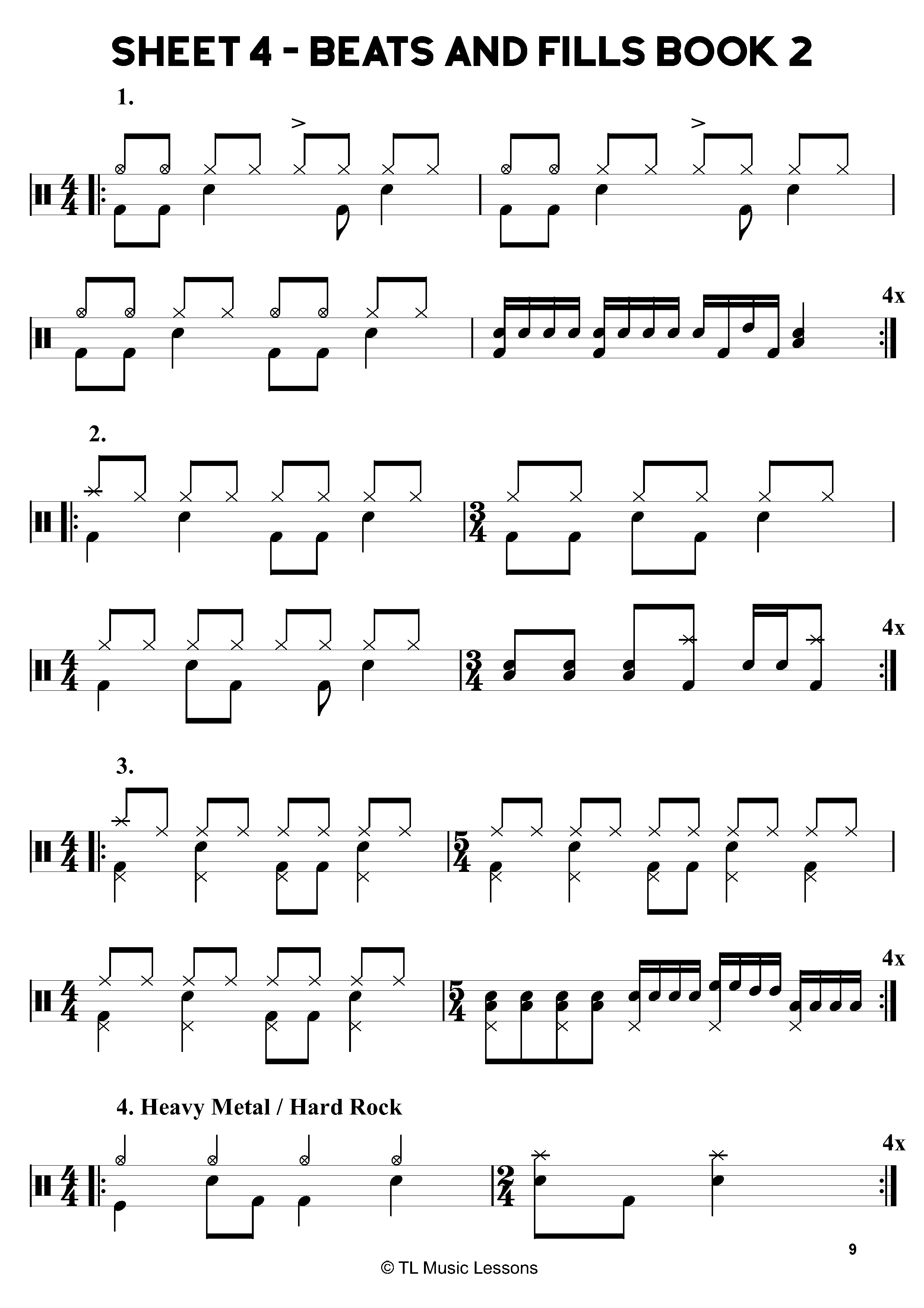
Here is Exercise Sheet 4 from 40 Beats and Fills Exercises Book 2.

The drum beats and drum fills are played in different time signatures (3/4, 5/4 and 2/4), as well as changing to and from the usual 4/4 bar length.

Time Signature Changes: “Do not panic – they’re quite easy”, as I say in the video!

The time signatures are not too hard And sometimes you don’t even need to worry about counting them. There are situations where you might need to count them and they might be harder depending on what is contained in the bars, but thes have been written for newcomers to time signatures in mind, so there are no real suprises – it’s meant to be a straightforward introduction.

On exercise 3, I have taken away the stepped hi hat so it’s 3 way coordination. The stepped hi hat is included on exercise 3 with the 5/4 bar, so there’s an added challenge there.

Video Demonstration

You can download the pdf for this page by buying the book or downloading the free preview on the product page.

There are more free pages like this one, use the the navigation below to view them.

← Go back to Sheet 3
Go forward to Sheet 5 →
Buy the full PDF ebook →

Drum Beats and Drum Fills in 6/8 time signature – Sheet 3 Inside the book

PDF Ebook Buy Now →

Next Page: Sheet 4 →

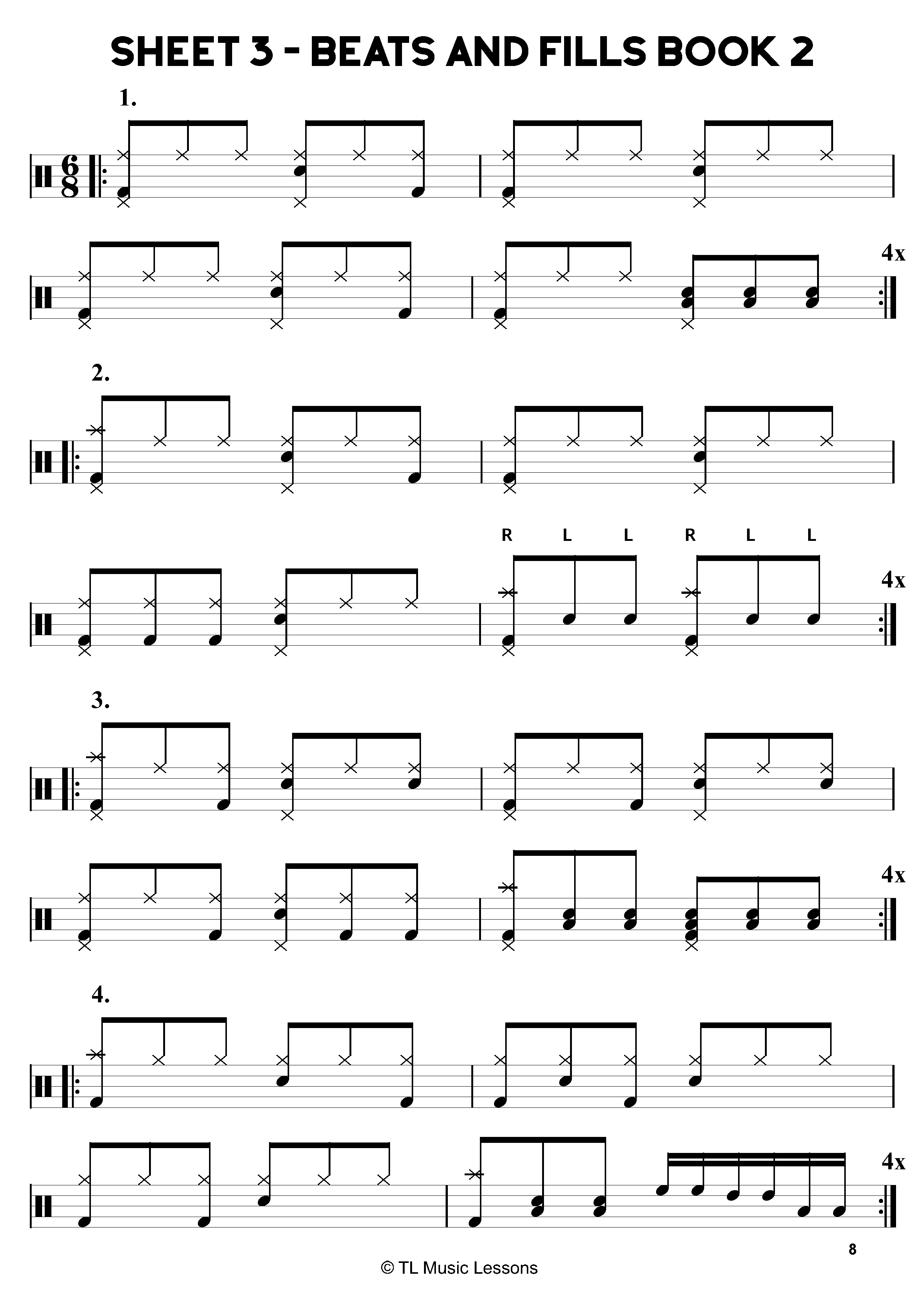
Here is Exercise Sheet 3 from 40 Beats and Fills Exercises Book 2.

The drum beats and drum fills are all in a 6/8 time signature. We will be putting emphasis on the beats 1 and 4 of the bar, which is standard for 6/8 drum beats. The counting should be 1 2 3 4 5 6 for 8th notes, and for 16th notes, you could count 1 + 2 + 3 + 4 + 5 + 6 +. This is unlike 4/4, where the 1 2 3 4 is counting the quarter notes, rather than the 8th notes.

We are playing in a blues style in this sheet, although you could also hear these beats in other styles such as Pop, Jazz and Musical Theatre.

Video Demonstration

As you can see in the video, some of the exercises are quite fun when played quickly. Do start slowly and correctly though, because those fills could sound messy if they are not played with accuracy.

You can download the pdf for this page by buying the book or downloading the free preview on the product page.

There are more free pages like this one, use the the navigation below to view them.

← Go back to Sheet 2
Go forward to Sheet 4 →
Buy the full PDF ebook →

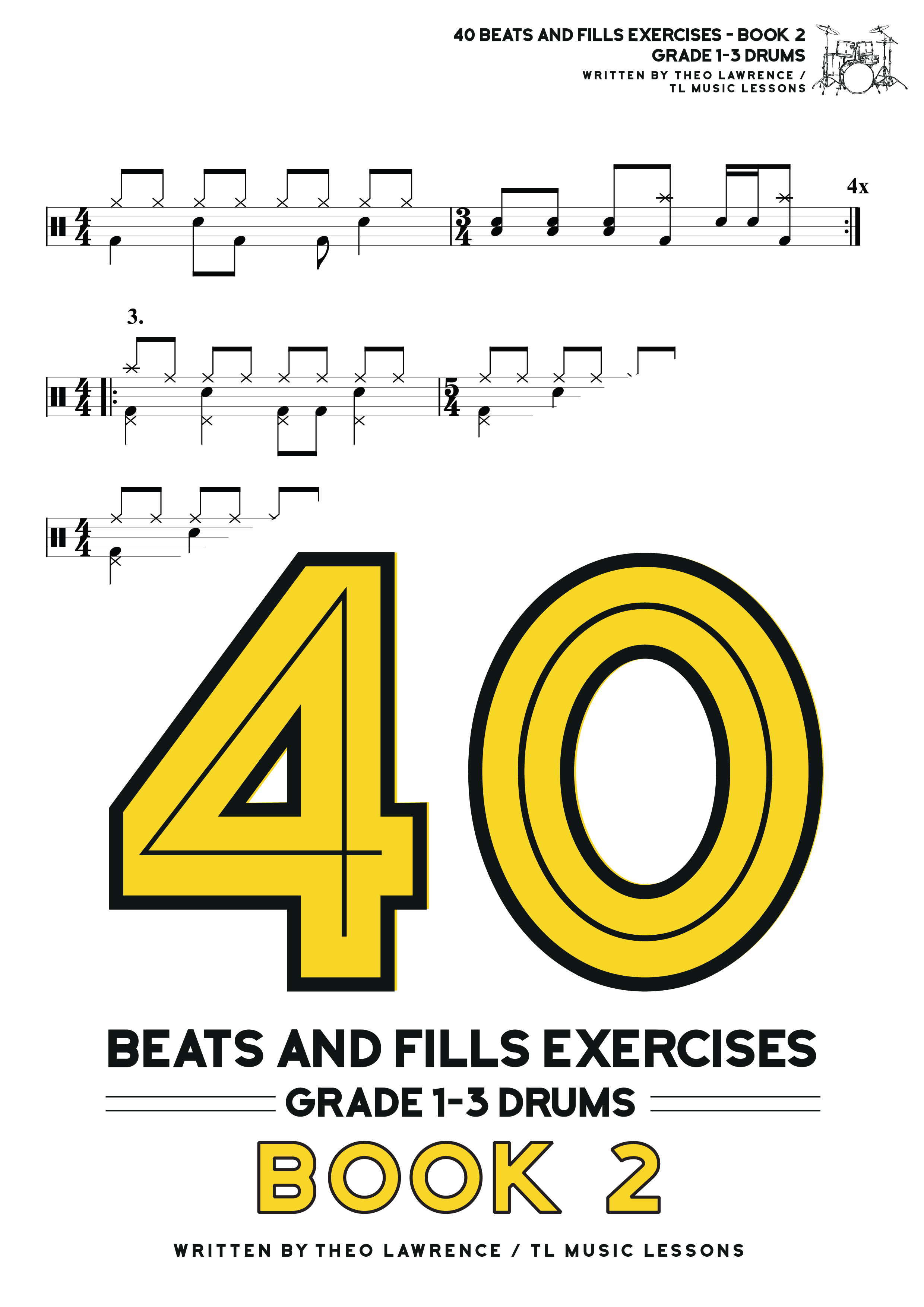
40 Beats and Fills Exercises Book 2

PDF Ebook Buy Now →
Look Inside The Book →

This book contains drum beats and drum fills in the styles of pop, rock, blues, musical theatre, jazz, heavy metal, hard rock, punk rock, and indie, as well as covering fundamental techniques such as stepped hi hat, open hi hats, 16th note hi hats, 4 way coordination and  time signature changes. The book ranges from grade 1 to 3.

The last book focused on grades 1-2, so this book is focusing on the high end of grade 1 and up to grade 3 level. The book would be an ideal add on for anyone studying Grades 1-3, and in particular grads 2-3. To achieve grade 3 and possibly grade 4 level, the exercises would need to be played precisely, with correct dynamics, speed and fluidity.

Demonstration Video

There is a video accompaniment with timestamps for every exercise in this book here: https://youtu.be/jMT9UHOBHNM

About the book

This is the second book in the series, following directly on from “40 Beats and Fills Exercises (Grade 1-2)”. There are 40 exercises over 12 sheets, and a bonus sheet 13. There is also a warm up sheet, which can be played at the start of a lesson if you are studying some of the book.

Final Thoughts

I hope you enjoy working on this book or teaching with this book. Stick the metronome on and get into each exercise. Aim to repeat each exercise at least 2 times (ideally 4 or more). You could do 4, or keep repeating until you are happy with it. If you have done the sheet a few times before, perhaps 2 times each would be sufficient. Start without the metronome first if you are needing to slow down and learn each one. Slow it right down if it’s tricky and really make sure to play it properly. It’s better than trying to messily play it too fast.

Kind regards to you all,

Theo Lawrence / TL Music Lessons

Intermediate Drum Warm-Up – Part 2

Following on from the Grade 1-3 Drum Lesson Warm Up posted recently, and the intermediate drum warm-up Part 1 for drummers that have reached a higher level of ability (about Grade 4-6 +), here is the second part of the Intermediate drum warm up.

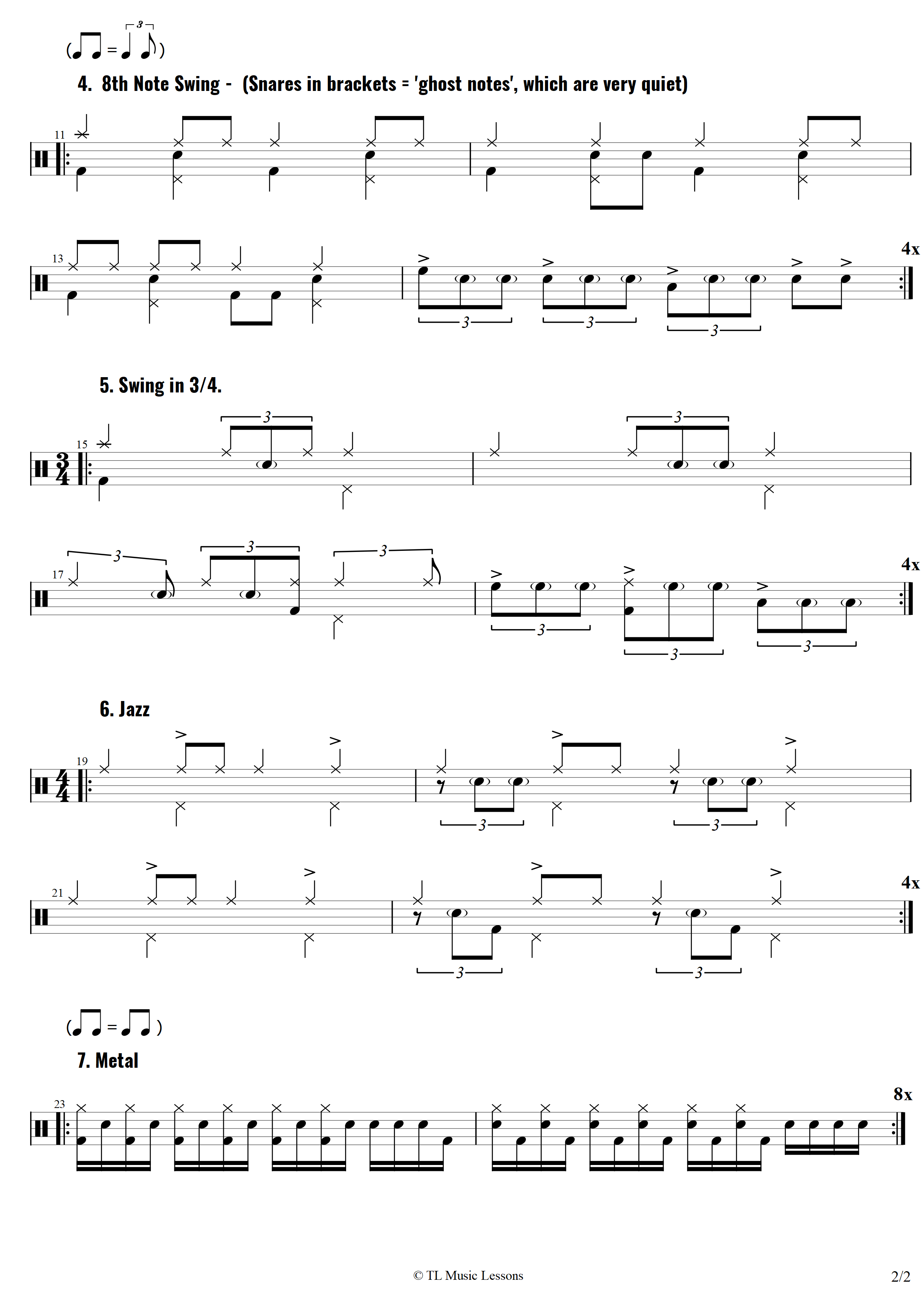
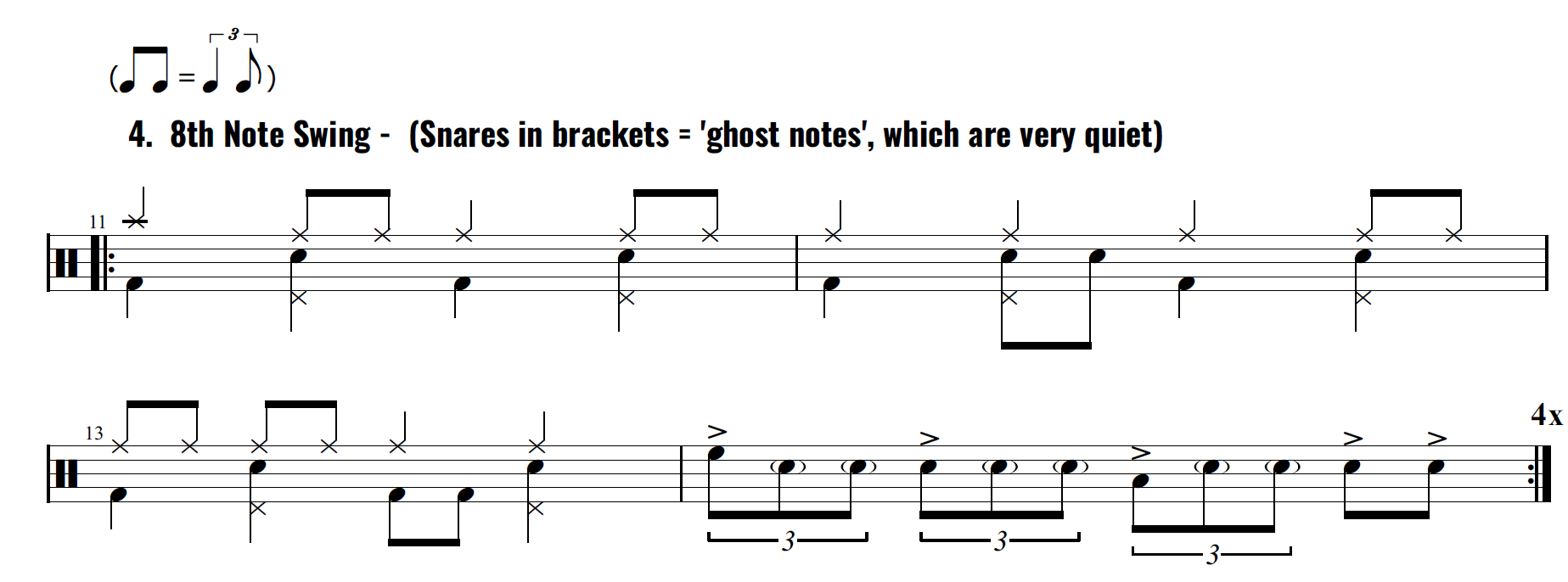
This second part of the warm up consists of stylistic exercise, including Swing in 4/4, Swing in 3/4, Jazz and metal. This is a continuation from part 1 where on exercise 3 there was a funk rock exercise.


Exercise 4 – 8th Note Swing in 4/4.

The snare drums with brackets around are ghost notes, which means small quiet taps on the snare drum about 1-2 inches from the snare head. These beats and fills could be heard in musicals or swing bands for example.


Exercise 5 – 8th Note Swing in 3/4

These beats and fill again could be heard in musicals, swing bands, and also in Jazz.

Exercise 6 – Jazz

The ghost note snares and bass drums on the 4th bar are what you might play if you were comping. Here is a video that goes into great detail about comping:

Exercise 6 Jazz Warm up

Exercise 7 – Metal

This exercise is a good warm up for anyone and only needs a single bass drum pedal (kick pedal). It’s sort of an introduction to blast beats. You can learn more here in this video:


8 beginners Jazz worksheets including bass drum and snare triplet patterns for comping ideas – FREE PDF

Get Free PDF Download →

There are 8 PDF files here with sheet music including Jazz drum beats. I thought rather than posting them seperately, I would rather group them all as one resource. They were created in 2010 near to when I started teaching and I used sibelius to make them.

Two of the sheets focus on the left foot hi hat and right hand cymbal ostinati.

Two of the sheets focus on only the left hand triplet based patterns used for comping.

Two of the sheets focus on the left hand snare drum and right foot bass drum, used for comping.

Two of the sheets (Full Jazz Grooves) bring it all together for 4 way coordination.

Get Free PDF Download →

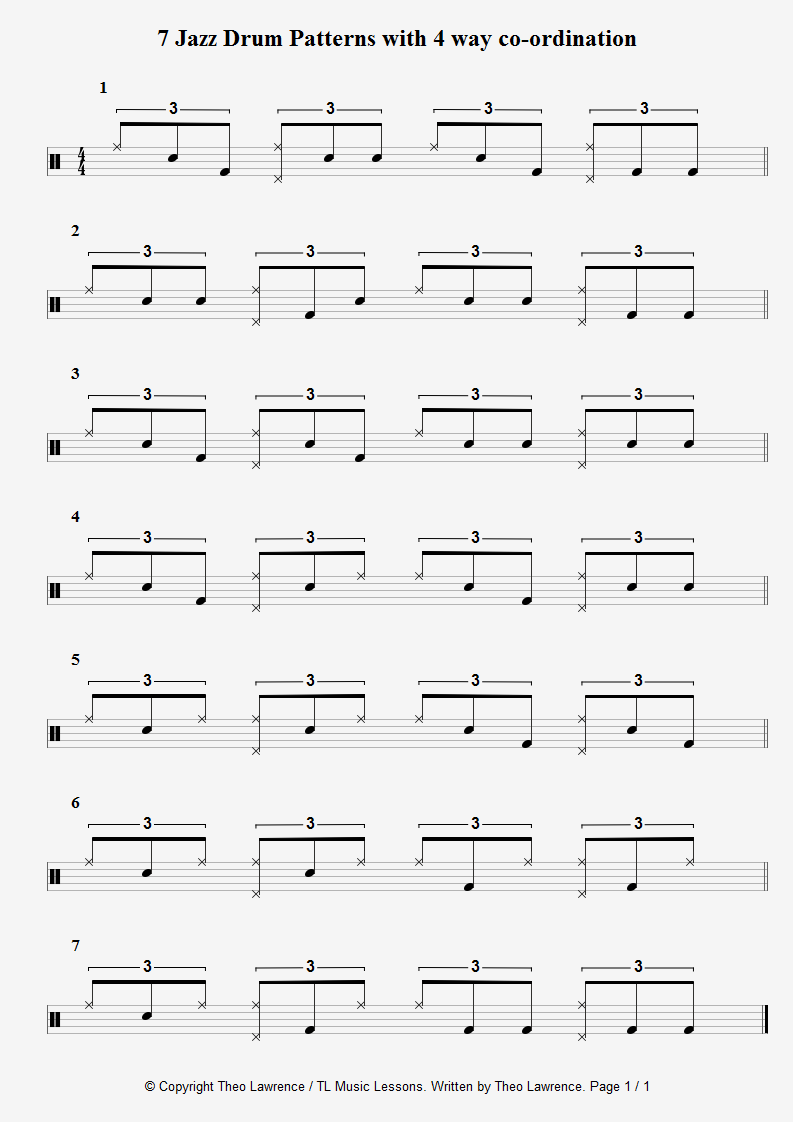
7 Jazz Drum Patterns with 3 and 4 way co-ordination sheets

These jazz drum patterns are for at least grade 3 level. The 3 way co-ordination exercises could also be tried slowly by Grade 1-2.

Drummers that are new to jazz could start with these even if they are a pro in other genres. These patterns will be hard if you are new to less regimented styles like Jazz and Latin drumming (i.e. you are more used to pop/rock).

That is the background I come from with drums – pop, rock, funk, metal. Then I was introduced to Jazz. After my Rockschool Grades (we skipped Jazz in my lessons), after my early teenage years of practicing and learning and exploring new and old music. At drum college I was introduced to Jazz when I was 16 or 17. Since this I have always had a place in my heart for Jazz. It is probably where I really started to get an understanding for melody and how it related with my primary passion of drums. The drums in Jazz compliment the melody a lot! The thing I was always taught with Jazz was to either ‘learn the melody’, or to ‘play off the improvised melody’. Over 10 years later and my interests have been drawn even more to creating melodies on other instruments, and I learn more and more how the instruments compliment each other.

So, onto the drum patterns. The patterns are all triplet based and all have a ride cymbal on the 1 2 3 4 beats. The rest of the triplet beats are played by different bass drum and snare drum combinations. These type of movements are fundamental to Jazz drumming. The left foot hi hat is also fundamental. I have also included a 4 way co-ordination sheet for when the 3 way co-ordination patterns begin to get easy. The patterns are all linear apart from the left foot and and right hand on beats 2 and 4 on the 4 way co-ordination patterns, which means that there is only one drum voice playing at once. This helps to get used to playing in triplets, and for focusing on the snare and bass drum patterns. In more advanced Jazz, these types of snare and bass drum patterns will poly rhythm with different right hand ostinati, making things a lot harder.


Sheet 1: 3 way coordination

Sheet 2: 4 way coordination


Related: 8 Starter Jazz Drum Beats with 3 way co-ordination

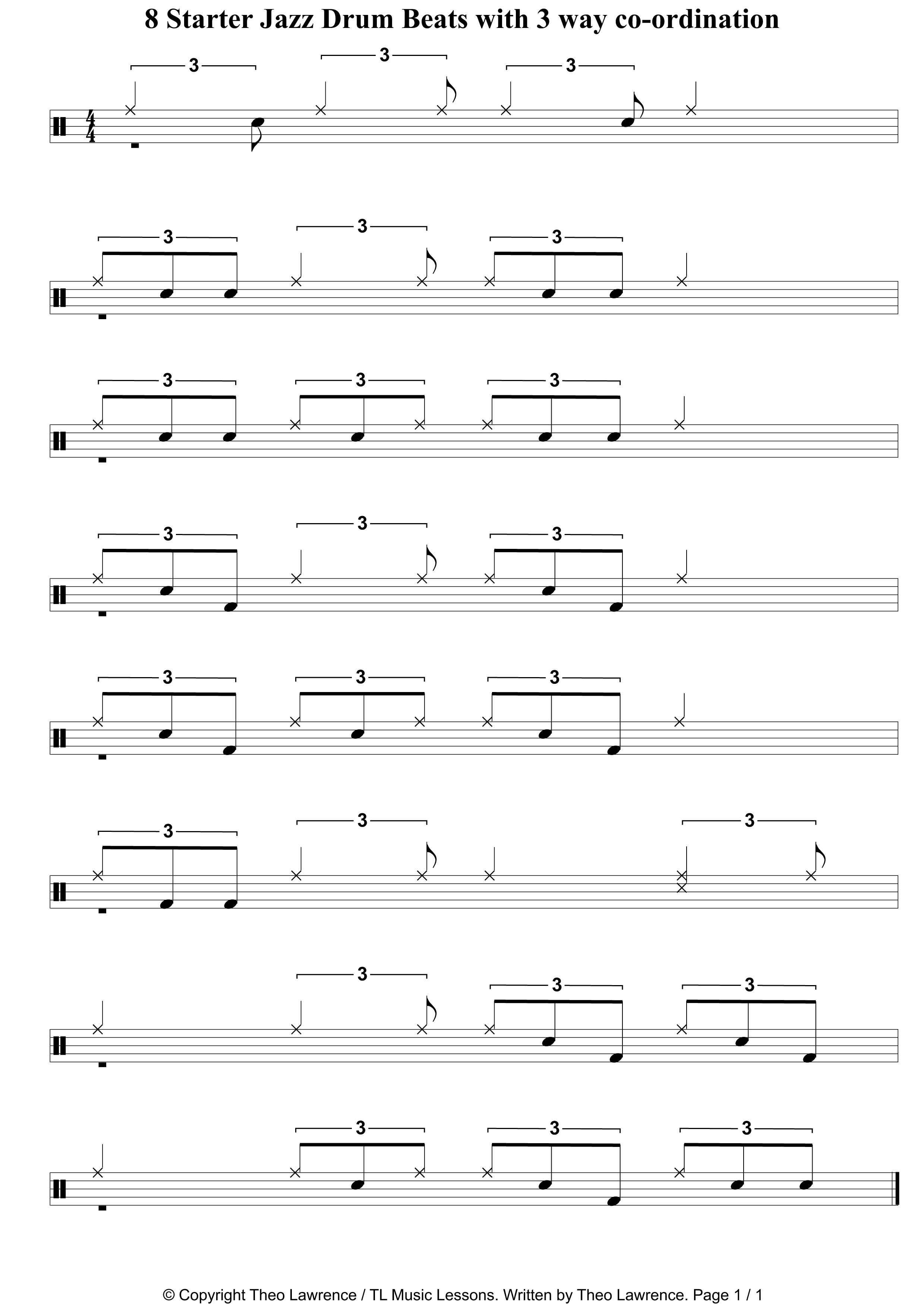
8 Starter Jazz Drum Beats with 3 way co-ordination

Jazz music can be very difficult. Even these starter beats for Jazz drumming are a challenge, and beginners will probably need a teacher’s help to play these.

The left foot is usually used in Jazz. To keep things simple we are just doing 3 way co-ordination in these 8 Jazz drum beats.


Related: 7 Jazz Drum Patterns with 3 and 4 way co-ordination sheets
Related: Learn to play the basic foundation Jazz drum groove
Related: 10 Jazz Ride Patterns