Sheet 1 – 40 Beats and Fills Exercises Grade 1-2

For this exercise sheet, you will need some basic beginners reading knowledge of drum beats and drum fills.

In the exercises, you will play 3 bars of drum beats, 1 bar of a drum fill and then repeat the exercise. There are 4 exercises on the sheet and each one can be played twice, or more times if you like and perhaps the sheet can be revisited on over several practice sessions if needed.

On the first 3 exercises, there are times when there are 2 hi hats on their own with no bass drum or snare drum, so it’s helpful to especially listen out for these two hits whilst playing to avoid missing one of them out, as some learners can do by accident.

All of the drum fills are played on the snare drum only. If there are 2 lines attaching the notes, they are played as 4 fast notes. If there is 1 beam attaching the notes, they are 2 medium speed notes, and if there is one single note on it’s own, it’s 1 single hit lasting for 1 beat. There is also a rests for 1 beat that look like a squiggle on the 3rd exercise’s drum fill, so for that you don’t play anything, and wait for 1 more beat before continuing.

More Sheets like this

If you found this exercise sheet useful, you can download all 10 sheets in this premium ebook: 40 Beats and Fills Exercises Ebook.

Drum Practice Routines – Sheet 2 – Grade 1-2

Free PDF Download:

Drum Practice Routines – Sheet 2 – Grade 1-2


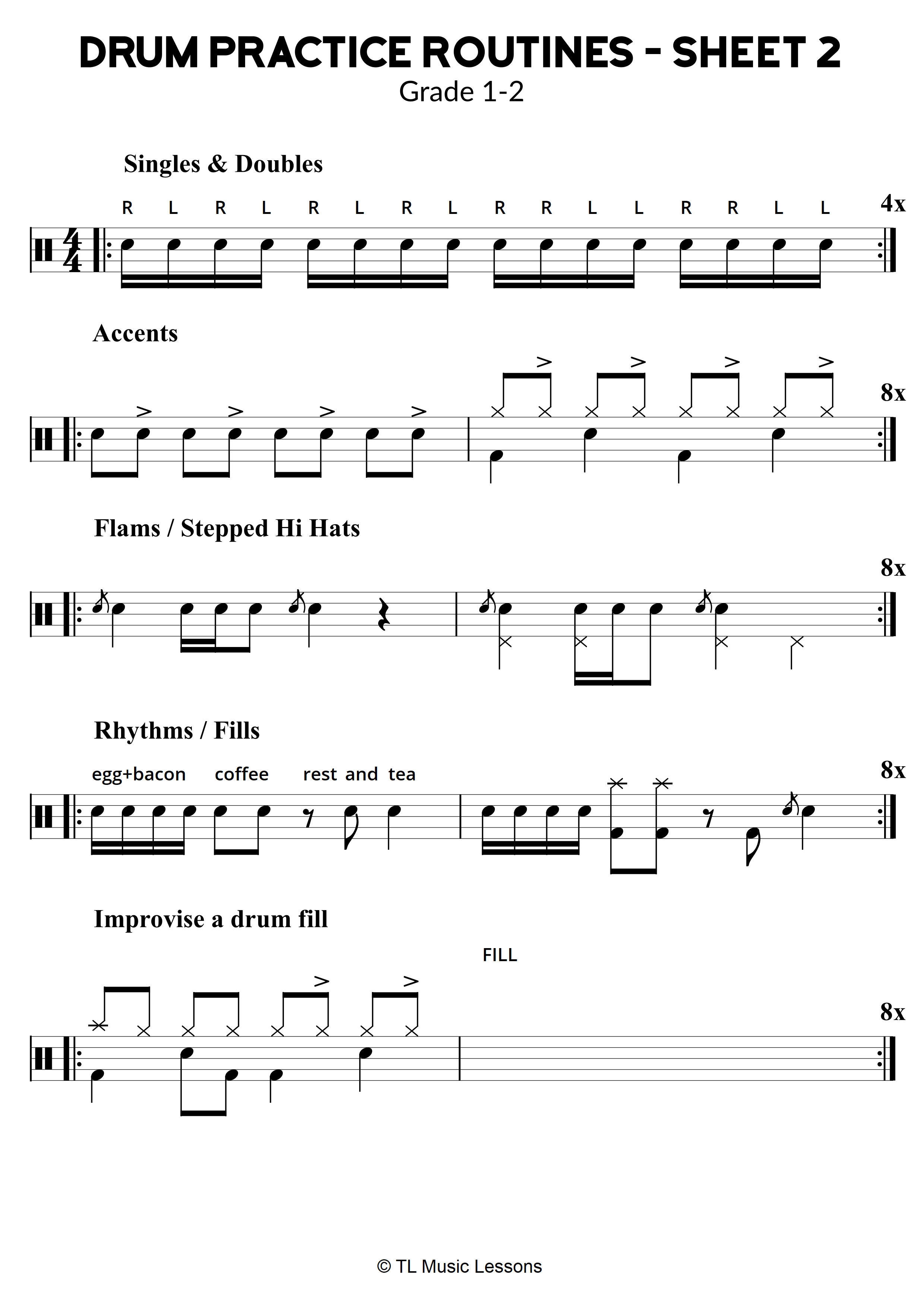
It’s still the summer holidays and most people are taking a well deserved break. I’ve been on holiday and I’m fully relaxed but I have a few lesson days coming up so I’m keeping on with lesson prep and making new material like this. I have made this sheet for some of my drum students to learn and practice over the holidays, which can be done in about 5 minutes and can be easily practiced several times per week.

In this practice routine, we are covering many of the fundamental parts of grade 1 and grade 2 material. First on the sheet we have singles and doubles (left handers need to play the opposite sticking to the ones shown). Whilst we don’t usually learn a proper double strokes technique until about grade 5 level, we still play doubles to get used to it, and you will just be hitting the drum with the same technique as you would for a single hit.

Secondly, we will be accenting (playing louder) the ‘off beat’, which means it’s not on the 1 2 3 4, it’s in between those. You could cound 1 + 2 + 3 + 4 +. The accents would then be on every +. Then, moving onto a basic drum beat in the second bar, the accents are played in the same place but this time you play them on the hi hats.

The flams and stepped hi hat section is for building up your stepped hi hat coorination aswell as for practicing the all important flam. Make sure the stick height for the quiet note in the flam is kept quite close to the drum (2 to 4 inches depending on the volume). The stick can start at a much higher position for the loud note in the flam.

For the rhythm/fills section, I have included ‘breakfast rhythm’ counting to help. If you say the words at the same time as playing the rhythm, it should help you. The rhythm on the drum fill is the same as the one in the first bar on the snare drum, so it’s a nice exercise that flows.

Lastly, many students complain about improvisation, so it’s important to practice this until confidence is higher. Start off with really easy drum fills lasting for 1 bar and build up your confidence with each practice.


Related: Drum Practice Routines – Sheet 1 – Grade 1-2

Drum Practice Routines – Sheet 1 – Grade 1-2

In this practice routine, we are covering many of the fundamental parts of grade 1 and grade 2 material. On the sheet we have a paradiddle 8 times (left handers need to play the opposite sticking).

There are accents on 8th note snare drums and then moving onto a basic drum beat, the accents are played in the same place but this time on the hi hat part of the drum beat.

The flams and stepped hi hat section has a classic rock feel to it and it is an easy way of introducing 4 way coordination into your playing.

For the rhythm/fills section, it’s the same rhythm on the drum fill as it is in the first bar on the snare drum, so it’s a nice exercise that flows, so we do that 8 times.


Related: Drum Practice Routines – Sheet 2 – Grade 1-2

5 Ways to Improve your Drumming Speed

Photo Credit: Mark Latham

Guest Blog Post by: NetSoundsMusic.com


Playing drums requires a little bit more physical effort than many other instruments. While many instruments require correct breathing and fingering techniques, and some utilize pedals as well, drummers are constantly using their whole body, including not just fingers or hands, but the whole arms and both legs. This is why drumming for prolonged times is very draining, especially at higher speeds.

Certain genres of music have high tempos as a defining trait. Speed metal, techno, trap and some types of folk music require you to consistently play 16th notes (or even 32nd notes!) at very high BPMs. But even classic rock or chillstep songs can have faster passages, sometimes known as speed-bursts, or a very intricate drum solo that is hard to execute because of the combination of speed and unpredictable, almost pattern-less lines.

Getting up to speed is not exactly easy. It is required that you physically practice playing at higher speeds, that you understand how muscles work, and to mentally recognize, feel and hear the 16th notes even at very high speeds. It is definitely a steep learning curve.

So, where to start? How about relaxing a little bit first.

1) Learn to play slow and precise:

This is a tip that has been repeated so often that it has completed its route from being the most popular advice to being the most hated one. Yes, learning to play slow will not increase your speed directly, but that is not the point. The point is to hear the beat and to get accustomed.

By playing slow, we mostly mean playing at slower tempos. Keep in mind that while playing at slower tempos, you can still add in speed bursts in form of 16th or even 32nd notes. That means that at a lower BPM, you can still play faster than when you play a high BPM. 16th notes of a lower BPM are still faster than many 8th notes of a high BPM. The low BPM simply makes it easier to get into the whole speed-game and it enables you to actually feel what you’re playing.

2) Relax your muscles as much as possible:

The second reason why you are supposed to slow down at first is to learn to relax. At higher speeds, we tend to tense up, and tension slows us down. So, to be able to play fast, you need to learn to control your movement, breathing, and tension. This requires a lot of mental effort and will take some time to get accustomed to.

Playing relaxed doesn’t mean playing quietly or slowly, though. It means that you are simply not straining a much as you probably do right now.

3) Start off slow and increase the BPM:

This is another widely repeated advice that is not wrong and that it is helpful, but please keep in mind that this is only part of the whole learning process. Learning a song part at a lower BPM, then increasing it is going to help you track your movement and get the precision down before getting the speed under control.

You can even take songs that you know and “over practice” them to get them down properly. Many rock acts play their songs at higher tempos live, which is both a way to reduce the duration of the venue and fit in more songs, but also gives a certain kick to the songs that are increasing the unique feeling of a live concert. Practicing along recordings of live performances might be a good idea for you.

4) Practice smaller parts at high tempos:

While learning how to play a hard drum solo slowly and then working your way up the metronome, another way is to learn the solo part by part with very small segments played at the correct tempo.

This will help you get down the movements at the correct time and then all you have to do is put them together. This is very effective and becomes even more useful once you get better and playing fast because you will be able to learn and master solos this way much faster.

5) Practice speed bursts and double the amount of notes:

Another way to use lower BPMs is to practice speed bursts. Add to your patterns a small and short solo line or bridge that lasts only for one bar or even less. Or double the number of notes.

This can be done by simply doubling what you are playing. For example, instead of a single kick, you can either play with a double bass drum set very fast or use a double bass drum pedal to add a second kick to the first one.

You can also create more solo-like lines from time to time. Lastly, you could try to consistently add a cymbal throughout the whole song, essentially changing the 8th note feel to a 16th note feel, though doing this consistently might not be very musical and also very difficult to pull off.

6) Be comfortable with your gear (Bonus)

As mentioned in the beginning, being relaxed is very important. This includes being used to your gear. Make sure you find the correct type of sticks and the best throne that fits your needs.

Experiment with different drum setups and don’t be afraid to change up your layout. Getting two bass drums or a double kick pedal might seem like a big change, but everything can be learned and mastered. Some setups work better for faster styles than others, so make sure to check out and draw inspiration from jazz, prog, and metal drummers to see how they are dealing with faster parts.

Summary:

Learning to play fast cannot be done in a day, and mastering high BPMs can take a very long time. One thing that is sure is that it can be done with enough practice and patience. Try out different methods and don’t be afraid to search for inspiration out of your comfort zone. There are many different genres that utilize fast drum lines, so try expanding your musical repertoire. And should you get stuck, don’t panic.

Stagnation is a normal phase that we all go through from time to time and sometimes it can feel that you haven’t progressed in weeks or even months. But this will go away. Play fun songs that you are comfortable with and with each song, your brain and muscle memory will passively pick up certain details that will help you increase your speed later on.

Peter has a passion for music since he was 12 years old. Enjoying jamming and teaching, he runs Net Sounds Music, a space to learn and get involved with music.

Drumming for Mental Health: How Playing Drums Can Help Relieve Stress and Anxiety

Photo credit: Lindsey Bahia on Unsplash

Guest Blog Post: Patrick Bailey

A note from learndrumsforfree.comMany thanks to Patrick for writing this article. I can certainly say that playing drums helped me get through my teenage years. I also think as an adult, stresses can get intense in many different ways and that drumming is an excellent and fun way of releasing stress. Before you read the article, I would like to draw attention to the word ‘Relieve’ in the title, because it’s important to note that this isn’t going to be a total fix, but it could be one of the things that helps. One point that I would like to add is that if you already can play the drums and haven’t been playing them much for a while, and you have stress and anxiety in your life, then I can’t think of a better reason to get into a regular practice routine. See if it helps.


There’s meditation, exercise, and holistic diets to help people with mental health issues–but one overlooked hobby to help reduce stress is playing a musical instrument, particularly drums. What are some of the mental health benefits of playing drums? Read to find out more.

When people think of musical instruments, they immediately associate it with talents or passion. A person usually plays drums because it’s their life calling–though it can be an exaggeration at times, this is true for the most part.


However, playing drums can also serve not just as a hobby or passion, but rather as a catalyst for change in terms of mental health. With mental health problems on the rise such as anxiety and depression, people are trying to find healthy, non-medicated ways to deal with their condition.


The current state of mental health problems

Anxiety disorders are considered one of the most common mental illnesses in the United States. Almost 20% of the country’s population have been diagnosed with anxiety disorders, and the numbers continue to rise. This also excludes people who show anxiety or depressive disorders without going through a proper medical diagnosis.


Mental health problems can be quite a challenge to detect and manage because unlike physical diseases, their symptoms can be subtle or deliberately hidden from others. Some people who go through mental health issues can often be scared to come out due to the negative stigma associated with conditions such as anxiety or depression.


Some of the common signs of anxiety and depression include:


  • Constant rumination of worries that snowball and get bigger and bigger
  • Breathing problems
  • Panic attacks
  • Feelings of paranoia
  • Lack of interest in daily activities
  • Overeating or loss of appetite
  • Feeling hopeless, down, or distressed for prolonged periods of time
  • Thoughts of self-harm
  • Irritability towards others
  • Easily agitated
  • Difficulty coping with responsibilities


Remember that the symptoms of anxiety and depression can overlap. Since anxious people are often depressed, they also tend to seek unhealthy coping methods such as addictions or self-harm. If you think that you or a loved one’s life may be at risk, don’t hesitate to seek help right away.


The best way to deal with mental health problems is to seek medical attention as soon as possible. A psychiatrist will be able to recommend specific strategies, both through medical interventions and therapeutic strategies to help address the condition. Some of the most common strategies to help people with anxiety is through pursuit of hobbies and interests. Anxiety disorders can be relieved through art, music, or movement.


How does playing drums help relieve stress and anxiety?

Vibrations and beats can help reduce stress levels in the body.

Although drums are not considered part of the melody and you can’t really think of notes and tunes, it is true that vibrations and beats can still help reduce stress levels in the body. This is because the rhythm being introduced auditorily helps release the antibodies called immunoglobin A. Immunoglobin A is a substance that helps reduce cortisol levels. Cortisol is a responsible trigger for stress and anxiety.


When cortisol levels are continuously high, the body responds through various physical and mental symptoms. You may be prone to more infections, be at risk for cardiovascular diseases, and also develop anxiety disorders. Playing drums and learning to follow through rhythms can help boost antibodies for your overall wellness.


Drumming is a physical activity.

It’s no longer a mystery with how physical activity can help relieve mental health problems. This is because when we exercise, our bodies release neurochemicals such as dopamine and serotonin which are considered “feel-good” substances. These chemicals are naturally released in the body which provides us with vitality and elevated moods.


Thus, drumming can also be an option for people who want to hit three birds in one stone–those who want to relieve mental tension, learn a new skill, and burn calories all at the same time! One hour of drumming can help burn about 250 calories for an 180 lb individual. Some common cardio exercises like indoor cycling, running, or dancing can produce identical results. If you’re musically inclined but want to be physically active, then drumming might just be the perfect hobby for you.


Playing drums is also a mindfulness exercise.

One of the roadblocks to curing anxiety and depression is constant rumination of past experiences or worries that are in the far future or non-existent. Mindfulness is the principle that helps people think of the present moment to release their thoughts and feelings from forming irrational responses.


Playing the drums means learning how to tap or respond to the rhythm being played, or being able to set a consistent pace. This requires the brain to think of the present with complete focus in order to avoid losing the beat. In a way, playing the drums can be a great way to include as a part of one’s mindfulness routines for treating anxiety and depression.


Playing through rhythmic music can make you smarter.

It may be puzzling to see a connection here, but it is good to know that researchers saw a correlation with increased intelligence scores and playing to rhythmic music such as tapping the drums. It is apparent that keeping a steady beat helps develop the brain’s problem solving skills.


Often, people with anxiety or depressive mood disorders can have a lack of self-worth. They would often feel unaccomplished or unable to ‘match up’ to other people in terms of their skills and accomplishments in life. Playing the drums can serve as a way to boost one’s confidence and motivation to continuously pursue a potential musical passion.


Playing the drums can be a social activity.

Music is a universal language–it transcends language barriers and helps people connect despite their diversities. Listening to music, playing music, and enjoying music together is one of the best social activities one can engage in.


When people play drums, it can be an open door to form friendships, share life experiences, and simply enjoy the presence of others through music. Thus, it can be a helpful social activity that can reduce anxiety and depression.


Drum your stresses away

Sometimes, passions are discovered in the moment. If you are on the fence about the exploring the wonderful world of drumming, perhaps you can give the hobby a try as a stress reliever. Who knows? It can help give a sense of fulfillment that you may not have experienced if it weren’t for picking up that drumstick or trying out that first tap.


Other instruments can help too. Read here about the surprising benefits of playing guitar.

Reading and Playing Buzz Rolls and Double Strokes

Some snare drum sheet music writes out buzz rolls with a Z through the stem. I don’t write it like that because my software doesn’t have that feature, but many others write it my way too anyway so I’ve got used to writing using 3 slashes instead (3 slashes like this /// through a stem line like this |).

Tremolo in Other Instruments

So, the slashes through the notes are also used in other pitched instruments as a tremolo marking. Violins have plenty of tremolo, which is achieved by moving the bow back and forth quickly. You’ll hear the sound in movies where the violins sound intense and brooding by playing 1 note for ages repeatedly. See the video below for an example of this. You’ll hear this more in old programs and films such as in the original Thunderbirds series’.

Tremolo Markings in Drums (The ‘/‘ slashes through the stems)

These tremolo markings in drums can be played with precise double strokes, or with a multiple bounch technique, which sometimes yeilds more than a double with each hand, but thats ok. This article talks further about the ambiguity of multiple bouncing vs precise doubles when reading.

About the Music Sheet (featured image)

On each line that the 1st bar has what you see in sheet music and the 2nd bar of each line shows you the method of playing it. I have chosen to write slashed 16th notes rather than write 32nd notes in the second bars because that’s how I teach drummers to count their buzz rolls, by playing 16th notes and buzzing each hand. So, for a 1 beat buzz roll, you would play “R L R L” 16th notes, and each hand will be buzzed, so it will actually be something like this: RR LL RR LL, or RRR LLL RRR LLL if you play several notes with each hand. For snare drum sheet music with multiple bouncing, I encourage more bounces so it has more of a drum roll feel to it.

Here’s how to play the multiple bounce roll:

When you see 16th notes with slashes in, during regular drum sheet music especially, I would say this always should be assumed as ‘use precice doubles’ if you can manage it with the double stroke technique. For example, the hi hats may have 16th notes but some of the hits are doubled, and these would be played with a strong double stroke technique. In this Samba Funk Grooves sheet you can see that the hi hats have been written as 32nd notes, but they could also have been notated with slashed 16th notes. You can see double strokes played on the hi hat in a groove in this video:

When you see slashed 16ths on the snare drum, this means to play them as 32nd notes, with double strokes (RRLLRRLL for 4 slashed 16th notes).

This video by Ryan Alexander Bloom shows how I play all of my precise doubles. I didn’t realise it was called the ‘Push Pull’ method until I looked up videos on it! At drum college they were just taught as the ‘double stroke technique’. Please make sure to watch the full video if you want to learn double strokes properly, it’s only a couple of mins…

After letting Ryan know that his video was featured here, we arranged for him to write a guest blog post for this website, which you can read here: 3 Simple Drum and Bass Steps – How to Play, With Notation and Variations


Related:

Snare Drum Piece – Jan 2018
Group Snare Drum Piece with 3 difficulty levels (Piece 2, Book 1)
Group snare drum piece with 3 difficulty levels (Piece 5, Book 1)
(Premium) – 10 Snare Drum Pieces – Book 1 – Levels 1-3 (PDF ebooks)
10 Pages Of Accent Exercises With 16th Notes – PDF Ebook (includes double strokes exercises)
Accent Techniques – Down, Tap, Up, Full Strokes

Snare Drum Piece – Jan 2018

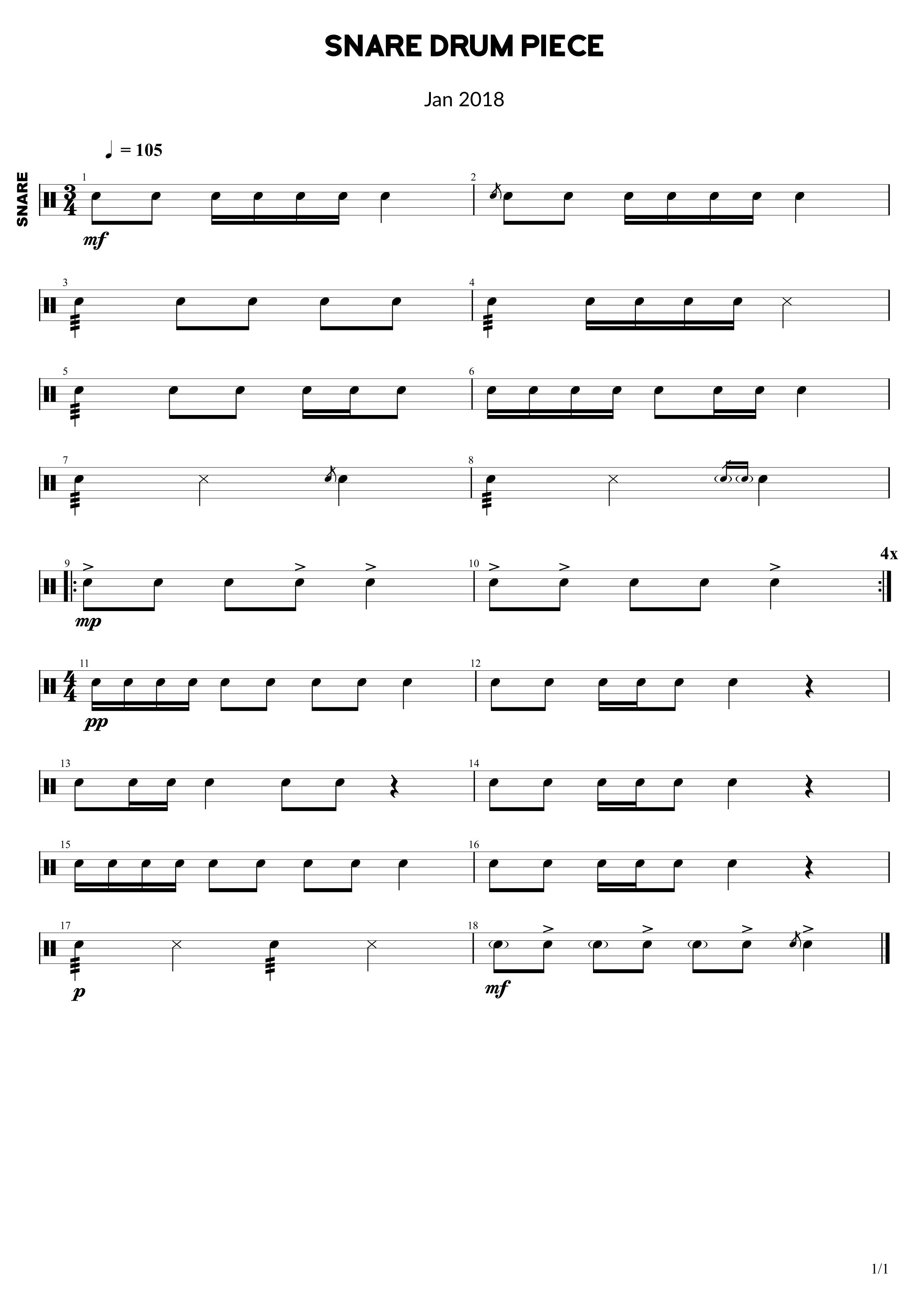
Here is some drum sheet music of a snare drum piece, which can be played by a solo snare or a snare line group.

The snare piece starts off in 3/4 timing and then moves into 4/4. There are various dynamic changes. There are also plenty of techniques involved. In bar 2 there is a flam. Bar 3 sees the first buzz roll. Bar 4 has a rim hit on the last note. Bar 8 has a drag at the end. Bar 9 and 10 are repeated 4 times and feature accents. Bar 11 starts the quietest section in pp, which means very quiet (pianissimo). Bar 12 sees the first rest, and the final techniques are found in the final bar, which are ghost notes.


Related: Group Snare Drum Piece with 3 difficulty levels (Piece 2, Book 1)

How To Read Dynamics in Music

Here is a list of dynamic markings you might encounter in drum sheet music. This list will be updated as more dynamic markings are thought of, and will start out as a basic list of fundamental dynamics notation.

  • pp (pianissimo = very soft/quiet)
  • p (piano = soft/quiet)
  • mp (mezzo piano = medium quiet / medium soft)
  • mf (mezzo forte = medium loud)
  • f (forte = loud)
  • ff (fortissimo = very loud)
  • a wide version of this shape: < (crescendo = gradually getting louder)
  • a wide version of this shape: > (diminuendo = gradually getting quieter)
  • > these arrows above the notes are accents, which indicate that you play loud on this note only.

(Premium) – 10 Snare Drum and Floor Tom Pieces – Book 1

Buy Now →

Summary

This book was written over the course of 1 year for a group of youth drummers (Montgomeryshire Youth Music Drumline) in Powys, Wales. I have compiled the year’s pieces into an ebook that can be used by other drum teacher, or by self taught drummers. The pieces are similar to Snare Drum Sheet Music style pieces, but with the added timbre of a floor tom. You can achieve quite an epic cinematic sound by combining the two drum voices in unison. Difficulty levels from Grade 1 to Grade 3-4.

People that might find this book useful

  • Drum groups, drum workshops and drum ensembles – Youth groups or adults
  • Drum teachers are completely free to print the book or single sheets for their students.
  • Drummers can teach themselves following on from a strong basic foundation in reading and playing
  • Drummers that need to perform for school or competition etc.
  • Drummers looking to improve their rhythms for drum fills and snare drum sheet music
  • Groups of drummers can perform together using a snare and floor tom each, or by using any other two drums

Rules for sharing this content

When you purchase the book, you will receive a .pdf file that you can keep and use forever.
You can email the .pdf file privately to your students
You can print out unlimited copies for your students or for yourself
You cannot resell the .pdf or distribute the .pdf file online in any way (not even for free). This also applies to exported images, photos or scanned copies of the book

About the book

The 10 pieces are performance pieces for drums, with no backing. Drum groups, or individual drummers can perform these pieces. They have been written to sound good as standalone pieces – they are not just practice exercises. The pieces do not focus on many dynamics, but they do cover many techniques, rhythms and some rudiments, from quarter notes to sextuplets and triplets, and from flams to drags and buzz rolls.

Some of the pieces have multiple parts, which may be played together. So, if your group has varying ability levels, some can play part 1, some part 2, and some part 3. Not all the pieces have 2 or 3 parts. Please check the contents page to match up the pieces. I have compiled the book in order of difficulty. The levels go from about grade 1 up to grade 3-4 level.

Reading Tip: I developed the writing over the year. For pieces with two stave lines – the top line is the snare and the bottom line is the floor tom.

Final Thoughts

This book is a follow on from “10 Snare Drum Pieces – Book 1”, written in 2015. That book was for snare drum only, and in the last 2 years has been purchased by 60 people from all around the world, many of which are teachers themselves who are using the book to teach their students or drum groups with.

I hope this new ebook will inspire more groups of this type. I’m sure it’s not the first time it’s been done with groups of drummers, each playing a snare and floor tom, but I do think it is very rare to see it. I hope to inspire other groups to adopt this idea. I’m sure this won’t be the first and last book of it’s kind, because I intend to continue teaching the MYM Drumline for many years to come, and I will be writing new pieces for the group regularly.

Recommended reading for use with this ebook:
Accent Techniques – Down, Tap, Up, Full Strokes
Reading Buzz Rolls And Double Stroke Markings

Buy Now →