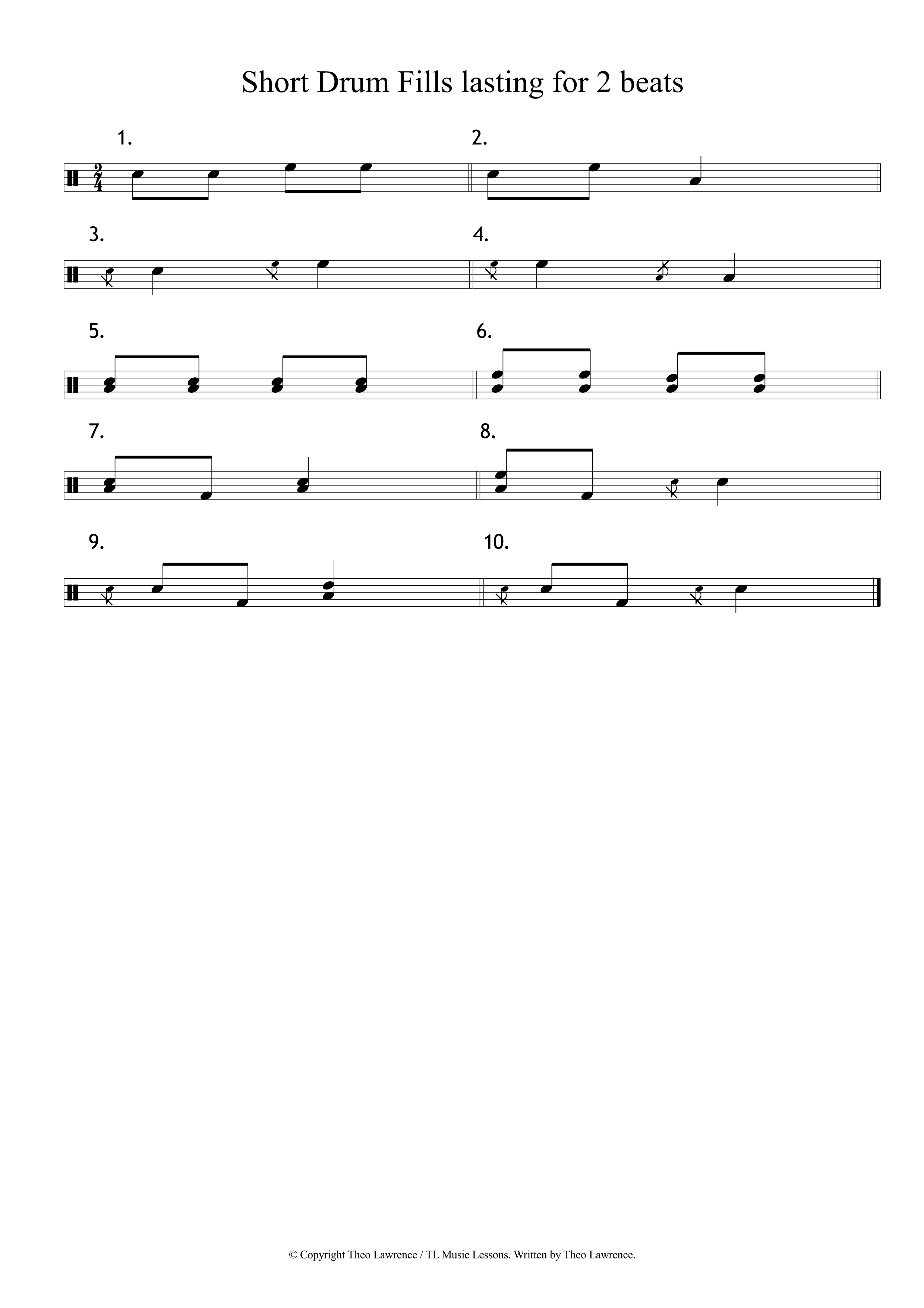
- Slowly play the Snare twice then Tom 1 twice.

- Snare, High Tom, Floor Tom.

- To play this fill, you have to do a flam on the snare drum and then a flam on tom 1 for 1 beat each.

- To play this drum fill, play a flam on Tom 1 then a flam on the floor tom, lasting for 1 beat each.

- Play the floor tom with your right hand, the snare with your left and, and hit them both at the same time 4 times to create this short drum fill.

- Tom 1 and Floor tom together twice, then Tom 2 and floor tom together twice.

- Floor tom + snare together, then bass drum, then floor tom + snare together again.

- To play this drum fill, play the Tom 1 and floor tom together, then the bass drum, and then a flam on the snare drum.

- Play a flam on the snare, then a bass drum, and then tom 2 and the floor tom together.

- Flam on the snare, bass drum on it’s own, then flam on the snare.

Easy beginners snare drum piece – sight reading exercise with crotchets and quavers

There are just two note grouping patterns (if you can count the 1st one), and the whole snare drum piece uses various combinations of these.
Most beginners pick this up quite quickly, and it’s a great way for them to understand the ‘twice as fast’ speed difference between quarter notes and eigth notes (crotchets and quavers). It’s also a good idea to introduce the metronome when it’s sounding good, starting at about 60 or 70 beats per minute and going up to 110 or more.
Related (Premium): The Level 1 book included in the download is slightly harder than this sheet – 10 Snare Drum Pieces – Book 1
12 Bar Blues Shuffle – Easy

A simple shuffled drum groove with a triplet based drum fill on bar 12. Shuffle is another word for Swing.
This can be played at various tempos and is something you could play or improvise around at a blues jam night.
Drums Warm Up Exercise with 4 way co-ordination

The feet are walking, right, left, right, left, on the bass drum and stepped hi hat all the way though, until the last line, where it’s left foot hi hat on every beat.
Follow the sticking (R L R L) for the hands on the snare drum.
Either play as seperate exercises with a metronome, or as one continuous exercise through the whole sheet, with repeats.
Related: 10 rock and pop drum beats with quarter note stepped hi hats – 4 way co ordination
Off Beat Open Hi Hat Grooves

The open hi hats can be seen in the sheet music where the hi hat has a circle around it.
All the beats have open hi hats on the “and” of the beat (i.e. 1 + 2 + 3 + 4 +).
These beats are a good introduction to playing open hi hats in general, and particularly good for learning the off best feel. These beats need to be repeated a lot and groove needs to be felt by the drummer. A simple ska type guitar riff accompaniment would be an appropiate jamming style for developing an internal sense of groove. On bass a fun slap and pop bass riff would fit, or else something funky without these techniques.
Related: For more of a challenge, try these: Open Hi Hat Grooves Practice Piece with Fills
Samba Funk Drum Grooves – Grade 8

This drum grooves sheet is good for learning to improvise in a samba funk style. It was initially written for a drum lesson as a rough guide to the kind of things that could be improvised with during a Grade 8 Rockschool song from the 2006-2012 syllabus (Sampa Samba), but this sort of thing can also be played in other songs of a similar style, or it could just be used as a general practice exercise for a drummer who is at Grade 8 or above.
Playing Tip: The fast 32nd note hi hat notes are played using the double stroke technique.
16th note hi hat drum beat exercises
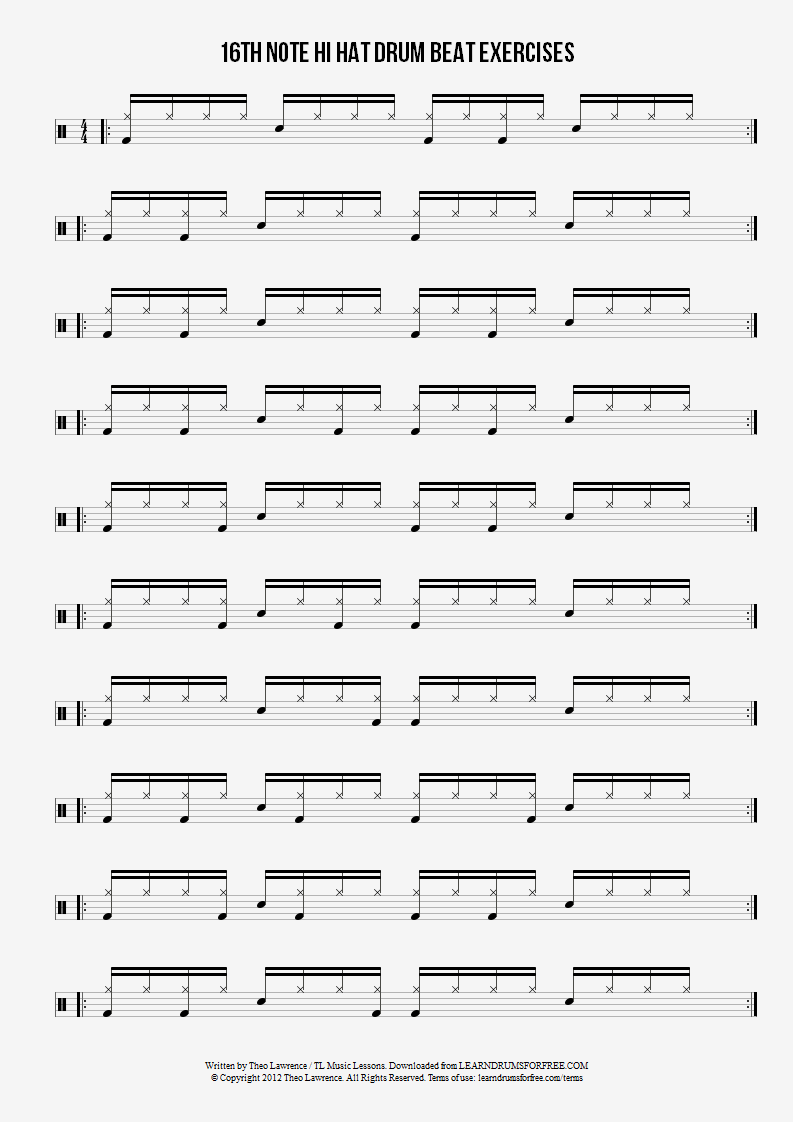
Right handers should play ‘Right Left Right Left’ in a continuous pattern with the hands. Bring your left arm over to the left so both hands can play on the hi hat comfortably and without crossing the arms. The right hand would play the snare drum.
Left handers: lead with your left hand and the snare will be played with the left hand also.
Bass Drum Skip Beats
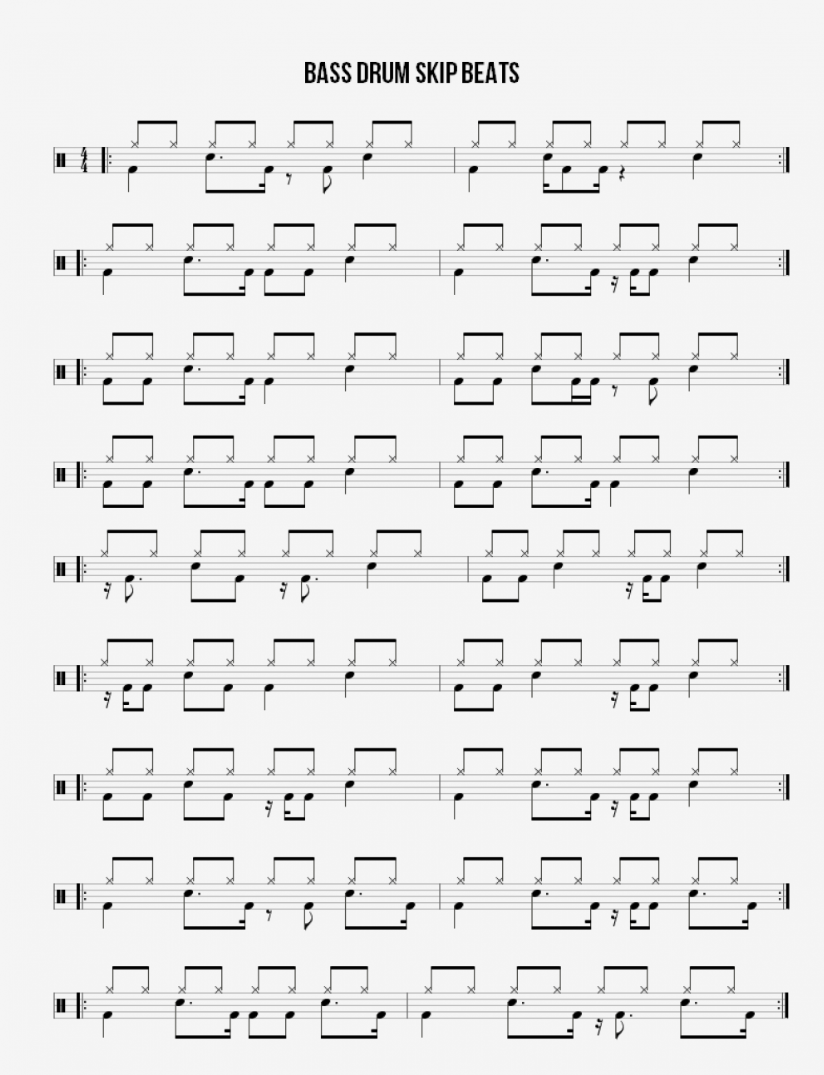
A bass drum skip beat is where the bass drum is played in between the high hats. The skip beats create syncopation, and is often used in funk drumming.
This sheet has a useful selection of different bass drum skip beat combinations. You could either treat the sheet as a series of 1 line exercises, or as 1 full exercises.
Related: Snare Drum Skip Beats
Snare Drum Skip Beats
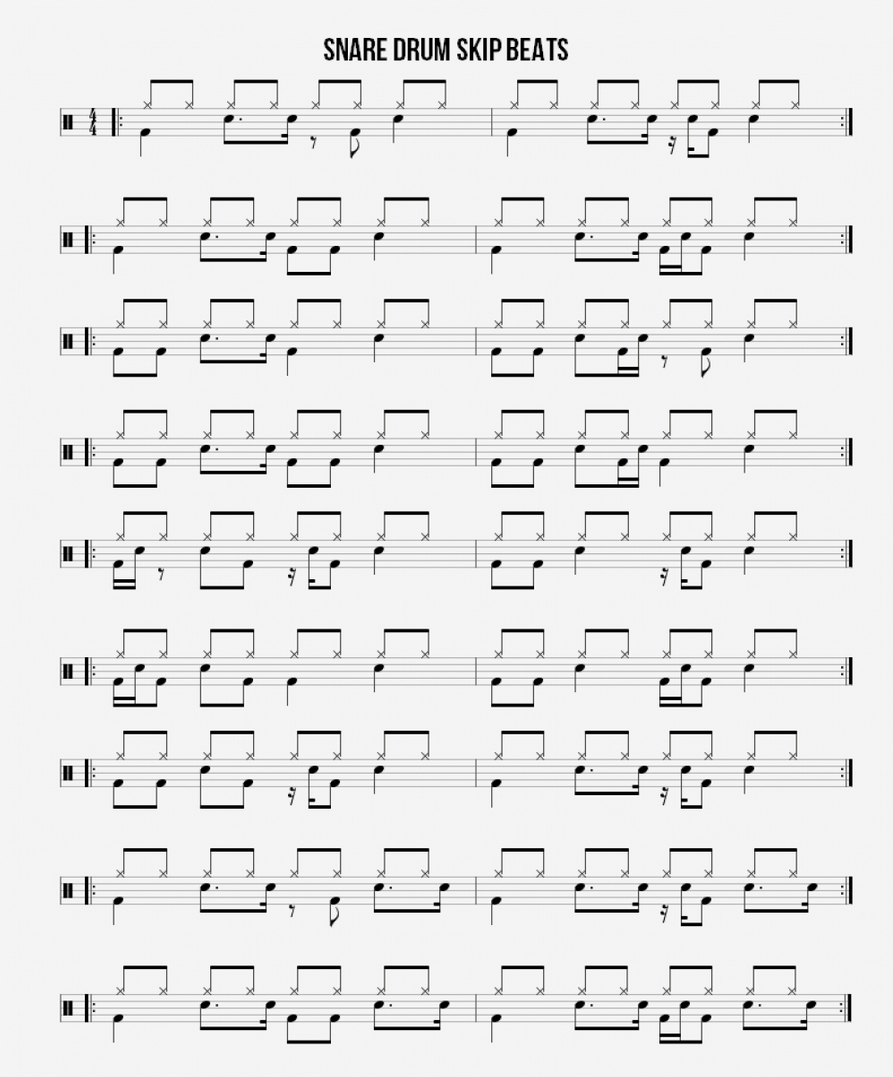
Skip beats are intermediate and above drum beats where the snare drum skips in between a regular 8th note hi hat ostinato.
The word syncopation is often used to describe the sound these kind of drum beats.
Skip beats can be heard in many styles of music, including funk, rock, drum and bass, pop, hip hop, and soul.
Try to master each drum beat seperately first, then start combining different grooves back to back with each other to make interesting drum loops or drum grooves.
Related: Beginners Snare Skip Beats
Related: Bass Drum Skip Beats
Practice sheet for learning to play drum beats in 6/8 time
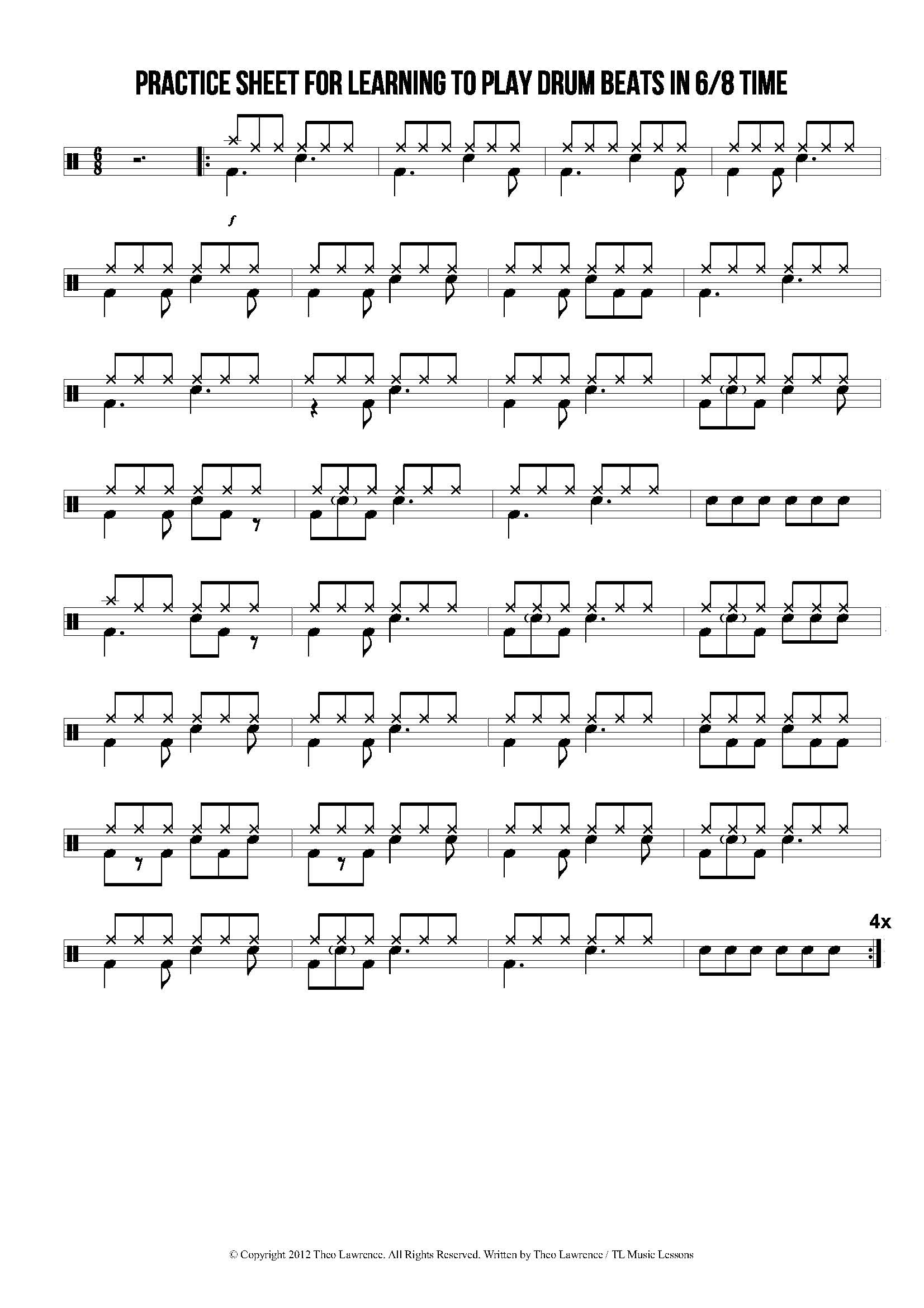
Here is a selection of beginner drum grooves in a 6/8 time signature. After practicing through the sheet at least once, try and work on playing with a metronome at various speeds. You may need to work on one bar or one line at a time if you need to practice some parts more than others, or if you would struggle to play the whole sheet in one go.