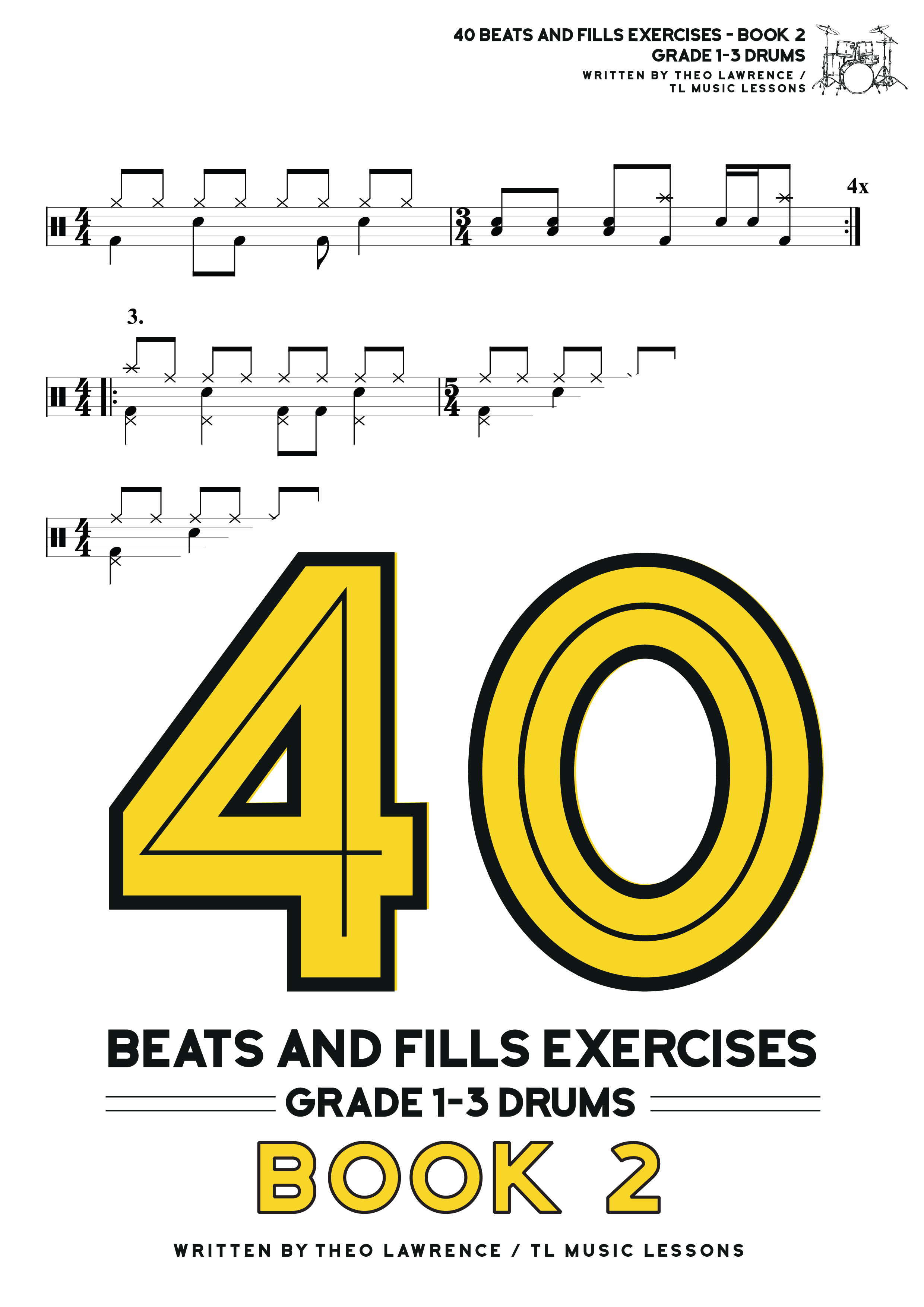
40 Beats and Fills Exercises Book 2

PDF Ebook Buy Now →
Look Inside The Book →

This book contains drum beats and drum fills in the styles of pop, rock, blues, musical theatre, jazz, heavy metal, hard rock, punk rock, and indie, as well as covering fundamental techniques such as stepped hi hat, open hi hats, 16th note hi hats, 4 way coordination and  time signature changes. The book ranges from grade 1 to 3.

The last book focused on grades 1-2, so this book is focusing on the high end of grade 1 and up to grade 3 level. The book would be an ideal add on for anyone studying Grades 1-3, and in particular grads 2-3. To achieve grade 3 and possibly grade 4 level, the exercises would need to be played precisely, with correct dynamics, speed and fluidity.

Demonstration Video

There is a video accompaniment with timestamps for every exercise in this book here: https://youtu.be/jMT9UHOBHNM

About the book

This is the second book in the series, following directly on from “40 Beats and Fills Exercises (Grade 1-2)”. There are 40 exercises over 12 sheets, and a bonus sheet 13. There is also a warm up sheet, which can be played at the start of a lesson if you are studying some of the book.

Final Thoughts

I hope you enjoy working on this book or teaching with this book. Stick the metronome on and get into each exercise. Aim to repeat each exercise at least 2 times (ideally 4 or more). You could do 4, or keep repeating until you are happy with it. If you have done the sheet a few times before, perhaps 2 times each would be sufficient. Start without the metronome first if you are needing to slow down and learn each one. Slow it right down if it’s tricky and really make sure to play it properly. It’s better than trying to messily play it too fast.

Kind regards to you all,

Theo Lawrence / TL Music Lessons

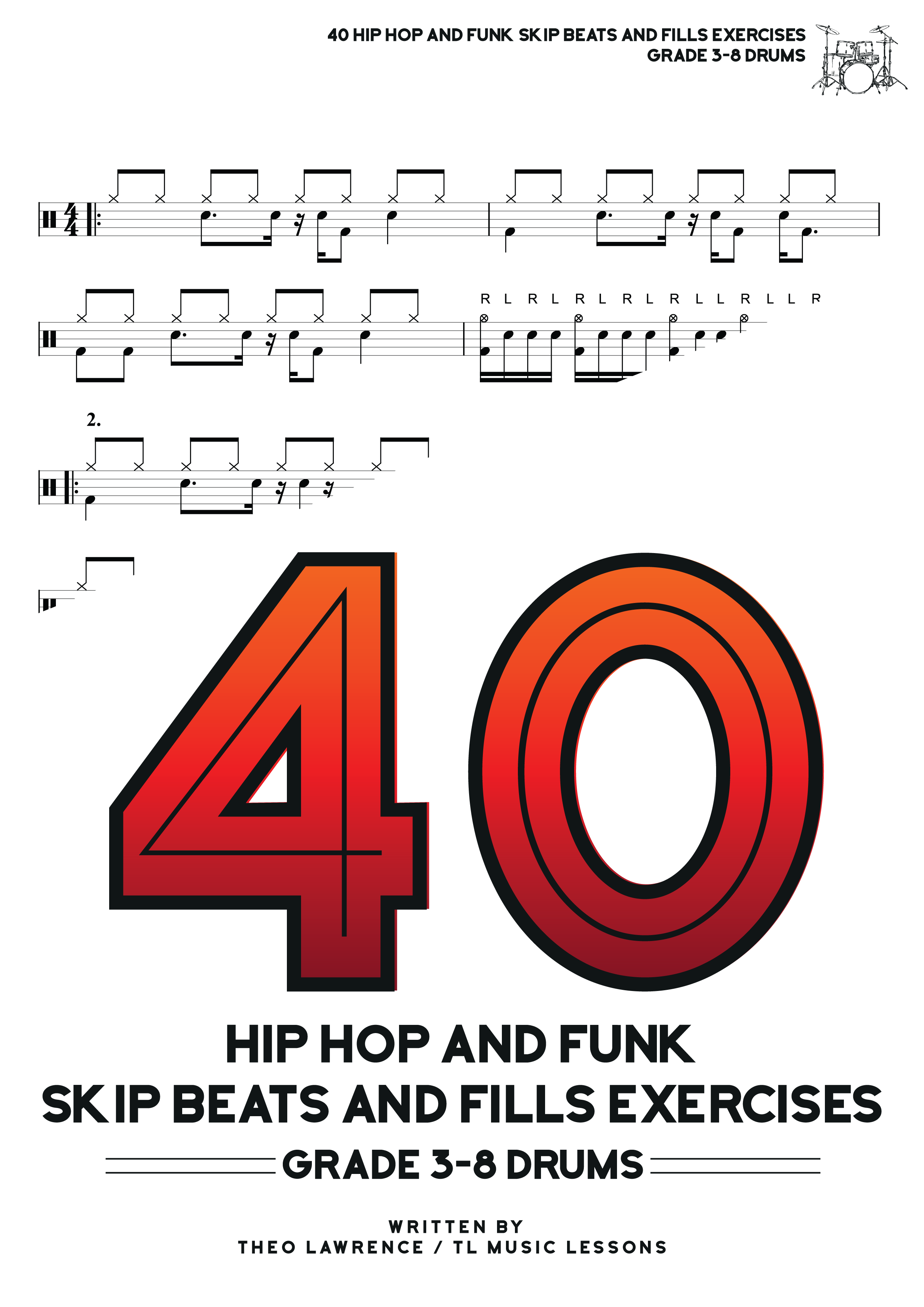
40 Hip Hop and Funk Skip Beats and Fills Exercises ebook – Grades 3-8

Buy The Book →

Introduction

This book contains drum beats and drum fills in the styles of Hip Hop, Rap, Grime and Funk, Soul and Rock/Pop. The book has some grade 3-4 level exercises and also some harder ones, ranging from Grade 5 to Grade 8. The book would be an ideal add on for anyone studying Grades 5-8, as many of the skills are needed at this level. To achieve grade 8, the exercises would need to be played precisely, with correct dynamics, speed and fluidity.

Video

You can use this video as a guide for when you are practicing the book but get stuck on a particular exercise – just look up the timestamp link below. Like I say later in the video, the book is not designed to be played in one go and you should focus on 1 or 2 sheets per session and really drill down those grooves and get the fills correct and precise. Precision is key with all of these exercises, no matter what speed you play them at.

Free PDF Sheets to browse or use before buying the book

  • Free PDF Download: Sheet 3 and Sheet 7 are available for free here: (just click the ‘Preview’ link top right of cover).

Similar Posts

People that might find this book useful

  • Drum teachers can print the book or single sheets for their students. They may like to select only some pages to teach if the students are not up to Grade 6 level. The flicks between ability levels and is not necessarily in order of ability. To achieve grade 8, the harder exercises would be played fluently and precisely at speed.
  • Drummers can teach themselves following on from a strong foundation in reading and playing at Grade 3 and above.
  • Drummers that want to learn funk and hip hop beats and fills in depth

About the book

The structure of the book is based on one of my favourite books “40 Beats and Fills Exercises (Grade 1-2)”. There are 40 exercises over 11 sheets, and I have also included 2 bonus sheets with basic skip beats with 8th note hi hats and 16th note hi hats, which adds an extra 20 exercises, but I’m not counting those in the title.

I created the book so that my students could study skip beats at grades 3-4 level and also for my students working on Grades 5, 6 and 8 (I usually skip grade 7) to work on alongside their grades.

Final Thoughts

I hope you enjoy working on this book or teaching with this book. Stick the metronome on and get into the groove. Repeat for less or more than 4 times for each exercise, it’s up to you. To extend the exercises, try playing the beats on the ride cymbal and adding in left foot hi hat ostinati.

Theo Lawrence / TL Music Lessons

Buy The Book →

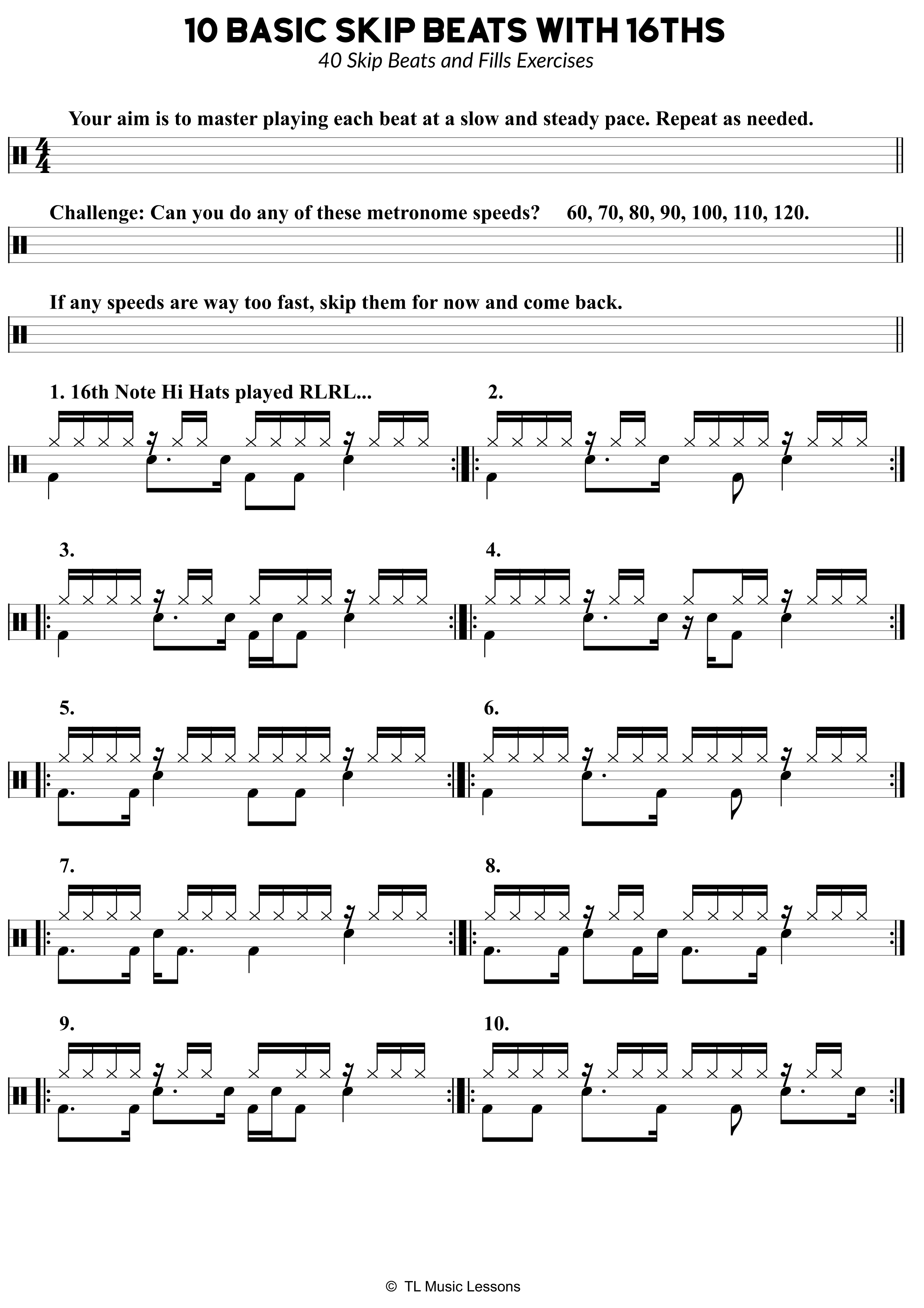
10 Basic Hip Hop and Funk Skip Beats with 16th note hi hats

This sheet contais 10 basic skip beats, with 16th note hi hats. They do get a little tricky towards the end. The two basic beats sheets should be mastered (or at least not a real struggle) before moving on to the rest of the skip beats book, because it does get harder (there is some basic stuff too). You can also play these with 8th note hi hats, which is a lot easier.

Here is a video showing you how to play all 10 of these drum beats:

As the video shows, you should aim for a RLRL pattern with the sticks (opposite for left handers), and therefore play the back beat snares with the right hand on beats 2 and 4, and any skip beat snares with the left hand (on the e or the a, if you are counting 1 e + a 2 e + a…). You should bring the left arm underneath or to the left of the right hand (depending on your drum set up positioning) to play the skip beats.

I would also recommend to play each beat a lot more than 2 times each! If you are doing these types of beats for the first time, you might like to break down each beat into sections. One way of doing this is to break down the bar into 4 sections and just play each section seperately (e.g. each section lasts for 1 beat). Nail each beat of the bar and then try to glue a couple of beats together. There are a few combinations like play beats 1 and 2 together, or 2 and 3 together for example. You could also practice looping the beats for a while and you could practice with various metronome speeds. You can also play ghost notes on any of the skip beat snares not on beats 2 and 4.

View the full book: https://payhip.com/b/63jF

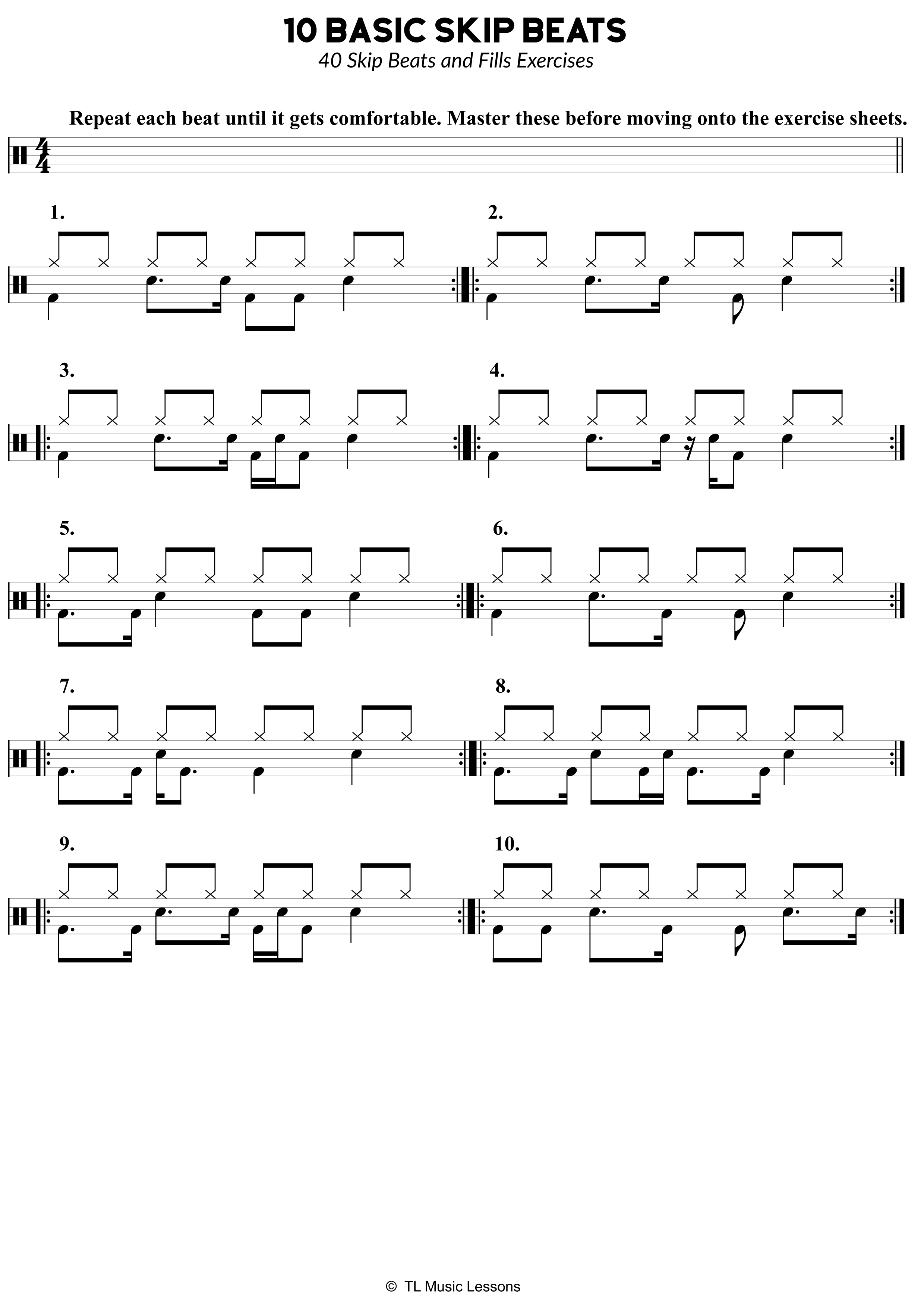
10 Basic Hip Hop and Funk Skip Beats

This sheet is one of 2 bonus warm up sheets in the book 40 Hip Hop and Funk Skip Beats and Fills Exercises. Before getting stuck into exercises usually lasting for 4 or more bars, we focus here on 1 bar at a time, looping each drum beat for a while and making it comfortable to play.

Here is a video showing how to play these 10 exercises:

You should focus on mastering each beat on this sheet before moving onto the rest of the book. When it starts to get more comfortable, introduce the metronome at around 60-70bpm and settle down into a groove for a bit. Try increasing the speed after a while. The skip beats are the snare drums or bass drums that slot in between the 8th note hi hats. The ‘skip’ should be exactly in the middle of the space between the hi hats. when added they should sound like even 16th notes between the hi hats and the skip beats. Concentrate hard on acheiving this even spacing to make your beats sound tight.

Often snare drum skip beats are played as ghost notes. This is not notated, but you should also go through the sheet again trying this.

You can also view the next sheet in the book for free: 10 Basic Hip Hop and Funk Skip Beats with 16th note hi hats.

A Full Motion PC Monitor Arm can help you to read sheet music on your computer

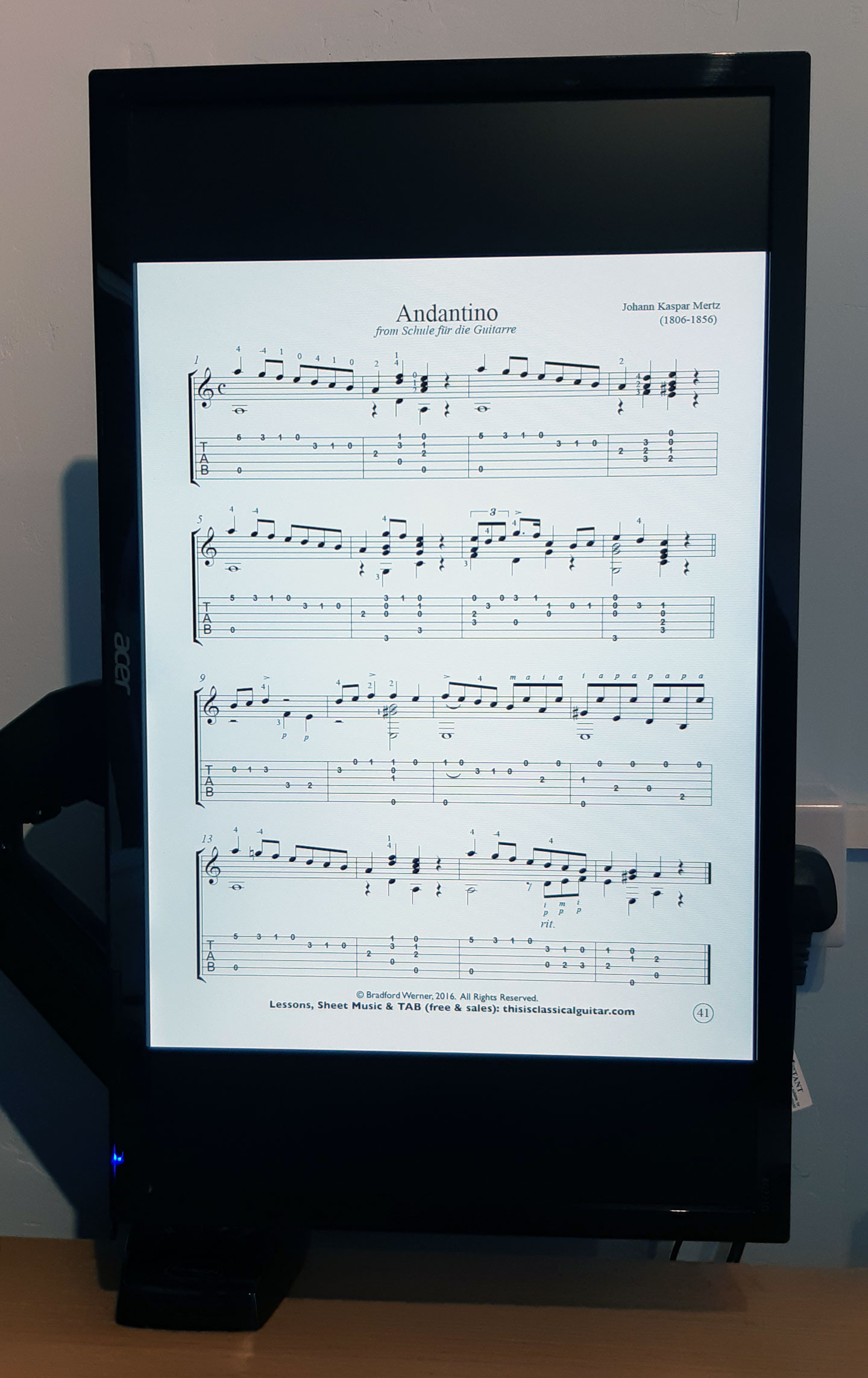
Today I installed a Full Motion PC Monitor Arm to my desk so that I can rotate my PC screen to read sheet music easily.

As I have been doing more teaching from home, and also have had more time to practice my instruments, I have been getting increasingly frustrated when reading music, because in Landscape mode it involves a lot of scrolling. You have to scroll much more frequenly than if the screen was in portrait mode.

I asked my techy gamer friend which one she has in her setup that I have seen, and she said to get this one, so I did.

Moving the monitor and benefits

I can now move the screen into portrait and load up a guitar book pdf and play away. You can go into full screen mode (Ctrl+L) and then press the down arrow key to move to the next page. Or you can use one of the other viewing methods without full screen mode and that way you can see a bit of the next sheet, and then press the down arrow to scroll or PgDn button to jump lower, or use the mouse.

To move the monitor, you can grab the screen and twist it around to make it portrait or landscape, or anything in between. You can also tilt it forwards and backwards and also move it left to right so that it can face someone to your left or right. This I think will come in very handy, because when I have been doing skype lessons on drums, I have been dragging my monitor around to face the drums, so this will be much easier, as you ust move it and then it stays in that position, so no screwing etc to move it.

How to change from Portrait to Landscape

To change the screen orientation to portrait in windows 10, you can right click on the desktop and click ‘Display Settings’ and change it there. My graphics card doesn’t allow the hotkey to change it annoyingly, but most people can change the screen orientation by clicking Ctrl+Alt+arrow keys.

Other Uses

The arm will help in lots of other ways too, like moving the screen so I can see it from the floor for workouts. I have been using the office to do home workouts from centr.com (unleashed and the da rulk masterclass have been enjoyable) and some others like Shona Virtue’s Fitness Programme after purchasing a cheap 8kg kettle bell from Aldi (was a rare find as weights were scarce).

I’m sure it will come in handy for positioning the monitor for gaming too, with a particular interest in F1 games.


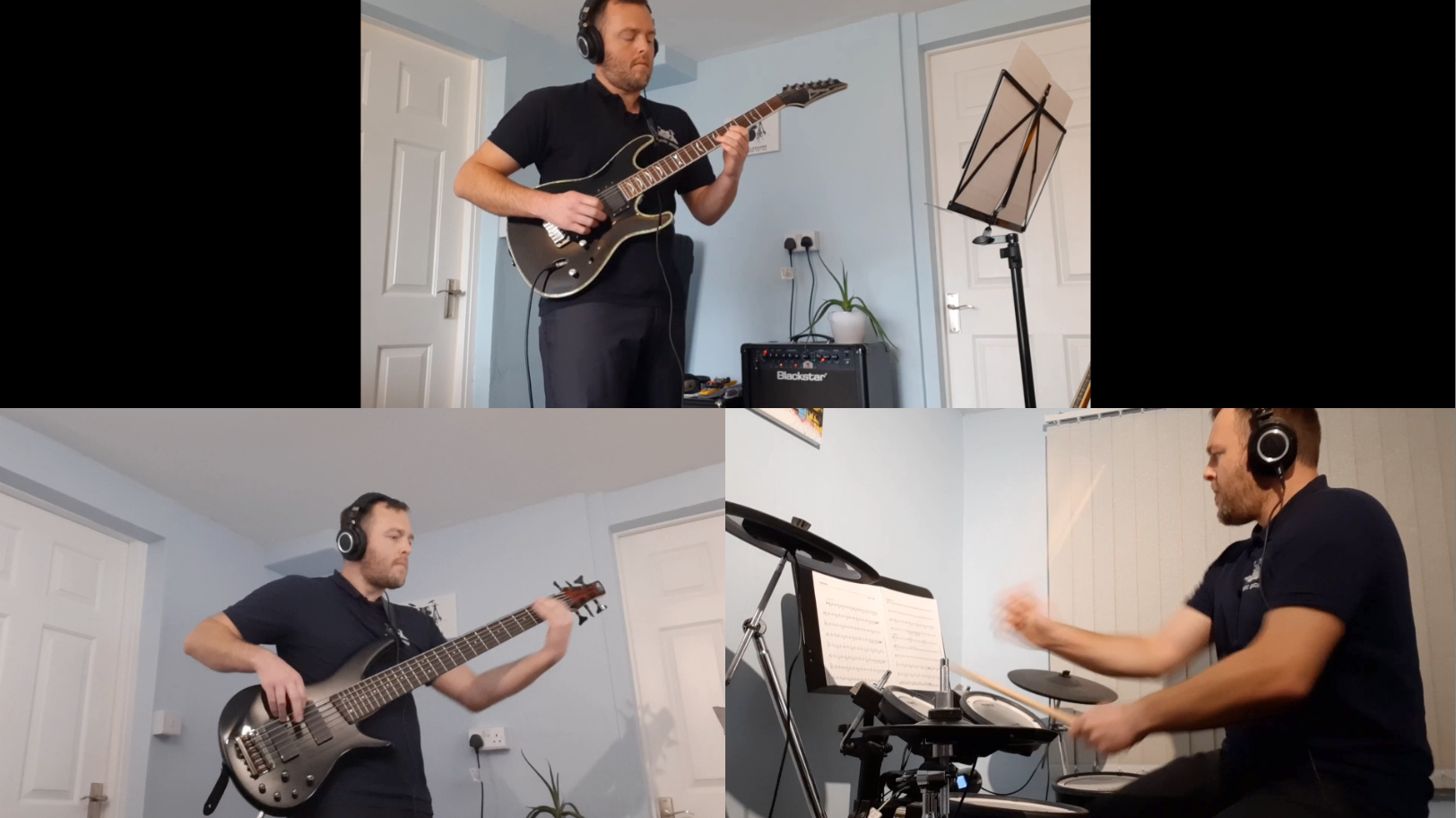
Guitar Drums and Bass performance of ‘Indecisive’ – Rockschool Grade 3 Piece

Many of my students have learned this piece and passed their exams. It’s an enjoyable piece to play with lots of energy and it’s deceptively hard to perform the whole song without mistakes.

The videos were recorded using a phone camera and a Zoom HD1 microphone.

I think these performances would get a fairly good mark out of 20 in an exam. Maybe 19 out of 20 each. I think the guitar performance was probably the strongest out of the 3, as there were small misakes in the others. But overall, I hope this is a good demo of the song and a good chance for students to see how the songs are played by each instrument, and give examples of the type of solos you could play in the song.

6 Rock & Blues Play Along Backing Tracks [Premium]

Contents

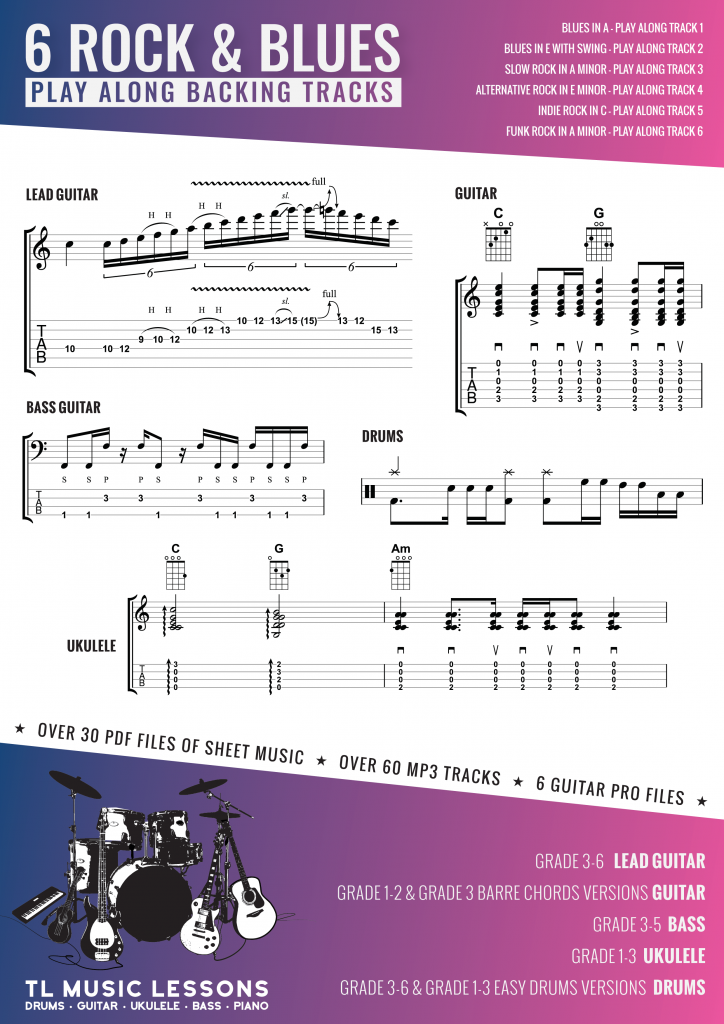
6 Rock & Blues Play Along Backing Tracks (with full sheet music)

★ Over 30 PDF Files of Sheet Music ★ Over 60 MP3 Tracks ★ 6 Guitar Pro Files ★

Buy Now ⟶

This download will be greatly enhanced by having a copy of Guitar Pro installed on your device.

Listen to the 6 tracks here:

  1. Blues in A (Sun Shines Through The Window) – Play Along Track 1

Grade 3 Lead Guitar & Barre Chords
Grade 1 Guitar
Grade 1-2 Ukulele
Grade 3 Bass Guitar
Grade 1-2 Drums
Lyrics for the Verses

  1. Blues in E with swing – Play Along Track 2

Grade 3 Lead Guitar & Barre Chords
Grade 1-2 Guitar
Grade 1-2 Ukulele
Grade 3 Bass Guitar
Grade 1-2 Drums

  1. Slow Rock in A Minor – Play Along Track 3

Grade 3-6 Lead Guitar
Grade 2 Guitar
Grade 3 Guitar (Barre Chords)
Grade 2 Ukulele
Grade 4 Bass Guitar
Grade 1-3 Drums

  1. Alternative Rock in E Minor – Play Along Track 4

Grade 6 Lead Guitar
Grade 2-3 Guitar
Grade 2-3 Ukulele
Grade 3 Bass Guitar
Grade 3-4 Drums

  1. Indie Rock in C – Play Along Track 5

Grade 3-5 Lead Guitar
Grade 2 Guitar 1
Grade 2 Guitar 2
Grade 2 Ukulele
Grade 3-5 Bass Guitar
Grade 3-4 Drums
Grade 2 Easy Drums

  1. Funk Rock in A Minor – Play Along Track 6

Grade 5 Lead Guitar
Grade 2 Guitar
Grade 3 Guitar
Grade 2 Ukulele
Grade 5 Bass Guitar
Grade 6 Drums
Grade 2-3 Easy Drums

Written and self published in 2020 by Theo Lawrence / TL Music Lessons.

Introduction

When the UK went into lockdown in March 2020 due to Covid-19, I quickly moved many of my lessons onto Skype/Zoom online lessons. I decided to make some of my own songs for my students to play so that they had backing tracks to play along with when they had learned and practiced the songs. I wanted to make sure they were possible for them to play, whilst also being a challenge to learn them. By the end of June, I had written these 6 songs and they felt like they worked together as a set of pieces to share with the world.

My students are all at different levels. Many of my beginners pupils of primary school age have been having lessons for at least a year or several years, so I wrote the lowest ability parts at Grade 1-2, and sometimes elements of Grade 3. I also have some grade 4-6 pupils on Guitar, Drums and Bass, so I wanted to make parts for them too. With all those parts together, there is something for almost everyone in here – just not for complete beginners because they need to work on the basics before learning these pieces.

People that might find this book useful

  • Guitar, Ukulele, Bass and Drum teachers can use these resources in their teaching or for their student’s performances.
  • Guitar, Ukulele, Bass and Drum students can teach themselves to play the music if they are able to read the sheet music. The backing tracks can then be used to practice with.
  • The Backing Tracks could potentially be used for school performances, such as for GCSE (check with the music teacher at school for song choice suitability.


About the PDF Sheet Music

These are the overall ranges of grades that the instruments cover in this selection of 6 songs. There are separate PDF files for each instrument part.

Grade 3-6 Lead Guitar
Grade 1-2 Guitar
Grade 3 Guitar Barre Chords
Grade 1-3 Ukulele
Grade 3-5 Bass Guitar
Grade 3-6 Drums
Grade 1-3 Easy Drums

About the MP3 Audio Files and the Guitar Pro Files

There are at least 3 different speeds of backing tracks available for each song. With performances in mind (such as for school GCSE submissions, school performances, or Eisteddfod entries), I have also included mp3s for each song without Lead Guitar, without Drums and without Bass Guitar. There are also one or two extras in there, such as ‘Just the Ukulele Part’ for some songs where I felt they would be especially helpful. If you need backing tracks that aren’t in the download pack, I strongly suggest investing in a copy of Guitar Pro, because you can do so much with these files. You can make the pieces be any speed you want, you can edit the parts, you can change the sounds of the instruments, and you can make your own mp3s and pdf files with it. You can also turn on the metronome and loop sections.

Summary

During the last few months, I have noticed that my students that carried on with online lessons have seemed to progress more than usual. I’m not sure if it’s the extra time at home with less going on, or if it’s these songs with backing tracks. I’d like to think it’s a mixture of all of those things, and probably more. I can say for sure that these pieces have gone down well with all of my students and that the range of techniques and rhythms included in the songs have been beneficial for them. It’s also been a nice outlet for me – it’s been like songwriting again (I’ve had a substantial break from it), and even though I was purposely trying not to write things that were out of reach for my students to learn, I was also enjoying the creative flow, and at times really went for it. I got really into the lead parts and was quite creatively free with those mostly, and on the drum parts I added my own style and flair into them, especially on the last piece with adding in fast double strokes on the hi hats and fills.

I hope you enjoy learning / teaching with these pieces.
6 Rock and Blues Play Along Backing Tracks

Buy Now ⟶


Theo Lawrence

www.tlmusiclessons.com

www.learndrumsforfree.com

www.payhip.com/tlmusiclessonsdrums

www.learnguitarforfree.com

www.payhip.com/tlmusiclessons

https://www.pinterest.com/tlmusiclessons

https://facebook.com/tlmusiclessons
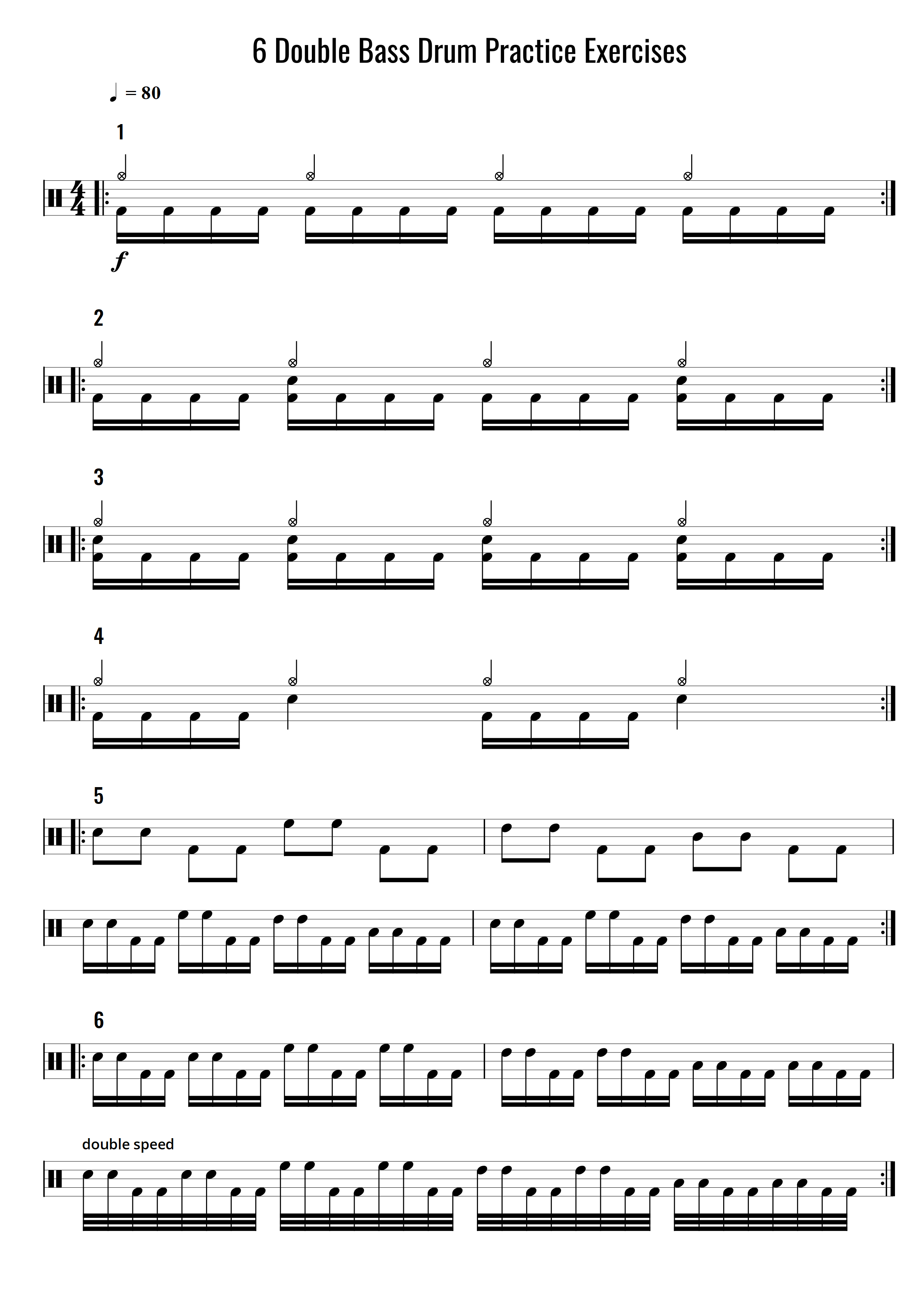
6 Double Bass Drum Practice Exercises

If you have a double bass drum pedal (double kick pedal) and are looking for some exercises to get started with, or to help you practice the basics, then these will be useful to you. These exercises would also be good for anyone that has been playing with a double kick or two bass drums for a while, because they can be played at fast speeds too – making the dificulty level harder.

Intermediate Drum Warm-Up – Part 2

Following on from the Grade 1-3 Drum Lesson Warm Up posted recently, and the intermediate drum warm-up Part 1 for drummers that have reached a higher level of ability (about Grade 4-6 +), here is the second part of the Intermediate drum warm up.

This second part of the warm up consists of stylistic exercise, including Swing in 4/4, Swing in 3/4, Jazz and metal. This is a continuation from part 1 where on exercise 3 there was a funk rock exercise.


Exercise 4 – 8th Note Swing in 4/4.

The snare drums with brackets around are ghost notes, which means small quiet taps on the snare drum about 1-2 inches from the snare head. These beats and fills could be heard in musicals or swing bands for example.


Exercise 5 – 8th Note Swing in 3/4

These beats and fill again could be heard in musicals, swing bands, and also in Jazz.

Exercise 6 – Jazz

The ghost note snares and bass drums on the 4th bar are what you might play if you were comping. Here is a video that goes into great detail about comping:

Exercise 6 Jazz Warm up

Exercise 7 – Metal

This exercise is a good warm up for anyone and only needs a single bass drum pedal (kick pedal). It’s sort of an introduction to blast beats. You can learn more here in this video: