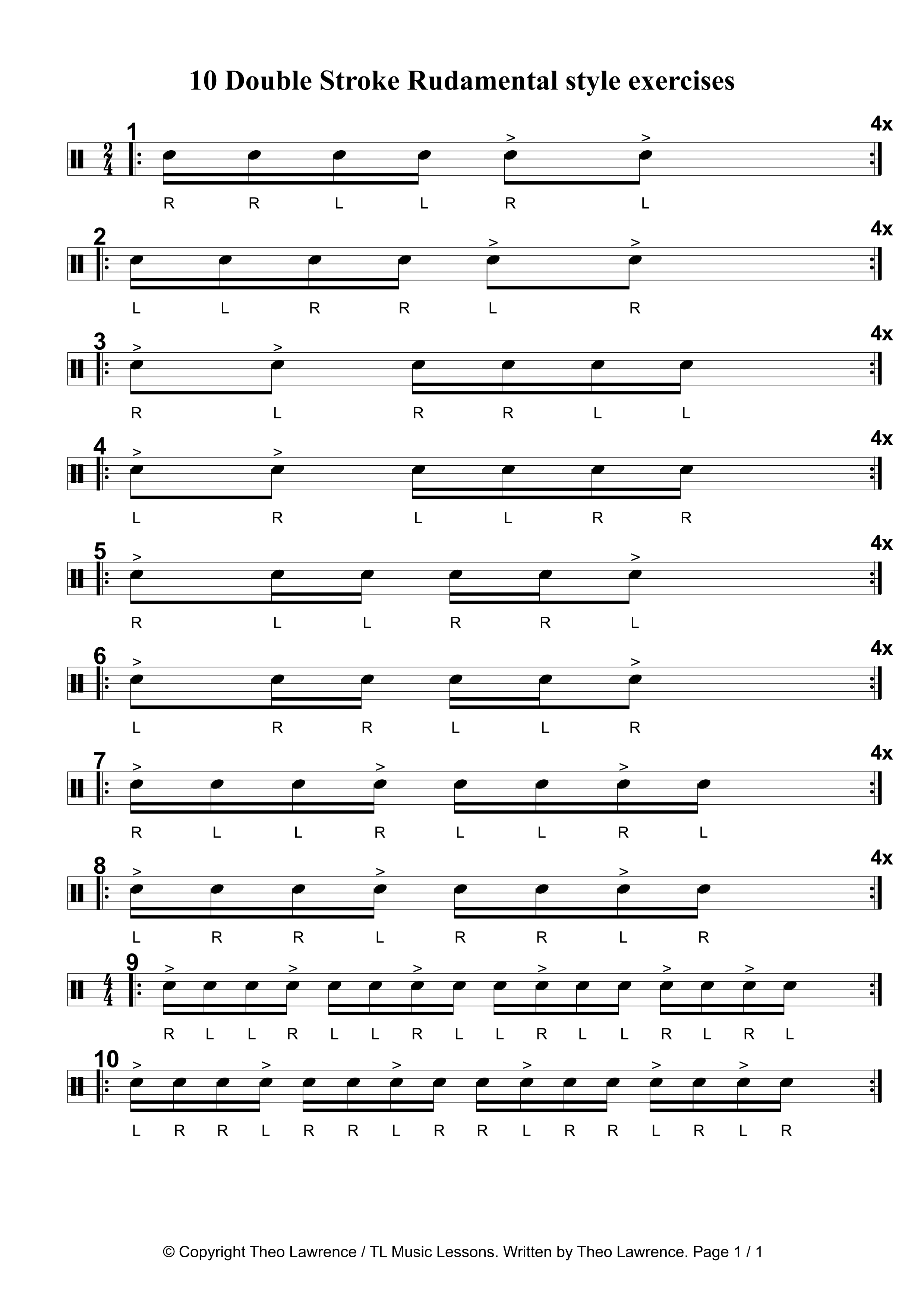
There are quite a few double stroke rudiment exercises in the 40 official drum rudiments, but none of these are in them. While the ’40 drum rudiments’ cover many of a drummers needs, in terms of practicing, there are many more double stroke exercises that are useful to learn.
The 10 rudiment – style snare drum exercises here are all involving double strokes. These snare drum exercises are all rhythms that I use quite often in my drumming, so to me they are quite essential I believe.
When learning rudiments, I was always taught that they are preparing you for possible eventualities in drumming – for example by learning and practicing the flam with different leading hands, you have prepared for using it in drum fills in songs, in a variety of situations. So to me, all of these 10 rudiment exercises are essential patterns that you will need at some point as a drummer, so to master these, will be beneficial to you for when you meet the patterns elsewhere.
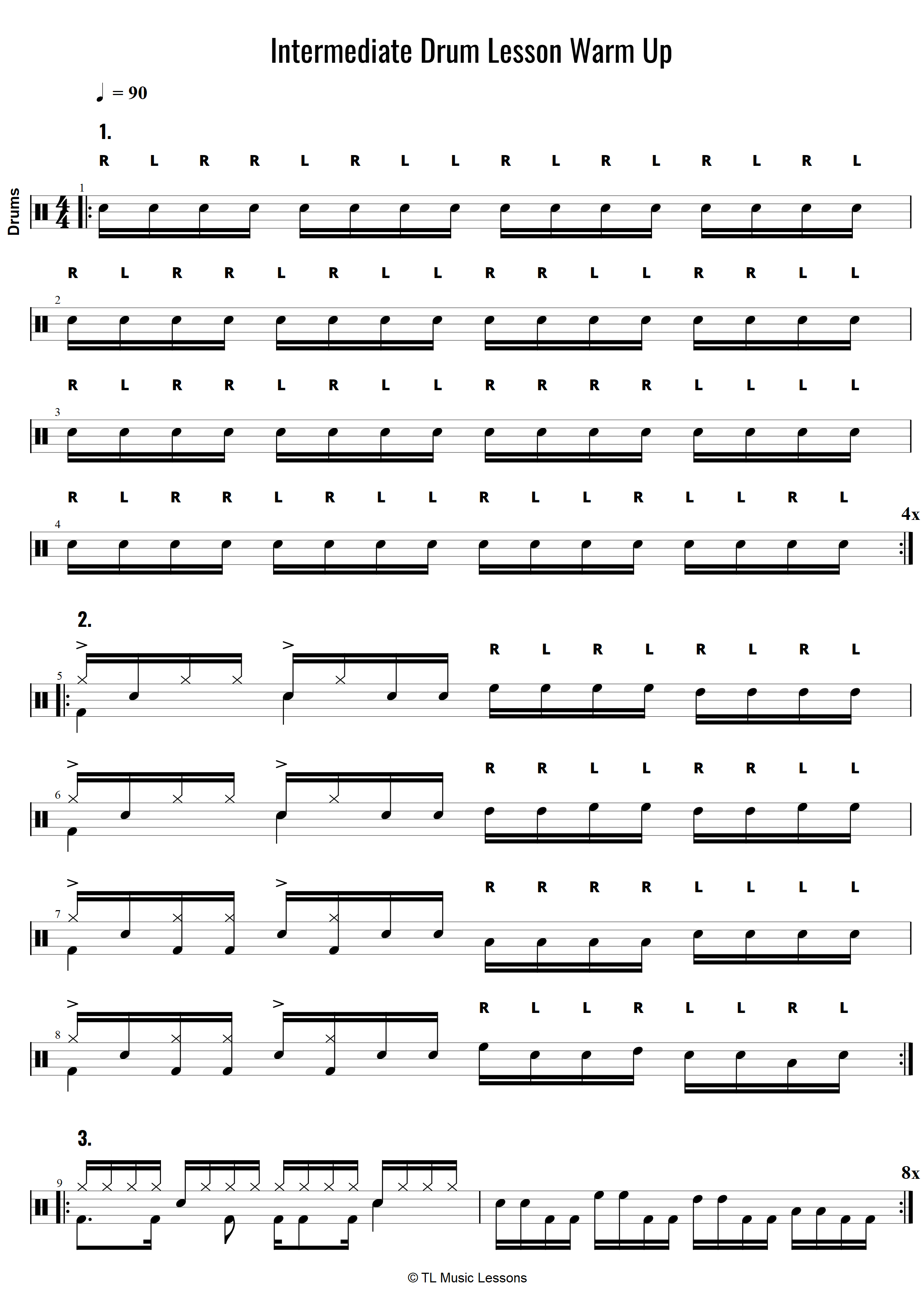
Following on from the Drum Lesson Warm Up posted a few days ago, this intermediate drum warm-up is for drummers that have reached a higher level of ability (about Grade 4-6 but could be used by higher grades too).
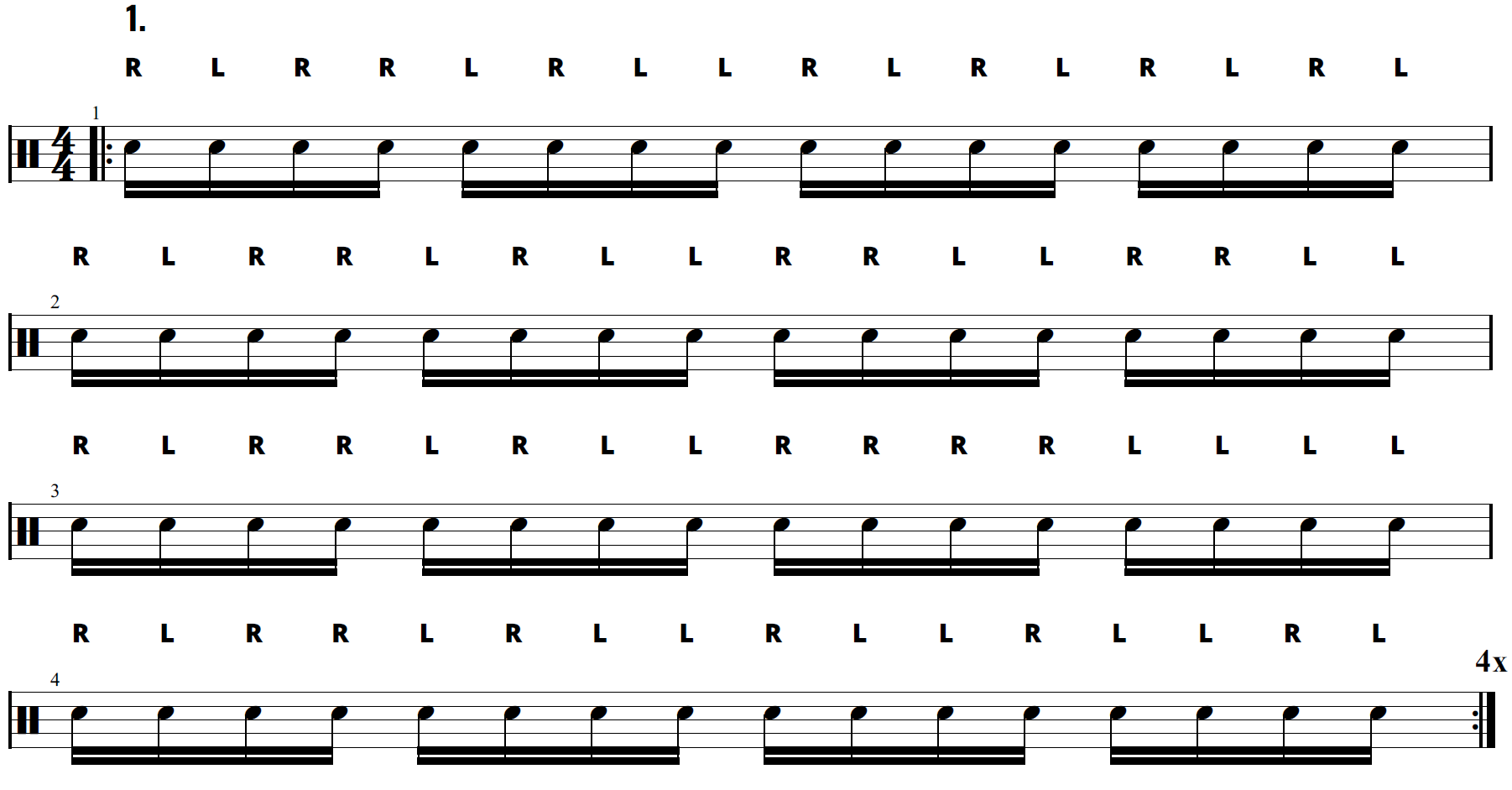
Exercise 1 – Intermediate Snare Warm-Up
Each of the 4 lines starts with a paradiddle, then the second half changes each time. The first line is singles, the second line is doubles, the third line is 4 with each hand and the 4th line is a 3-3-2 pattern (RLLRLLRL).
Exercise 2 – Paradiddle Drum Beat with Sticking Patterns on the Drum Fill
Using the sticking from exercise 1, we change the paradiddles into a drum beat by moving the right hand to the hi hat and the left hand to the snare drum. The drum fill then borrows the sticking we used in exercise 1, from the second half of each line.
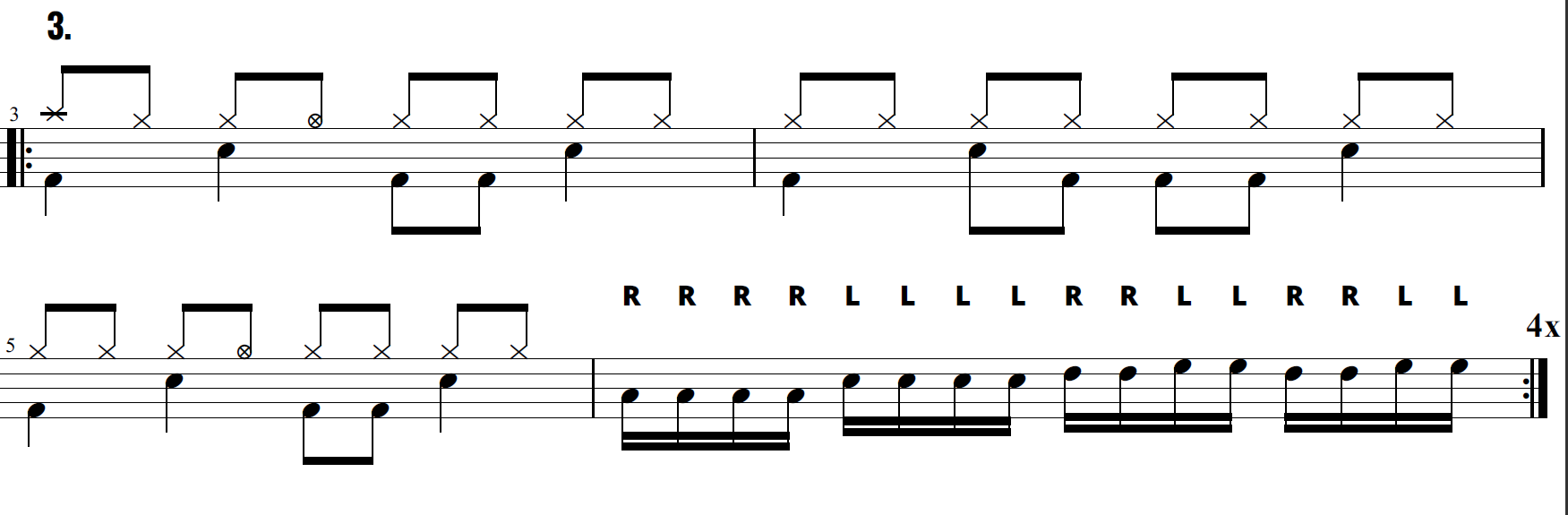
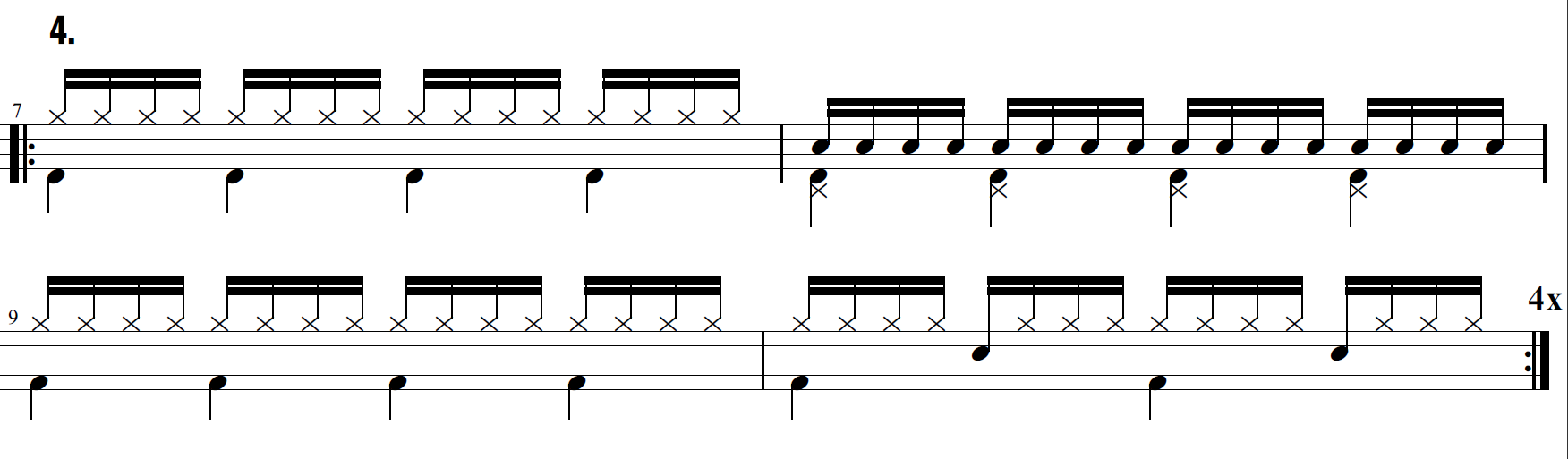
Exercise 3 – Funk Rock Drum Beat and Drum Fill working on fast double bass drum with 1 foot
A rhythmic bass drum pattern with 16th note hi hats followed by a drum fill that works on the bass drum.
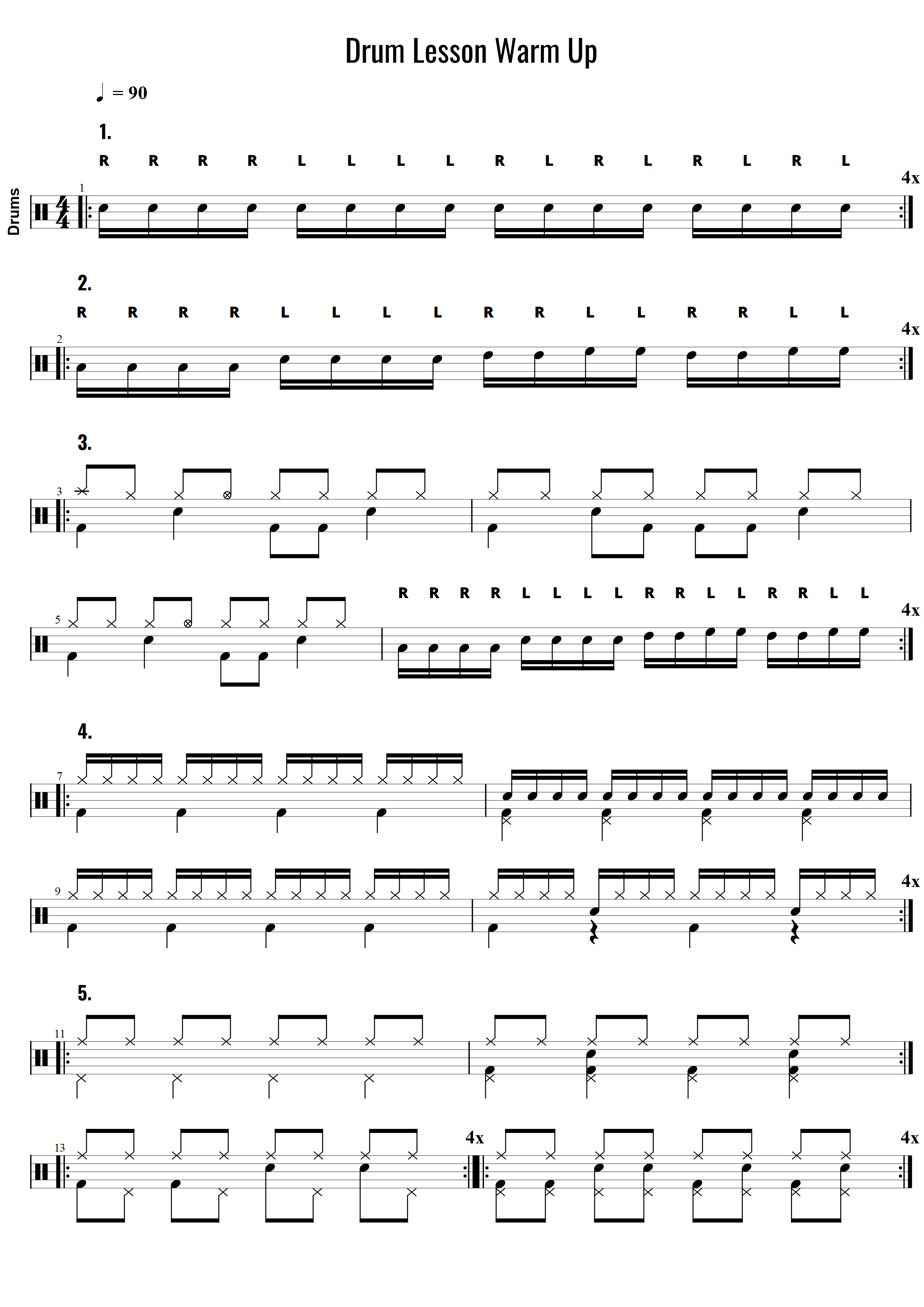
5 warm up exercises for the start of a drum lesson. Sticking patterns, drum beats, drum fills and beats with 4 way co-ordination.
These exercises that would be a good warm up at the start of a drum lesson or at the start of a drum practice session. Anyone from Grade 1 up to Grade 6 could use this as a warm up. It would be quite a challenge for grade 1. For a grade 6 player, they should be able to play through this quite quickly.
Exercise 1:
Snare drum exercise with a RRRR LLLL RLRLRLRL sticking pattern.
Exercise 2:
A drum fill exercise using a RRRR LLLL RRLLRRLL sticking pattern.
Exercise 3:
A 3 bar drum beat with open hi hats and drum fill exercise using Exercise 2 as the drum fill
Exercise 4:
Working on a 16th note hi hat pattern and moving that to a snare drum whilst adding a stepped hi hat to work on 3 way co-ordination.
Exercise 5:
Drum grooves focusing on 3 way co ordination and 4 way co ordination between both hands and both feet.
Some snare drum sheet music writes out buzz rolls with a Z through the stem. I don’t write it like that because my software doesn’t have that feature, but many others write it my way too anyway so I’ve got used to writing using 3 slashes instead (3 slashes like this /// through a stem line like this |).
Tremolo in Other Instruments
So, the slashes through the notes are also used in other pitched instruments as a tremolo marking. Violins have plenty of tremolo, which is achieved by moving the bow back and forth quickly. You’ll hear the sound in movies where the violins sound intense and brooding by playing 1 note for ages repeatedly. See the video below for an example of this. You’ll hear this more in old programs and films such as in the original Thunderbirds series’.
Tremolo Markings in Drums (The ‘/‘ slashes through the stems)
On each line that the 1st bar has what you see in sheet music and the 2nd bar of each line shows you the method of playing it. I have chosen to write slashed 16th notes rather than write 32nd notes in the second bars because that’s how I teach drummers to count their buzz rolls, by playing 16th notes and buzzing each hand. So, for a 1 beat buzz roll, you would play “R L R L” 16th notes, and each hand will be buzzed, so it will actually be something like this: RR LL RR LL, or RRR LLL RRR LLL if you play several notes with each hand. For snare drum sheet music with multiple bouncing, I encourage more bounces so it has more of a drum roll feel to it.
Here’s how to play the multiple bounce roll:
When you see 16th notes with slashes in, during regular drum sheet music especially, I would say this always should be assumed as ‘use precice doubles’ if you can manage it with the double stroke technique. For example, the hi hats may have 16th notes but some of the hits are doubled, and these would be played with a strong double stroke technique. In this Samba Funk Grooves sheet you can see that the hi hats have been written as 32nd notes, but they could also have been notated with slashed 16th notes. You can see double strokes played on the hi hat in a groove in this video:
When you see slashed 16ths on the snare drum, this means to play them as 32nd notes, with double strokes (RRLLRRLL for 4 slashed 16th notes).
This video by Ryan Alexander Bloom shows how I play all of my precise doubles. I didn’t realise it was called the ‘Push Pull’ method until I looked up videos on it! At drum college they were just taught as the ‘double stroke technique’. Please make sure to watch the full video if you want to learn double strokes properly, it’s only a couple of mins…
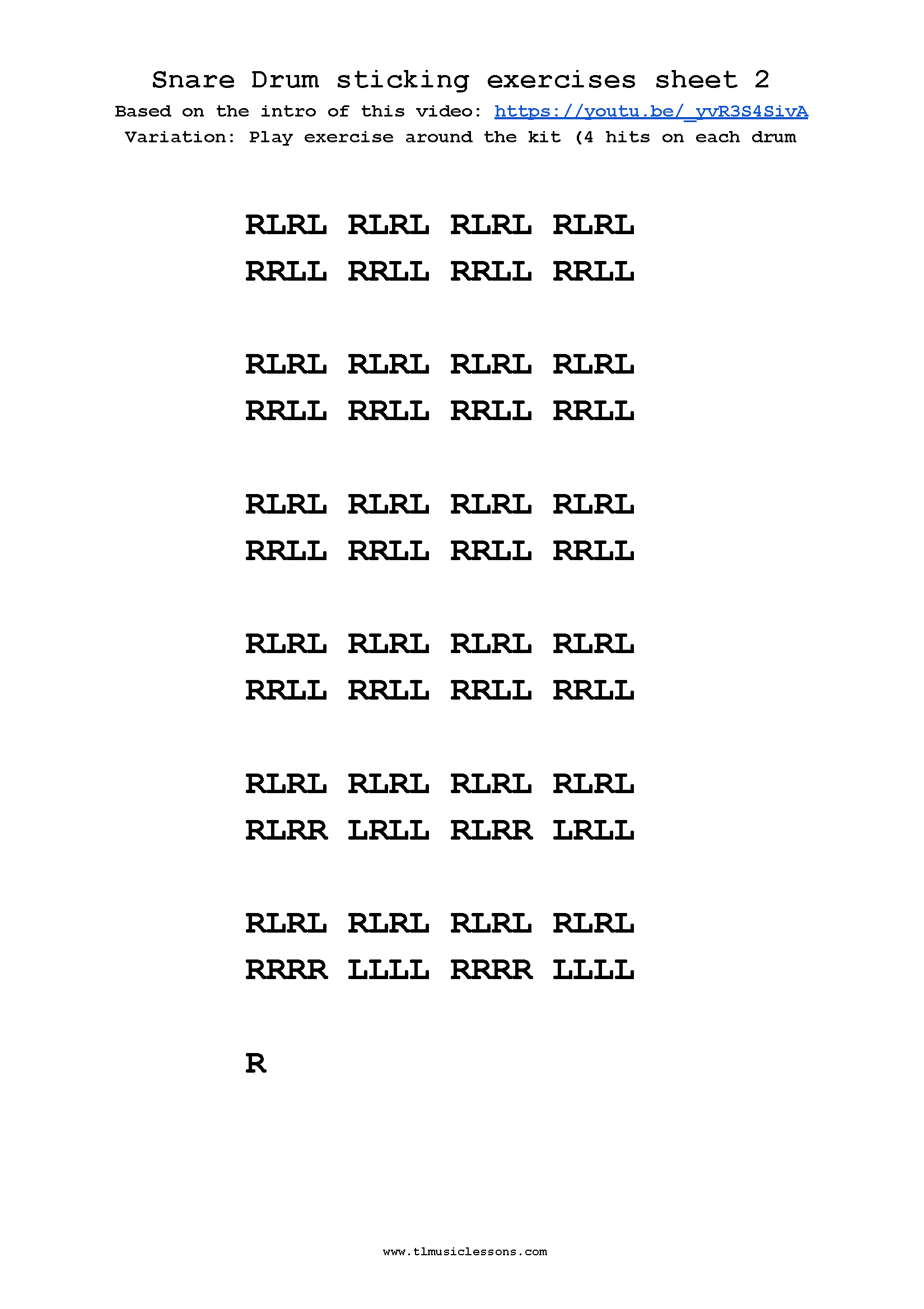
The first exercise sheet was written to help my drum students build up their coordination and sticking techniques for the snare drum.
The second exercise sheet was transcribed directly from this excellent Hit Like A Girl 2017 entry video by Jenn Proos. The entire ‘sheet 2’ is what she is playing up to 30 seconds. Please watch the video below to see it:
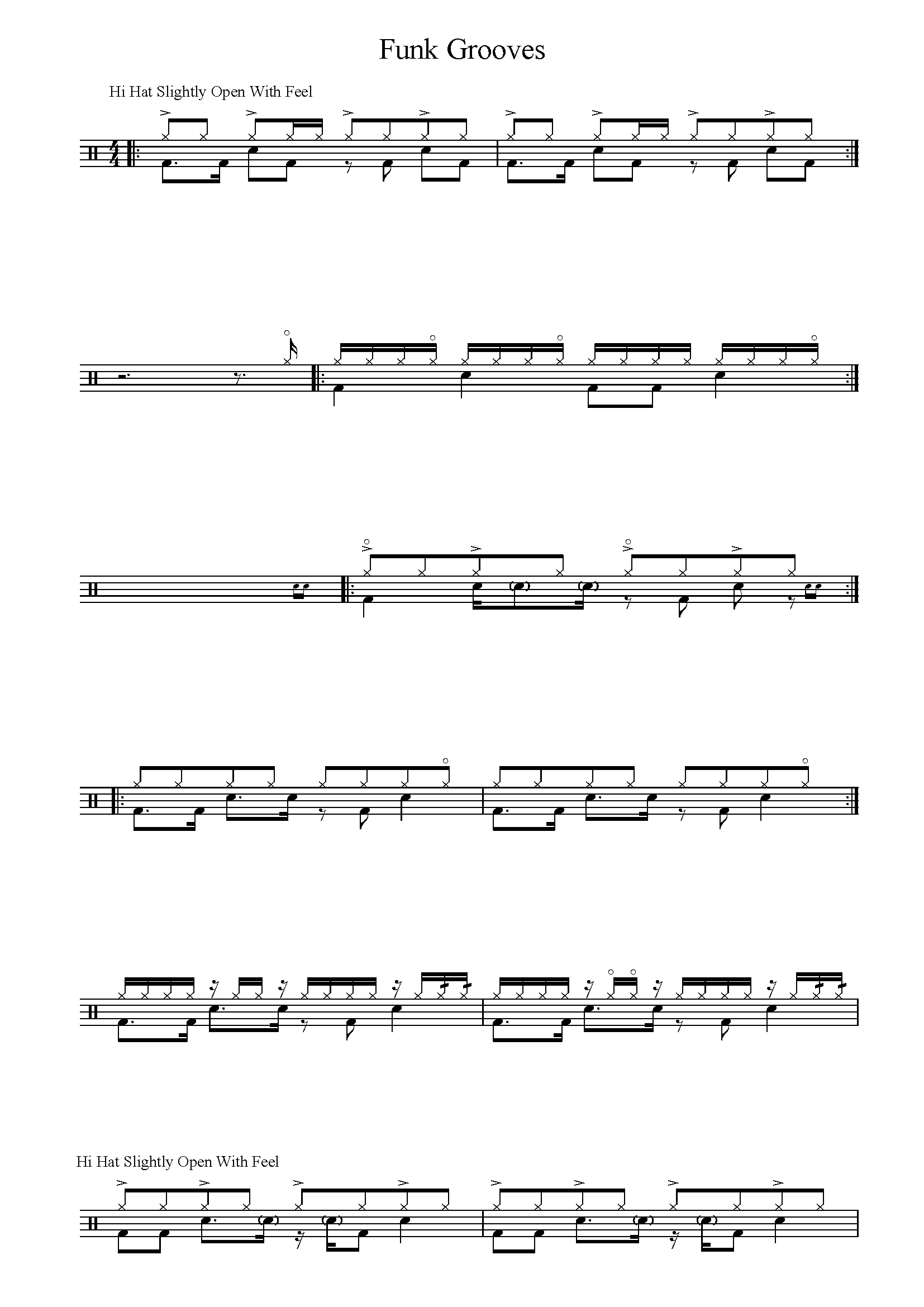
This drum grooves sheet is good for learning to improvise in a samba funk style. It was initially written for a drum lesson as a rough guide to the kind of things that could be improvised with during a Grade 8 Rockschool song from the 2006-2012 syllabus (Sampa Samba), but this sort of thing can also be played in other songs of a similar style, or it could just be used as a general practice exercise for a drummer who is at Grade 8 or above.
Playing Tip: The fast 32nd note hi hat notes are played using the double stroke technique.
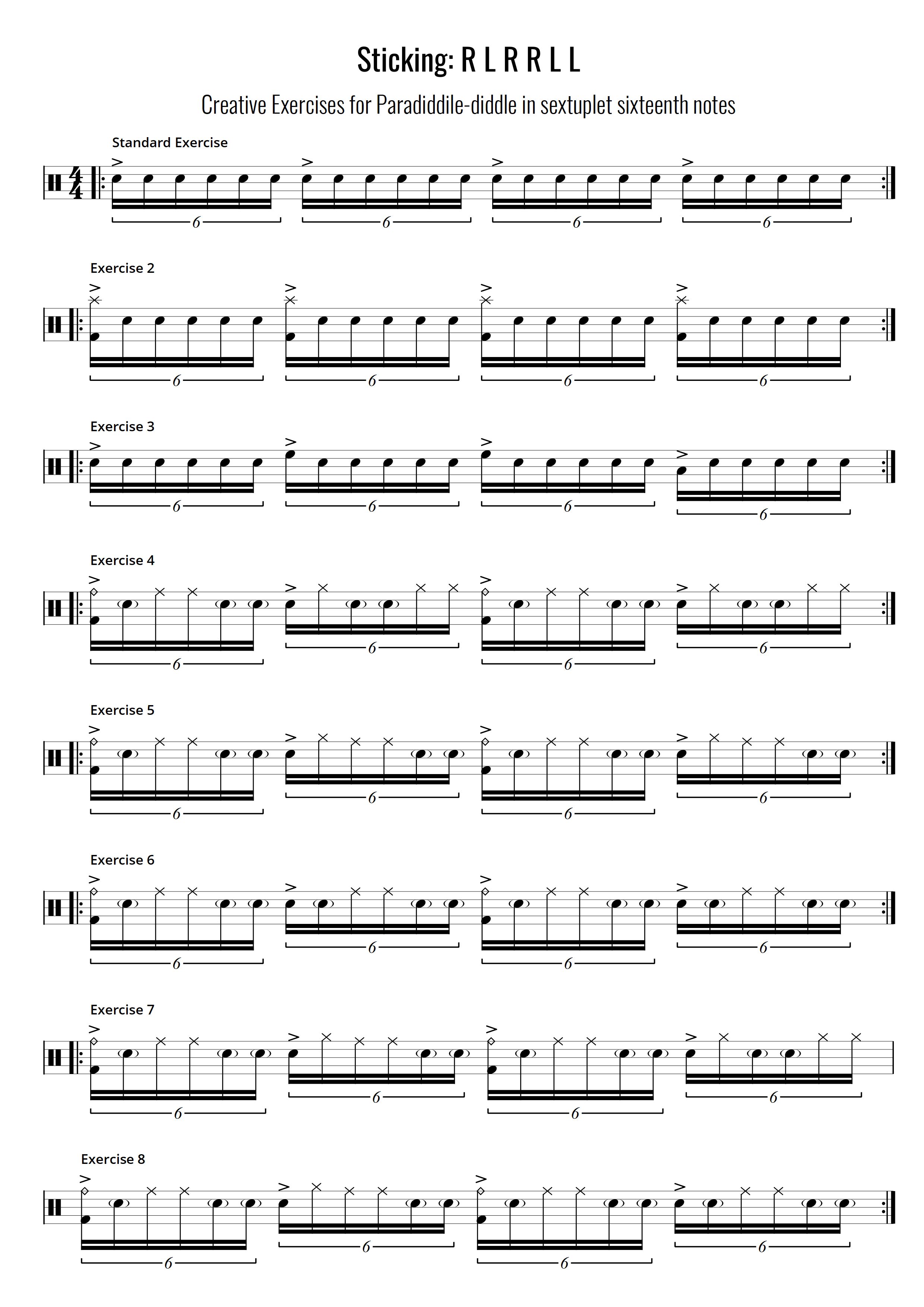
Here are some creative examples of how you can expand on the ‘Paradiddile-diddle in sextuplet sixteenth notes’ exercise 1 from Grade 7 technical exercises.
There are accents (>) underneath each line of rhythms to watch out for. There are also ghost notes (brackets around the notes), which means to play quiet taps. The diamond shape on the ride cymbal line is the Ride Bell. Play this with the shoulder of the stick to the left hand side of the bell (opposite for left handers).
This is an exercise that can be used in your practice schedule, and can be used as drum fills in your playing. This 6 Stroke Roll rudiment (played on the snare drum) is part of the technical exercises in Rockschool Grade 7 (Alternative paradiddle-diddle in sextuplet sixteenth notes), and is a good excercise for becoming more comfortable with playing it. This six stroke roll exercise can also be used / modified for drum soloing.
Contains information related to marketing campaigns of the user. These are shared with Google AdWords / Google Ads when the Google Ads and Google Analytics accounts are linked together.
90 days
__utma
ID used to identify users and sessions
2 years after last activity
__utmt
Used to monitor number of Google Analytics server requests
10 minutes
__utmb
Used to distinguish new sessions and visits. This cookie is set when the GA.js javascript library is loaded and there is no existing __utmb cookie. The cookie is updated every time data is sent to the Google Analytics server.
30 minutes after last activity
__utmc
Used only with old Urchin versions of Google Analytics and not with GA.js. Was used to distinguish between new sessions and visits at the end of a session.
End of session (browser)
__utmz
Contains information about the traffic source or campaign that directed user to the website. The cookie is set when the GA.js javascript is loaded and updated when data is sent to the Google Anaytics server
6 months after last activity
__utmv
Contains custom information set by the web developer via the _setCustomVar method in Google Analytics. This cookie is updated every time new data is sent to the Google Analytics server.
2 years after last activity
__utmx
Used to determine whether a user is included in an A / B or Multivariate test.
18 months
_ga
ID used to identify users
2 years
_gali
Used by Google Analytics to determine which links on a page are being clicked
30 seconds
_ga_
ID used to identify users
2 years
_gid
ID used to identify users for 24 hours after last activity
24 hours
_gat
Used to monitor number of Google Analytics server requests when using Google Tag Manager